Studies have found a pronounced decline in male effective population sizes worldwide around 3000–5000 years ago. This bottleneck was not observed for female effective population sizes, which continued to increase over time. Until now, this remarkable genetic pattern was interpreted as the result of an ancient structuring of human populations into patrilineal groups (gathering closely related males) violently competing with each other. In this scenario, violence is responsible for the repeated extinctions of patrilineal groups, leading to a significant reduction in male effective population size. Here, we propose an alternative hypothesis by modelling a segmentary patrilineal system based on anthropological literature. We show that variance in reproductive success between patrilineal groups, combined with lineal fission (i.e., the splitting of a group into two new groups of patrilineally related individuals), can lead to a substantial reduction in the male effective population size without resorting to the violence hypothesis. Thus, a peaceful explanation involving ancient changes in social structures, linked to global changes in subsistence systems, may be sufficient to explain the reported decline in Y-chromosome diversity.
In an exclusive interview with Remix News, Dutch political commentator and lawyer Eva Vlaardingerbroek warns Europeans that they must take a stand against rapid demographic change or become a minority in their native countries.
You’ve spoken a lot about White rights and the White replacement. But of course this kind of opens you up to these accusations of racism. So, how do conservatives deal with this Catch-22 of not wanting to be replaced in their native countries, but also not wanting to be attacked with this term?
You can’t. That’s the thing, you can’t. So you have to pick a side. Of course, you’re going to be attacked if you say, “Hey, this continent, Europe, has been predominantly White for the entirety of its history, and now suddenly within one generation, a few bureaucrats have decided against the will of the people that we should suddenly be a minority. Why do we agree with that, or why do we allow that to happen?” If you say that, you are going to be attacked.
But the only other option then you have is saying nothing and have it happen, so the choice is yours, and I’ve made my choice. I think there are many ways in which you can defend yourself, of course, against this ridiculous attack, so I’m sure that they’re going say about me that I’m a terrible racist again. No, that’s not true. I don’t think that any race is superior to another. I just think that mine is also not inferior to that of others.
Central Asian scholars also developed an Islamic system of higher education modeled on the Central Asian system of the Buddhist vihâra, or monastic college. The vihâra was supported by a tax-exempt pious foundation that paid the expenses of the students and also of the teacher or teachers, who lived in the vihâra with the students. The primary method of teaching was oral lecture and debate, and the main subject of study was the Dharma, or Buddhist law and theology. These fundamental elements were taken over wholesale by the Arabs, who adopted even the distinctively Central Asian form of the vihâra architectural plan—a square structure with a large courtyard, each side of which contained chambers for the students and teachers plus four îwâns, large half-open halls in the form of gateways. The vihâra seems to have been Islamicized as the madrasa in Central Asia in the eighth and ninth centuries, though it is only noted in historical sources somewhat later.
Beckwith, Christopher I.. Empires of the Silk Road: A History of Central Eurasia from the Bronze Age to the Present (p. 154). Princeton University Press. Kindle Edition.
Medieval Western European culture grew intellectually as a direct result of contact with Muslim Spain and Palestine. The translation into Latin of Arabic books introduced new, exciting, and often controversial ideas. The work of al-Khwârizmî54 (Algorithmus) translated as the Book of Algorithmus introduced Arabic numerals, including the zero and “algorithmic” calculation along with them, while the Algebra introduced advanced algebraic mathematics. They were revolutionary to the scientifically oriented minds of Western Europe. The translation of previously unknown philosophical and logical works of Aristotle, along with the works of the great Islamic Aristotelian philosophers, also caused fundamental restructuring of Western European thought. The ideas accompanied at least one important institution. The first European college,55 the Collège des Dix-huit or ‘College of the Eighteen Scholars’, was established in Paris in 1180 by Jocius of London (Jocius de Londiniis) after his return from the Holy Land.56 It was the oldest of the colleges that formed the original University of Paris. The college retained most of the essential characteristics of its direct ancestors, the madrasa and vihâra, including the pious foundation that supported the student residents and a professor,57 and perhaps the architectural form as well.58 The transmission of Islamic knowledge, techniques, and institutions to the West thus fueled the intellectual revolution of the High Middle Ages.
Beckwith, Christopher I.. Empires of the Silk Road: A History of Central Eurasia from the Bronze Age to the Present (pp. 179-180). Princeton University Press. Kindle Edition.
Antisemitism used to mean “someone who doesn’t like Jews,” but nowadays it means “someone that Jews don’t like for some reason or another.” The deliberate trick here is to make you think there is something wrong not with the Jewish baby killers, liars, or scum who are doing bad things but with the person noticing and reacting to the bad things these miscreants are doing.
So, what are the bad things that most people notice about Jews? Before naming and defining the most important ones, let’s first find out what Jews themselves say about antisemitism. Is it a rational and logical reaction to Jewish behaviour? Or is it, as most Jews claim, an irrational hatred of a totally harmless people who have been the innocent victims of human jealousy, vindictiveness, and persecution since the beginning of time?
Theodore Herzl, the Jewish father of Zionism, believed that hostility towards Jews was a natural consequence of their behaviour:
This perfectly understandable reaction follows from the defects of the Jews… The Jews are a people distinct and separate from others, whose interests are different, and often in conflict with those of the peoples among whom they live.[1]
A fact shared by Chaim Weizmann, the first president of the State of Israel:
Whenever in a country the number of Jews reaches a certain level of saturation, that country reacts against them… Now, this reaction is not antisemitism in the ordinary or vulgar sense of the word, but a universal social and economic consequence of Jewish immigration; it is impossible to ignore it.[2]
“It seemed to me,” writes Bernard Lazare, the Jewish author of the book Antisemitism, its History and Causes,
that an opinion as universal as antisemitism, having flourished in all places and at all times, before the Christian era and after, in Alexandria, Rome, Antioch, Arabia, and Persia, in medieval and modern Europe, in a word, in all parts of the world where there have been and where there are Jews, it seemed to me that such an opinion could not be the result of a whim and a perpetual caprice, and that there must be deep and serious reasons for its blossoming and its permanence.[3]
We both have different experience and backgrounds but I think overall we’re seeing much the same thing from different angles. I would say I am black-pilled and also we can have some influence on modern kings and queens. What you can see in today’s cabal is it’s a very tight knit group with ancient origins and a strong history of cohesion. At the same time they are very powerful and with modern surveillance technology and control technology, they are an extremely formidable ruling class.
We don’t even know who is in control of it all, which is an indication of very strong power at the top. Zero leaks, no squealers, no backstabbers (in public). My sense of what happened to Harvey Weinstein is he pissed somebody in that top power group off really bad and they publicly have humiliated and tortured him and made him an example for everyone to see. Either Jeffrey Epstein is dead murdered in jail or he was sprung from jail and is living with a new face somewhere in the world happily ever after. Either way it shows the incredible power of the group that controlled him and that he served. Of course you also know that not one of his clients has even been named, let alone dealt with publicly.
Non-compliance or mass disbelief worked against monkeypox and against people continuing to take the COVID vax, so I am not saying we can’t do any non-compliance. Our ‘difference’ on this appears to me to be just a matter of context and word interpretation. I doubt there will be very much if anything we can do about any kind of currency takeover, digital or otherwise. Look what happened to Bitcoin: first they sort of seemed to oppose it then they jumped on it, now they control it, now it’s an asset storage medium. In that video they suggest that we ‘take back Bitcoin’ and use it the way it was supposed to be used. That kind of resistance is totally impotent. I doubt they would affect even $5,000 worth of Bitcoin with a movement like that.
The main black pill is modern technology coupled with a very strong group that is able to remain largely secret at the top. It’s true that in the past kings and queens did listen to the population and were sometimes forced to bow to their wishes, but by and large for all time almost all people have been serfs or slaves or servants or wage slaves, peasants, peons. and there’s less chance today of the masses doing anything, or maybe I should say there’s no greater chance that we’ll get anywhere different today.
That said, the future may bring some very beautiful and weird stuff that will make everything different. Digital babies will be a major part of that. A more intelligent population and ruling class will very possibly fix many of the maddening problems we see today. A more intelligent population will not tolerate so many stupid lies and also will not need them. Disapproval from a more intelligent population will have even more effect on the elite than ever before. Also, ethics and morality are persuasive on their own. Virtue is it’s own reward, so a smarter elite may on their own ascend to a more ethical lifestyle and use of power. we may eventually end up with the most perfect political system of all — a wise and benevolent dictatorship. ABN
Democrats did everything they could to make Black people become a cancer to this country. Why?
Because we didn’t need them, they envied our growth and independence. We are now witnessing a bitter slave master retaliating by showing his old slaves what his new desperate… pic.twitter.com/s6s0Icq6GN
— Dom Lucre | Breaker of Narratives (@dom_lucre) April 24, 2024
Although the Indo-Europeans settled in new lands, in some cases (such as Greece) evidently by conquest, they did not always dominate the local people in the beginning. Instead, they often served the local peoples as mercenary warriors, or came under their domination in general. In either case, the Indo-European migrants—who were mostly men—married local women and, by mixing with them, developed their distinctive creole dialect features. The most influential of the new dialects was Proto-Indo-Iranian, the speakers of which appear to have been influenced linguistically by a non-Indo-European people from whom the Indo-Iranians borrowed their distinctive religious beliefs and practices.
Beckwith, Christopher I.. Empires of the Silk Road: A History of Central Eurasia from the Bronze Age to the Present (p. 32). Princeton University Press. Kindle Edition.
The traditional theory that Indo-European developed into its attested daughter languages over many millennia in the Proto-Indo-European homeland is essentially impossible typologically. It has recently been contested, and a more likely “big-bang” type of split proposed instead, such as the one historically attested later for the spread of Turkic and Mongolie26 The old theory is essentially disproved also by the fact that, if the Indo-European daughter languages had already been fully developed before the migrations, there would be evidence of early Greek, for example, in Iran, or Russia; evidence of Germanic in India or Italy; evidence of Tokharian in Greece or Iran, and so on. But there is no such evidence. Leaving aside much later, historically attested migrations, Anatolian is known only from Anatolia, Greek only from Greece, Tokharian only from East Turkistan, Germanic only from northwestern Europe, Armenian only from Armenia, and so on. The only possible exception is Old Indic, which is attested first in upper Mesopotamia and the Levant, and later in India. Although it is assumed that the Iranian expansion into Persia is responsible for splitting the Old Indic–speaking people into the two attested branches, even in this case there is no evidence for Indic ever having been spoken in Europe, say, or northern Eurasia. Proto-Indo-European was spoken in the Central Eurasian homeland, while the attested daughter languages were spoken in their attested homelands outside it, where they developed as creoles almost instantaneously after their introduction there. The scenario presented here thus accords with typology, the recorded history of language development and spread, and with the actual attested situation of the Indo-European daughter languages.
Beckwith, Christopher I.. Empires of the Silk Road: A History of Central Eurasia from the Bronze Age to the Present (p. 35). Princeton University Press. Kindle Edition.
This essay is written in response to Ricardo Duchesne. In it Beckwith corrects many errors and in so doing illuminates many aspects of ancient Indo-Europeans and how modern people think about them. It is a very informative piece. ABN
Ricardo Duchesne’s reply to Martin Hewson’s review of his book, The Uniqueness of Western Civilization (2011), focuses on a number of important points concerning the impact of peoples speaking Indo-European languages in Antiquity and the Middle Ages. However, several of Duchesne’s key assertions need to be modified to accord with the data.
The core comitatus consisted of a small number of warriors, who are called or referred to as friends. Chinggis Khan himself had four: Khubilai, Jelme, Jebe, and Sübedei, whom Jamukha characterizes as the four fierce wolves or dogs of Chinggis. The characterization of the comitatus warriors as wolves or other fierce animals goes all the way back to Proto-Indo-European times. The core group—usually a small number of men—committed ritual suicide (or was executed) to accompany the lord if he predeceased the group, and each man was buried “armed to the teeth” for battle in the next world. The comitatus warriors took their oath freely and, in doing so, broke their original connections to their clan or nation. They became as close or closer than family to their lord, they lived in their lord’s house with him, and they were rewarded lavishly by him in return for their oath. The comitatus is attested archaeologically in burials, historically in descriptions of cultures from all parts of Central Eurasia, and in early literary texts. The most famous are perhaps the Rig Veda hymns to the deified comitatus of Indra, the Marut chariot warriors. A vivid example is found in a dialogue between the lord and his warrior friends where Ahi is the snake-demon enemy, the dragon of many Central Eurasian heroic epics.
Beckwith, Christopher I.. Empires of the Silk Road: A History of Central Eurasia from the Bronze Age to the Present (pp. 13-14). Princeton University Press. Kindle Edition.
The lord and his comitatus formed the heart of every newborn Central Eurasian nation. In Central Asia the warriors of a typical ruler’s full comitatus, even that of a mere governor, numbered in the thousands and was extremely expensive to maintain. In the Middle Ages, the comitatus and ideas of rulership gradually changed with the adoption of world religions, which frown on suicide or ritual murder, but they otherwise continued down to the conquest of Central Eurasia by peripheral powers.
Beckwith, Christopher I.. Empires of the Silk Road: A History of Central Eurasia from the Bronze Age to the Present (p. 15). Princeton University Press. Kindle Edition.
Shortly after Charles Darwin published his magnum opus, The Origin of Species, in 1859 he started reading a little-known 100-year-old work by a wealthy French aristocrat.
Its contents were quite a surprise. “Whole pages [of his book] are laughably like mine,” Darwin wrote to a friend. “It is surprising how candid it makes one to see one’s view in another man’s words.”
In later editions of The Origin of Species, Darwin acknowledged Georges-Louis Leclerc, Comte de Buffon, as one of the “few” people who had understood that species change and evolve, before Darwin himself.
Now a new book will attempt to shine a light on the French naturalist’s extraordinary achievements and groundbreaking ideas, which date back to the 1740s. “Buffon was one of the very first people to postulate the change of species over time,” said Jason Roberts, author of a new book, Every Living Thing, which will be published next week, on 11 April. “He did not call it evolution – that word was coined later – but he was one of the first people to talk about it and suggest there was some kind of system.”
This video details how Birx screwed USA and president Trump. It is framed as a diabolical incompetence and arrogance theory with enormous weight placed on Birx’s role, which was awful. But is that the whole story? Why did the diabolical plot continue and get even worse when the vaxxes came to market? Wasn’t the DOD and NSA in full control behind the scenes? How about the PREP Act, harmful hospital protocols, banning early treatments? This video provides an important angle on what happened and is well-worth viewing, but it must be only one part of a more complex story. Somebody had to be handling Birx, more than one person, some group. Who were they? Who is running the country right now? That is the answer. ABN
Over the last dozen years I’ve published more than two hundred major articles totaling well over a million words, with the bulk of these having been produced during the last six years and roughly two-thirds of them included in my American Pravda series.
Most of these individual pieces have developed or promoted analyses of events that are radically divergent from what is presented by our mainstream media and standard history books. Taken a whole, this body of work constitutes a sweeping historical counter-narrative, possibly larger and more extensive that what could be found elsewhere on the Internet, or at least I’m not aware of anything comparable.
This enormous creation has relied very heavily upon the previous work of numerous researchers and writers. These have ranged from the most highly-credentialed and respectable figures to individuals of the conspiratorial fringe, and those two categories have sometimes changed places over the decades.
Although the sources I used were always cited, quoted, and linked in the individual articles, over the years many readers have requested that I provide a complete bibliography. Given that my own work has depended so heavily on this underlying material, I have now done that, spending several days gathering together all of these references into a single comprehensive bibliography, while also adding bibliographic links nears the bottom of each individual article.
Listed below are well over 600 books plus a couple of dozen films, documentaries, and major videos, all grouped by article in chronological order. Given this display format, probably about one-third of these items are duplicates.
Nearly all my articles are available in a couple of dozen freely downloadable ebooks, about half of them representing collections, and these are also listed below. About a dozen of these collections are available in hard-copy format from Amazon.
You definitely want to bookmark this one. It’s a large compendium of Unz’s work, almost all of which is well-worth reading. I do not always agree with Ron (he took the covid vax and dissed those who didn’t), but he is always worth reading and usually provides a unique perspective on whatever the issue is. I also like that he gives his work away and does not overly hype it. ABN
Lithuanian mythology underwent its formation at the time when the active and belligerent tribes who were the ancestors of modern Lithuanians were distinguishing themselves from the bulk of the Baltic protonation, circa 500 AD. At this time the Lithuanian tradition acquired its specific character. The mythologies of Lithuanians and other Balts are versions of the common Indo-European field of mythological images, but the Lithuanian and Baltic traditions preserved archaic Indo-European images, which disappeared from other European regions before the early Middle Ages. Since the most important characters of the Lithuanian pantheon were common to all Balts, we will begin by describing their common elements.
GODS AND HEROES
The highest figure in the Baltic pantheon is Dievas, in Prussian Deywis or Deyws, and in Latvian Dievs. This god is of Indo-European origin, and his name, as in some religions of the Near East, has been expanded to embrace all gods (God — the name of the highest of gods, god — the name applied to all gods). Earlier Dievas or Deivas simply denoted the shining dome of the sky, cf. ancient Indian deva ‘god’ and dyazts ‘sky’, Latin deus and dies, originating from the Indo-European root deiuo-s, which means both God and sky. Dievas, Dievs, Deivs is also related to the Greek Zeus. In Lithuanian dialects his name is sometimes Pondzejis, Avestian Daeva, Luvian Tiwat, Lidian Tiyaz, as the German Tiwaz. The Finns took the name of Dievas from the Balts, cf. Finnish taivas and Estonian taevas ‘sky’ .
In the mythology of the Balts, Dangaus Dievas (God of the Sky) retains quite a few original Indo-European characteristics — he lives in heaven, is related to shining celestial bodies and is imagined as a light, radiant person deciding fates. For Prussians and Lithuanians, however, Dangaus Dievas becomes an inactive god, deus otiosus. In some lists of Prussian gods he does not figure at all, while in Lithuanian tales he takes part in the creation of the world and its aftermath. In Latvian songs Dievas is much more active — he goes down the hill on which he lives and walks around a field of rye carrying bliss and fertility to the earth. And although traditionally it was possible to rely upon him when striking a contract, making a vow, or in times of crises, his cult among the Balts was doubtful. In any case, sacred places devoted to Dangaus Dievas are not even mentioned in Baltic mythology.
If Dievas was the highest character in the pantheon, then Perkunas, Latvian Perkons, Prussian Perkuns, Perkztno, the god of storm and thunder, master of the atmosphere and all celestial matters, and evidently Dievas’ son, was the most important and prominent. The name of this god is believed to have originated either from words denoting oak, cf. Latin quercus (from perkwus), Celtic herc, or a related root meaning a mountain, like in Hittite parunas ‘a rock’ or Sanskrit parvatas ‘The top of a hill’. In Baltic mythology Perkunas is linked both to a mountain — in Lithuanian mythology Perkunas lives on the top of a hill reaching the sky — and to oaks, growing in sacral places, or to sacred oak woods. Related to Perkunas are such Indo-European gods as Slavonic Perun, Parjanya who is mentioned in the Rigveda, the Germanic goddess Fjorgyn, the gods Donar, Thor, etc. Perkunas’s functions coincide with thunder gods of the Near East; with Baal, for instance, he is related by his care of fertility.
Perkunas is pictured as middle-aged, armed with an axe and arrows, riding a two-wheeled chariot harnessed with goats, like Thor. As is obvious, Perkunas enters the common field of Indo-European and Near Eastern thunder gods, just like Dievas, corresponding to deities of these religions — from An, or Anu, of the Sumerians and Babylonians, to Germanic Tiwaz.
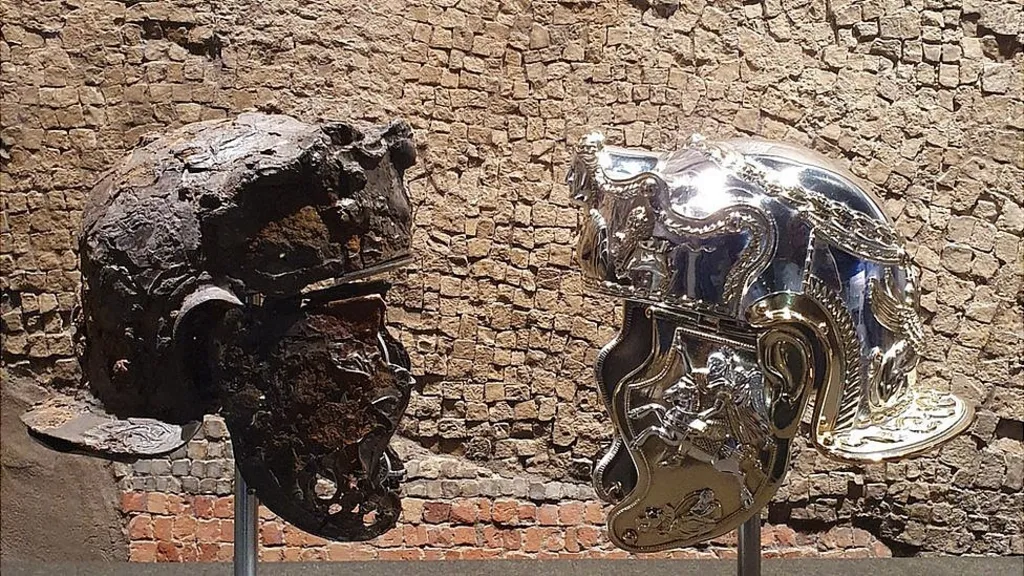
A “bling” Roman helmet found in a Leicestershire field offers a tantalising glimpse into a world in flux, experts have said.
The artefact, lavishly decorated with silver and gold, was uncovered in 2000, along with 5,000 coins, near the village of Hallaton.
It has gone on display in Market Harborough with previously unseen artefacts after further study revealed new insights into its decoration, construction, and historical period it was made in.
The helmet has been dated to the mid 1st Century AD, a crucial time for Britain as this saw the full-scale invasion of the island by four Roman legions in 43AD.
Helen Sharp, curator of archaeology at Leicestershire County Council museums, said: “The Hallaton helmet is extremely important, it is one of a handful of silver-plated helmets ever found in Europe.
“It is extremely high status; it would have been worn by an extremely high-status officer, and it just shows how well connected the Leicester area was at the time.



 American Buddhist Net