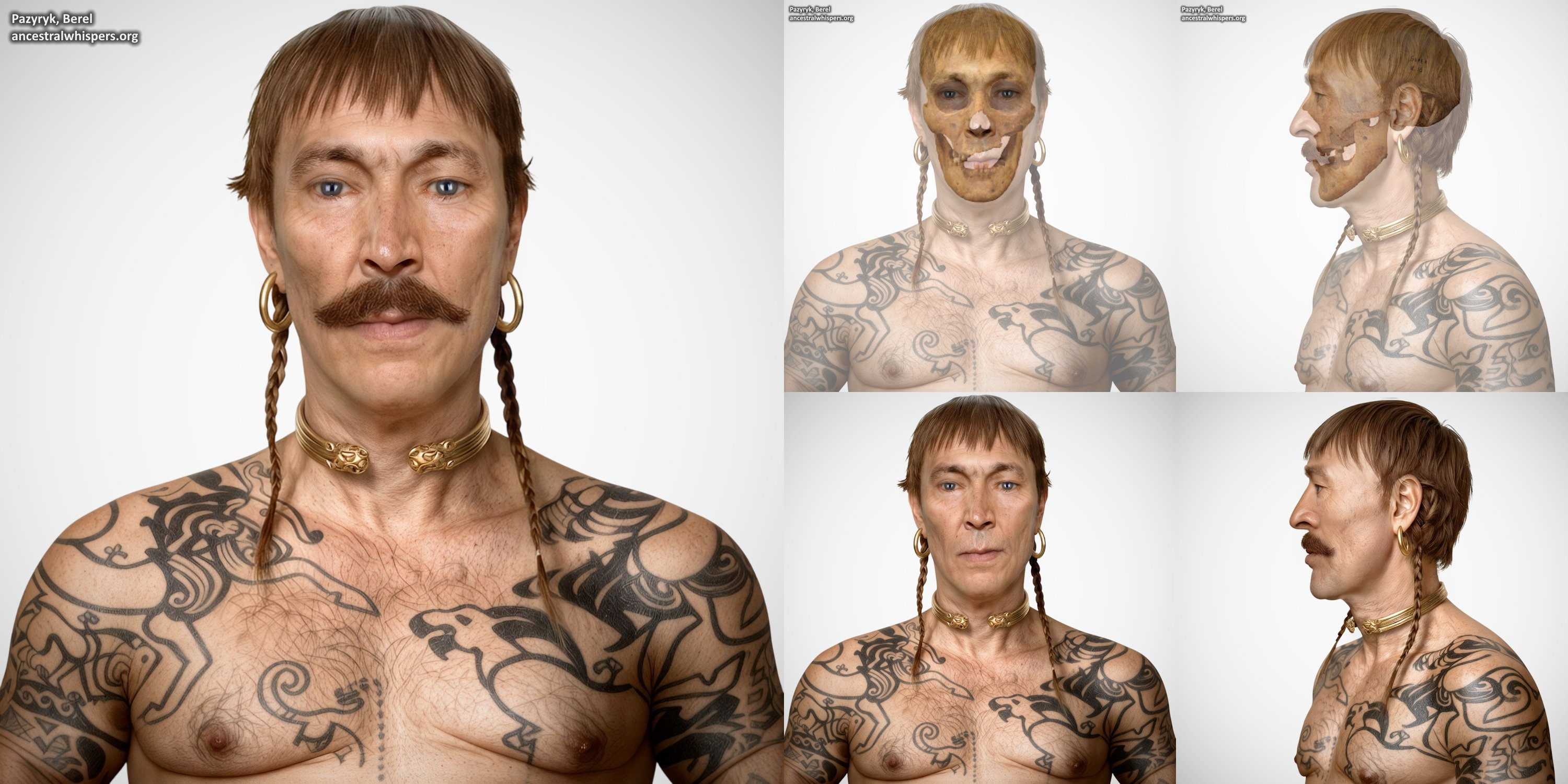
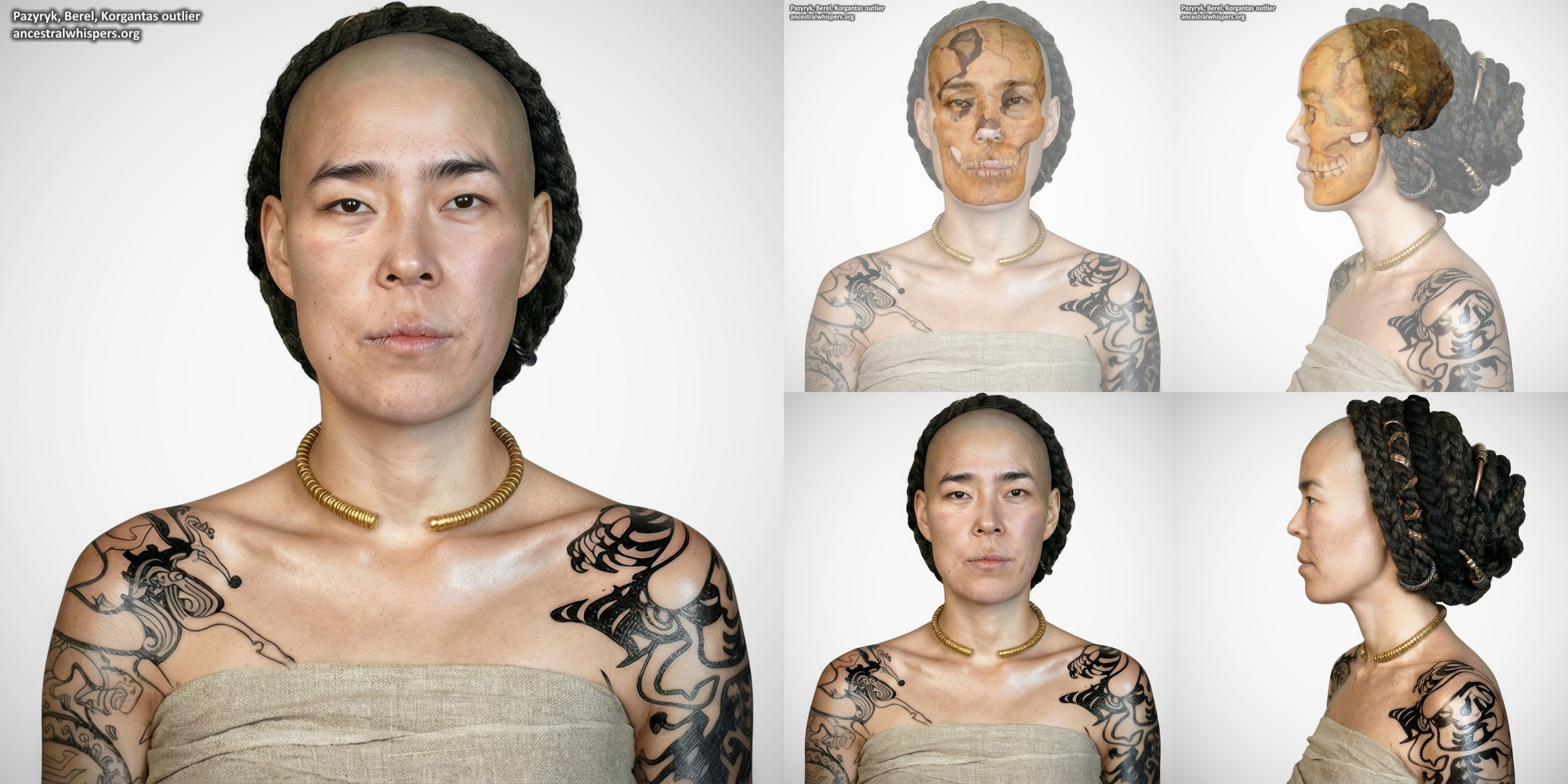
The man and woman, approximately 30-55 years old and 18-25 years old, respectively, were buried in the same kurgan, richly furnished with grave goods. Morphologically, the two individuals differed: the man displayed a mix of Caucasoid and East Asian traits, with a stronger leaning toward Caucasoid features, similar to other cranial remains from this set, and was likely of local Pazyryk Iranic Scythian elite origin. In contrast, the woman exhibited more pronounced East Eurasian features. Individuals with such traits appear in both common and elite burials, such as at the Ak-Alakha-3/5 cemetery. Archaeologists and anthropologists have speculated that the female outlier may have been incorporated into the elite stratum of Pazyryk society and is possibly associated with the Korgantas culture.
Both skeletons show evidence of post-mortem trepanation. The male skull bore an irregular perforation resulting from blunt trauma, later refined with a sharp tool. The female skull exhibited a rectangular perforation (64 × 35.8 mm) with cut marks, along with the excised fragment (42 × 33 mm), suggesting a deliberate opening after death, likely as part of the mummification process.
Cranial measurements indicate that the man had a medium-large cranial length of 185 mm, a medium-large cranial width of 147 mm, and a large cheek width of 139 mm. The woman had a large cranial length of 182 mm, a medium-large cranial width of 143 mm, and a large cheek width of 135 mm (Kitov, 2023).
This is from Trump’s Sept. 2025 address at the UN.
It highlights his attitude and probably why he arrested Maduro, who has been a very big player in election scamming and strengthening of the global left.
I hope Trump intends to bust the entire cabal, all of them. ABN
I have not watched this yet, but believe it will be of interests to readers. ABN
UPDATE: Watched this last night. It is very well done, informative, credible and well-worth viewing, especially if you have been following the Kirk murder story. ABN
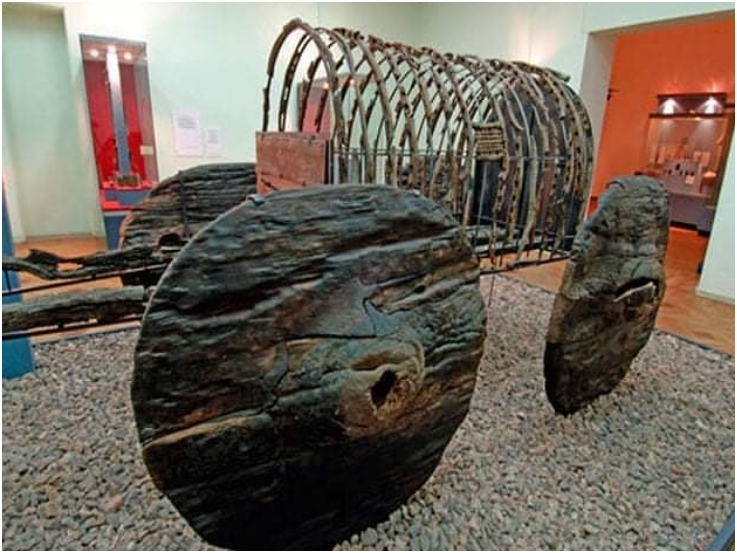
A four-wheeled canopy wagon was recovered from the Lchashen cemetery near Lake Sevan, Live Science reported on Monday, citing Armenian archaeologists and the History Museum of Armenia.
The wagon is said to be one of the best-preserved early covered wagons.
The Late Bronze Age vehicle, dated to the 15th–14th centuries B.C., was unearthed with five other oak wagons in an elite burial ground and later conserved for display in Yerevan. According to the museum and published studies, the discovery followed the Soviet-era drainage of Lake Sevan, which exposed more than 500 graves and rich grave goods.
A four-wheeled canopy wagon was recovered from the Lchashen cemetery near Lake Sevan, December 29, 2025.
The Lchashen wagon features a complex mortise-and-tenon construction with bronze fittings that join at least 70 components, while its canopy frame alone required hundreds of precisely mortised holes.
The wagon measures roughly 2 meters in length, and its two-piece wooden wheels stand about 160 centimeters tall. Archaeologists note that four of the cemetery’s vehicles carried superstructures, suggesting ceremonial or prestige use as well as transport.
The article by Ron Unz delves into the interconnectedness of significant historical events, particularly focusing on World War II and the Bolshevik Revolution. Unz posits that mainstream historians often fail to connect crucial dots in historical narratives, leading to an incomplete understanding of these events. He presents a case connecting Joseph Goebbels’ personal crisis stemming from an affair to the instigation of Kristallnacht, which subsequently influenced British policy and ultimately contributed to the outbreak of World War II. This narrative emphasizes how personal and political crises can have far-reaching implications, suggesting that a more nuanced understanding of history requires acknowledging the interplay of personal motivations and larger political frameworks.
Unz continues to explore the assassination of Grigory Rasputin and its role in the Bolshevik Revolution. He critiques traditional historiography for portraying Rasputin as merely a sinister figure without recognizing his significant political influence and the consequences of his death. Historian Sean McMeekin’s analysis highlights that Rasputin was a pivotal figure whose murder destabilized the Czarist regime, contributing to its downfall during the February Revolution of 1917. This analysis suggests that historians have often overlooked the chain of events linking Rasputin’s death to the rise of the Bolsheviks, indicating a need for more comprehensive historical narratives that consider less obvious influences on major political upheavals.
The article also discusses the “Lost Peace of 1916,” where Germany attempted to negotiate a peace settlement during World War I, which was rejected by the Allies. Unz argues that accepting this proposal could have drastically altered the course of history, preventing further loss of life and possibly averting the rise of the Nazis and the subsequent disasters of World War II. He underscores the failure of historians to incorporate this critical moment into wider historical narratives, emphasizing that the refusal of the Allies to consider peace negotiations contributed to the conditions that ultimately led to the Second World War and the punitive Treaty of Versailles, which set the stage for future conflict.
Lastly, Unz examines the Katyn Forest Massacre and its implications during World War II, particularly in relation to the Holocaust. He suggests that the Soviet regime’s involvement in the massacre and the subsequent cover-up reflect a broader pattern of historical narratives that often overlook or misrepresent the complexities of wartime atrocities. The juxtaposition of the timing of the Katyn propaganda campaign and the Warsaw Ghetto Uprising raises questions about the strategic motivations behind these events. Unz posits that the Holocaust’s prominence in historical memory may overshadow other significant atrocities, such as the Katyn Massacre, and argues for a more inclusive approach to understanding the multifaceted nature of historical events, emphasizing that the narratives we construct can significantly influence public perception and memory.
In reading all these different accounts of the international controversy following the discovery of the mass graves at Katyn, I noticed something that none of the authors had highlighted.
Massacres have hardly been unknown during brutal wars and the Soviet government had become especially notorious in that regard. Prisoners captured in battle have sometimes been slaughtered soon afterward.
But no other example in modern history came to my mind in which sizable numbers of captured POWs who had already been held for many months in prison camps were then taken out and summarily executed, each of them individually shot in the back of the head.
When we consider that the dead numbered more than 20,000 and that they constituted the military and civilian elite of Polish society, the Katyn Forrest Massacre must surely have been regarded as the most appalling European war-crime of the last several centuries. Indeed, by some measures this methodical, cold-blooded execution of so many POWs might rank as one of the worst such atrocities in all of recorded history.
Moreover, by the time the facts became known in 1943, the government of the killers and that of their victims had become less than comfortable military allies in the war against Nazi Germany.
On April 13th, German radio began promoting the appalling story, and it soon became their most successful wartime propaganda project. If the hundreds of thousands of Polish troops serving in Allied armies or the millions of Polish-American voters had become fully aware and convinced of those true facts, the entire course of World War II might have followed a very different trajectory…




 American Buddhist Net