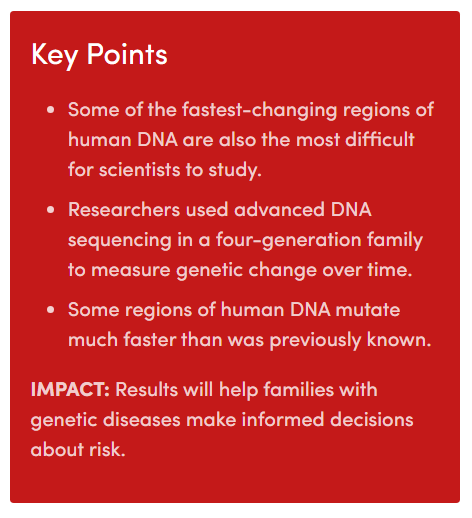
Knowing how human DNA changes over generations is essential to estimating genetic disease risks and understanding how we evolved. But some of the most changeable regions of our DNA have been off-limits to researchers—until now.
A team of researchers from University of Utah Health, University of Washington, PacBio, and other institutions has used multiple DNA sequencing technologies to develop the most comprehensive atlas yet of genetic change through generations.
The new investigation revealed that parts of the human genome change much faster than was previously known, laying the foundations for new insights into the roots of human disease and evolution.
“It’s mutations that ultimately differentiate us from other species,” says author Lynn Jorde, PhD. “We’re getting at a very basic property of what makes us human.”
Anxiety isn’t just one thing—there are different types, each with its own causes and treatments
Unfortunately, doctors often treat it as if it’s all the same, frequently giving medications that make it far worse. As a result, despite the billions being spent on treating anxiety, the condition affects more and more people.
In many cases, anxiety can only be treated if you understand the root cause of it.
This article dives into the different types of anxiety and their causes so you can seek the correct treatment and avoid the harmful therapies frequently prescribed by rushed physicians.
One of the most common treatments for anxiety are benzodiazepines. Unfortunately, these drugs have many severe side effects, including being highly addictive. As a result, once individuals are started on them, they often cannot stop.
In contrast, many natural therapies exist for anxiety which work in harmony with the body and do not create the immense issues benzodiazepines often do.
Norway has issued a chilling alert to the rest of the world after the nation’s leading scientists exposed a cover-up of data linking a global surge in excess deaths to Covid mRNA “vaccines.”
A group of Norwegian scientists is sounding the alarm after a major study of international mortality data exposed a global cover-up of excess deaths among the “vaccinated.”
While the link between deaths and Covid shots is not new, the researchers found evidence that reporting on the official data had been manipulated to hide the link to the injections.
They uncovered previously unreported data showing that excess deaths skyrocketed among the Covid-vaxxed.
This has been known for a long time among brilliant conspiracy theorists, but it is good to see it going mainstream. Empires rule by lying all the time and it works because the public is slow to see what is really going on and no one is ever punished for the lies, which reveals the deep perfidy of the entire scheme. ABN
Health secretary Robert F Kennedy Jr has revealed a list of ‘toxins’ he claims could be driving a ‘tsunami’ of autism across the US.
Kennedy said he would commission a series of studies into whether mold, pesticides, food chemicals or medicines are contributing to the development of the condition.
He also suggested a surprising fifth possible factor: ultrasound scans. He noted the technology became widely available around the same time autism started spiking in the 1980s.
RFK Jr went on to suggest industries were profiting off of environmental toxins that are driving more autism diagnoses, an apparent nod to his vaccine skepticism and crusade against artificial food ingredients.
Kennedy told reporters: ‘We need to move away from the ideology that the relentless autism prevalence increase is simply an artifact of better recognition and better diagnostic criteria.
‘The epidemic is real. Only a small percentage can be charged to better recognition or better diagnostic criteria.
An Australian study published earlier this year also found boys exposed to endocrine-disrupting chemical Bisphenol A (BPA) in the womb were six times more likely to be diagnosed with autism before age 11 than those without exposure.
That team suggested BPA – which lines plastic and metal food packaging, an ever growing pollutant in the modern world – was associated with neurological and behavioral changes associated with autism.
Children in households with water treated with fluoride appear to be at a much higher risk of autism, according to a shock study.
Researchers discovered a staggering six-fold increase in autism spectrum disorder (ASD) diagnoses among children who grew up fully exposed to fluoride versus those who did not consume the treated water.
The team from the nonprofit medical research group Institute of Chronic Illnesses Inc in Maryland looked at health records from 1990 to 2012, studying over 73,000 children in Florida during the first 10 years of their lives.
The results revealed a stunning 526 percent jump in the risk of ASD among children with full access to fluoridated water versus those who had none.
An increase in the risk for intellectual disabilities (102 percent) and developmental delays (24 percent) was also discovered in Florida counties receiving fluoride in their tap water.
Some studies suggest that fluoride might be linked to autism and other brain-related problems because it can stress brain cells and affect how they grow and function.
LITTLE ROCK, Ark. (KATV) — Governor Sarah Huckabee Sanders has officially signed Senate Bill 189 into law, granting approval for the sale and purchase of ivermectin for human use without a prescription.
The new legislation, signed into law on Tuesday, allows ivermectin suitable for human consumption to be sold over-the-counter in Arkansas, making it accessible to individuals without the need for a prescription or consultation with a healthcare professional.
The legislation explicitly states that “ivermectin suitable for human use may be sold or purchased as an over-the-counter medication in this state without a prescription or consultation with a healthcare professional.” This development marks a notable shift in the state’s stance on the drug, which has traditionally been available only through a doctor’s prescription.
Evidence on the association between maternal tea/coffee consumption and children’s cognitive development is limited. This study included 1423 mother–child pairs from the Chinese National Birth Cohort (CNBC). Maternal tea/coffee consumption status was collected in the 1st, 2nd and 3rd trimesters of pregnancy. Cognitive development was assessed using the Bayley Scales of Infant and Toddler Development III (BSID-III) in children aged averagely 36-months. We utilized group-based trajectory modeling (GBTM) to fit trajectories of maternal tea/coffee consumption across the three trimesters of pregnancy. Linear regression models were used to analyze the association between maternal tea/coffee consumption and children’s cognitive development scores. Positive associations between maternal tea consumption during pregnancy and children’s cognitive development were observed. Children of mothers who belonged to a continuous tea drinking trajectory throughout pregnancy had higher cognition, fine motor, and gross motor scores than those whose mothers belonged to a trajectory of tea-drinking in the 1st trimester of pregnancy, only. Comparison of tea-drinkers (yes/no) in each trimester separately indicated that tea-drinking in the second and third trimesters were more strongly associated with the outcomes than tea-drinking in the 1st trimester. The second and third trimesters of pregnancy might be key periods regarding maternal tea consumption affecting children’s cognitive development. No significant association were found between maternal coffee consumption during pregnancy and children’s cognitive development. The GBTM modelling provides clues to truly reflect the status and trajectory of pregnant women’s tea and coffee consumption across different trimesters as their lifestyles change dynamically throughout pregnancy, which provides new motivation to investigate the association between maternal life pattern with offspring’s cognitive development.


 American Buddhist Net