•Natural light is a crucial nutrient many of us lack. When ultraviolet (UV) light enters the bloodstream, it can unlock phenomenal health benefits.
•In the 1930s, ultraviolet blood irradiation (UVBI) emerged as a revolutionary treatment. Hospitals across America adopted it, and it produced miraculous results for patients, demonstrating remarkable efficacy against a wide range of conditions (e.g., infections, autoimmunity, cardiovascular disease, and pregnancy issues).
•Unable to monopolize the therapy, the American Medical Association (AMA) published a flawed study that discredited UVBI, leading to its decline in the U.S. However, Russia and Germany continued to recognize its value, conducting decades of research proving UVBI’s utility for various challenging medical conditions.
•In America, UVBI is primarily used by integrative practitioners to treat complex illnesses that do not respond to other therapies such as Lyme disease, chronic fatigue syndrome, spike protein injuries, and chronic migraines.
In the writings here, I have argued that we are often denied vital knowledge, treatments, and care to protect the interests of the medical-industrial complex. In my eyes, the story of Ultraviolet Blood Irradiation provides one of the clearest examples of this corruption.
Psychedelic compounds can create feelings of euphoria, a loss of your sense of self, and as various treatment studies demonstrate, cause a transcendent experience so deeply moving that it helps people kick heavy burdens like depression and alcoholism—at least temporarily. And after ingesting a psychedelic, your brain might even feel like it’s connecting to the “Ultimate Reality,” according to researchers at Johns Hopkins University in Baltimore, Maryland.
Compounds like psilocybin attach to serotonin receptors in your central nervous system. However, neuroscientists still don’t understand what links the resulting hallucinations and reality altering sensations to the broader sense of spiritual connection that some users have reported experiencing, such as “seeing God.” But combining therapy, brain scans, and controlled doses of psychedelics could provide a firm roadmap for the scientists trying to unravel the mystery.
A 2019 research survey, centered on a detailed questionnaire from Johns Hopkins’ Center for Psychedelic and Consciousness Research, probed 4,285 healthy people about their out-of-body experiences of God, or a higher “Ultimate Reality.” The volunteers included both users and non-users of classic psychedelic drugs such as psilocybin, LSD, ayahuasca, and DMT. The psychedelics users were most likely to choose what they felt to be “Ultimate Reality,” out of a choice between “God,” “Higher Power,” “Ultimate Reality,” or an “Aspect or Emissary of God (e.g., an angel),” according to the results, published in the journal PLOS One. Users said they felt a presence that could affect their reality, and that they had a decreased fear of death. The survey noted that related studies had shown similar experiences in people who had taken the same psychedelic compounds.
As far back as 2006, researchers at Johns Hopkins found that a dose of psilocybin, a psychedelic compound from certain species of fungi, caused about 60 percent of healthy volunteers to have a “complete” spiritual trip. Participants having a spiritual experience said they felt a kind of unity of everything, without a physical form. They called it “pure consciousness.”
For Buddhists who may wonder if using psychedelics violates the Fifth Precept of Buddhism, please see: Are We Misunderstanding the Fifth Precept? wherein it is argued that the Fifth Precept clearly refers to alcohol and not psychedelics. I do not mean to encourage the use of psychedelics, but research on psychedelics has shown they confer many benefits on users. I support legalizing, while also guaranteeing the purity of, beneficial psychedelics for adults. ABN
The more of us know this, the more doctors will feel pressure to cut their shit. Voting is always dubious in USA, but our collective grapevine is always strong when enough of us have the right information. Share what you know with others. No need to argue. Just let others know what you think — that someone else has different information, a different opinion. Being too polite and not talking is big part of what got us into the mess we are in today, on this and many other issues. ABN
It is easy to grow your own tobacco. Cure it by hanging mature plants in a shed or somewhere they won’t be disturbed. You can use it as chew as soon as it is dry, but the flavor improves with age. Store it in mason jars when they have cured to a point you like. It will keep for many years and only improve. I use a very small amount, about 1 sq mm, for chew a few times a day. I add nothing to it, just a plain small piece of a leaf. Nicorette tablets are also good. One 2mg tablet can be used and reused a few times during the day. You do not need very much to get the benefit. ABN
Salk researchers find cannabinol preserves mitochondrial function and prevents oxidative damage to cells
LA JOLLA—Decades of research on medical cannabis has focused on the compounds THC and CBD in clinical applications. But less is known about the therapeutic properties of cannabinol (CBN). Now, a new study by Salk scientists shows how CBN can protect nerve cells from oxidative damage, a major pathway to cell death. The findings, published online January 6, 2022, in the journal Free Radical Biology and Medicine, suggest CBN has the potential for treating age-related neurodegenerative diseases, like Alzheimer’s.
“We’ve found that cannabinol protects neurons from oxidative stress and cell death, two of the major contributors to Alzheimer’s,” says senior author Pamela Maher, a research professor and head of Salk’s Cellular Neurobiology Laboratory. “This discovery could one day lead to the development of new therapeutics for treating this disease and other neurodegenerative disorders, like Parkinson’s disease.”
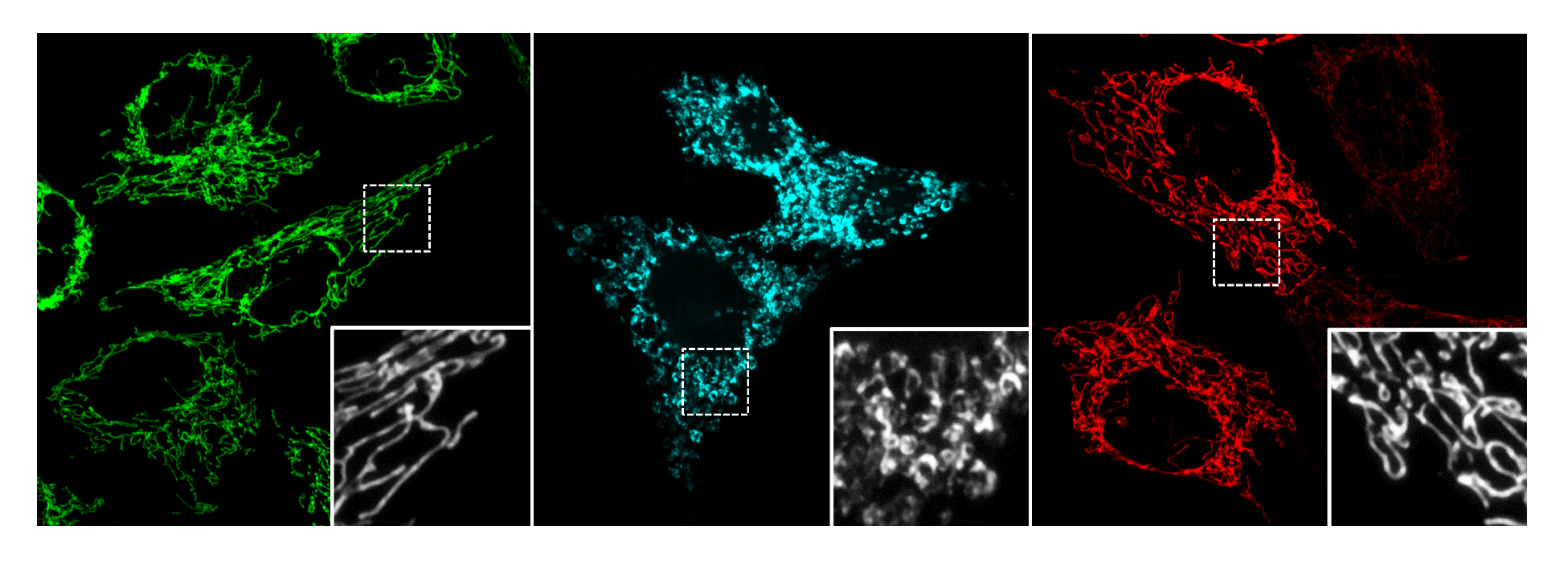
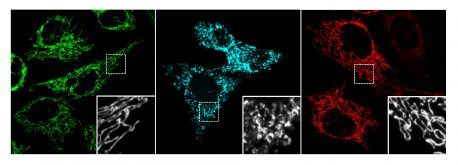
Healthy mitochondria (green); mitochondria showing the effects of oxidative stress (blue); and oxidative stress with CBN (red). Insets show higher magnification of the structure of the mitochondria. Click here for a high-resolution image. Credit: Salk Institute
Derived from the cannabis plant, CBN is molecularly similar to THC, but is not psychoactive. It’s also less heavily regulated by the FDA. Previous research by Maher’s lab found that CBN had neuroprotective properties, but it wasn’t clear how it worked. Now, this new study explains the mechanism through which CBN protects brain cells from damage and death.
Maher’s team looked at the process of oxytosis, also called ferroptosis, which is thought to occur in the aging brain. Growing evidence suggests that oxytosis may be a cause of Alzheimer’s disease. Oxytosis can be triggered by the gradual loss of an antioxidant called glutathione, causing neural cell damage and death via lipid oxidation. In the study, the scientists treated nerve cells with CBN, and then introduced an agent to stimulate oxidative damage.
They further found that the CBN worked by protecting mitochondria, the cell’s powerhouses, within the neurons. In damaged cells, oxidation caused the mitochondria to curl up like donuts—a change that’s also been seen in aging cells taken from the brains of people with Alzheimer’s disease. Treating cells with CBN prevented the mitochondria from curling up and kept them functioning well.
The spatiotemporal variations in national excess all-cause mortality rates allow us to conclude that the Covid-period (2020-2023) excess all-cause mortality in the world is incompatible with a pandemic viral respiratory disease as a primary cause of death. This hypothesis, although believed to be supported by testing campaigns, should be abandoned.
We describe plausible mechanisms and argue that the three primary causes of death associated with the excess all-cause mortality during (and after) the Covid period are:
Biological (including psychological) stress from mandates such as lockdowns and associated socio-economic structural changes
Non-COVID-19-vaccine medical interventions such as mechanical ventilators and drugs (including denial of treatment with antibiotics)
COVID-19 vaccine injection rollouts, including repeated rollouts on the same populations

 American Buddhist Net