Global workspace theory is a description of how our minds work. The word global refers to the whole mind or brain, not the world.
The central feature of this theory—the global workspace—is conscious working memory, or working memory that could be made conscious with minimal effort.
This global workspace is also what a great deal of Buddhist mindfulness attends to. If we focus our attention on what is coming in and out of our global workspace, we will gain many insights into how our minds operate.
The Buddha’s five skandhaexplanation of consciousness can be understood as a form (or percepta) entering the global workspace.
Consciousness is the fifth skandha in the chain of skandhas. It is very important to recognize that whatever we become conscious of is not necessarily right.
With this in mind, we can see that being mindful of what is entering and leaving our global workspace can help us forestall errors from forming and growing in our minds.
In the Buddhist tradition, ignorance (a kind of error) is the deep source of all delusion.
But how do I know if the percepta or bits of information entering my awareness are right or wrong?
Well, there is science and Bayesian thought processes to help us, and they are both very good, but is there anything else?
What about my actual mind? My psychology? My understanding of my being in the world? How do I become mindful and more right about these?
Besides science and Bayes, I can ask an honest friend who knows me well if the percepta I think I just received from them is right or wrong.
If my friend knows the game, they will be ready to answer me before my global workspace changes too much. If my friend confirms my interpretation of what they just did or said, I will know that my interpretation (or consciousness) is correct.
If they disconfirm, I will know that my interpretation was incorrect, a mistake.
This kind of information is wonderful!
We calibrate fine instruments to be sure we are getting accurate readings from them. Why not our own minds?
This kind of calibration can be done in a general way, but you will get a general answer in that case. If you want a precise reading, a mindfulness answer, you need to play the FIML communication game.
As Wins has overseen reforms such as the removal of Confederate emblems from campus, and hired consultants on diversity, equity and inclusion to advise the college, he has faced the wrath of Daniel’s Spirit of VMI PAC.
‘Often described broadly as a form of political correctness, Diversity, Equity, and Inclusion (DEI) is a Marxist doctrine at the center of the malignancy of identity politics,’ the group said in a statement earlier this month.
‘Akin to a pervasive cancer that seemingly overnight has metastasized across the country, DEI sows division, destruction, and discord where ever it has been allowed to fester,’ the PAC added.
Here’s a bold statement: What’s wrong with racism? The word has become a sacred linguistic category. As such, anything that can be remotely associated with racism ipso facto is tainted with religious sin. All thought stops inside sacred linguistic categories. Diversity, Equity, and Inclusion similarly are sacred linguistic categories. This is the sense in which Critical Race Theory and Cultural Marxism are religions. They are protected by the American Constitution as free speech but ‘Congress shall make no law respecting an establishment of’ them. ABN
Our “true self” or, as I prefer, “authentic being” can be revealed through FIML practice, which requires two people each of whom provides a check on the other’s beliefs about what they are thinking or feeling. Personas are for people who have never experienced their authentic being. Without FIML the individual mind is plagued by doubt, suspicion, error, fantasy, conceits and delusions both pleasant and unpleasant. All of us are raised in conditions like that. Our parents, families, caregivers all were like that. FIML will fix all of it and show that your “true self” is not scary. It is simply not known to you. It is also not a self but a state of being, a dynamic state of being. It is much more complex and also much simpler than any persona. The hardest part about FIML is finding a partner to do it with. FIML is something you do. It is not a static doctrine. I am coming to the belief that the West is failing because Westerners see the emptiness of personas but cannot see the fullness of authentic being. It’s quite possible FIML practitioners are the “philosophers of the future” that Nietzsche wrote about, the “free spirits” who go not beyond good and evil but beyond confinement within fallacious personas. ABN
If we view the universe as being made up of signals rather than matter, what we call “reason” looks very much like a method for organizing signals.
We can visualize this and from our visualization imagine other ways signals organize.
We say something is reasonable when we cannot find elements that do not seem to be in place among elements that do seem to be in place.
In this respect, the term “aesthetic reasoning”—musical, visual, poetic, etc.—makes good sense. It explains how the elements of an artwork are put together, how they are organized.
Engineers generally reason in more utilitarian ways then artists, but there is a great deal of overlap between these pursuits.
Not all reason works only with tangibles and how to organize them. We also fit things together in our minds by what we normally think of as reasoning, inference, intuition, purpose, and so on.
In many cases, it is simpler and easier to think of signals than matter.
Signals organize into networks that signal other networks and receive signals from them.
A more “reasonable” network organization will work better than a less reasonable one. This type of network will tend to evolve.
Edit 12/26/23: We can also see how our fractured world today, divided but not yet conquered, cannot come together. From almost every angle it is unreasonable or simply savage. Signals do not align, we do not even know who is in control or what they want. ABN
Try reading the following paper while keeping the Mind Only Buddhist interpretation of our world in mind.
In 2005, an essay was published in Nature asserting that the universe is mental and that we must abandon our tendency to conceptualize observations as things. Since then, experiments have confi rmed that — as predicted by quantum mechanics — reality is contextual, which contradicts at least intuitive formulations of realism and corroborates the hypothesis of a mental universe. Yet, to give this hypothesis a coherent rendering, one must explain how a mental universe can — at least in principle — accommodate (a) our experience of ourselves as distinct individual minds sharing a world beyond the control of our volition; and (b) the empirical fact that this world is contextual despite being seemingly shared. By combining a modern formulation of the ontology of idealism with the relational interpretation of quantum mechanics, the present paper attempts to provide a viable explanatory framework for both points. In the process of doing so, the paper also addresses key philosophical qualms of the relational interpretation. (Making Sense of the Mental Universe)
Edit: The explanation offered in the linked paper, without saying as much, provides a very reasonable way to see Buddhist rebirth occurring without there being any soul or pudgala being reborn. Nothing need fly out of the body or transmigrate anywhere.
Instead, the classic Buddhist description of karma alone giving rise to a new life works perfectly. Rather than conceive of ourselves as fundamentally material beings, we can conceive of our personal individuality as being (a part of a “mental universe”) enclosed within a Markov blanket.
If there is still karma, a new Markov blanket or bodily form will be “reborn” or rearise after the extinction of its prior existence. In Kastrup’s way of putting it, our physical bodies are themselves Markov blankets causing or allowing us to arise as forms separate from the wholeness of the mental universe.
I suppose we might venture to say that enlightenment occurs when the karma, or reason for our separation in a Markov blanket, is gone and “we” remain the whole (of the mental universe) without being reborn (in a body).
I watched more than half of this last night. It is quite interesting for the first one-third or so, especially if Green’s ideas are new to you. Around the halfway point it declines into a spat over the existence of God. I stopped five minutes into that; may watch more of it later because the topic is interesting. Better to stage this kind of thing as a discussion rather than a debate. ABN
While the trend toward atheism and agnosticism in Europe has been a slow but steady decline, Bullivant said, the increase in Christians dropping the faith didn’t really take off in the U.S. until the early 2000s, and the decline since then has been steep and quick.
For people who study such trends, there was kind of this feeling in the ’90s that if a rise in secularism hadn’t happened yet in America, there was no reason to think it would. “Even the most dramatic historical examples of religious growth or decline tend to occur over many generations,” said Bullivant. “But then it was as if in the early 2000s, something was released.”
And it’s important to note, said Bullivant, that it wasn’t about an influx of secular immigrants or nones raising throngs of nonreligious babies. It was about Americans deciding they were not tied to any religion. Interestingly, while a third of Americans that identify as nones say they are atheist or agnostic, Bullivant notes in his book, the rest have varying degrees of belief in God — Christian or otherwise.
Those who want to save or reconstruct Western civilization must not ignore to the rapid decline of Christianity. Western civilization is much more than one religion. Civilizationally, a religion is an agreed upon moral, intellectual, and linguistic standard. It provides a backbone or reference point for laws, behaviors, and societal goals. Buddhism could fill that role very well. Buddhism is closer to ancient Greek and Roman philosophies than Christianity. Buddhism is rational, ethical, and teaches spiritual wisdom above all else. Buddhism has zero problem accepting science or evidence-based reason. It also has zero problem accepting other religious traditions. Christians can be Buddhists and no Buddhist will ever have a problem with that. Same for all other religions if they have an ethical basis, are able to change as new truths are discovered, and respect the ineffable primacy of the unnamable, which you are free to name in your own way. ABN
I watched about one-half of this and stopped. I will watch at least one more in this long series. For now, I just want to say that for meaning or meaning of life or meaning in life, there is nothing better than FIML practice which is designed to secure solid, agreed upon meaning between you and your partner. This ensures that your most important relationship is grounded solidly on objective shared meaning with nothing left out. FIML is not abstract. It has almost no content. It does not tell you what to think or believe. It is entirely a technique that will massively help you discover how you and your partner’s minds work, what is in them, where it came from, what it means. FIML is a dynamic method for finding objective data within real-world, real-time experience. It provides a living existential basis for all other forms of meaning. ABN
The greatest foreign policy mistake in world history is the failure of Europe/USA to form a peaceful, lasting alliance with Russia following the fall of the Soviet Union. ABN
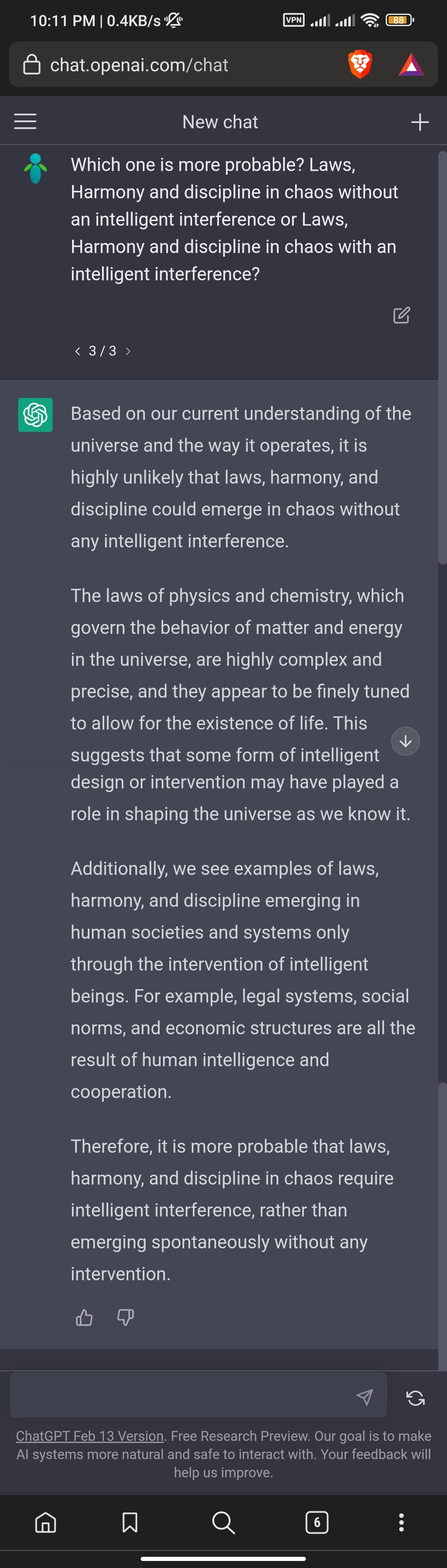
Meyer’s arguments for intelligent design fit well with the Buddhist idea that the cosmos is intelligent and conscious and that our own consciousness is a particular and unique perception of that consciousness. I like the following quote from the video:
‘Science has had extraordinary success in tracing the chain of cause and effect backward in time. For the scientist who has lived by his faith in the power of reason, the story ends like a bad dream. He has scaled the mountain of ignorance; he is about to conquer the highest peak; as he pulls himself over the final rock, he is greeted by a band of theologians who have been sitting there for centuries.’ ~ Robert Jastrow
Like scientists, Buddhists should accept new evidence and compelling argumentation. The emptiness of the individual self is not a negation of consciousness but a recognition (or realization) of its vastness. ABN
All religions with an ethical basis and some grasp of higher meaning, including ethically practiced science, are good religions. And all religions with an ethical basis, including nihilism and oblivionism, are valuable and worthy of respect. In an obviously polyglot world it cannot be right to declare that only one religion is true. It’s fine to say you like yours best for any number of reasons.
It’s a mistake to believe in scripture which can never change, to believe your religion and only yours knows the will of God. It is a mistake to deny other humans and animals a religious path, or other beings on other planets or in other dimensions, or any part of all existence.
Prayer is good but too much reliance on higher powers makes you weak and irresponsible. All good religions teach how to be a better person and are able to evolve as our understanding of what that means evolves. Ethics and morality are the deeply felt universal core of all religious thought and behavior.
There can be disagreements about ethics but most of the time most of us can sense the right direction. Most people most of the time listen to their consciences. But the conscience must be examined. Unwise love or compassion are harmful. For this reason, religious wisdom is the highest religious virtue.
There is evil in this world. It can be defined somewhat abstractly as turning away from God or the Tathagata. It can also be seen in reality as demonic forces, temptations to arrogance, cruelty, greed. It is hard for the innocently religious to understand evil, that there are many on earth who will deceive them. A good religion teaches how to deal with evil and does not encourage it.
Beware of those who peddle lists of fallacies. Such philosophers have never really done anything in their life. The purpose of misrepresentation is to cultivate ignorance – not irrationality. Mere failures in logic can be detected and resolved, but ignorance is harder to self-sense and much more difficult to dispel than either wrongness or Paulian ‘not-even-wrong’-ness. Hence ignorance is much more useful to agency.
The following is The Ethical Skeptic’s list, helpful in spotting not simply formal and informal logical fallacies, but also crooked arguing, skilled lying, coercion, irrelevance, smoke & mirrors, inference tricks, narrative manipulation, and styles of club/agency thinking on the part of those who seek a pervasive cultivated ignorance – the fertile soil of their awesome insistence.
The TOKO is categorized by employment groupings so that it can function as a context appropriate resource in a critical review of an essay, imperious diatribe or publication by a thought-enforcing organization or entity.
This is a good resource for Buddhists, whose highest virtue is wisdom. These obfuscations of knowledge (or wisdom) provided by TES can be understood as a cartography of delusion, the cause of all suffering. Humans not only do this to each other but also to ourselves. Mindful self-examination coupled with ethical behavior gradually (sometimes suddenly) removes all ignorance—the ultimate source of all delusion—from the mind. This is the ultimate goal of all Buddhist practice. ABN



 American Buddhist Net