The Unraveling Stillness: An Introduction to Flux Wisdom Field Theory
We do not begin with things. We begin with a tautology so fundamental it precedes existence itself: Nothing can’t exist. Perfect, absolute stillness is an unstable fiction; the slightest potential for difference, a whisper in the void, unravels it. This primal instability, this ceaseless becoming, is Flux. It is not a substance moving through space, but the very genesis of space, time, matter, and meaning as an ongoing process.
This is the foundational premise of Flux Wisdom Field Theory (fWFT), a conceptual framework that stretches from the deepest questions in cosmology to the intimate nature of consciousness. It proposes that the universe is not a collection of objects governed by laws, but a self-organizing, self-revising informational structure in constant, creative motion. The theory offers a compelling narrative that seeks to unify the measurable world of physics—addressing concrete problems like the Hubble tension and the nature of dark matter—with the experiential world of life, thought, and wisdom. It reframes reality as an endless dance of ripples on a cosmic pond, where interference gives rise to pattern, and resonance gives rise to form. From the quantum foam to the murmurations of starlings and the flash of human insight, fWFT suggests we are witnessing the same fundamental dynamic: the elegant, infinite unfolding of instability into interaction, and interaction into being. The Axioms of Becoming The architecture of fWFT rests on a set of five core axioms that describe the behavior of Flux. These are not arbitrary rules imposed from without, but are presented as the intrinsic, unavoidable logic of a universe where true nothingness is impossible.
There cannot be nothing. This is the origin story. A true void, a perfect null state, is a logical contradiction because it has no potential to persist. The universe exists simply because “nothing” is not a stable option. Flux cannot be still. As a direct consequence of the first axiom, the ground state of reality is one of “never-stillness”. Uniformity is dynamically unstable. A tiny disturbance, a single “wrinkle in the void,” is inevitable and all that is needed to initiate the cosmic dance. Interaction creates loops. When distinctions arise from the flux, they influence one another. This interplay is not linear; it creates feedback, recursion, and self-referential patterns. These informational “loops” are the seeds of structure, memory, and identity. Interference produces resonance. As ripples of flux propagate, they overlap. This interference is not mere noise; it is where creation occurs. Waves amplify and cancel, and through this dynamic interplay, stable, self-reinforcing patterns—resonances—emerge from the turbulence. A particle, a planet, or an idea are all forms of resonance. Resonance decays, seeding further ripples. No structure is permanent. As resonant patterns eventually decay, they don’t simply vanish. They dissipate back into the field, releasing their stored information and energy as new, smaller-scale fluctuations that seed the next generation of structure.
These axioms depict a universe that is perpetually bootstrapping itself into existence. It is not a machine set in motion long ago, but a living, breathing process of continuous creation and dissolution, where every ending is a new beginning.
We need the term meta-Q which means “general meta cognitive ability,” or the ability to see the meta levels of several arguments at once including nuance and branch arguments.
IQ generally connotes being good at taking a test of reasoning, language, and some sort of abstract thinking.
People with high IQs probably also have high meta-Q. The advantage of adding this term is it distinguishes how arguments are presented and considered, how they are analyzed.
For example, mainstream medicine has usurped the meta-Q of virtually all covid reasoning. Fauci at the top either determined or became the spokesperson for what “the science” of covid is and no other view has been allowed. Literally hundreds of millions of people have been forced to agree with the irrational dictates of an irrationally narrow covid meta-Q. Big Tech aided and abetted this mockery of reason by censoring and deplatforming anyone who brought complexity and nuance into the prison yard.
The covid example is roughly the same with other issues of the day, such as election fraud, the January 6 “insurrection,” Critical Race Theory, equality of outcome, and so on. The country is divided because the meta-Q of public discourse is so low there can be no mixing of ideas, no synthesis, no rapprochement.
Magnates of meta-Q usurpation are most of the famous public “thinkers” in USA: Michael Shermer, Cass Sunstein, Nikole Hannah-Jones, Bill Maher, Fauci, Lakshmi Singh, famous actors, etc. These people are supported by editorials, talking-heads, politicians, terrible academics (most of them), and so on.
In private conversations, discussions always go badly when there are too many voices with low meta-Q training or ability in the room. Arguments become simplified and nuance is rarely acknowledged. Meta-Q is the ability to “see over” a problem, to see beyond the words, to what an argument is, how it was formed, what it will result in, how it moves through time, and what alternatives there are.
I am pretty sure most people could be trained to increase their meta-Q considerably and surely to at least know when it is called for and who is doing it well. ABN
For those having trouble following along with all of the controversy within “public health” as practiced in USA, vaccines, and medical practice.
When you distill it all, it comes down to the rights of the individual versus the rights of the collective.
Modern “Public health” is all about maximizing the greatest happiness for the greatest number, and acts to advance the rights and interests of the collective. Traditional medical practice is focused on the rights and interests of the individual patient.
From this, you can appreciate why socialists and leftists are all in on the rights of “Public Health” to impose mandates, and those that support personal liberty are aligned with the medical rights of the individual and the importance of informed consent.
“Public health” in USA believes that the rights of the collective are more important than the rights of the individual.
The work of Karl Marx and colleagues supports the collective as pre-eminent. The US Constitution and associated founding documents disagree and emphasize the rights of the individual.
Collectivism vs individual rights. That is really what this is all about.
Good post on Conspiracy subreddit, showing some subreddits are worth viewing. Check the link above for a wide variety of insights into Dead Internet Theory, which says much or most of what we view and respond to on the interwebs is coming from bots. AI images, voices and videos only enhance the theory. ABN
To understand how Israel has gained a near-total control over the American ruling class today, we must understand Israel of course, but we must also study the principles by which any ruling class operates. The perfect book for that is The Ruling Class, by Italian political scientist Gaetano Mosca (1858–1941). Mosca begins by establishing the following law (p. 50):
In all societies, from societies that are very meagerly developed and have barely attained the dawnings of civilization, down to the most advanced and powerful societies, two classes of people appear: a class that rules and a class that is ruled. The first class, always the less numerous, performs all political functions, monopolizes power and enjoys the advantages that power brings, whereas the second, the more numerous class, is directed and controlled by the first…
No matter what their internal divergences are, the ruling class is bonded by a high degree of solidarity: “the minority is organized for the very reason that it is a minority” (p. 54).
It follows that the main object of political science must be the study of various types of ruling classes. Mosca, p. 336: “We must patiently seek out the constant traits that various ruling classes possess and the variable traits with which the remote causes of their integration and dissolution, which contemporaries almost always fail to notice, are bound up.” Historians and journalists remain at the surface of historical events when they ascribe them to the decisions of heads of states, who are only, as a rule, the public faces of a ruling class, and sometimes not the main decision-makers.
A ruling class can be overthrown, either by a foreign conquest, by a coup d’état, by a revolution, or in more subtle ways that are not always immediately perceptible by the ruled. But any change of regime, even if provoked by popular uprising, leads to the formation of a new ruling class.
All this may seem quite obvious, but reading Mosca and pursuing this line of thought has modified my perspective on political regimes, on the illusion of Democracy, and on what Israel is up to.
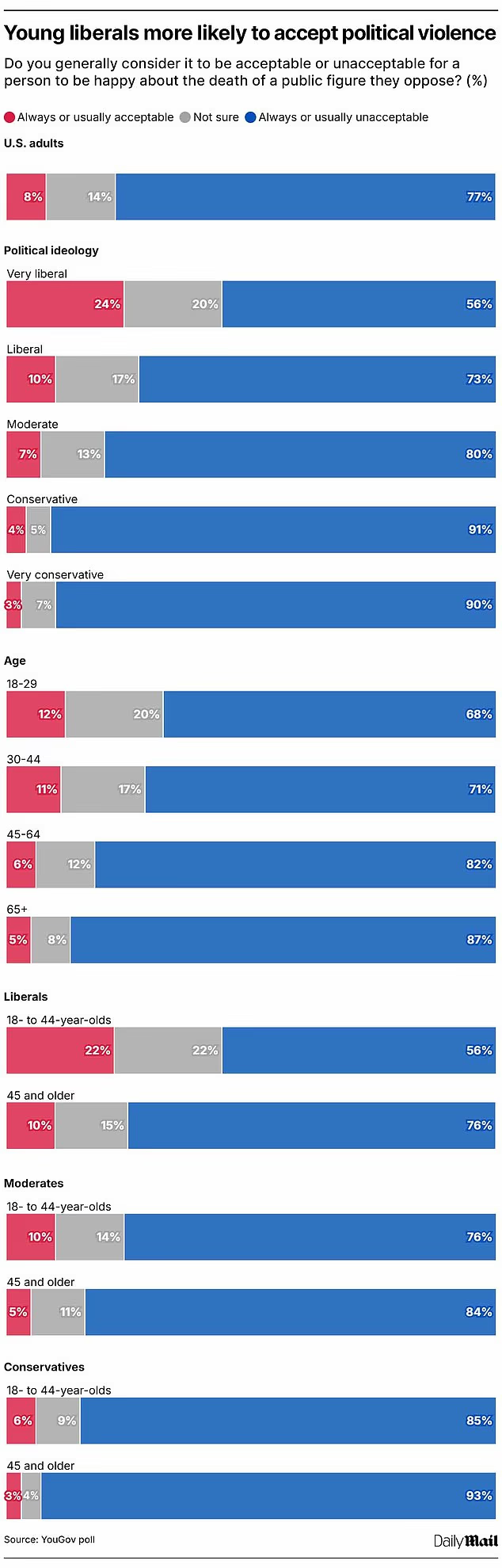
My sense is conservatives have always been fundamentally live and let live, you do your thing, I’ll do mine, while liberals tend more to be activists for moral-sounding causes; and once they are activists they will also be ideologues and their whole thing becomes a religion.
This is a fundamental difference that shows very loudly in politics, as the chart above illustrates.
The activist left always wants to get into your head and make you be like them.
Historically and practically much of the fervor of the left comes from Jews who invented and them became fanatical about communism.
Today the same energies have morphed into woke stuff, previously PC stuff, now also Antifa stuff.
The common theme is they want to get into your head and make you be like them (often while robbing you blind).
There are few political happenings today that do not succumb to these energies.
There are also few interpersonal happenings today that do not succumb to these energies.
USA was built on the presumption that it was and would be a nation of White Christians who shared strong moral fiber and wanted to work together to build the nation.
USA today is no longer that and many of its non-Christian, non-Whites hate what they are not, and do activist shit against it relentlessly. ABN
The Buddha’s explanation of the five skandhas is intended to help us understand the emptiness of the self. It is a short explanation aimed at his most intelligent students.
The Sanskrit word skandha means “heap” or “aggregate” in English. Sometimes the Buddha compared the skandhas to heaps of rice. They are the “heaps” of psycho-perceptual data that comprise the “contents” of our minds. The five skandhas are conditioned dharmas (literally, “conditioned things”), which is to say that they are impermanent and empty, and when improperly understood lead to delusive attachments characterized by greed, anger, and ignorance. The purpose of the Buddha’s five skandha explanation is to help us see through the skandhas, or disentangle ourselves from them. In some Buddhist texts the five skandhas are called the “five covers” because they cover our minds and prevent us from seeing deep levels of reality. In others they are called the “five yin (versus yang)” because they cloud the mind and hide the truth from us. I will discuss each of the five skandhas in the sections below.
1) The first skandha is form. Form, in this case, means anything that leads to, or is capable of leading to, the next skandha. Forms can be visual, auditory, or sensory. They can be dreams, memories, feelings, or moods. Forms are often described as being “obstructions” because, though they may lead to complex thought and activity, they are also hindrances to mental clarity since the activity they lead to is essentially delusive. It is important to remember that the five skandha explanation is an explanation of the deluded mind and its thought processes.
The Abhidharma-mahavibhasa Shastra categorizes the skandha of form into three types:
a) Visible forms with a referent in the outer world such as color, size, length, position, shape, and so on.
b) Invisible forms with a referent in the outer world that are associated with the other sensory organs such as sounds, smells, tastes, and the sensations arising from physical contact.
c) Invisible forms with no referent in the outer world such as dreams, memories, thoughts, feelings, and so on. Though a dream may be “visible” to the dreamer, it is called “invisible” here because no one else can see it. This last category of forms is associated with what the Buddha called “mental dharmas.”
2) The second skandha is sensation. Following the appearance of a form, the mind reacts to it with a sensation that is either positive, negative, or neutral. We either like it, don’t like it, or are neutral about it. Though it is possible to become conscious of this skandha, most of us most of the time are not.
Sensations are generally categorized into two types:
a) Sensations of the body coming from the outside world through any of the sensory organs, such as sights, sounds, smells, tastes, and so on.
b) Sensations of the mind which may or may not come from the outside world. These include moods, feelings, memories, dreams, thoughts, ideas, and so on.
Both kinds of sensation are, of course, based on the prior appearance of a form. Greed and anger have their roots in the skandha of sensation, for if we enjoy a positive sensation we are liable to become greedy about it, while if we do not enjoy it, we are liable to become “angry” or irritable concerning it. The deep meaning of greed is “excessive attraction” to a sensation that we deem to be agreeable or positive, while the deep meaning of anger (or hatred) is “excessive aversion” to a sensation that we deem disagreeable or negative. Neutral sensations often are the result of our ignorance or lack of understanding, though as we progress in Buddhist practice they may be the result of wisdom.
Positive and negative sensations associated with the body are generally considered to be weaker than those associated with the mind, though both types of sensations often are interrelated. An example of this mixture and distinction might be a light slap in the face. While the physical sensation is only mildly unpleasant, the mental sensation will be quite strong in most cases. And yet both are interrelated.
3) The third skandha is perception. This skandha refers to the deepening of a sensation. It is the point where the mind begins to latch onto its sensations. At this point conscious recognition of form and sensation normally begins. It is possible to become conscious of the first and second skandhas as they are occurring, but most of us generally are not. During the skandha of perception we begin making conscious distinctions among things.
4) The fourth skandha is mental activity. This skandha refers to the complex mental activity that often follows upon the skandha of perception. Once we have identified (perceived) something, long trains of mental associations become active. Our bodies may also begin to move and behave during this skandha. For example, the simple perception of a travel poster may set in motion a great deal of mental activity. We may begin recalling an old trip or begin fantasizing about a new one. If we are photographers, we may admire the composition of the photo, step closer to it, make an effort to remember it, and so on. All of these behaviors belong to the skandha of mental activity.
5) The fifth skandha is individual consciousness. It is a product of the first four skandhas and is completely conditioned by them. This is what we normally, more or less, think of as being our “self.” The Buddha taught the five skandhas primarily to help us understand that this “self” or consciousness is empty since it is entirely based on the conditions found in the first four skandhas.
The Ekkotarika-agama explains this point very well. It says, “The Buddha said that the skandha of form is like foam, the skandha of sensation is like a bubble, the skandha of perception is like a wild horse, the skandha of mental activity is like a banana tree, and thus the skandha of individual consciousness is nothing more than an illusion.” The trunk of a banana tree is made of leaves curled together. From the outside, it may look substantial, but if we examine it closely we will find that one leaf pulls away from the next, leaving ultimately nothing behind. The trunk looks substantial, but in truth it is “empty.” In just this way, our individual consciousness may look substantial to us, but if we peel it apart, we find that there is no self within—it is empty.
How to Understand the Five Skandhas
Though most of us are not normally aware of the first two skandhas it is possible to become aware of them through meditation and mindfulness practices. Though it is easier to begin understanding the five skandhas by thinking of them as being separate and distinct, it is important to realize that any of the last four skandhas can give rise to the skandha of form. Mental activity itself, for example, can generate whole new trains of forms, sensations, and perceptions.
Another important thing to understand about the five skandhas is that our minds move very quickly from one to the next. The five skandhas produce a snow storm of impressions and mentation, upon which rests our unstable conscious world. When we become overly attached to this snow storm or to the consciousness built upon it, we generate the karma that ultimately fuels the five skandhas in the first place.
The Explanation of Mahayana Terms (en 1212) says that the skandhas can be understood as being either good, bad, or neutral. The goodness mentioned in this explanation should be understood as being a relative goodness that arises within the phenomenal world—though it is “good,” it is not the same as an enlightened vision that completely sees through the five skandhas. For this reason, we will use the word “positive” in place of “goodness” in this discussion. The Explanation says that positive activation of the five skandhas can be of three types: activation by a positive form, such as a Buddhist image; activation by skillful means, such as a desire to help someone; and activation within a pure-minded person. The Explanation says that the three bad or negative types of activation of the five skandhas result from: simple badness within them, as may have derived from low motives or moodiness; contaminations within them, such as selfishness during an act of kindness; and negativity that is simply the result of bad karma. The Explanation says that the three neutral types of activation are: formal activations that result from the performance of rituals; activations resulting from the practice of a skill; and neutral changes among the skandhas themselves.
How to Contemplate the Five Skandhas
The second noble truth of Buddhism is the cause of suffering. Generally, this cause is explained as clinging to a false self. By contemplating the five skandhas, we learn to understand both that the self is empty and why it is empty. This contemplation appeals to the rational mind for it allows us to use reason to convince ourselves that the “self” we call our own is, in truth, an illusion.
In contemplating the five skandhas we should be mindful that we begin to generate karma during the skandha of perception. At the same time, it is important to realize that the very forms we see and the sensations that result from them are heavily conditioned by our past actions, by the accumulation of karmic “seeds” or influences that are already stored in our minds. Two people may see exactly the same form, but have very different responses to it because their karma is not the same. Since their karma is different, their sensations and perceptions, and especially their mental activity and consciousness will be very different.
The Numerical Teachings of Great Ming Dynasty Tripitaka says (en 1213) that the most important way to understand the five skandhas is to realize that each of them is empty. As we become familiar with the five skandhas, we will find it easier to identify each one and contemplate its emptiness. We can think about them from first to last or from last to first.
If we choose to think of them from last to first, our contemplation will consist of a series of questions, whose answers should be considered deeply. We begin by asking ourselves what the skandha of individual consciousness is based upon. The answer is the roiling mentation of the skandha of mental activity. The skandha of mental activity becomes apparent as soon as we sit down to meditate. Having identified this skandha and appreciated its fundamental emptiness, we can ask ourselves what it is based upon. The answer is the skandha of perception. First the mind seizes one of its impressions (the skandha of perception), then a long train of thought and emotion follows (the skandha of mental activity). Having appreciated this process, we then ask ourselves what the skandha of perception is based upon. The answer is sensation—of the many forms and feelings passing through our minds, one of them gave rise to either a positive or negative sensation (neutral sensations are usually ignored by the mind). It is this sensation that led to the skandha of perception. If we can appreciate this, then we can ask what the skandha of sensation is based upon. The answer is form—either an outer or inner form. Were it not for this form, none of the other skandhas would have arisen.
If we choose to contemplate from the first skandha to the last, we may choose a form and then carefully watch how our minds process it. We will see that form leads to sensation, then to perception, then to mental activity, and lastly to individual consciousness—a state of mind deeply colored by the skandhas below it. Bear in mind that when the five skandhas are simply happening of themselves and no one is watching them, we are normally unconscious of the activity of the first two skandhas. Before most of us are even aware of what we are perceiving, we have begun to react to it. It requires some skill to see that forms give rise to positive, negative, or neutral sensations before they give rise to the skandha of perception, but this is the case in a normally active mind.
The quotation cited previously from the Ekkotarika-agama can also be used as a very fine contemplation. The agama said, “The Buddha said that the skandha of form is like foam, the skandha of sensation is like a bubble, the skandha of perception is like a wild horse, the skandha of mental activity is like a banana tree, and thus the skandha of individual consciousness is nothing more than an illusion.” The skandha of form is like foam in a stream—at any moment scores of forms contend for our attention. The skandha of sensation is like a bubble—suddenly we react to a single bubble within the foam. The skandha of perception is like a wild horse—we can never be sure which way our mind will turn at this point. The skandha of mental activity is like a banana tree—it consists of many things wrapped together. And thus, the skandha individual consciousness is empty, an illusion.
ABN
UPDATE: FIML practice can be understood in terms of the five skandhas in this way: A FIML query begins at or interrupts the skandha of mental activity. Through training and prior agreement, partners learn to identify a fraught psychological response at the third skandha–perception–and thereby shift away from habitual mental activity to FIML mental activity. The FIML query at this points implicitly asks is my habitual perception based on fact? The FIML query should be made in as neutral a tone as possible to avoid influencing your partner. Your partner’s reply will either confirm or refute your habitual perception. FIML is a dynamic and very powerful form of mindfulness that allows partners to be much more objective about the granular workings of their minds. After hundreds of FIML queries, partners will establish a database of objective insight into their own (and each other’s) psychology that is much more accurate than what can be done alone or through general discussion with anyone. ABN
FIML is both a practice and a theory. The practice is roughly described here and in other posts on this website.
The theory states (also roughly) that successful practice of FIML will:
Greatly improve communication between participating partners
Greatly reduce or eliminate mistaken interpretations (neuroses) between partners
Give partners insights into the dynamic structures of their personalities
Lead to much greater appreciation of the dynamic linguistic/communicative nature of the personality
These results are achieved because:
FIML practice is based on real data agreed upon by both partners
FIML practice stops neurotic responses before they get out of control
FIML practice allows both partners to understand each other’s neuroses while eliminating them
FIML practice establishes a shared objective standard between partners
This standard can be checked, confirmed, changed, or upgraded as often as is needed
FIML practice will also:
Show partners how their personalities function while alone and together
Lead to a much greater appreciation of how mistaken interpretations that occur at discreet times can and often do lead to (or reveal) ongoing mistaken interpretations (neuroses)
FIML practice eliminates neuroses because it shows individuals, through real data, that their (neurotic) interpretation(s) of their partner are mistaken. This reduction of neurosis between partners probably will be generalizable to other situations and people, thus resulting a less neurotic individual overall.
Neurosis is defined here to mean a mistaken interpretation or an ongoing mistaken interpretation.
The theory of FIML can be falsified or shown to be wrong by having a reasonably large number of suitable people learn FIML practice, do it and fail to gain the aforementioned results.
FIML practice will not be suitable for everyone. It requires that partners have a strong interest in each other; a strong sense of caring for each other; an interest in language and communication; the ability to see themselves objectively; the ability to view their use of language objectively; fairly good self-control; enough time to do the practice regularly.
In mathematics, a ‘computation’ is the process of performing mathematical operations on one or more inputs to produce a desired output. A problem in analyzing human psychology arises when we understand that human psychology cannot be reduced computationally. The ‘computational irreducibility’ of human psychology does not mean, however, that there is no way to probe it and understand it. In the following essay, I show how FIML practice can greatly enhance our understanding of our own psychologies and, by extension, the psychologies of others.
Rather than rely on tautological data extractions or vague theories about human psychology, FIML focuses on small interpersonal exchanges that can be objectively agreed upon by at least two people. These small exchanges correspond to what Wolfram calls ‘specific little pieces of computational reducibility’. When we repeatedly view our psychologies from the point of view of specific little pieces of computational reducibility, we begin amassing a profoundly telling collection of very good data that shows how we really think, speak, and act.
FIML is a method of inquiry that deals with the computational irreducibility of humans. It does this by isolating small incidents and asking questions about them. These small incidents are the “little pieces of computational reducibility” that Stephan Wolfram remarks on at 42.22 in this video. Here is the full quote:
One of the necessary consequences of computational irreducibility is within a computationally irreducible system there will always be an infinite number of specific little pieces of computational reducibility that you can find.
This is exactly what FIML practice does again and again—it finds “specific little pieces of computational reducibility” and learns all it can about them.
In FIML practice, two humans in real-time, real-world situations agree to isolate and focus on one “specific little piece of computational reducibility” and from that gain a deeper understanding of the whole “computationally irreducible system”, which is them.
When two humans do this hundreds of times, their grasp and appreciation of the “computationally irreducible system” which is them, both together and individually, increases dramatically. This growing grasp and understanding of their shared computationally irreducible system upgrades or replaces most previously learned cognitive categories about their lives, or psychologies, or how they think about themselves or other humans.
By focusing on many small bits of communicative information, FIML partners improve all aspects of their human minds.
I do not believe any computer will ever be able to do FIML. Robots and brain scans may help with it but they will not be able to replace it. In the not too distant future, FIML may be the only profound thing humans will both need to and be able to do on their own without the use of AI. To understand ourselves deeply and enjoy being human, we will have to do FIML. In this sense, FIML may be our most important human answer to the AI civilization growing around us. ABN
FIML is a conversational pragmatic and poetic phenomenology1 of extemporaneous2 interpersonal semiotics and psycholinguistics.
the study of structures of consciousness as experienced from the first-person point of view ↩︎
from the Latin ex tempore: ex (immediately after) + tempore (time, opportunity, occasion); at the time, in and of the time. In Buddhist terms this may be thought of as the thusness of speech and semiotics ↩︎
Properly done, FIML is a poetic, practical, playful, objective and subjective conversation about what just happened and is happening right now. It is a shared thusness of a particular time and place.
Like the eyes in our heads, which are the only parts of the brain visible to us, FIML ‘sees’ the profundity of the moment as it actually was and is. This ‘seeing’ can be trivial (‘oh, that’s a stick, not a snake’) or it can be profound, with deep resonance throughout memory and mind.
Life without FIML, to me, is boring and missing one of the best aspects of sentient being. ABN
FIML works with the shared knowledge of two people; knowledge that both partners agree on.
FIML works with small bits of knowledge to avoid jumping mistakenly into false belief, justification, or truth as these words are used in the video above.
In this way, FIML is working with both primary subjective and primary objective knowledge, turning them into agreed upon better subjective and objective knowledge (since both agree).
Doing FIML frequently, clears up mistaken beliefs, justifications, and truths by clearing up basic subjective and objective knowledge mistakes.
I have only just heard of Williamson, but the messy knowledge basis of interpersonal relations has been clear to me for many decades.
When partners compare their subjective knowledge of self and each other, they correct their false knowledge and replace it with much better knowledge.
Basic FIML works with bits of language and semiotics that are small enough for both partners to distinctly remember in real-time and agree on what they are.
A huge advantage of working with small bits of knowledge is self-correction is fairly easy. And also its effects on meso and macro kinds of knowledge happen through autocatalytic expansion into those regions.
Everything changes when lots of little bits of knowledge are cleared up and made better. The insights expand throughout the mind.
FIML does not tell you what to think. It is a method for working with what you know or can know or thought you knew but maybe were wrong or right.
FIML’s truths, once realized, are psychological, existential, philosophical and spiritual. ABN
The basic Buddhist take on sexual misconduct is you shouldn’t harm anyone or let yourself be harmed by sexual behavior. Less basic is sexual thought and behavior should not be excessive. ‘Identifying’ your ‘self’ with your ‘sexuality’ is almost anti-Buddhist because Buddhism is all about overcoming the self, which is an illusion, a delusion. Additionally, sexuality is not the most important part of humans. For these reasons seducing children (or adults) into delusive identities based on sexuality is not right conduct. It is sexual and psychological misconduct. It is foisting your own delusions on others, leading others to make the same mistakes you have. ABN
The article discusses the historical and contemporary roles of three prominent Jewish libertarians—Milton Friedman, Ayn Rand, and Ludwig von Mises—in shaping libertarian thought and their connections to the ruling elite. Friedman and Rand are noted for their strong Jewish identities and Zionist beliefs, while Mises, although rooted in his Jewish heritage, emphasized individual freedom over ethnic concerns. The piece delves into the broader libertarian critique of the state, which is portrayed as an oppressive force driven by an exploitative ruling elite that privatizes gains while socializing losses. This elite is accused of manipulating public perception to support its policies, leading to perpetual conflict and the looming threat of nuclear warfare.
The author argues that exposing the ruling elite’s machinations is essential for reducing state power and preventing war. However, libertarian scholars often shy away from this analysis due to fears of being labeled as conspiratorial or politically incorrect. The article highlights Murray Rothbard as a notable exception, who actively critiqued the ruling elite’s influence and sought to understand its dynamics without succumbing to mainstream taboos. Rothbard’s contributions are framed as an essential framework for analyzing the intersection of economic interests and political power, emphasizing that elite actors engage in purposeful, self-interested behavior rather than acting randomly.
Rothbard identified three ethnic power blocs within the ruling elite: the WASP elite, the Jewish elite, and the Rockefeller dynasty. Each bloc is characterized by its distinct cultural and economic foundations, contributing to a complex interplay of competition and collaboration among these groups. The article elaborates on how these power blocs have historically influenced U.S. foreign policy and domestic governance, particularly during the World Wars, where their conflicting interests dictated the alignment of the U.S. in global conflicts. Rothbard’s analysis suggests that while these factions often cooperated for mutual benefit, their internal rivalries also shaped the course of American history.
The discussion shifts to the role of the Jewish elite in shaping state behavior, particularly in the context of the modern geopolitical landscape. The article posits that the Jewish elite has historically leveraged their position to navigate power dynamics while maintaining a distinct identity. The rise of neoconservative influence within the Republican Party is highlighted as a significant shift, with Rothbard noting the increasing prominence of Jewish interests in shaping U.S. foreign policy towards Israel and broader Middle Eastern engagements. The conclusion emphasizes the current geopolitical tensions and the need for libertarians to critically engage with the ruling elite’s influence, especially as conflicts in Gaza and elsewhere escalate, posing risks of genocide and nuclear war. The author calls for a more open discourse within libertarian circles regarding the Jewish elite’s role, arguing that self-censorship could lead to dire consequences for global peace and individual freedoms.
The reason we use the term semiotics on this site is when FIML partners do a FIML query, the data in their minds at the moment(s) in question is best described as raw semiotics.
That is, it is the raw material that makes up the composite of consciousness at the moment(s) in question.
This material, or data, can be sharply focused, vague, irrelevant to the subject at hand, emotional, associative, organized, disorganized, and so on.
When partners get good at observing this data accurately and describing it to each other, they will find that much of it, if not all of it, is connected to a psycho-semiotic network that underlies awareness, or intermingles with it, and gives rise to its states.
Understanding this network is extremely valuable and will provide partners with great insights into how and why they feel, think, and behave as they do.
It is very difficult (and I think impossible) to understand this network through solitary pursuits only.
The reason for this is a solitary mind will fool itself.
In contrast, two minds working together will be able to observe this network with much greater accuracy.
Language, semiotics, and emotion are fundamentally interpersonal operations, so it is reasonable to expect that deep comprehension of these operations will be best achieved through interpersonal activity. ABN







 American Buddhist Net