To understand the outcome of the next four years (and beyond), it is important to begin with the same information. One key not discussed anywhere else is outlined below.
Consider this a baseline for future context in the world of the USA and President Trump politics.
♦ Summarized it looks like this: In late summer 2023 not only myself, but several insightful analysts in the world of high finance, had come to the conclusion that Musk’s financial effort with the purchase of Twitter was unsustainable, unless something changed.
Something did change.
In early August of 2023, understanding the dynamic at stake, and also having a strategy for his own interests, Oracle’s Larry Ellison said, ‘he would not let Elon Musk fail with Twitter’.
Billionaire Larry Ellison, a Tesla Board member, already had invested money in place, but that wasn’t the motive on this move. In hindsight, Ellison was brilliant and intensely strategic. It is important to understand what exactly ‘board members’ are recruited for, and the stability/security reasons for why they are recruited.
Ellison pumped money into the problem, relieving Musk of the cash flow problem created by his inability to divest shares (Musk was max-limited by Board). Ellison also helped make the $1.5 billion loan made by SpaceX, (unknown at the time) go away.
Ellison essentially positioned Twitter for the same dynamic reason that Bezos bought and used WaPo. This is the world of high finance, and these moves are all about influence, leverage and ultimately positioning. Ellison wanted a vessel for influence, a friendship and common ideological alignment therein just made sense.
With financial breathing room and a nod in the direction he needed to follow, after a brief stint with Ron DeSantis, Musk using his platform, leaned forward into Trump. The rest of that relationship origin is history.
Oracle, specifically Larry Ellison, is now positioned as the biggest benefactor of a second Trump administration, with a very specific group of technocrats in close alignment. AWS Jeff Bezos has been trying to make up ground ever since.
♦ Now that’s the elevator speech part; that’s the encapsulated or summarized version. But it’s in the details where things get interesting.
It should be emphasized up front that no one is a bad guy in the framework of what took place; however, neither is this altruism.
These are essentially self-interests in a common alignment. As long as the alignment is for good purposes, then the network of billionaire allies is in a very cool place.
[This is an extremely good analysis — concise, clear as a bell, and deeply insightful. It provides a seasoned and wise overview of where we we are headed, and how it might turn out for the good or the bad. This essays illustrates the fundamental way people should think about politics, which is a rational, if cut-throat, human endeavor. Much of politics is out of our control, but we the plebs do have input into the system when we more or less agree and make our voices heard, which we have been doing for the past 8-10 months. US politics is as good as it gets right now. We the plebs must only keep the pressure on and strive to find and embrace our general agreement on major subjects, such as: freedom of speech, no mass immigration, no government spying, no totalitarianism, 2A, good economic policies, no war, solidarity with Europe and Russia, etc. ABN]
UPDATE: Takes a little effort to get into this video, but it is well worth watching. I watched the entire thing and learned plenty. If you are at all interested in the first few centuries BCE and/or religious history, you will enjoy this talk. ABN
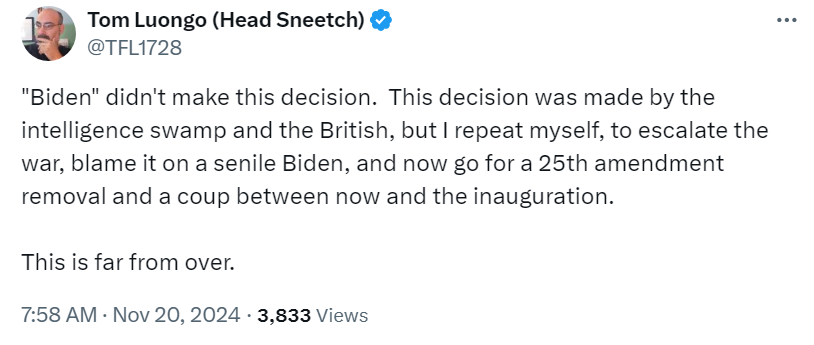
Could be, who knows? Maybe the people at the top know or think they do. These are super elite comitatus KOBK decisions that have nothing to do with anyone but them. Putin knows this and is probably assessing Russia’s best assessment of who actually controls the West and who actually made the decision to use the missiles. Is it to keep Trump from becoming president or is it to prepare Russia for a Trump presidency with some hard facts in the air? ABN
Viewing nature as a signaling network shows its advantage with this question.
Instead of asking where our moral sense comes from, we ask instead what makes for a good signaling network?
The answer is “good organization.”
By “good,” I mean efficient, well-made, good use of resources, easy to maintain, rational, etc.
You are a signaling network.
A well-organized you will probably tend to be morally pretty good and wanting to get better at it, depending on your conditions.
Of course some people view “morality” as whatever is in their best interests. And that is a type of moral thinking. When it is found out, though, most other people, very reasonably, do not like it.
If we view nature as the evolution of signals and signaling networks rather than as the evolution of matter, we will see that changes in signal organization are fundamental to the evolutionary process.
In this sense, it is the most ordinary thing in the world that you, a complex signaling system that is conscious, would consciously seek good organization and/or want to adapt your organizing principles, both objective and subjective, to conditions that impact you.
Conditions that impact you are signals being perceived by the signaling network you think of as yourself.
Your adaptations, both small and large, will encompass many moral considerations and choices.
Morality can be viewed as a kind of organization. The networks that make up your being must organize their relations with the world around them and other sentient beings. We make many moral decisions when we do this. These decisions are an integral part of how we are organized.
Last night I heard a drunk swearing at his friend from the street. “You fucking bastard…” etc. Not well-organized, but still he was yelling a local version of morality and this was fundamental to his networks and behavior.
UPDATE 11/09/22: The above shows that what we scientifically think of today as evolution does not contradict what might be called spiritual evolution, or Buddhist evolution that happens in three ways combined: through 1) morality/ethics; 2) concentration/mindfulness; and 3) wisdom/understanding. Karma is the path of our mind as it wends through its various and numerous realities, sometimes tending toward goodness or the Tathagata, sometimes tending away. By consciously contemplating our signaling networks and describing them to ourselves and close friends we can make our signals clearer and more ethical and thus become wiser, have better understanding. The act of doing this is a kind of concentration or mindfulness. It really doesn’t matter what your religion is, including atheism or even oblivionism, honestly analyzing your signaling will change you probably for the better. ABN
If the government coerces you to take an untested vax, while loudly declaring it is ‘safe & effective’, don’t take the vax and do not believe the agencies or people who tried to coerce you. The covid vax was particularly pernicious because it had to be injected into your bloodstream and did not even fit the normal definition of a vaccine. When the government changes the definitions of vaccines, which they did for covid, or anything else, be very suspicious.
These principles are obvious and easy to understand and are a good basis for mass non-compliance and disbelief in government coercion and lies. All that is required is did they lie about something important or did they coerce us to do something dangerous, in violation of our inalienable rights.
The same can be applied to history. We know they lied about WMD in Iraq and we also know (and knew at the time) that Iraq had nothing to do with 9/11 — therefore, knowing this, we should suspect their motives for all wars past and present and future. Rather than go into many examples of this, I am going to assume readers know what they are.
As for history, if it is illegal or massively frowned upon to question any historical event, we should be sure to question it. We must not allow politicians to tell us our First Amendment rights are a threat to ‘our’ (meaning their) democracy as John Kerry has done recently and Jacinda Ardern and many others did during the plandemic.
On this basis, it behooves all of us to question the Holocaust. It is ludicrous to make questioning that subject illegal, as it is in most of Europe, or scandalous as it is in USA.
That’s all. Civil non-compliance based on simple rules and examples as given above allow all citizens to lend their voices to most subjects without necessarily agreeing on every aspect. This is the most important kind of power we the people have. Totalitarianism cannot take over our nations or remain in power where it already has taken over if a majority of citizens see the lies and do not agree or comply. This kind of power is made super-duper strong if citizens also know that others know and if all of us know we all know. ABN
_______________
UPDATE: I posted this about two months ago and believe it bears reposting today. Between now and inauguration, much will happen,. After inauguration, the real battle will begin. As a collective, we the people of USA and the West must exhibit unity on the most important issues facing us without necessarily agreeing on every detail. ABN
If the government coerces you to take an untested vax, while loudly declaring it is ‘safe & effective’, don’t take the vax and do not believe the agencies or people who tried to coerce you. The covid vax was particularly pernicious because it had to be injected into your bloodstream and did not even fit the normal definition of a vaccine. When the government changes the definitions of vaccines, which they did for covid, or anything else, be very suspicious.
These principles are obvious and easy to understand and are a good basis for mass non-compliance and disbelief in government coercion and lies. All that is required is did they lie about something important or did they coerce us to do something dangerous, in violation of our inalienable rights.
The same can be applied to history. We know they lied about WMD in Iraq and we also know (and knew at the time) that Iraq had nothing to do with 9/11 — therefore, knowing this, we should suspect their motives for all wars past and present and future. Rather than go into many examples of this, I am going to assume readers know what they are.
As for history, if it is illegal or massively frowned upon to question any historical event, we should be sure to question it. We must not allow politicians to tell us our First Amendment rights are a threat to ‘our’ (meaning their) democracy as John Kerry has done recently and Jacinda Ardern and many others did during the plandemic.
On this basis, it behooves all of us to question the Holocaust. It is ludicrous to make questioning that subject illegal, as it is in most of Europe, or scandalous as it is in USA.
That’s all. Civil non-compliance based on simple rules and examples as given above allow all citizens to lend their voices to most subjects without necessarily agreeing on every aspect. This is the most important kind of power we the people have. Totalitarianism cannot take over our nations or remain in power where it already has taken over if a majority of citizens see the lies and do not agree or comply. This kind of power is made super-duper strong if citizens also know that others know and if all of us know we all know. ABN
If the government coerces you to take an untested vax, while loudly declaring it is ‘safe & effective’, don’t take the vax and do not believe the agencies or people who tried to coerce you. The covid vax was particularly pernicious because it had to be injected into your bloodstream and did not even fit the normal definition of a vaccine. When the government changes the definitions of vaccines, which they did for covid, or anything else, be very suspicious.
These principles are obvious and easy to understand and are a good basis for mass non-compliance and disbelief in government coercion and lies. All that is required is did they lie about something important or did they coerce us to do something dangerous, in violation of our inalienable rights.
The same can be applied to history. We know they lied about WMD in Iraq and we also know (and knew at the time) that Iraq had nothing to do with 9/11 — therefore, knowing this, we should suspect their motives for all wars past and present and future. Rather than go into many examples of this, I am going to assume readers know what they are.
As for history, if it is illegal or massively frowned upon to question any historical event, we should be sure to question it. We must not allow politicians to tell us our First Amendment rights are a threat to ‘our’ (meaning their) democracy as John Kerry has done recently and Jacinda Ardern and many others did during the plandemic.
On this basis, it behooves all of us to question the Holocaust. It is ludicrous to make questioning that subject illegal, as it is in most of Europe, or scandalous as it is in USA.
That’s all. Civil non-compliance based on simple rules and examples as given above allow all citizens to lend their voices to most subjects without necessarily agreeing on every aspect. This is the most important kind of power we the people have. Totalitarianism cannot take over our nations or remain in power where it already has taken over if a majority of citizens see the lies and do not agree or comply. This kind of power is made super-duper strong if citizens also know that others know and if all of us know we all know. ABN
If the government coerces you to take an untested vax, while loudly declaring it is ‘safe & effective’, don’t take the vax and do not believe the agencies or people who tried to coerce you. The covid vax was particularly pernicious because it had to be injected into your bloodstream and did not even fit the normal definition of a vaccine. When the government changes the definitions of vaccines, which they did for covid, or anything else, be very suspicious.
These principles are obvious and easy to understand and are a good basis for mass non-compliance and disbelief in government coercion and lies. All that is required is did they lie about something important or did they coerce us to do something dangerous, in violation of our inalienable rights.
The same can be applied to history. We know they lied about WMD in Iraq and we also know (and knew at the time) that Iraq had nothing to do with 9/11 — therefore, knowing this, we should suspect their motives for all wars past and present and future. Rather than go into many examples of this, I am going to assume readers know what they are.
As for history, if it is illegal or massively frowned upon to question any historical event, we should be sure to question it. We must not allow politicians to tell us our First Amendment rights are a threat to ‘our’ (meaning their) democracy as John Kerry has done recently and Jacinda Ardern and many others did during the plandemic.
On this basis, it behooves all of us to question the Holocaust. It is ludicrous to make questioning that subject illegal, as it is in most of Europe, or scandalous as it is in USA.
That’s all. Civil non-compliance based on simple rules and examples as given above allow all citizens to lend their voices to most subjects without necessarily agreeing on every aspect. This is the most important kind of power we the people have. Totalitarianism cannot take over our nations or remain in power where it already has taken over if a majority of citizens see the lies and do not agree or comply. This kind of power is made super-duper strong if citizens also know that others know and if all of us know we all know. ABN
A RECENT GROUNDBREAKING EXPERIMENT in which anesthesia was administered to rats has convinced scientists that tiny structures in the rodents’ brains are responsible for the experience of consciousness. To pull it off, these microscopic hollow tube structures, called “microtubules,” don’t rely on our everyday flavor of classical physics. Instead, experts believe, microtubules perform incredible operations in the quantum realm. Citing the work of earlier researchers, the study infers that the same kind of quantum operations are likely happening in human brains.
During their rat brain experiments, scientists at Wellesley College in Massachusetts gave the rodents isoflurane, a type of inhaled general anesthetic used to induce and maintain unconsciousness for medical procedures. One group of drugged rats also received microtubule-stabilizing drugs, while the other did not. The researchers discovered that the microtubule-stabilizing molecules kept the rats conscious for longer than the non-stabilized rats, which more quickly lost their “righting reflex,” or the ability to restore normal posture, according to their findings, published in the peer-reviewed journal eNeuro in August 2024.
The Wellesley study is significant because the physical source of consciousness has been a mystery for decades. It’s a major step toward verifying a theory that our brains perform quantum operations, and that this ability generates our consciousness—an idea that’s been gaining traction over the past three decades.
The notion that quantum physics must be the underlying mechanism for consciousness first emerged in the 1990s, when Nobel Prize-winning physicist Roger Penrose, Ph.D., and anesthesiologist Stuart Hameroff, M.D., popularized the idea that neural microtubules enable quantum processes in our brain, giving rise to consciousness. Specifically, they postulated in a 1996 paper that consciousness may operate as a quantum wave passing through the brain’s microtubules. This is known as Orch OR theory, referring to the ability of microtubules to perform quantum computations through a mathematical process Penrose calls “objective reduction.”
In quantum physics, a particle does not exist in the way classical physics observes it, with a definite physical location. Instead, it exists as a cloud of probabilities. If it comes into contact with its environment, as when a measuring apparatus observes it, then the particle loses its “superposition” of multiple states. It collapses into a definite, measurable state, the state in which it was observed. Penrose hypothesized that “each time a quantum wave function collapses in this way in the brain, it gives rise to a moment of conscious experience.”
…Concern shifts, then, from care of the person, or care of the other, to care for the relational process. From what forms of relationship do we flourish? Here again is a pragmatic question for conversations now in progress.
Are your thought patterns valid? Are your premises true? Is your mind sound?
Buddhism further asks are your mental states wholesome? Are they conducive to enlightenment, wisdom, freedom from delusion?
There are many things we can do while alone to clean up our thought processes. And there are some things we can only do with the help of another person.
Only another person can tell us if our premises, thoughts, and conclusions (however tentative) about them are true, valid, and sound.
Buddhism has a concept of a “spiritual friend,” a “good friend,” a noble friend,” or an “admirable friend.” All of these terms are translations of the Pali Kalyāṇa-mittatā, which is well-explained at that link. (Chinese 善知識). That link is well-worth reading in full.
From the link above and from many years of working with Buddhist literature and people, my sense is that a Buddhist “good friend” is someone who is to be admired and emulated. They are similar to what we mean today by mentors or “good role models.”
I deeply respect the concept of a Buddhist good friend, but find it lacks what I consider the preeminent virtue of philosophical psychology—real-time honesty based on a teachable technique.
Indeed, I cannot find anything anywhere in world philosophy, religion, or literature that provides a teachable technique for attaining real-time honesty with another person.
I also do not quite understand how this could be.
For many centuries human beings have thought about life but no one has come up with a technique like FIML?
How can that be?
I do not see a technique like FIML anywhere in the history of human philosophy nor anywhere in modern psychology.
The importance of a “good friend” who does FIML with you cannot be overemphasized because it is only through such a friend that you can discover where your premises about them are right or wrong, where your thoughts about them are valid or not, and through those discoveries where your mind itself is arranged soundly or not.
UPDATE 12/14/23: Buddhists can and should make Buddhist practice their own, update or improve the practice with new ideas that are sound, valid, and true. This is a very positive and excellent side of Buddhism, which itself is not written in stone. Buddhism is preeminently a mind-to-mind teaching. It does not depend on ancient texts or the absolute interpretation of words. It depends on fulsome understanding of the deep truths at the core of all Buddhist thinking—impermanence, emptiness, and nirvana. Anything that is consonant with those three truths and conforms to Buddhist morals is good Buddhism. Anything that contradicts those three truths and/or Buddhist morals is not Buddhism.
The Buddha encouraged teaching the Dharma in people’s native languages. He discouraged writing his teachings down because he did not want them to become sacred texts that people worship rather than understand. FIML practice is an efficient, detailed, sound, and accurate way for “good friends” to deeply share mind-to-mind communion/communication with each other. In this sense, it is excellent Buddhist practice. FIML has no other teaching than how to communicate really well with a good friend. FIML does not tell you what to think or believe. Anyone can do it. ABN
The problem of the criterion is a fundamental issue in epistemology, which is concerned with the nature and scope of knowledge. It is a problem that arises when trying to determine the extent of knowledge and formulate the criteria for epistemic values, such as truth, justification, and evidence.
The problem can be phrased as a pair of questions: “What do we know?” and “What is the extent of our knowledge?” However, these questions seem to be circular, as it appears that we cannot answer the first question without already having an answer to the second, and vice versa.
This problem has been discussed by philosophers for centuries, with ancient roots dating back to the works of Pyrrho and Sextus Empiricus.
The problem of the criterion is closely related to the issue of justification, as it is difficult to determine what criteria should be used to justify our beliefs and knowledge claims. This problem has been addressed in various ways, including the development of different epistemological theories and the exploration of the nature of truth and evidence.
In essence, the problem of the criterion highlights the difficulty of determining the starting point of knowledge and the criteria for evaluating knowledge claims. It is a problem that has puzzled philosophers for centuries and continues to be a topic of ongoing debate and inquiry.
the above was AI generated in Brave browser
Pyrrho’s tripartite statement is completely unprecedented and unparalleled in Greek thought. Yet it is not merely similar to Buddhism, it corresponds closely to a famous statement of the Buddha preserved in canonical texts. The statement is known as the Trilakṣaṇa, the ‘Three Characteristics’ of all dharmas ‘ethical distinctions, factors, constituents, etc.’ Greek pragmata ‘(ethical) things’ corresponds closely to Indic dharma ∼ dhamma ‘(ethical) things’ and seems to be Pyrrho’s equivalent of it. The Buddha says, “All dharmas are anitya ‘impermanent’…. All dharmas are duḥkha ‘unsatisfactory, imperfect, unstable’…. All dharmas are anātman ‘without an innate self-identity’.”
~Beckwith, Christopher I.. Greek Buddha: Pyrrho’s Encounter with Early Buddhism in Central Asia
The quote from Beckwith just above highlights how Beckwith has very convincingly connected Pyrrho’s skepticism with early Buddhism. The Trilaksana or Three Characteristics are the foundation of the Four Dharma Seals, belonging to the very earliest (attested) teachings of the Buddha. They are the heart of virtually all Buddhist philosophy and practice. They also define the Problem of the Criterion in Buddhist terms. The Fourth Seal is nirvana or freedom from the anxiety and suffering of not fully understanding the the first Three Dharma Seals.
I am also making this point because the Problem of the Criterion, or the Four Dharma Seals, are very real and impact our daily lives at every level all the time. And this is not just an abstract philosophical problem. It affects all of our relationships and everything we say and hear. In this vein I want to say that FIML (without my specifically knowing it at the time) is designed to address the Problem of the Criterion as it arises between two people in a close relationship.
I have said more than a few times over the years that it is hard for me to understand why ancient philosophers, including the Buddha, did not discover FIML or teach it. I believe it is possible Buddhist monks in the Buddha’s day were given instructions that amounted to some form of FIML, but there exists no evidence of this.
Whatever the case, FIML is designed to deal with interpersonal conundrums that arise out of the Problem of the Criterion, our inability to solidly nail what we know to the wall. FIML cannot completely fix the problem. It does not solve the Problem of the Criterion but it does make everything much clearer and better by at least an order of magnitude and probably more. By fully recognizing this inherent problem within all communication FIML partners can cooperatively work to solve it for the most part between themselves. ABN
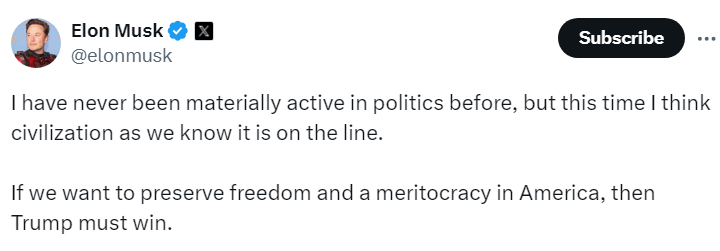
Musk is better than Zuckerberg, RFK Jr is better than Fauci, Carlson is better than Maddow, Trump is better than Harris. Modern history has provided many examples of societies that failed to stop communism when they still could have, and having failed to do that fell into communist massacres that killed tens of millions while also completely destroying their cultures. The two main examples are Russia and China. Many in Russia were aware of the danger of communism many decades before the nation was destroyed. Too many of those who were aware played nice, dithered, were complacent, did nothing when they could have done a lot. We are now living in something akin to early 20th Century Russia. Is today 1905, 1912, 1914? I don’t know but we are close to full totalitarian takeover and destruction that will be every bit as bad as what happened to Russia. It won’t be called communism but it will be a civilizational disaster. This applies to every nation in the collective West and all of our closest allies, like Japan, Taiwan, etc. It is the West that is going to fall hard, not just USA, UK, NZ, or whatever single nation you choose to focus on.
There is an argument out there that it’s all a circus. The elite have total control. Trump has been chosen to usher in digital IDs and currency. Etc. There is truth to this POV and it should be kept in mind that we are not going to get a perfect government. Digital everything is probably inevitable, including digital babies. We live in a quickly evolving world and we have to negotiate that. But remember, Russia could have saved itself if it had reformed in time. It didn’t, so the Bolsheviks won and destroyed everything. If it weren’t for Putin, Russia would look like Ukraine today. Making the right choices in muddled circumstances is the mark of great thinkers. It’s never all black-and-white. ABN


 American Buddhist Net