This is a civilization-wide problem across the West (and the world). It rests on a psycholinguistic feature or flaw inherent in human beings.
This feature or flaw is used in mind-control and self-actuating mind-control.
Once this feature has been tapped as a flaw, it works on its own in a majority of people, thus producing pathological hive-mindedness.
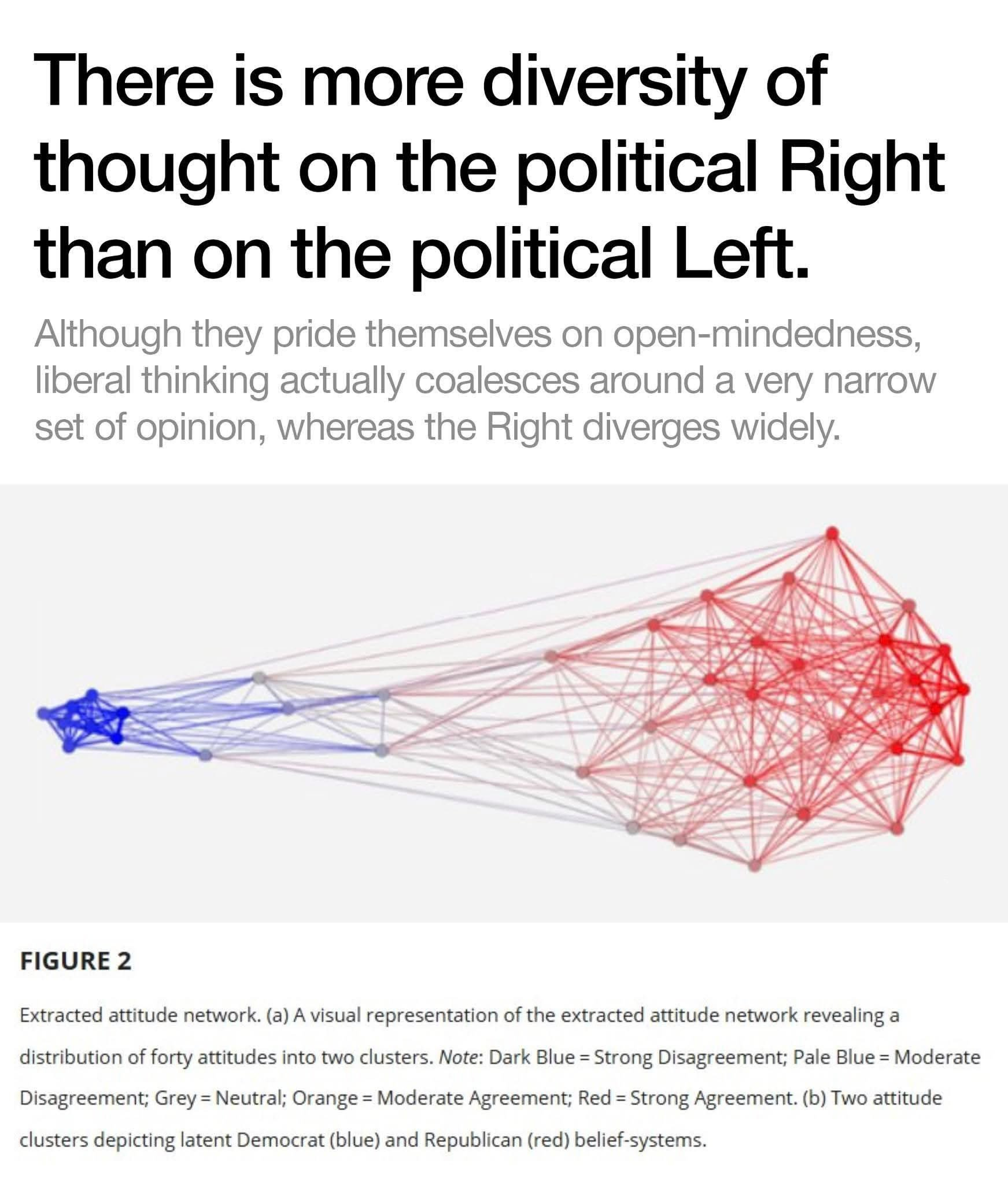
To be brief, psycholinguistic arrays tend to cluster around core concepts. The nature of trained-in core concepts is they become reified and ‘root’ the mind firmly against distractions, deviations and suasion.
This is good when you are training to be an electrician. This is bad when you are training to be a psychotherapist.
All cultures and subcultures are formed around core concepts (and psycholinguistics) through training and imitation.
It takes a better than average mind to see above this or around it.
Learn and understand FIML and you will see this in great detail within yourself and understand why it is both a feature and a flaw in all human language use.
It is not solely a psychological thing, which is why I often use the term psycholinguistics. ABN
UPDATE: This is high school, college level speech. Mildly engaging and I can see why Vance did it. Von lets him glide over whatever issue is raised. Vance is planting political seeds that will grow to his advantage. The giggling they do perplexes me as I can’t believe it’s real and yet they must be representing something. He is the VP and therefore worth listening to once in awhile. As long as he toes Trump’s line I support him. There is no alternative line today. ABN
The title above states precisely what people do with interpersonal speech and semiotics: When confronted with seemingly ambiguous data, they seek subconsciously to arrange it in a pattern that is familiar. People do this all the time. Throughout history people have been doing this. It is a major source of suffering, violence, idiocy, madness, cruelty, and lost opportunity. Isn’t it obvious? When we talk or communicate in any way our message is frequently misunderstood, sometimes very seriously misunderstood. This causes all of us to live in a massively reduced world because the only way we typically deal with this interpersonally is by seeking subconsciously for a pattern that is familiar. So far, no one has suggested a cure for this horrible human malady, until FIML came along. FIML fixes precisely this problem: It’s not hard: You just have to change the way you think (and listen and talk). ABN
This clip shows the psycholinguistic core of mind-control. Deep instinct aroused by a single word and the victim (her) will not be able to explain or describe how this came about. To her, it just is. To her controllers, this is the successful result of many years of psycholinguistic conditioning. We all are up against these forces. They can be understood and avoided or cured. But we must be conscious of the process of conditioning and willing to react to it wisely.
From a Buddhist point of view, mind-control is the polar opposite of wisdom, either doing it to others deliberately or doing it to yourself through lack of introspection. All of Buddhist practice is directed at freeing the mind from reified identity, mind-control, delusion. ABN
The scientific investigation of Unidentified Aerial Phenomena (UAP) has reached a critical juncture with the recovery and analysis of the extraordinary “Buga sphere phenomenon” – a metallic, spherical object first documented in Colombia on March 2, 2025. This remarkable case presents unprecedented evidence of technology demonstrating flight capabilities beyond conventional human engineering, offering researchers a rare opportunity to directly examine a physical artifact that displays characteristics consistent with advanced aerial technology of unknown origin.
“This is truly extraordinary… this sphere that flew and descended. For me personally, the most important evidence that demonstrates a non-human origin, not to say extraterrestrial, non-human of this sphere is that it flies through the skies and flies from one side to the other as if it were a drone, but it isn’t; it doesn’t have a propulsion system, and therefore it’s something more,” explains Jaime Mausán, during a Youtube video about the Buga Sphere.
Interpersonal communication errors can occur for many reasons during acts of listening, cogitating, and/or speaking.
For example, in a conversation involving two people (A & B), person A may mishear (listening error) what B said; and/or person A may misunderstand or miscogitate what they heard; and/or person A may misspeak.
Errors in any part of that communication process will cause some sort of confusion between A and B. Errors can be of many types. The speaker may mispronounce, misenunciate, use the wrong word, be inadvertently misleading, hit a wrong tone of voice, etc. In turn, the listener may mishear, be inattentive, be overly attentive to one aspect of what the speaker is saying, not know a word or a reference, etc. Next, even if the listener heard correctly, they may misunderstand or miscogitate by making wrong associations, drawing wrong conclusions, etc. Any unconscious error in hearing or cogitating will probably lead the listener to misspeak when it is their turn.
Errors of these sorts if not corrected will compound and cause the conversation to become unsatisfying or confusing.
It is the goal of FIML practice to catch these errors as soon after they arise as possible. FIML partners should strive to be perfect with each other in all three of these communication areas–listening, cogitating, and speaking. The best way to do this is to pay close attention to yourself. If you feel an emotional jangle, be sure to confirm with your partner (by doing a FIML query) that your jangle is justified. If it is not, you have discovered an error. Correct the error and continue.
One very simple and common jangle involves feeling irritated (even very, very slightly) at your partner because they did not understand what you said (probably not so clearly). Take it as a given that our uses of language are frequently less than perfect. You must expect that a good many of the things you say will not be stated as clearly as they could be; many more of them, though clear enough, will contain ambiguities or misleading word choices. If as a speaker you become irritated at your partner for something that is inevitable in your own speech, you are making a huge mistake.
Another common jangle involving cogitation is feeling stupid or inattentive when your partner makes an association that you did not get even though you heard all of their words correctly. This jangle could also involve thinking your partner is stupid or not making sense because you did not get what they said. Either way, it is crucial that both FIML partners know that these kinds of mistakes in cogitation are quite common. Identify them when they occur–as soon as you can–and correct them.
A third common jangle, this time involving hearing, is attributing a wrong emotion or intention to the speaker’s tone of voice. The human speech apparatus is not that highly developed. To speak, we have had to re-purpose our teeth, lips, and tongues, which other animals use for eating, to make noises that convey sometimes sophisticated meaning to other people. How could things not go wrong with that? We also breathe, vomit, kiss, and do other stuff with that same oral cavity. FIML partners must recognize that we are working with a primitive “wind instrument” when we talk and that this instrument may blow too hard, get clogged with phlegm, or experience many other kinds of mishaps that can distort the sounds of our voices. A person with a high, soft voice can easily be misunderstood as being a light-weight, while a person with a deep voice and large lungs can easily be misheard as being aggressive when they are not. Each one of us should be aware of how our voices might be misunderstood and then apply this level of detail to understanding, at least, our partner’s voice.
Another common listening jangle/error that can occur, even if you clearly understand all of the above, is a speaker’s tone of voice can be seriously misunderstood if we think it refers to us when it is referring to the subject at hand. For example, you say something about the car needs fixing and your partner responds in an irritated tone of voice. If you hear that irritation as referring to you when your partner is just sick of the damn car, you will be making a serious mistake. If you say nothing, you may simmer with wrong bad feelings for some time, which often leads to yet more bad feelings. If you do say something, you may start an argument and/or otherwise greatly compound the original problem. All that actually had happened was your partner expressed a fairly primitive emotion (irritation at the damn car) which you misunderstood to mean irritation at you. Your partner used our crude speech apparatus to grunt irritation at a very common problem and you used your crude ears and listening abilities and crude tendency to think everything applies to you to make a big mistake, one that will only add to the original problem.
As you and your partner continue doing FIML practice, you will get better and better at finding and correcting these kinds of errors the moment they arise. It’s not always easy, but it is always very satisfying if you discuss the matter long enough for both of you to achieve a real resolution.
Russia is a collective culture, consisting of ’in-groups’. Russians do smile at people they know. Shop assistants smile at the clients they already know, not necessarily at others.
If you smile at a stranger in Russia, he/she can smile back, but it can already mean an invitation to come and talk. Russians take smiling as a sign that the person cares about them. To smile at a stranger can raise the question:” Do we know each other?”
You see two behaviours in one person in Russia: formal – unsmiling is for ’them’ (strangers); friendly – smiling for ’us’ (friends, people he/she knows). Some Russians skip to friendlier behaviour after a shorter time. You can consider yourself accepted when people you have met begin smiling at you.
Real feeling – not fake
Smiling in Russia usually shows the real good mood and good relationship between people, as it is not used as a form of politeness. When a Russian smiles at you, he/she really cares about you or is genuinely in a good mood.
How to smile
Russians prefer not to show their teeth too much when smiling. Showing your upper and lower teeth when smiling, looks a bit vulgar, a horse grin to Russians.
Smiling without a reason
Others must understand the reason of smiling in Russia. If they don’t, it is considered strange. They start wondering what is behind the smile. Perhaps they interpret that the person who ”keeps smiling” is a bit simple or stupid. All Russians know the saying: “The laugh without reason – is the sign of stupidity” (“Smeh bez prichiny – priznak durachiny”)
Pretty sure if was in Kumarajiva’s Commentary on the Great Perfection of Wisdom that I read a passage about how a man should not show his teeth when smiling; a smile should be demure or none at all. Smiles can be understood very differently in different places. ABN
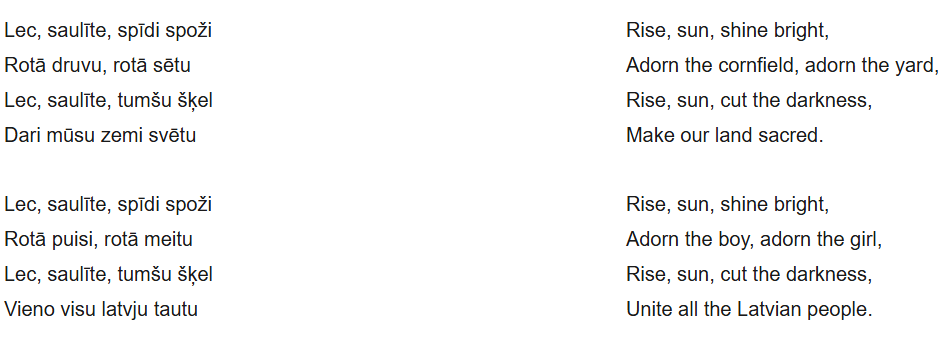
The Baltic languages Latvian and Lithuanian have preserved to this day the world’s oldest versions of spoken Indo-Aryan. They are remarkably similar to ancient Sanskrit. This song shows the continuity of culture, language, and spirituality from ancient times to today, still remembered and felt in this part of Europe. ABN
I’ll probably have more to say on this subject, but for now let me just say I am delighted to have found a psychotherapy that is highly compatible with FIML practice.
Indeed this psychotherapy is based on the same principles as FIML, though the approach is different.
In FIML unwanted psychological reactions are discovered in real-world, real-time situations with a partner.
In Coherence Therapy—the psychotherapy I just discovered—unwanted psychological reactions are called schemas. Schemas are transformed through memory reconsolidation in a way that is theoretically very similar to FIML practice.
Here is a video that explains the process of memory reconsolidation that is achieved through Coherence Therapy:
Coherence Therapy (CT) requires a therapist, while FIML does not.
In a nutshell, CT uses three steps (as described in the video) to achieve results. I will list them below in bold font and explain briefly how FIML differs and is also very similar.
1) CT: Reactivate the target schema as a conscious emotional experience. This is done with the help of a therapist.
FIML: In FIML, harmful or unwanted schemas are encountered in real-life with a participating partner. No therapist is needed, though prior training in the technique is helpful.
2) CT: Guide a contradictory experience. This juxtaposition unlocks (de-consolidates) the target schema’s memory circuits. (“Mismatch”/”prediction error” experience)
FIML: The “contradictory experience” is discovered in real-life through the FIML query. The partner’s answer to the FIML query provides the “juxtaposition” that unlocks or de-consolidates the encountered schema. In FIML, we have been calling this process the discovery and correction of a contretemps or mix-up.
3) CT: Repeat contradictory experience in juxtaposition with target schema. This rewrites and erases target schema.
FIML: Repetition of the contradictory experience happens in real-life whenever it next happens if it happens again. Generally, most schema or unwanted reactions are corrected within 5-10 recurrences. Serious unwanted schemas may take more repetitions.
Since CT uses a therapist as a guide, it is better than FIML for very serious problems and for people who are unable to find a partner to do FIML with.
Since FIML does not use a therapist, it is better for dealing with a very broad range of many unwanted schemas, not just the most serious or ones discovered by a therapist.
I am quite sure that CT will be very effective for many kinds of psychological agony. If a problem is acute, I would recommend CT based on my experience with FIML.
A shortcoming of FIML is it requires a caring partner and the transformations it induces are generally all induced in the presence of that partner. Much good comes of that and most transformations can be extrapolated to other people and other situations, but for serious problems like panic or deep anxiety, a CT therapist may be more helpful.
FIML is best for two people who want to optimize their psychologies. Partners will discover and correct many unwanted schemas and many bad communication habits.
If you can understand CT, you should be able to do FIML. If you have already done CT and had good results and now you want to go further and optimize your psychology, FIML will help you do that.
I believe the core theory of CT is sound. If that is so, it should be clear that bad schemas arise constantly in life. We start new ones all the time. Bad schemas are like trash that inevitable accumulates and must be cleaned away. FIML does this job very well.
I honestly believe Jews are genetically prone to self-deception at very high levels. Many generations of inbreeding have produced a population which is talented at speaking but also seemingly incapable of speaking truthfully. Speaking untruthfully is a normal human trait and most humans do it quite often, but generally only with small matters or culturally conditioned matters. In my considerable experience, Jews are very good at bold-faced lying, trickery, scams. For many, perhaps including the speaker above, the irony of their self-deception never seems to occur to them.
To add to this topic, many ‘Asian’ cultures tend to have speech prescriptions and proscriptions which lead to a form of frequent lying or making things sound ‘nice’ or ‘inoffensive’. This is different from what I see in Jewish speech but related. In much of Asia the basic rule is never say anything your listener may not want to hear. This is why there are so many plastic smiles and ‘agreeable’ people in those cultures. Chinse themselves remark on the culturally idiosyncratic ‘Chinese smile’, which they rightly believe non-Chinese rarely, if ever, fully understand.
Evolutionarily, self-deception can be a big advantage because it makes the self-deceiver more convincing to others. This trait is particularly valuable in parasitic cultures or individuals, which have recently proliferated wildly within the West.
For context, all human traits are on a spectrum and almost all humans have these traits to some degree. When individuals have varying degrees of any trait, obviously groups of individuals will also present varying degrees of these traits. White people have all of the human traits and, as must be the case, they vary within and between different white populations. I mention whites because that is the case and also because whites are in the very confusing (for them) position of being beset upon by a global variety of cultural traits most whites are not used to or entirely unaware of. Examples of this are clan-based societies (such as Muslims), tribe-based societies (such as Jews), and societies ideologically indoctrinated with their cultural takes on themselves, the world, and white people (such as post-colonial ones). To not understand these matters and not feel free enough to discuss them openly is to greatly handicap yourself and your culture when dealing with other cultures and people. Freedom of speech in white societies should be used to tackle these topics, the sooner the better.
One thing I can guarantee you is no other culture in this world does not often discuss these topics. A great deal of white mind-control against this kind of speech comes from Jewish control of white media, money, politics, and more; precisely the topic the speaker above unironically wants to proscribe to protect her tribe and her tribe only. Why does the most powerful tribe in the West need special protection? The answer is obvious: they need it to preserve their power and get more of it. Only self-deception will prevent you from seeing this. Self-deception can be genetic, cultural, or induced by mind-control, which is a form of hostile internecine parasitism. ABN







 American Buddhist Net