Reversive blockade: Ponerological Definition and as used by Psychopaths

Reversive blockade: Emphatically insisting upon something which is the opposite of the truth, this blocks the average person’s mind from perceiving the truth. In accordance with the dictates of healthy common sense, he starts searching for meaning in the “golden mean” between the truth and its opposite, winding up with some satisfactory counterfeit. People who think like this do not realize that this was precisely the intent of the person who subjected them to this method. If such a statement is the opposite of a moral truth, at the same time, it simultaneously represents an extreme paramoralism, and bears its peculiar suggestiveness. We rarely see this method being used by normal people; even if raised by the people who abused it; they usually only indicate its results [on their thinking] in the shape of characteristic difficulties in apprehending reality properly. Use of this method can be included within the above-mentioned psychological knowledge developed by psychopaths concerning the weaknesses of human nature and the art of leading others into error. Where they are in rule, this method is used with virtuosity, and to an extent conterminous with their power.

link

This concept reversive blockade deserves some real thought. It is fundamental to mass mind-control. Ponerology is ‘the study of evil’. Mind-control is a major weapon of evil political systems and their top actors and toadies. Claiming mass illegal immigration into USA is good for the country is an example of reversive blockade; you can feel your mind trying to make sense of that statement, even in the light of knowing you are paying for it and there is no money for citizens in Lahaina or Appalachia after recent disasters, which themselves appear to have been caused by ponerologists. ABN

Philosophical psychology

Are your thought patterns valid? Are your premises true? Is your mind sound?

Buddhism further asks are your mental states wholesome? Are they conducive to enlightenment, wisdom, freedom from delusion?

There are many things we can do while alone to clean up our thought processes. And there are some things we can only do with the help of another person.

Only another person can tell us if our premises, thoughts, and conclusions (however tentative) about them are true, valid, and sound.

Buddhism has a concept of a “spiritual friend,” a “good friend,” a noble friend,” or an “admirable friend.” All of these terms are translations of the Pali Kalyāṇa-mittatā, which is well-explained at that link. (Chinese 善知識). That link is well-worth reading in full.

From the link above and from many years of working with Buddhist literature and people, my sense is that a Buddhist “good friend” is someone who is to be admired and emulated. They are similar to what we mean today by mentors or “good role models.”

I deeply respect the concept of a Buddhist good friend, but find it lacks what I consider the preeminent virtue of philosophical psychology—real-time honesty based on a teachable technique.

Indeed, I cannot find anything anywhere in world philosophy, religion, or literature that provides a teachable technique for attaining real-time honesty with another person.

I also do not quite understand how this could be.

For many centuries human beings have thought about life but no one has come up with a technique like FIML?

How can that be?

I do not see a technique like FIML anywhere in the history of human philosophy nor anywhere in modern psychology.

The importance of a “good friend” who does FIML with you cannot be overemphasized because it is only through such a friend that you can discover where your premises about them are right or wrong, where your thoughts about them are valid or not, and through those discoveries where your mind itself is arranged soundly or not.

first posted MAY 30, 2017

UPDATE 12/14/23: Buddhists can and should make Buddhist practice their own, update or improve the practice with new ideas that are sound, valid, and true. This is a very positive and excellent side of Buddhism, which itself is not written in stone. Buddhism is preeminently a mind-to-mind teaching. It does not depend on ancient texts or the absolute interpretation of words. It depends on fulsome understanding of the deep truths at the core of all Buddhist thinking—impermanence, emptiness, and nirvana. Anything that is consonant with those three truths and conforms to Buddhist morals is good Buddhism. Anything that contradicts those three truths and/or Buddhist morals is not Buddhism.

The Buddha encouraged teaching the Dharma in people’s native languages. He discouraged writing his teachings down because he did not want them to become sacred texts that people worship rather than understand. FIML practice is an efficient, detailed, sound, and accurate way for “good friends” to deeply share mind-to-mind communion/communication with each other. In this sense, it is excellent Buddhist practice. FIML has no other teaching than how to communicate really well with a good friend. FIML does not tell you what to think or believe. Anyone can do it. ABN

A useful guide to understanding what FIML is

The Ethical Skeptic (TES) has written a very good essay: The Distinction Between Comprehension and Understanding. I want to use a schema presented in his essay to describe what FIML is, how to see it and understand it. Comprehending it requires doing it and reaping its benefits.

TES provides this illustration of the layers of thought and psychology that culminate in comprehension:

I might not use a hammer to represent comprehension but since we have a hammer, it would represent FIML’s ability to smash through the dogma of psychology, our ordinary understanding of psycholinguistics, the simplicity with which we view real-time speech, and our ignorance that there exists anything profound in being able to analyze real-time, real-world speech as it is happening.

FIML is a method, a technique. It has no content save what you bring to it. FIML works with and reveals the profound subjectivity of the individual. Since basic FIML cannot be done alone but only with a partner, it also reveals the profound subjectivity of your partner. In doing this, it smashes the dogmas of psychology and virtually all public/common notions about what the human mind even is.

The difficulties of FIML are fundamentally two: 1) seeing it at all and 2) doing it. FIML is not something people normally ever do. I have been writing, reading, and thinking about FIML for many years and have never seen any reference to anything like it anywhere in the history of the world. If you know of one, please tell me. I will be delighted.

FIML is probably hard to see because all languages everywhere contain a very strong proscription against questioning anyone in the moment in order to begin a sober analysis. People just don’t do that. Getting that close and personal about something someone has just said (or did) is instinctively perceived as disrespect, argumentativeness, stupidity, rocking-the-boat, etc. FIML 100% is not that, but since no one has cultivated the habit or acquired the training to do it, no one can even see it let alone do it.

Most of us can see moments of speech and change our minds quickly if we are ordered, instructed, or want to curry favor. I guess that is a starting point, but none of that is FIML. FIML begins with a subjectively felt (or comprehended) need to find out if you have interpreted something correctly. Very ordinary, right? Yes, it is in “slow-time,” but not in real-time.

When done in real-time, the emphasis is on the one asking the question because this one has noticed an interpretation arising in their mind that may be wrong. The interpretation could be completely new or more likely habitual. By frequently noticing these interpretations and then asking your FIML partner about them (using FIML rules) and listening to their reply, you will gradually begin to see a true picture of your actual profound and marvelous subjective mind as it moves through and responds to its living existence.

FIML is no more difficult to learn than playing a musical instrument, riding a motorcycle, or cooking. Once both you and your partner understand what FIML basically is and why it is so necessary, you will progress quickly and gain many insights into your behaviors and thinking processes. At some point, you will achieve a kind of mutual comprehension of each other that is very clear and beautiful and cannot be gained in any other way.

Some oddities of communicating with doctors

One aspect of seeing a doctor is you will remember them (often vividly) and whatever rapport you thought had been established, but when you next see them (assuming weeks or months have passed), they almost certainly will not share your memories of whatever rapport you may have thought had been established, if they remember you at all. This can make them seem cold or unfocused or unstable.

From their POV, many doctors handle this by being kind of plastic friendly at best. For patients, it’s weird because there are few other communications as important as with your doctor and yet there is almost no one else you know who is as disconnected from normal relationship dynamics with you as your doctor. So a doctor’s mood when you see them probably has next to nothing to do with you.

ABN

The Astral Plane

The astral plane, also called the astral realm or the astral world, is a plane of existence postulated by classical, medieval, oriental, esoteric, and new age philosophies and mystery religions.[1] It is the world of the celestial spheres, crossed by the soul in its astral body on the way to being born and after death, and is generally believed to be populated by angels, spirits or other immaterial beings.[2] In the late 19th and early 20th century the term was popularised by Theosophy and neo-Rosicrucianism.

Another view holds that the astral plane or world, rather than being some kind of boundary area crossed by the soul, is the entirety of spirit existence or spirit worlds to which those who die on Earth go, and where they live out their non-physical lives. It is understood that all consciousness resides in the astral plane.[3] Some writers conflate this realm with heaven or paradise or union with God itself, and others do not. Paramahansa Yogananda wrote in Autobiography of a Yogi (1946), “The astral universe … is hundreds of times larger than the material universe … [with] many astral planets, teeming with astral beings.”

link

My sense is the term astral plane has fallen a bit out of favor. In some cases it is replaced by ethereal plane. In Buddhism, it is traditionally referred to as ultimate reality or vaguely as nirvana, or what comes after nirvana. More recently among scientists and philosophers, we are seeing the concept of a conscious universe or a thinking universe, a universe in which consciousness is a primary force, feature or dimension. However we refer to it, we need a term that evokes dimensions or planes of awareness beyond earthly or mundane awareness or ‘relative reality’, as it is put in Buddhism.

The concept of an astral plane dates back to Plato if not before. The Buddha was referring to something like that without using any term when he spoke about nirvana. The Buddha was a Scythian who argued against the strong Scythian belief in an absolute distinction between right and wrong and a single, great God (Ahura Mazda) who created the world and could be known only through doing good.

It’s a good development that scientists and philosophers today are increasingly seeing what the Buddha and many others have seen throughout the ages. I believe deep meditative states and a moral life afford us frequent opportunities to commune with or glimpse dimensions or realms beyond our normal default cultural behavioral realms.

Buddhism is a profoundly ethical teaching but it also rejects absolutes. We humans are characterized by emptiness, impermanence, and the suffering wrought by clinging to any concept, belief or idea, and yet are capable of freeing ourselves from ‘relative reality’ through ethical practice and experiential samadhi states.

The Buddha remained silent on matters related to anything like the astral plane because he knew that focusing on ethereal aims (especially in his day?) tends to reify them, which then leads to ossification, doctrine, worship without reason. I wonder if in our day, the Buddha would reason differently as many reasonable thinkers now accept that consciousness may be inexplicable by rank materialism or particle physics or biology based on those; and thus may/must be a primary aspect of all that we know of.

My current understanding of Buddhism and ancient history has been recently influenced by Christopher Beckwith’s The Scythian Empire: Central Eurasia and the Birth of the Classical Age from Persia to China, which I highly recommend to Buddhists and everyone else. ABN

Indeterminacy of translation and FIML

I betray my poor education by admitting that I had never heard of W. V. Quine’s “indeterminacy of translation” until last week. My ignorance is especially egregious as I have worked as a professional translator for many years.

Maybe I had heard about it but had forgotten. I am being self-reflective because FIML practice is deeply, fundamentally concerned with the “indeterminacy” of translating one person’s thoughts into another person’s head.

Quine’s thesis is not just about translating from one language to another, though there is that. It is much more about the fundamental impossibility of determining what anything means well enough to “translate” it into another context, a next sentence, into another person’s mind, or even “translating” your own speech from the past into the context of your mind today.

If I had known about Quine, I probably never would have thought of FIML because his ideas and the slews of papers written on “indeterminacy of translation” surely would have made me believe that the subject had been worked through.

As it was, I have plodded along in a delightful state of ignorance and, due to that, maybe added something practical to the subject.

In the first place, I wholeheartedly believe that speech is filled with indeterminacy, which I have generally called ambiguity or uncertainty. In the second place, I have confined my FIML-related investigations mainly to interpersonal speech between partners who care about each other. I see no solution to the more general problem of indeterminacy within groups, subcultures, or linguistic communities. Until brain scans get much better, large groups will be forced to resort to hierarchical “determinacy” to exist or function at all.

For individuals, though, there is much we can do. FIML practice does not remove all “indeterminacy.” Rather, it removes much more than most people are aware is possible, even remotely aware is possible. My guess is FIML communication provides a level of detail and resolution that is an order of magnitude or two better than non-FIML.

That is a huge improvement. It is life-changing on many levels and extremely satisfying.

FIML does not fix everything—and philosophical or “artistic” differences between partners are still possible—but it does fix a great deal. By clearing up interpersonal micro-indeterminacy again and again, FIML practice frees partners from the inevitable macro-problems that micro-ambiguity inevitably causes.

Moreover, this freedom, in turn, frees partners from a great deal of subconscious adhesion to the hierarchical “determinacy” of whichever culture they are part of. Rather than trapping themselves in a state of helpless acceptance of predefined hierarchical “meaning,” FIML partners have the capacity to sort through existential semiotics and make of them what they will with far less “indeterminacy,” or ambiguity, than had been possible without FIML practice.

first posted DECEMBER 7, 2014

The Dark Arts of Psychology: Nudges

During the Covid crisis, nudging emerged as one of the primary psyops tools used by globalists, governments, NGOs, and “security” (intelligence) forces against us ordinary folk. 

Recently, a number of peer-reviewed papers have come to light, exposing just how pervasive and damaging the use of nudges was during Covid-19. They also reveal how nudging, including fear nudging, is being used to control individuals and populations on matters such as health, climate change, meat-eating, tobacco use, alcohol use, weight control, electoral candidates, political campaigns, and more.

The PsyWar Campaign continues to work to control our hearts and minds on all matters of statecraft.

For those that need reminding, nudging is a form of psychological manipulation that is often used in psyops and psywar campaigns.

A nudge is a technique for modifying people’s behavior in a predictable way by influencing people to behave in a desired outcome. Nudging is usually performed covertly, although that is not considered a criterion of the nudge. A nudge can be described as: “any aspects of the choice architecture that predictably alters people’s behavior without forbidding any options or significantly changing their economic incentives.” 

Nudging alters the environment, triggering automatic cognitive processes to favor the desired outcome. Nudging makes it more likely that an individual will make a particular choice or behave in a particular way.

Fear nudging involves using nudges that utilize a fear component to drive behavior, opinions, or decision-making. While this is a particularly effective form of nudging, it is absolutely unethical, in my opinion and that of others.

link

Nudge is just a cute word for mind-control. It is itself a psycholinguistic trick to control your mind. Our world today can very legitimately be described as a mind-control circus. Virtually, everything you see in the public realm is mind-control. You have no intellectual toolset if you don’t understand this. Once you see it, it is easy to renegotiate your world far more wisely. ABN

‘The law dictates what a vaccine is and the CDC did not have the power to change that’ — Dr David Martin

I am quite sure readers of this site know what a dirty scam it was to change the meaning of the word vaccine and then mandate that garbage. Posting this to remind a wider audience. Be sure to share with those who may have missed this crucial point, because it exposes the core of plandemic malfeasance. Changing the definition of a legally defined word—and especially doing that illegally—is a form of violent psycholinguistic mind-control. Many 100s of millions of people were fooled by this criminal legerdemain, which in truth appears to have been an act asymmetric warfare. ABN

Psycholinguistics: our normal interpersonal communication system inevitably produces significant error

Our normal interpersonal communication system inevitably produces significant error; thus leading to misery, personality disorder, mental illness. In spiritual terms, the normal ways we talk and listen carry toxic seeds of ignorance (and evil) that scatter everywhere. Even the sciences are affected.

Without the FIML corrective, nothing will change.

I have done FIML long enough that I feel deeply sorry for everyone who does not do it.

It’s not super easy to do FIML, to correct the mistakes that cause so much suffering, but it can be done with no more effort than learning to cook well or play the piano passably well. And like those skills, it’s fun to do once you get going with it.

Societies collapse because ignorance, greed, and madness accumulate and rot them out from inside. It happens to all of them. It is happening to us very seriously right now.

Marriages, friendships, and individual lives collapse for similar reasons. Errors build on errors, minds overwhelmed; suffering ensues.

I beg of you. Give it a shot. Learn FIML.

Within a short time you will see what it does, how it does it, and why it is so necessary for a good life.

The importance of the Readiness Period for speech, listening, and decision making

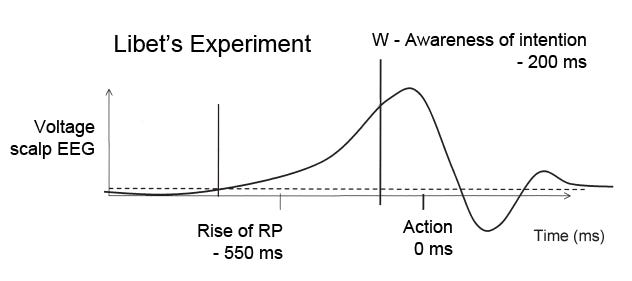
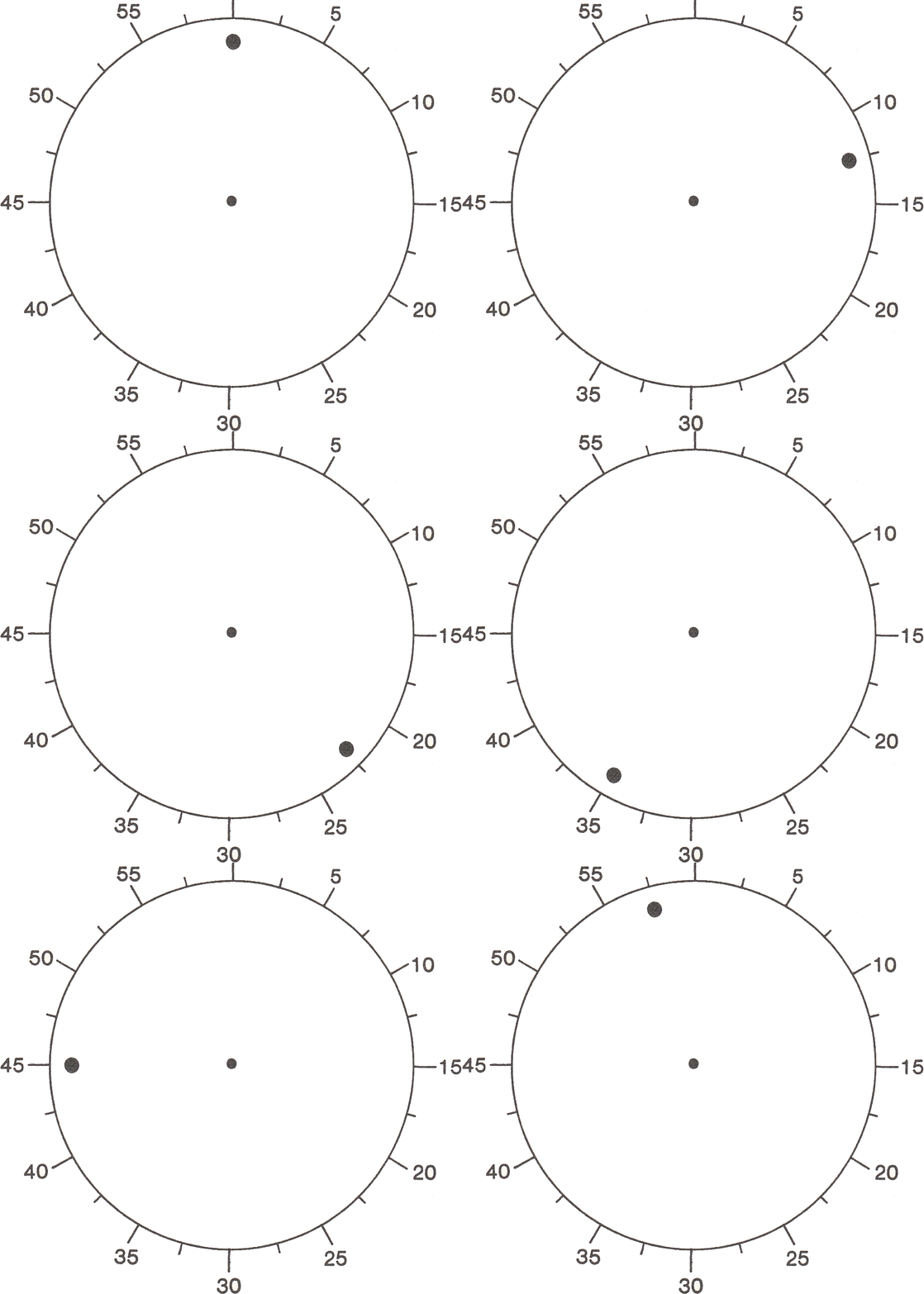
Libet gave participants of his experiments a simple task, while measuring their brain activity: they had to decide to flex a finger whenever they wished, and note the position on a fast-moving clock at the precise moment they took the decision.

The result was that the brain showed activity at least 400ms before the participants became aware of their “decision making.”

Here’s a diagram showing what’s going on:1

“RP” stands for “Readiness Potential,” that is, the supposed build-up in brain activity before the decision to act and the subsequent action. What we see is that this brain activity starts before the participants became aware of their intention to flex the finger.

The results have led the no-Free-Will crowd to [falsely] exclaim, “see, everything is driven by your brain, and you taking decisions is just an illusion!”

However, this seems to be a typical case of taking something very specific and isolated out of context and then drawing conclusions based on existing biases.

link

The exercise of free will in basic FIML is done during the “Readiness Potential” period described above. FIML done with a partner is an exquisite exercise of free will that completely changes how we speak and listen for the better. FIML is somewhat difficult because it requires being aware of the Readiness Potential period close to its onset. But this can be learned with practice. Buddhists or others who practice mindfulness may find this part of FIML to be rather easy. From this point of view, FIML can be described as mindfulness shared by two people, or pair-work mindfulness. FIML mostly focuses on interpersonal speech and listening but also includes all other interpersonal semiotics. More posts related to FIML and brain science can be found here. ABN

Different languages, similar encoding efficiency: Comparable information rates across the human communicative niche

Abstract

Language is universal, but it has few indisputably universal characteristics, with cross-linguistic variation being the norm. For example, languages differ greatly in the number of syllables they allow, resulting in large variation in the Shannon information per syllable. Nevertheless, all natural languages allow their speakers to efficiently encode and transmit information. We show here, using quantitative methods on a large cross-linguistic corpus of 17 languages, that the coupling between language-level (information per syllable) and speaker-level (speech rate) properties results in languages encoding similar information rates (~39 bits/s) despite wide differences in each property individually: Languages are more similar in information rates than in Shannon information or speech rate. These findings highlight the intimate feedback loops between languages’ structural properties and their speakers’ neurocognition and biology under communicative pressures. Thus, language is the product of a multiscale communicative niche construction process at the intersection of biology, environment, and culture.

link

Google and FIML

Google has helped all of us upgrade our info about the world around us, whatever we are interested in, etc.

In the past, people had brains as complex as ours and a love of good information as great as ours, but they had to make do with less.

Somewhat resembling Google, FIML practice upgrades interpersonal information shared by (usually) two people.

Rather than guess and fill our minds with superstitions about the people we care about most, FIML allows us to “look up” the info we need when we need it.

This has a dramatic and beneficial effect on both the self and other(s). The foundations of human psychology are exposed in FIML practice.

Once you see how FIML works and what it does, you will be doing it as often as you jump on the computer to look up something you want to know.

FIML is advanced interpersonal technology that makes first-rate psychological information as readily available as a computer search. It does take some practice, but is emotionally even more valuable than Google.

first posted SEPTEMBER 9, 2016

Eight years ago when this was first posted, I was still naive about Google, which is a beast at both gathering and curating information. The analogy posed above belongs to a different time. Properly done, FIML practice does not curate information or selfishly gather information and hide it as Google now does. ABN

How the Science of Memory Reconsolidation Advances the Effectiveness and Unification of Psychotherapy

Abstract

Memory reconsolidation research by neuroscientists has demonstrated the erasure of emotional learnings. This article reviews these historic findings and how they translate directly into therapeutic application to provide the clinical field with an empirically confirmed process of transformational change. Psychotherapists’ early use of this new, transtheoretical knowledge indicates a strong potential for significant advances in both the effectiveness of psychotherapy and the unification of its many diverse systems. The erasure process consists of the creation of certain critical experiences required by the brain, and it neither dictates nor limits the experiential methods that therapists can use to facilitate the needed experiences. This article explains memory reconsolidation, delineates the empirically confirmed process, illustrates it in a case example of long-term depression, indicates the evidence supporting the hypothesis that this process is responsible for transformational change in any therapy sessions, describes the differing mechanisms underlying transformational change versus incremental change, and reports extensive clinical evidence that the basis and cause of most of the problems and symptoms presented by therapy clients are emotional learnings, that is, emotionally laden mental models, or schemas, in semantic memory.

link

FIML practice works most of all because it focuses directly on memory formation and reconsolidation, thus allowing beneficial changes to be made quickly in real-time. Discussions of how this is done can be found here: Memory reconsolidation as key to psychological transformation and here: Disruption of neurotic response in FIML practice.

Below is an excerpt that explains how memory reconsolidation works. FIML does precisely what is described below in real-time, real-world situations as they arise between partners or when they are together and something else arises. ABN

The Erasure of an Emotional Learning

MR research by neuroscientists has demonstrated that an emotional learning is nullified by the following set of three experiences, which have therefore been termed the empirically confirmed process of erasure (ECPE) (Ecker 2018). Hundreds of MR research studies have used a vast range of different procedures and protocols to produce these experiences (reviewed by Ecker 20152018), which means that what the brain requires for erasure of an emotional learning is not any particular external procedure, but rather the internal occurrence of these three subjective experiences, whatever may be the external procedures that create them. Therefore the ECPE does not dictate or favor the use of any particular therapeutic techniques, and psychotherapists are free to facilitate these critical experiences using any of the therapy field’s vast array of experiential methods.

  1. 1.Reactivated, Symptom-Generating Target Learning Experienced in AwarenessThis is the deliberate use of salient cues or contexts that reactivate the target emotional learning or schema underlying the client’s presenting symptom or problem. For example, a woman in therapy for depression and absence of motivation was cued into reactivation of her lifelong schema that had newly come into awareness and was verbalized as, “Mom sees and knows everything I ever care about or do, and then takes over and takes away everything I ever care about or do, which feels devastating for me, and my only way to be safe from her pillaging is for me to care about nothing and do nothing.” To assure that the schema is being directly accessed at its roots in the emotional learning and memory system and is not merely a cognitive insight, it is critically important that the emotions accompanying the reactivated schema are fully felt affectively and somatically while the schema also is cognized verbally and conceptually. Note that the schema is at core a mental model, from which are generated particular emotions, which in the example above would include helplessness, hopelessness, fear, desperation, despair, aloneness, and the deep pain of feeling used, pillaged and eclipsed in this way by her own mother. How that schema was found, brought into awareness, and then disconfirmed and unlearned is described in the case vignette in the next section.
  2. 2.Experience of Mismatch/Prediction Error Destabilizes the Target Learning’s Neural EncodingWhile the target schema is reactivated in awareness as described above, this is an additional, concurrent experience or knowing that contradicts what the client knows and expects according to the schema. This is termed a memory mismatch or prediction error experience by memory researchers. In response to this experience of the world differing from the target learning’s expectations, the client’s brain rapidly transforms the neural encoding of the target learning from its stable, consolidated state in long-term memory into a destabilized, de-consolidated, labile state, which is susceptible to being updated and re-encoded by any relevant new learning that may occur next. This destabilization, which requires and is triggered by the mismatch/prediction error experience, begins the reconsolidation process.Footnote2 The labile, destabilized condition persists for about 5 h, widely termed the reconsolidation window, after which the neural encoding automatically reconsolidates, that is, it returns to a stable state in long-term memory. The case vignette below describes how a contradictory knowing was found for the schema of the depressed woman, creating the needed mismatch experience.
  3. 3.Experience of Counter-Learning Drives Unlearning, Nullification, Re-encoding and Replacement of Target LearningThis experience consists of just a few repetitions, during the rest of the therapy session, of the same mismatch experience created in the previous step. Each mismatch is a juxtaposition experience, in the sense that the client experiences both reality according to the target learning and a contradictory perception or knowing, with both in the same single field of awareness. Two or three repetitions of that juxtaposition experience serve as counter-learning that functions as an experiential disconfirmation of the target learning. Because the counter-learning is occurring while the encoding of the target learning is labile, the counter-learning rewrites and replaces the encoding of the target schema in memory. As a result, the target learning no longer exists in memory, so it cannot be reactivated and cause a relapse. The target learning is a model of the world in semantic memory, not an episodic memory of specific events and experiences; the latter is not erased. The unlearning of the target learning’s version of reality is the profound resolution of a core emotional issue in the client’s life, as noted earlier.Footnote3 Successful erasure of the target learning is then verified by observing the markers of transformational change beginning to appear immediately: the symptom(s) driven by the target learning cease to occur; the target learning itself, which previously was felt as a potent and horrible truth of the world, no longer feels true or real and is not reactivated by situations that formerly did so, eliminating a problematic, distressed ego state; and those changes persist effortlessly and permanently. If the same counter-learning occurs without first finding, reactivating and destabilizing the target learning (steps 1 and 2 above), the counter-learning only creates its own encoding separate from that of the target learning. In that case, the two learnings compete for control of behavior and state of mind, producing at best only incremental change that is prone to relapse when the emotionally more intense target learning becomes newly retriggered by current circumstances.
ibid

An advantage of FIML as therapy for unwholesome or unwanted schema is FIML is mostly done in real-time, real-world situations so the schema is right there in front of you clear as a bell in your own mind. You can see it and see very clearly how it is distorting reality.

Therapies that work by recalling unwholesome schema in a professional settings have the advantage of: 1) relying on a professional; 2) avoiding doing this work with your spouse or best friend; and 3) aiming for wholesale erasure of the schema once and for all.

FIML practitioners could use a schema method to do this but generally FIML works by focusing on the unwholesome schema the moment it arises and whenever it arises in the real-world (conditions permitting). This method erases or extirpates the unwholesome schema by observing its maladaptive dysfunction as many times as needed.

FIML is also able to deal with more than one maladaptive schema, and in real-life there are many, without causing confusion because when unwholesome schemas are encounter in real-world, real-time, their structure and origins are generally easily seen for what they are.

Many unwanted schema can be extirpated with just a few FIML exchanges. Some are more stubborn and may require more time and multiple occurrences.

Another advantage FIML has is it prevents new schemas from arising and taking hold. Unwholesome schemas do not all come from the deep past or from childhood. Schemas also arise later in life and often are based on serious misinterpretations. FIML is very effective at stopping schemas of this sort immediately, before they can consolidate and cause harm.

I would add that unwholesome schemas exist in virtually everyone and often we are dealing not with our own schemas but those of others. FIML partners can eliminate problem schemas between themselves, but often do no more than recognize them in others. However, understanding ourselves through FIML practice does help us understand others much better, and how deal with them more compassionately due to that understanding. ABN

Cybernetics — (the basic theory underlying woke/ totalitarian control of language and behavior today)

Cyberneticscontrol theory as it is applied to complex systems. Cybernetics is associated with models in which a monitor compares what is happening to a system at various sampling times with some standard of what should be happening, and a controller adjusts the system’s behaviour accordingly.

The term cybernetics comes from the ancient Greek word kybernetikos (“good at steering”), referring to the art of the helmsman. In the first half of the 19th century, the French physicist André-Marie Ampère, in his classification of the sciences, suggested that the still nonexistent science of the control of governments be called cybernetics. The term was soon forgotten, however, and it was not used again until the American mathematician Norbert Wiener published his book Cybernetics in 1948. In that book Wiener made reference to an 1868 article by the British physicist James Clerk Maxwell on governors and pointed out that the term governor is derived, via Latin, from the same Greek word that gives rise to cybernetics. The date of Wiener’s publication is generally accepted as marking the birth of cybernetics as an independent science.

Wiener defined cybernetics as “the science of control and communications in the animal and machine.” This definition relates cybernetics closely with the theory of automatic control and also with physiology, particularly the physiology of the nervous system. For instance, a “controller” might be the human brain, which might receive signals from a “monitor” (the eyes) regarding the distance between a reaching hand and an object to be picked up. The information sent by the monitor to the controller is called feedback, and on the basis of this feedback the controller might issue instructions to bring the observed behaviour (the reach of the hand) closer to the desired behaviour (the picking up of the object). Indeed, some of the earliest work done in cybernetics was the study of control rules by which human action takes place, with the goal of constructing artificial limbs that could be tied in with the brain.

In subsequent years the computer and the areas of mathematics related to it (e.g., mathematical logic) had a great influence on the development of cybernetics—for the simple reason that computers can be used not only for automatic calculation but also for all conversions of information, including the various types of information processing used in control systems. This enhanced ability of computers has made possible two different views of cybernetics. The narrower view, common in Western countries, defines cybernetics as the science of the control of complex systems of various types—technical, biological, or social. In many Western countries particular emphasis is given to aspects of cybernetics used in the generation of control systems in technology and in living organisms. A broader view of cybernetics arose in Russia and the other Soviet republics and prevailed there for many years. In this broader definition, cybernetics includes not only the science of control but all forms of information processing as well. In this way computer science, considered a separate discipline in the West, is included as one of the component parts of cybernetics.

link

By seizing control of the psycholinguistic constellation of words and concepts within societies and fractally within individuals, societies and individuals are controlled by a cybernetic feedback loop that is self-sustaining.

This fully explains the why of speech controls (censorship, shaming, invention of new terms, etc) and how this leads very quickly to formation of a control mechanism for all of society.

The algorithms that control search engines and social media posts are extremely powerful cybernetic control mechanisms. As of today and probably well into whatever future arises, everything depends on the people (and their digital machines) that control societal cybernetics. As of today, there is no way to control those people.

It will probably always be easy for independent thinkers to see what is happening but never possible for them to effect change unless they are at the very top of the hierarchy which controls the cybernetics.

At the same time, it will always be all but impossible for independent thinkers lower down in the hierarchy to bring enough of the population to see what is happening and effect change from the bottom.

Independents and a responsive base of people at the bottom may occasionally effect some change, but the top has so much more control none of those bottom-up changes will matter for long if they matter at all. Everything we see in the world today supports this view. ABN