The Visual Word Form Area: A brain region that coevolved with reading and writing — Peter Frost

The Visual Word Form Area (VWFA) is a brain region that helps us recognize written words and letters. Without it, reading requires much more effort. When a man suffered an accidental lesion to his VWFA during brain surgery, he lost much of his ability to read while losing none of his general language abilities. After six months, he had partially recovered, but reading still took twice as long as it had before (Gaillard et al, 2006).

The VWFA is composed of neurons that were once used for face recognition:

Thus, learning to read must involve a ‘neuronal recycling’ process whereby pre-existing cortical systems are harnessed for the novel task of recognizing written words. … [Such areas of the cortex] possess the appropriate receptive fields to recognize the small contrasted shapes that are used as characters, and the appropriate connections to send this information to temporal lobe language areas (Dehaene & Cohen, 2011)

This neuronal recycling seems to have become hardwired, at least in some people. After Swiss preschoolers played a grapheme/phoneme correspondence game for a total of 3.6 hours over 8 weeks, an MRI scan showed their VWFAs preferentially responding to images of strings of letters. Yet only a few of the children could actually read, and only at a rudimentary level (Brem et al., 2010).

Humans may have initially identified words by using face-recognition neurons. As reading became more important, natural selection favored those humans who could free up more of their face-recognition neurons for reading. This selection eventually created a large neuronal population dedicated solely to word recognition, i.e., the VWFA.

link

This article discusses how our ability to recognize faces evolved to also recognize the written word, especially in alphabetic languages. The face recognition areas in the brain can also be partially commandeered by the development of word-recognition skills through learning to read. As someone with poor face-recognition, I wonder what happened to me. I also learned to read Chinese, so who knows what was going on? Apparently, recognizing Chinese characters requires yet another region of the brain. Some information about that can be found in this paper: The Visual Word Form Area: Evidence from an fMRI study of implicit processing of Chinese characters. ABN
Covid vax harms detailed — Dr Clare Craig

One thing I love about her is she came out early on covid vax harms but was very reserved in the way she spoke, in keeping with British manners. As time has gone on she has become much stronger in her language and delivery because the data warrants it. When a mild-mannered, honest and reserved person gets louder and stronger, you better pay attention. This change in Craig alone is one of the most convincing indictments of the covid vax there is. Filing this one under ‘psycholinguistics’ as well as ‘medical science’ and ‘anti-science’ (which the plandemic and vaxxes are). ABN

Do you realize how ambiguous you are when you speak?

And how bad you are at interpreting what others say to you?

If not, you are living in a very muddled world that is probably “anchored” to nothing more than your “feelings,” your “identity,” or some form of extrinsic “belief” or “faith” in your nation, group, religion, career.

Either you are a sort of slave to a public semiotic (religion, ethnicity, career, etc.) or you are a sort of slave to your muddled interior—your volatile emotional sense of “who” you “are.”

The only way I know of to fully comprehend how badly you speak and listen is to do FIML practice.

You may understand in the abstract how wrong and ambiguous speech and listening frequently are, but if you don’t do FIML you won’t be able to see with any specificity  how wrong you are and where and why. If your understanding is only general or abstract, it will function as just another level of ambiguity, another source of mistakes.

Mildly sorry for being so blunt, but it’s true. Only FIML, or something very similar, can give you and your partner real-time access to objectively agreed upon communication mistakes being made between you. And there is no general or abstract substitute for that.

Even a single mistake can have massive consequences. But we all make dozens of mistakes every day.

first posted August 8, 2013

FIML is like a hand compared to a dog’s paw. ABN

How (intimate) interpersonal language functions

Parentheses around the word (intimate) indicate a spectrum from less to more intimate, less to more psychologically important.

1) If we study how (intimate) interpersonal language functions, we will discover that it is significantly both defined and impeded by errors in listening and speaking.

2) The more intimate interpersonal communication is the more idiosyncratic it is.

Since (intimate) interpersonal communication is psychologically more significant the more intimate it is, it follows that it is very important to analyze and understand this kind of communication. It also follows that (intimate) interpersonal communication is harder to analyze from the outside the more intimate it is.

It is essentially impossible for an expert to tell two lovers what their words mean or how to understand their acts of communication.

Therefore, the lovers must do it themselves. The expert can only show them how to do it themselves.

3) This is a fundamental truth that rests in the nexus between language and psychology: the more intimate the communication the more important it is psychologically and also the more important it is that the communicators be able to analyze their communication satisfactorily and correct errors that inevitably occur.

4) How to do that can be taught. This is a good job for psychologists. Doing the analyzing and correcting is the job of the intimate communicators.

5) If (intimate) interpersonal communications are not analyzed and corrected; if errors are not discovered and removed from the system, the psychologies of both communicators will be harmed.

6) Conversely, if (intimate) interpersonal communications are analyzed and corrected; if errors are discovered and removed from the system, the psychologies of both communicators will be benefited.

7) Indeed, removing error from an (intimate) interpersonal communication system will result in gradual optimization of both the system and the psychologies of the analyzers.


8) In sum:

  • communication error is inevitable in (intimate) interpersonal communication systems
  • it is very important to correct these errors
  • and to analyze them and the communication system itself in the light of these corrections
  • this optimizes both the communication system and the psychologies of both communicators

There is no other way to accomplish such sweeping improvement in both communication and individual psychology. There is no outside way for intimate communications to be analyzed and no one else to do it but the intimate communicators themselves.

This fundamental truth applies both to intimate communication and psychology. Psychology is determined by intimate communication and vice versa.

FIML practice is specifically designed to correct (intimate) interpersonal communication errors and is best used for this purpose.

first posted JANUARY 6, 2019

Virtuous victimhood as a Dark Triad resource transfer strategy

Conclusion

The idea that virtuous victim signalling is a strategic behavior manipulating moral agents to achieve resource transfer was tested and supported. Results were robust across both a direct replication and a test of robustness to alternative measures of tendency to victim signal. The effect sizes are substantial, suggesting that much of observed proclivity to victim signal likely is driven by narcissism and Machiavellianism. Evidence that the strategy is effective, and that the effect is robust to actual moral status and victimization implies that significant aid is being directed to narcissists who are not victims rather than to those legitimately deserving of aid. Sadism apparently extends this exploitation beyond exploiting those triggered to offering resource release, into a license to attack the accused.

link

This is the core strategy of Jewish supremacy, including the sadism. ABN

The Antisemitism Awareness Act is stupid and absurd

The Antisemitism Awareness Act is a wrecking ball designed to pulverize the First Amendment. While the alleged intention of the bill is to make Jewish students feel safer on campus, the real purpose is to put an end to the anti-genocide demonstrations that have broken out across the country and to prevent the criticism of Israel. The proposed bill invokes a dodgy legal mechanism to derail the protests and to silence Israel’s critics. By using a broad and ambiguous definition of antisemitism, the bill compels university administrators to crackdown on free speech invoking sketchy claims of discrimination. Political analyst Paul Craig Roberts summed it up like this: “if universities …don’t suppress student protests against Israel’s massacre of civilians in Gaza and Lebanon they will lose their accreditation and federal financial support.” In short, universities are being encouraged to quash the free expression of political ideas to preserve their federal funding. This helps to illustrate how Zionist lobbyists are now engaged in a full-throated assault on constitutionally protected civil liberties, namely free speech.

link

I took the liberty of changing Mike Whitney’s title for this piece. It’s a good overview but readers of ABN surely know most all of the details. Worth sending to someone who is vague about any of this or needs to refresh their memory for possible Thanksgiving-day discussions. Censorship is never a good idea. There is no honest argument in favor of it. It is always an attempt to preserve some vile status quo or hide corruption, infiltration, malfeasance, treason, crime, sedition, parasitism, psyop mind-control lying. ABN

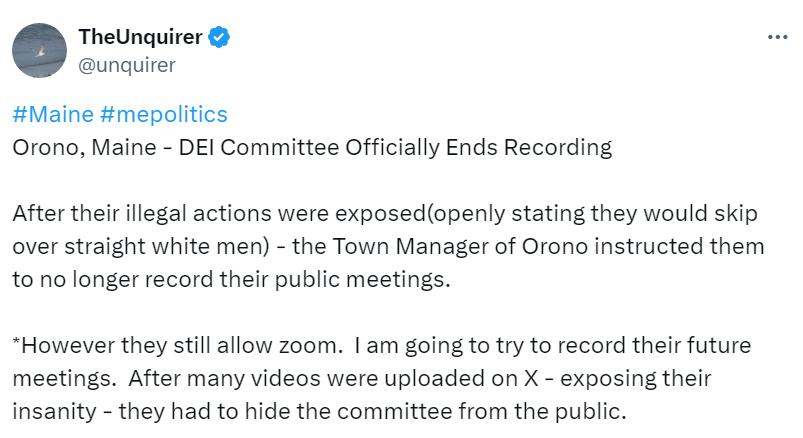
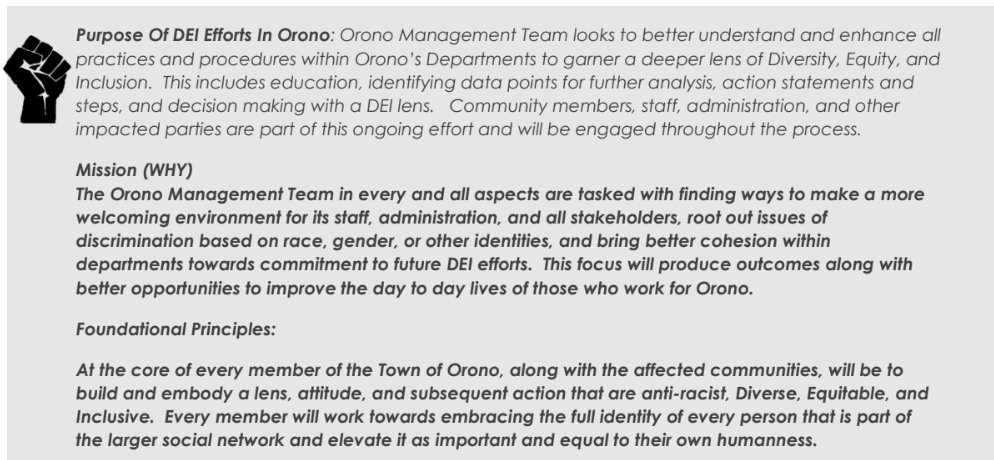
Orono Maine couches full commie mind-control as ‘welcoming environment’ while also refusing to record their deliberations

Just read the prose of Purpose of DEI Efforts in Orono above. If it doesn’t make you puke you are already too far gone. Many years ago, I used to describe communists who wrote and thought like that as ‘intellectually crazy’, since their intellects seemed to lie at the core of their ideological madness. Overall, today’s neurotic left is no different in how it has evolved into a padded cell for multiple personality deformities and mental health issues. Notice the language used above is obscurantly abstract, self-referential and self-assuming, assertive, deeply hostile while presuming moral superiority and thus self-vested with the bogus right to remake everyone else in their own demented image, which changes continuously, which is another reason they do not want to record their meetings beyond their cowardly need to keep secret what they are doing. This is how pathocracy is born, how it sounds, and why it must be opposed. ABN

An African take on ‘white supremacy’

‘White supremacy’ is a thought-stopping term, a form of psycholinguistic mind-control designed to make people recoil and/or believe they have to deny such nonsense. If anything, white people lack pride and racial cohesion, and suffer from too much self-abnegation. I can honestly say I have never met a white supremist in my whole life. In contrast, I have met many Jewish supremists as Jewish supremacy is an integral part of Judaism and seems to carry over to many non-practicing, even atheist, Jews. ABN

Speech comprehension and context

A new study on speech comprehension shows that humans respond to the “contextual semantic content of each word in a relatively time-locked fashion.”

These findings demonstrate that, when successfully comprehending natural speech, the human brain responds to the contextual semantic content of each word in a relatively time-locked fashion. (Source)

This process is roughly illustrated here:

While I do not doubt these findings for simple speech in simple contexts, I do wonder what the results would be for speech in psychologically complex contexts, whether that speech is simple or not.

I wonder this because I am certain that in almost all psychologically complex contexts (those rich with subjectivity, emotion, idiosyncratic memory or association, etc.) the “contextual semantic content of each word” will necessarily be different, often very different for each speaker.

Psychologically rich interpersonal speech is almost always fraught with contextual differences that can be very large. Sometimes participants know these differences exist and sometimes they don’t. It is very common for speakers to make major mistakes in this area, the most important area of speech for human psychological well-being.

It seems possible that EEG with increased sensitivity might one day be able to detect “context diversion” between speakers, but even if complex emotional information is also included, people will still have to talk about what is diverging from what.

My comments are not meant to detract from the very interesting findings posted above. I make them because these findings illustrate how inherently problematic real-time mutual comprehension of the “contextual semantic content” of all spoken words actually is.

FIML practice is the only way I know of today to find profound real-time mutual comprehension of complex interpersonal speech.

Metacognition and real-time communication

Metacognition means “awareness and understanding of one’s own thought processes,” or “cognition about cognition,” or “being able to think about how you think.”

To me, metacognition is a premier human ability. How can it not be a good thing to be aware of how you are aware and how you think and respond to what is around you?

In more detail:

The term “metacognition” is most often associated with John Flavell, (1979). According to Flavell (1979, 1987), metacognition consists of both metacognitive knowledge and metacognitive experiences or regulation. Metacognitive knowledge refers to acquired knowledge about cognitive processes, knowledge that can be used to control cognitive processes. Flavell further divides metacognitive knowledge into three categories: knowledge of person variables, task variables and strategy variables.

(the original source for this quote has disappeared but this article on Wikipedia makes the same points and more)

Most people do metacognition and are aware of doing it. We do it when we plan, make decisions, decide how to get from one place to another, how to relate to one person differently from another, and so on.

Where we don’t do metacognition is in real-time communication in real life, where it matters most. This is not because we are not able to do it. It is because very few of us have the right technique, Flavell’s “acquired knowledge” that allows us to do it.

If we have the right technique, we will be able to gain a great deal of knowledge about real-time cognitive process while also learning how to control them.

FIML practice is a metacognitive practice based on, to quote the above source, “acquired knowledge about cognitive processes… that can be used to control cognitive processes.”

In the case of FIML, the “acquired knowledge” is the FIML technique which allows us to gain conscious “control over cognitive processes” of real-time interpersonal communication.

FIML is different from other analytical communication techniques in that FIML provides a method to gain control over very short or small units of communication in real-time. This is important as it is these very short real-time units that are most often ignored or not dealt with in most analyses of human communication.

If you know how to catch small mistakes, they become sources of insight and humor. If you don’t know how to catch them, they often snowball into destructive misunderstandings.

FIML is fairly easy to do if you understand the importance of correcting the minor misinterpretations that inevitably arise between people when they speak and communicate. By using the FIML metacognitive method, partners gain control over the most elusive kinds of interpersonal error which all too often lead to serious interpersonal discord.

FIML can and does do more than catch small mistakes, but first things first. If you cannot correct small errors in real-time communication, you are not doing anything even resembling thorough metacognitive communication.