The minds of social species are strikingly resonant
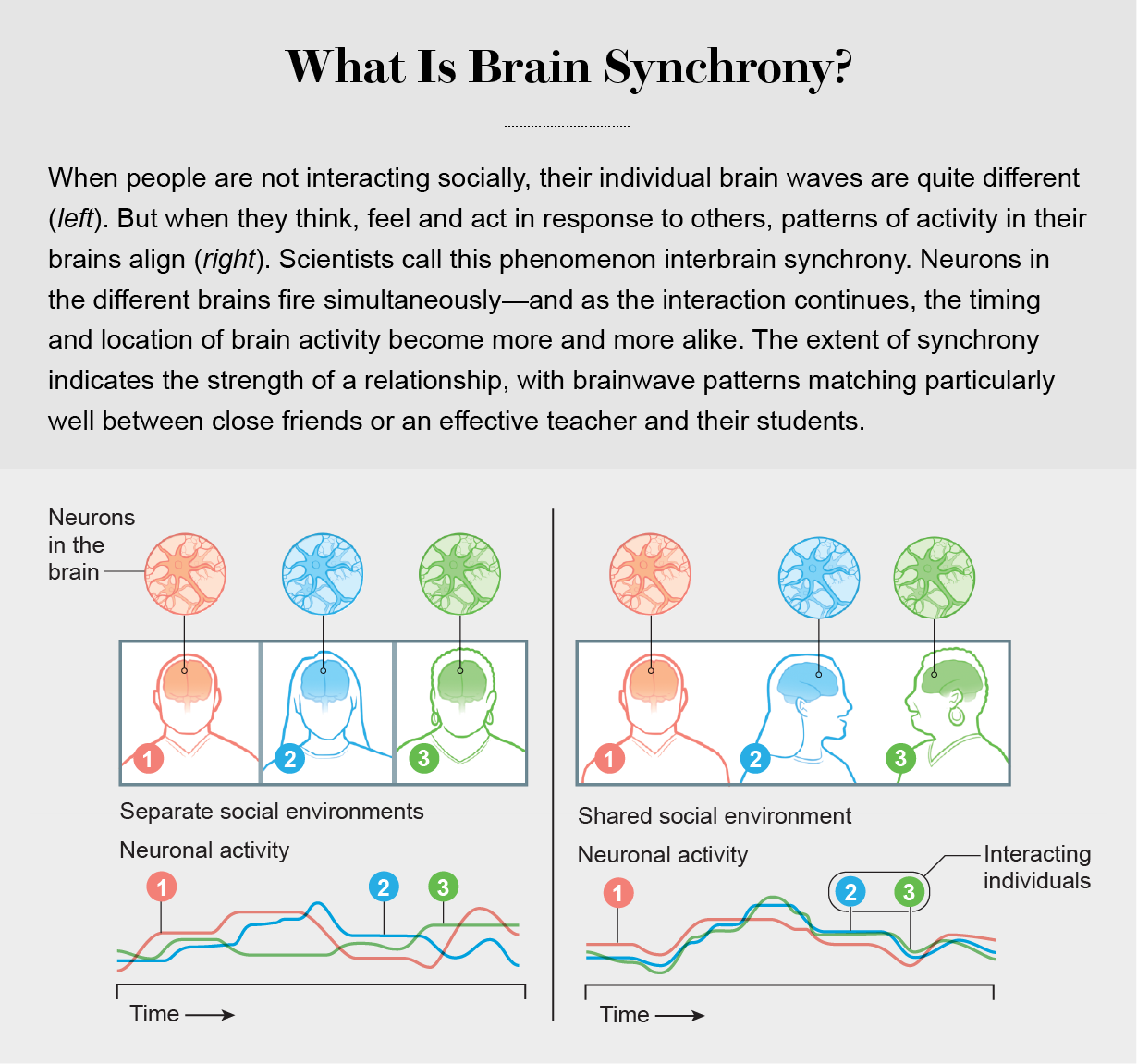
Collective neuroscience, as some practitioners call it, is a rapidly growing field of research. An early, consistent finding is that when people converse or share an experience, their brain waves synchronize. Neurons in corresponding locations of the different brains fire at the same time, creating matching patterns, like dancers moving together. Auditory and visual areas respond to shape, sound and movement in similar ways, whereas higher-order brain areas seem to behave similarly during more challenging tasks such as making meaning out of something seen or heard. The experience of “being on the same wavelength” as another person is real, and it is visible in the activity of the brain.
Researchers are discovering synchrony in humans and other species, and they are mapping its choreography—its rhythm, timing and undulations—to better understand what benefits it may give us. They are finding evidence that interbrain synchrony prepares people for interaction and beginning to understand it as a marker of relationships. Given that synchronized experiences are often enjoyable, researchers suspect this phenomenon is beneficial: it helps us interact and may have facilitated the evolution of sociality. This new kind of brain research might also illuminate why we don’t always “click” with someone or why social isolation is so harmful to physical and mental health.
In the beginning of learning it, FIML may also disrupt or alter brain synchrony.
Altered synchrony is probably the reason FIML is difficult to learn and understand at first.
When FIML practice is accepted as a natural form of speech—and partners have trained themselves in it—a more accurateand powerful synchrony will emerge. ABN
from article linked above
When we interact socially, what we fundamentally do is display and receive semiotics. We share them to greater or lesser extents.
What we do not do nearly enough is investigate this sharing at the level of real-time micro and meso semiotics.
FIML does precisely this and you do not need fMRI to do it.
From a Buddhist point of view, FIML is the dynamic sharing and analysis of subtle and very subtle states of mind.
The synchronies you share with your FIML partner will be deeper and richer than any others because you have worked and trained at fully understanding them. ABN
UPDATE: Almost all humans become slaves to their metacognitive content, whatever that may be. In the video above, all participants are beholding (or pretending to behold) Jesus as the top of their metacognitive content. In Iran, political leaders are beholding something else at the top of their metacognitive content. In Israel, leaders are beholding something else. All three of these religions sprang from an inchoate Abrahamic tradition. Among these three, there are numerous further divisions and subdivisions. I believe there is not a single Catholic in the room above. Prayer is good and I am glad they are praying. I am not trying to dump on anyone, but do want to mention that Buddhism is different from all other religions in that it enjoins us (more or less) to not behold, or hold, anything at the top of our metacognitive content. This is the area the Buddha refused to describe, define or answer questions about. Why is that? It is because reifying top metacognitive content, holding it as absolute truth, is to retreat from its true reality; believing you absolutely know what God wants, however you put that, is a hindrance to fully experiencing Ultimate Reality, which you can call God if you want. The Buddha did not even use the term Ultimate Reality. He left the top metacognitive category blank, to be filled only by your own individual experience. For the fun of it, no matter how you see yourself, try throwing all of it out, leaving nothing at the top of your metacognition — no content, no identity, no self, no pride, no gods, no Buddha. Then go outside and walk around. Notice how easy it is to function perfectly well after replacing your habitual metacognitive prison with pure experience. ABN
Personally, I see all of the Abrahamic religious variations as being unwise and potentially dangerous.
All religions and extremist politics, such as communism and woke, occupy the top cognitive levels of the mind; and for that reason lend themselves to fanaticism and consensus bias.
Christian-Zionists and many evangelical sects have been infiltrated by Jewish Supremists, who even dare to change the Bible and its Christian interpretations.
Buddhism has its problems, but three features of Buddhism are very wise and largely protect the tradition: 1) Buddhism does not take any written words to be God’s words, and thus subject to fanatical misinterpretations. 2) The Buddha always said he was just a man and not a god. 3) It is considered very bad conduct for Buddhists to claim to be enlightened when they are not.
As for Buddhism being ‘Godless’, that’s not true. Buddhism holds the position of ‘having no belief’ about the nature of Ultimate Reality because to do so is to retreat from it. Humans are not smart enough to say what it is but can experience it.
Buddhism is a rich and ancient philosophy. It is the foundation of Greek skepticism, but not limited to skepticism’s intellectual paradigm. Pyrrho took what he could understand from Buddhist monks in Bactria about 100 years after the Buddha’s passing.
Buddhism: No scriptures claiming to be the Word of God. No proselytizing, only welcoming those who come on their own. Strong focus on individual responsibility, which prevents the weakness Buddhists perceive in Christians or the craziness we see in religious fanatics of all stripes.
I’m just one person. What I have written is an extemporaneous response to the videos above and how they capture a slice of the terrifying nonsense in the world today.
I know a good deal about Jewish Supremacy, so I write about it often. Gaza and the public assassination of Charlie Kirk, and now the Epstein files and war with Iran, have shown millions how our world really works, how evil has burrowed so deeply into all of our institutions. ABN
While reading David Deutsch’s The Beginning of Infinity, I came across the following sentence:
What is needed is a system that takes for granted that errors will occur, but corrects them once they do—a case of ‘problems are inevitable, but they are soluble’ at the lowest level of information-processing emergence. (p. 141)
This statement comes from the chapter “The Jump to Universality,” in which Deutsch argues that “error correction is essential in processes of potentially unlimited length.”
Error correction is fundamental to FIML practice. In fact, the nuts-and-bolts of FIML practice could be described as being little more than a method for correcting errors “at the lowest level of information-processing” during interpersonal communication. This level is “the lowest” because FIML deals primarily with very short segments of speech/communication. In many posts, we have called these segments “psychological morphemes” or the “smallest speech/communication error” we can reliably identify and agree upon with our partner.
If you try to tackle bigger errors—though this can be done sometimes—you frequently run into the problem of your subject becoming too vague or ill-defined to be rationally discussable.
I haven’t read enough of Deutsch’s book to be sure of what he means by “universality,” but I do think (at this point) that FIML is universal in the sense that it will clear up interpersonal communication errors between any two qualified partners. “Qualified” here means that partners care about each other, want to optimize their relationship, and have enough time to do FIML practice.
We all demand that our computers be error-free, that buildings and bridges be constructed without error, that science work with error-free data as much as possible. But when it comes to communication with the person we care about most, do we even talk about wanting a method of error correction, let alone actually using one?
You can’t correct big errors if you have no method for correcting errors that occur “at the lowest level of information-processing,” to use Deutsch’s phrase. Once you can correct errors at this level, you will find that you and your partner are much better able to tackle bigger questions/errors/complexes. This happens because having the ability to reliably do small error-correcting gives you the capacity to discuss bigger issues without getting lost in a thicket of small mistakes.
Your ability to talk to each other becomes “universal” in the sense that you can tackle any subject together and are not tethered to static ideas and assumptions about what either of you really “means.”
FIML does not tell you how to think or what to believe. In this sense, it is a universal system that allows you and your partner to explore existence in any way you choose.
To use Deutsch’s words again, “error correction is essential in processes of potentially unlimited length.” Your relationship with your partner can and should be a “processes of potentially unlimited” growth, and error correction is essential to that process.
Donald Trump‘s commanders have been accused of telling troops that the war with Iran is part of God’s plan for Armageddon.
The Military Religious Freedom Foundation (MRFF), a non-profit civil rights watchdog, said it has received 110 complaints from troops since the war broke out on Saturday.
The complaints span more than 40 different units across 30 military sites, first reported on veteran journalist Jonathan Larsen’s Substack.
A non-commissioned officer (NCO) wrote to the MRFF Monday that his combat-unit commander had claimed Trump was ‘anointed by Jesus to light the signal fire in Iran to cause Armageddon and mark his return to Earth.’
‘He urged us to tell our troops that this was “all part of God’s divine plan” and he specifically referenced numerous citations out of the Book of Revelation referring to Armageddon and the imminent return of Jesus Christ,’ the NCO said.
The Great Day of His Wrath (1853), oil painting on canvas by the English painter John Martin
Trump said that it was his assessment that ‘the way the negotiation was going’ with Iran, he believed they would attack first, ‘and I didn’t want that to happen.’
‘You see we were having negotiations with these lunatics and it was my opinion that they were going to attack first,’ the president explained. ‘They were going to attack first, I felt strongly about that.’
‘So if anything I might have forced Israel’s hand.’
This is a very good overview of how AI works today, and how it doesn’t work. Sort of relatedly, we humans are ourselves trapped in internal idiosyncratic language systems. Even when you reach out of yours, you will be reaching into someone else’s. ABN
And distorted motives warp human interactions, which in turn degrade individual psychology.
There is no way around it—the ways almost all people communicate are much cruder than their brains are capable of.
And that is the cause of most of what we now call (non-biological) “mental health” problems.
Here is an example: I want to say something very complex to my primary care doctor. I can give her the gist in a minute or two but I do not want to have that go on my medical record.
So I ask her if I can start a discussion that she will promise to keep off my record.
She says, “I’ll think about it.”
A week later I get a letter from her nurse saying she is not willing to do what I asked.
No reason why was given. Do rules prevent her from doing that? I have heard of doctors allowing patients to keep some concerns off the record, but who knows what the reality is? Do you?
If I insist, will that go on my record? Did what I asked in the first place go on my record? My doctor is trapped within or is voluntarily following some guideline that is most decidedly not in my best interests.
This same sort of thing can happen interpersonally. If I raise a topic that is psychologically important to me with even a close friend, I have to wonder will they understand? Will they allow me to expand the subject over a few weeks or months or longer? Will my initial statements change our friendship?
The basic problem is how do you discuss complex psychological subjects with others?
One of my friends works in alternative health care. She knows what I want to bring up with my doctor and admits that even in her professional setting where patients have an hour to open up, there is not enough time.
Back to my primary care doctor. I saw her again a year later and she asked if I remembered her. I said, “Of course I remember you.” She said no more and neither of us raised the off-the-record topic. An intern was with her.
I wonder what she thinks of me. Did she interpret my slightly nervous behavior when I first asked as a “sign” of something? Does she think I am volatile or bipolar or just nuts? (I am not.)
I am 100% sure that she cannot possibly know what I wanted to bring up with her. In this case, I have all of the information and I want to give it to her but she cannot or will not allow that unless my initial fumblings toward a complex subject are made public.
Even a close friend could find themselves in a similar position. And I wonder if I have done that myself to someone. Most people most of the time are not able to scale those walls that divide us.
On either side of the wall is a complex person capable of complex understanding, but one or both persons cannot scale the wall. My doctor is smart enough to have become an MD and yet I cannot tell her about a complex medical condition that is of great importance to me.
I know that I do not want to open the subject and risk a shallow public label (a common hindrance to many potential communications). I honestly do not know what my doctor is thinking. Maybe I will try again the next time I see her.
One year later: I didn’t try again. After much thought, I decided to switch doctors. And I will not bring this subject up with my new doctor. It’s a sad reality that trying at all ruined (in my mind) my relationship with my first doctor and convinced me that the topic is not one I can discuss with any medical professional in a professional setting and maybe in any setting.
__________
UPDATE: I first posted the above a few years ago. The world has changed. What I wanted to discuss with my doctor is the attacks I have suffered at the hands of Jewish Supremists. ABN.
Over 40,000 years ago, our early ancestors were already carving signs into tools and sculptures. According to a new analysis by linguist Christian Bentz at Saarland University and archaeologist Ewa Dutkiewicz at the Museum für Vor- und Frühgeschichte (Museum of Prehistory and Early History) in Berlin, these sign sequences have the same level of complexity and information density as the earliest proto-cuneiform script that emerged tens of thousands of years later, around 3,000 B.C.E.
Using a computational approach, the team examined over 3,000 signs found on 260 objects to reveal insights into the origins of writing. Their findings, which have been published in the journal PNAS, were clear—and surprised even the researchers.
Paleolithic objects dating back between 34,000 and 45,000 years bear mysterious sign sequences—often repeated lines, notches, dots and crosses. Many of these artifacts were discovered in caves in the Swabian Jura, such as a small mammoth found in the Vogelherd Cave in Lone Valley in southwestern Germany.
A Stone Age human carved the mammoth figurine out of a mammoth tusk and carefully engraved it with rows of crosses and dots. Other artifacts found in the Swabian Jura are also etched with signs.
Proto-cuneiform tablet of the Uruk IV period (VAT 14774). This so-called numero-ideographic tablet features number signs on the left-hand side and more diverse ideographs on the right-hand side. This tablet is additionally partitioned by a horizontal line. Credit: Staatliche Museen zu Berlin, Vorderasiatisches Museum / Olaf M. Tesmer, CC-BY-SA 4.0
By this I mean our deepest levels of meaning, emotion, and intention are either implied or more often concealed from the person(s) we are speaking with.
In professional and formal settings (school, clubs, church, etc.) this is pretty much how it has to be since there is not enough time to delve more deeply and no good reason to do so in most cases.
Problems arise, however, when the arm’s length habits of formal settings are imported into intimate private settings such as close friendships, marriages, families.
Arm’s length communication is effective in formal settings, but its use of reduced messaging techniques in private settings invariably enters gray areas followed by conscious lying.
I think people do this in their private communications mainly because they don’t know how to communicate in any other way. Humans are basically somewhat smart apes who have a fairly complex (for us) communication/language system grafted onto the instincts of a wild animal.
When the inevitable ambiguities and lies of arm’s length communications build up within the intimate communications of couples or close friends, the result will be explosive emotions or alienation and apathy.
The simple arm’s length system is a primitive, basic system for communicating obvious things. To be honest, if you enjoy your communications at work or the clubhouse more than at home, you are basically showing how primitive you are.
In formal settings communication is entirely based on predetermined mutual agreement concerning values, beliefs, etc.
Private settings require much more nuance and thus a much more nuanced communication technique.
FIML is designed for private, intimate communication. It allows partners to open their minds to much richer and much healthier interactions.
You cannot achieve optimum psychological health if you engage only in arm’s length communication. You can only do so by using a technique like FIML that allows you and your partner to consciously share the profound world of interpersonal subjectivity.
FIML takes some time and practice but it is no harder than learning how to ski or cook or play a musical instrument moderately well.
A very small decision I make on many mornings is which coffee cup is going to be mine and which goes to my partner.
The two cups we normally use are the same and I cannot tell one from the other. If I thought one was better than the other, I would give it to her.
What happens is at some point while I take the cups from the cupboard and set them on the counter, I incline toward deciding that one of them will be for me and one for her. This “decision” is so small I describe it as “incline toward deciding.”
As I continue preparing morning coffee, my very small decision about which cup is mine spends more time in my mind. By the time I pour the coffee, I am generally always mildly set on which one is going to be mine for the morning and which hers.
My initial “inclining toward deciding” has changed into my being “mildly set on” which cup is mine. I might even feel a bit possessive toward “my” cup as I pour the coffee.
The main point is that once we make even a very weak decision or incline toward a weak decision it requires energy to change that.
Of course, I do not really care which cup I get and yet I have inclined toward one or decided on one of them. At some point in this process you have to do that.
If I try to change my decision once the coffee is poured and give “my” cup to my partner, I am aware of expending a bit of energy.
The energy required to change which cup is mine is greater than the energy required to decide which cup is mine. I only fell into my initial decision but must climb out of it if I want to change it.
I bet you do this or something like it, too. Just watch yourself and observe it happening. Once you see it, try changing to the other cup or whatever it is you have chosen.
It’s not hard to change your decision but it decidedly requires a little bit of energy. That may be some of the smallest mental energy you will ever exert, but you will have to exert it.
I find I feel a bit awkward when I change my initial decision. It seems my mind is already set at some lower level so the meta-level that changes that does not have the right networking or connections for the transition to be completely smooth. This is the opposite of the initial decision which seems to have required little or no energy. And has managed to grow bigger all on its own, outside of my awareness.
Notice also, if you are like me, you will happily give your partner the better cup if one of them is better. That decision, too, will require energy to change, maybe even more energy than if the cups are the same. This probably happens because if you change your decision to the better cup (for yourself), you will also feel a bit selfish in addition to the above considerations. This will happen even if your partner wants you to change cups.
So either way—changing between two cups that are the same or changing from the worse cup to the better one—you will need to expend a bit of energy, even though your initial decision probably required none at all.
This interpretation is the result of Jewish Supremacy’s infiltration of USA and the West. Its ‘intellectual’ basis is a made-up oldish text, purported to be ancient and originating from ‘God’. Its ‘spiritual’ basis is money and lust for power. Jewish Supremacy was born out of a centuries-long Jewish inferiority complex, which has lasted well into the modern era. Freud suffered from it and based his bogus theories on it. Claiming you are superior to the people who released you from your medieval conditions and taught you everything good you now know, is a diabolical psychological reversal which only a people steeped in self-delusion could manage or even conceive of. ABN
If interpersonal communication were anything else, we would demand much better accuracy.
Almost everything else used or made by humans is better: clocks, speedometers, carpentry, all engineering, all computers, Amazon customer service, shoe sizes, medical devices. You name it, almost everything we use or make conforms to standards far more exacting than psychologically rich interpersonal communication.
This is because until recently, we have not had a good way to measure or verify psychological richness in real-time real-world situations.
Think about that. Isn’t it amazing?
Our bank measures our balance to the penny. If we input a phone number correctly, we get the right phone.
But if you say something rich with psychological import, how can you be sure your partner understood you? Or if you believe they have just said something like that to you, how do you know what it was? How do you make sure?
Normally, we answer the above questions by guessing, figuring probabilities based on past experiences. That’s like using an odometer and a watch in place of a speedometer; we can get a general view based on averages from where we think we have been, but often entirely miss the scenery where we are.
FIMLprovides a method to calibrate, verify, and correct psychologically rich interpersonal communication in real-time real-world situations. Don’t do important relationships without it.



 American Buddhist Net