Clélia Verdier has vivid memories of giving birth to triplets. She remembers the agonizing pain of labor, the joy of holding her daughters for the first time and the devastation when one died soon after.
The only catch? She was never pregnant, never went into labor and never became a mom. In reality, she was in a medically-induced coma in a hospital the entire time.
Verdier isn’t the first to dream up a whole life for themselves while in a coma, only to wake up and discover that none of it was real.
But for Verdier, 19, from Lyon, France, it was especially complicated to come to grips with the realization that the babies she felt like she had given birth to never even existed.
While she was only in the coma for three weeks, she said the realistic dream spanned across seven years
She explained to the Daily Mail that she ‘made a serious suicide attempt by taking a large amount of medication’ in June 2025, and was placed into a medically-induced coma for three weeks.
She remembers having ‘extremely intense’ dreams and nightmares during the coma, but because she was ‘not aware that she was in a coma’ at the time, they ‘became her reality.’
One dream, in particular, has stuck with her: the one in which she became a mother.
She explained that it seemed so real and she could feel both physical and emotional pain throughout the hallucination.
Signals are fundamental to everything that exists. There can be no physical realm without signals and certainly no life.
What is a signal? Anything that transmits any effect to anything else is a signal. In this sense, all signals “mean” something, including the smallest signal anyone can think of.
The advantage of basing a model of psychology (not just human psychology) on signals is our fundamental unit of analysis is universal, including everything we can know and think about.
Our bodies do an enormous amount of signalling—both internal and external—without our being conscious of most of it. Many living and non-living systems maintain homeostasis through signalling that is non-conscious (or so we now believe). The laws of physics describe signals that explain, for example, how our solar system came to be the way it is and why it remains in homeostasis.
Signals also explain how non-conscious life-forms—viruses, bacteria, plants, your blood, etc.—have arisen and how they maintain their dynamic homeostasis vis–à–vis the ever changing environment that surrounds them and signals to them constantly.
Consciousness itself almost certainly emerges out of a network of signals. Conscious beings read signals in the environment while frequently signaling each other. Cats and birds use conscious signals extensively. Even life-forms that we believe to be non-conscious, such as worms and plants, send and receive signals constantly to each other, while also signalling internally and with their environment.
Draw the line between conscious and non-conscious signalling wherever you like. Then let’s jump to human psychology.
Humans are different from cats and other animals in that we specialize in signals. Birds are specialists of the air, fish of the water, and humans of signals.
Humans signal each other constantly with signs that can employ any of our senses—sight, hearing, touch, taste, and so on. Our preeminent signalling system is, of course, language. With language humans are capable of remembering complex groupings of signals. We are also capable of thinking about these signals and transmitting our understanding of them to others.
Right now, as you read, you are receiving a complex signal from me.
Consciousness is arguably our most precious quality. Human consciousness is filled with and based upon signals. For our psychological well-being—the well-being of our consciousness—the signals we send and receive to and from other human beings are of fundamental importance.
To say it another way, humans are profoundly interactive signalling systems and the quality of the signals sent between us and other human systems are of primary importance to our sense of well-being, our psychological health, our conscious sense of who we are and how we are doing.
When our consciousness is filled with or marked by clear, truthful, and ethically sound signals, we feel good. In those moments we do not suffer confusion, neurosis, or pain. When consciousness is filled with or marked by confusion, lies, and ethically unsound signals, we feel bad. In those moments, we suffer, often greatly. (Of course, there are exceptions to these statements. Injury and truth, to name two, can cause us pain and confusion. But the basic distinction made here works well enough.)
It makes sense, thus, to focus on human signalling if we want to figure out what makes us tick.
The science of human signalling is often called semiotics, which can be roughly defined as the study of signs and their meanings. Semiotics can and does also include non-human signs and signals, but for now let’s limit ourselves to human signalling. There are other sciences that describe human signalling, but semiotics, which emphasizes signs and their interpretation, will serve us well enough that we can temporarily ignore other ways of understanding human meaning—game theory, traditional psychology, anthropology, etc. Semiotics works well because semiotic analyses can be reduced to single signals; they have a distinct and clearly defined basic unit—the signal or the sign.
Why do we focus so much of our inquiry into human psychology on emotion? Emotion is inchoate, often even unfelt, until it is defined or given meaning as a signal or sign.
Emotions are real, but they are massively subject to cultural interpretation, to definitions that have arisen outside of the individual experiencing them. Culture is little more than a system of signs and symbols shared among a group of people. Human cultures have great variety because the signs and signals and the meanings of those signs and signals develop differently in different places and under different conditions. This fact alone should suffice to show that the meanings of human signs often are arbitrary.
As long as a bunch of people believe that the sun is a chariot driven by a god, that meaning of the sun will work as a cultural standard, or cultural element with varying interpretations. If most people in a community think the sun is the center of the universe, that will also work until a better idea comes along. If enough people believe that human hearts have to be sacrificed to keep the sun moving across the sky, that will also work well-enough to hold that society together. Wherever you look, you will find great cultural variety, much of it based on arbitrary decisions that have long been forgotten by the people adhering to that system of meaning,.
In this context, isn’t it clear that focusing our inquiries into human psychology on emotion is going to provide us with many tautological results?
Similar statements can be made about many other elements of our traditional understanding of human psychology, including such elements as personality, neurosis, mental health, what being normal means, what our goals and desires are, and so on. The emotions and/or “psychological states” that these areas of inquiry deal with are vague and almost entirely changeable over time and place.
What is not vague are signals. When we ask what signals are and what their quality is we can get much better answers based on much better data compared to the answers we get when we ask only how someone feels and where those feelings came from.
How do we do that? More precisely, in the context of what we call human psychology, how do we analyze our signalling?
Is it valuable to compare my assessment of my internal signalling with “data” taken from “surveys” of other people who speak my language and live in a society which is sort of maybe the “same” or similar to my own? Yes, you can get something from that data but you will also make many mistakes because it is very crude, or general, data and will never fully apply to any individual or even come close to actually describing anything of significant value to most people. Such data will contain so many mistakes, it should be handled with great caution, if it is used at all. (You most certainly can fool people with that data. But that happens because many people will believe the data is scientific and provides an accurate metric that describes who they are. And that is an example of how a cultural semiotic can and does impose “meaning” on individuals; not hugely different from believing you have to sacrifice human hearts to make the sun go round.)
You can’t really get at the important signalling people do by using general surveys because your data is is coming from a tautological loop based on surveys that are generally put together on the basis of other surveys involving stuff like common words or feelings.
For psychology, for human mental health, the most important signalling people do is interpersonal signalling with significant other people.
When we try to figure ourselves out by remembering (a dubious exercise in so many cases) what our parents did or said or made us feel, we can get some useful information, but it is not that reliable and suffers from the same sort of misinterpretation as personality studies or studies of human emotion do. You can read whatever you want into it and/or be subject to the vagaries of chance interpretations.
The only significant interpersonal signalling data we can really know with significant certainty are data noticed, remembered, and agreed upon by two (or more in some cases) people engaged in significant interpersonal communication (signalling).
A mere observer (much less a surveyor) of this communication will never be able to know or analyze the data with anything approaching the accuracy or validity of the two people involved if those two people have a reliable method for gathering that data. Even if an observer has a video record of the exchange, they will never be able to know or analyze it with the accuracy of the individuals directly involved if those two people have a reliable method for gathering that data.
The day may come when brain scans can provide us with real-time data of that sort, but for now all we have is FIML practice, or something very much like it.
A specialized network responsible for washing away cellular waste in the brain might play a role in the development of schizophrenia and other psychotic disorders. In a recent brain imaging study, researchers found that young people at a high genetic risk for psychosis showed early signs of a malfunctioning brain clearance system, which was linked to a toxic buildup of stimulating chemicals. The research was published in the journal Biological Psychiatry Global Open Science.
Every day, the brain generates metabolic waste as it processes information. To keep the biological environment stable, a network called the glymphatic system flushes out this debris. This system pushes cerebrospinal fluid into the brain tissue, where it mixes with the fluid surrounding the cells. The fluid then washes away extra neurotransmitters, inflammatory proteins, and misfolded proteins.
This fluid movement is driven by star-shaped brain cells called astrocytes. Astrocytes have specialized water channels, called aquaporin-4 channels, that act like tiny valves. When these channels fail to work properly, or when the blood vessels leak, the entire clearance process slows down. Waste products then accumulate in the brain tissue, potentially causing damage.
In my opinion, “personality disorders” are more easily understood as signaling problems.
All types of personality disorder involve dysfunctional signaling with other people. Signals are both sent and received in ways that result in suffering.
As currently defined, personality disorders “develop early, are inflexible, and are associated with significant distress or disability.”
Thus, if there are no significant brain injuries or other biological problems, all personality disorders (PD) develop through experience.
This means that during childhood the PD sufferer has received many bad signals (and/or interpreted many signals badly) resulting in their failing to form a coherent well-functioning internal signaling system.
The way to fix this is work with the signals. And the best way to do this is FIML practice. A professional psychotherapist cannot possibly provide this level of treatment.
This brings me to a second point: is there anyone who would not benefit from improving their signaling?
Why do we view psychotherapy as treatment designed merely to make us look and feel “average”? Why don’t we instead work to optimize our psychologies every day?
The Buddha said we are all crazy. We are. We all need to work on our signaling—our personality disorders—all the time.
The distinctions between one PD and another and those who have PDs and those who don’t are vague. This is because all PD problems (absent significant biological deficits, which may include intelligence) are idiosyncratic varieties of signaling malfunctions.
If signaling is the core problem, it should follow that all acquired PD will be classifiable as some kind of signaling malfunction. And that is precisely what we see.
Narcissism is a too simple signaling system. Borderline is an unstable signaling system. Compulsive, passive aggressive, histrionic, avoidant, and so on all are variations of a poorly formed internal signaling system.
The way to study this is through interpersonal semiotics; that is interpersonal semiotic analysis of real-time, real-world communicative signs and symbols.
All people need to do this to optimize their psychologies (their internal signaling systems). Why would anyone not want to do this? Maybe not wanting to do this is the surest sign of PD there is.
The hardest part about doing FIML is finding a willing and able partner. To me, this shows how pervasive bad signaling is. Most people will do almost anything but examine their own signaling with the help of another person.
Normal socially-defined communication—business, school, professional, etc.—operates within known limits and terminologies. Skill is largely defined as understanding how to use the system without exceeding its limits, how to play the game.
Many other forms of communication must be imagined. That is, I have to imagine what you mean and you have to imagine what I mean.
In many cases of this type I will imagine that you are normal to the extent that I am able to imagine what normal is. And I will imagine that you imagine me to be normal. As I imagine you I will probably assume that your sense of what is normal is more or less the same as mine. This is probably what the central part of the bell curve of imagined communication looks like. People in this group are capable of imagining and cleaving to normal communication standards. If you reciprocate, we will probably get along fine.
If my imagination is better than normal, I will be able to imagine more than the normal person or given to imagining more. If this is the case, I will tend to want to find a way to communicate more than the norm to you. If you reciprocate, we might do well communicating. If you don’t, I might appear eccentric to you or distracted.
If my imagination is worse than normal, I will have trouble imagining or understanding normal communication. I won’t have a good sense of the cartoons we are required to make of each other and will probably appear awkward or scatterbrained to most people. If you reciprocate, we might do well communicating and find comfort in each other.
Normal communication, even when imagined, is based on something like cartoons. I see myself as a cartoon acting in relation to the cartoon I imagine for you. If my cartoon fits you well enough that you like it and if your cartoon of me fits well enough that I like it, we have a good chance of becoming friends.
A great deal of normal imagined communication is cartoon-like, and being normal, will take the bulk of its cartoons from mass media—movies, TV, radio, and, to a lesser extent today, books and other art forms.
People still read and learn from books and art, but normal communication has come to rely heavily on the powerful cartoons of mass media.
The big problem with our systems of imagined communication is they are highly idiosyncratic, messy, and ambiguous. We have to spend a lot of time fixing problems and explaining what we really mean.
It’s good to have idiosyncratic communication, but we have to find ways to understand each other on those terms.
FIML is both a practice and a theory. The practice is roughly described here and in other posts on this website.
The theory states (also roughly) that successful practice of FIML will:
Greatly improve communication between participating partners
Greatly reduce or eliminate mistaken interpretations (neuroses) between partners
Give partners insights into the dynamic structures of their personalities
Lead to much greater appreciation of the dynamic linguistic/communicative nature of the personality
These results are achieved because:
FIML practice is based on real data agreed upon by both partners
FIML practice stops neurotic responses before they get out of control
FIML practice allows both partners to understand each other’s neuroses while eliminating them
FIML practice establishes a shared objective standard between partners
This standard can be checked, confirmed, changed, or upgraded as often as is needed
FIML practice will also:
Show partners how their personalities function while alone and together
Lead to a much greater appreciation of how mistaken interpretations that occur at discreet times can and often do lead to (or reveal) ongoing mistaken interpretations (neuroses)
FIML practice eliminates neuroses because it shows individuals, through real data, that their (neurotic) interpretation(s) of their partner are mistaken. This reduction of neurosis between partners probably will be generalizable to other situations and people, thus resulting a less neurotic individual overall.
Neurosis is defined here to mean a mistaken interpretation or an ongoing mistaken interpretation.
The theory of FIML can be falsified or shown to be wrong by having a reasonably large number of suitable people learn FIML practice, do it and fail to gain the aforementioned results.
FIML practice will not be suitable for everyone. It requires that partners have a strong interest in each other; a strong sense of caring for each other; an interest in language and communication; the ability to see themselves objectively; the ability to view their use of language objectively; fairly good self-control; enough time to do the practice regularly.
[In mathematics, a ‘computation’ is the process of performing mathematical operations on one or more inputs to produce a desired output. A problem in analyzing human psychology arises when we understand that human psychology cannot be reduced computationally. The ‘computational irreducibility’ of human psychology does not mean, however, that there is no way to probe it and understand it. In the following essay, I show how FIML practice can greatly enhance our understanding of our own psychologies and, by extension, the psychologies of others.
Rather than rely on tautological data extractions or vague theories about human psychology, FIML focuses on small interpersonal exchanges that can be objectively agreed upon by at least two people. These small exchanges correspond to what Wolfram calls ‘specific little pieces of computational reducibility’. When we repeatedly view our psychologies from the point of view of specific little pieces of computational reducibility, we begin amassing a profoundly telling collection of very good data that shows how we really think, speak, and act.]
FIML is a method of inquiry that deals with the computational irreducibility of humans. It does this by isolating small incidents and asking questions about them. These small incidents are the “little pieces of computational reducibility” that Stephan Wolfram remarks on at 42:22 in this video. Here is the full quote:
One of the necessary consequences of computational irreducibility is within a computationally irreducible system there will always be an infinite number of specific little pieces of computational reducibility that you can find.
This is exactly what FIML practice does again and again—it finds “specific little pieces of computational reducibility” and learns all it can about them.
In FIML practice, two humans in real-time, real-world situations agree to isolate and focus on one “specific little piece of computational reducibility” and from that gain a deeper understanding of the whole “computationally irreducible system”, which is them.
When two humans do this hundreds of times, their grasp and appreciation of the “computationally irreducible system” which is them, both together and individually, increases dramatically. This growing grasp and understanding of their shared computationally irreducible system upgrades or replaces most previously learned cognitive categories about their lives, or psychologies, or how they think about themselves or other humans.
By focusing on many small bits of communicative information, FIML partners improve all aspects of their human minds.
I do not believe any computer will ever be able to do FIML. Robots and brain scans may help with it but they will not be able to replace it. In the not too distant future, FIML may be the only profound thing humans will both need to and be able to do on their own without the use of AI. To understand ourselves deeply and enjoy being human, we will have to do FIML. In this sense, FIML may be our most important human answer to the AI civilization growing around us. ABN
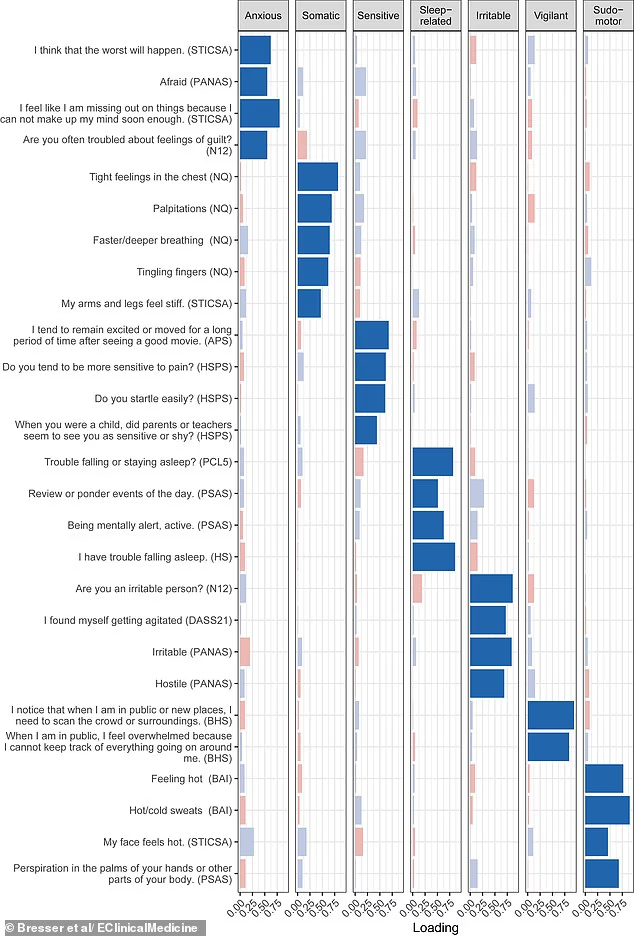
Most of us go through periods of stress in our everyday lives – but there are actually seven types of ‘hyperarousal’, according to a new study.
Researchers say the feeling of tension can be teased out into distinct subgroups.
This includes anxious, somatic, sensitive, sleep–related, irritable, vigilant and sudomotor – and each are characterised slightly differently.
Perhaps the most well–known, the ‘anxious’ feeling of tension, is defined by being worried or concerned about something bad happening in the future. It can also indicate feelings of guilt or fears about missing out on things.
Feeling ‘sensitive hyperarousal’ indicates emotional vulnerability and being easily startled, the scientists explained.
Another common source of tension is ‘sleep–related’ – defined by trouble falling or staying asleep and leading to trouble being mentally alert.
‘No previous study has addressed the unresolved question of whether hyperarousal may be one common…construct or rather has multiple dimensions,’ the team, from the Netherlands Institute for Neuroscience, wrote in the journal EClinicalMedicine.
‘This study discovered seven different dimensions of hyperarousal and provides a concise instrument to assess them.’
Psychology gets lots of stuff wrong, but generally does a good job with descriptive overviews like this. This study is based on a questionnaire of 467 adults, all of whom had some sort of psychiatric diagnosis. Seems worth thinking about. Anything well described constitutes or can lead to useful explanations, which may yield methods of control or intervention. ABN
Experienced FIML practitioners enjoy levels of metacognitive control ordinary humans cannot even dream of.
This control comes after years of diligent FIML practice. It happens because the skills acquired through FIML combined with its metacognitive results allow practitioners to practice FIML on themselves.
FIML practice gradually removes virtually all communication error between partners. This error-removal process is ongoing because all living systems must continually remove waste and error to function optimally.
Successful FIML results in two major achievements:
very clear, optimally functioning cognition and metacognition
the skill-set needed to attain the above
When these achievements have been realized, FIML practitioners will find they are able to rather easily apply them to their own introspection, their own subjective states while alone.
Ordinary people cannot do this because they have not experienced the metacognitive states brought about by FIML nor have they acquired the skills to quickly remove error from their thoughts.
The FIML skills of quickly removing error from our thoughts cannot be acquired overnight. It must be built upon diligent practice and experience. You cannot imagine it into being.
Once these skills and experiences have become established in the mind as reliable functions, they can be applied to mental states while alone.
In this post I am going to argue that strong metacognitive awareness of one’s own intentionality in real-time translates into better and more accurate memory retrieval.
More specifically, I mean that the strong metacognitive awareness of one’s own intentionality that results from FIML practice is a skill that transfers to memory retrieval.
FIML partners spend a good deal of time asking and answering questions about each others’ intentionality in real-time.
The metacognitive skills that develop out of that practice streamline communication between partners, while also streamlining communication within the brains of each partner.
Each partner benefits psychologically as a standalone individual from the practice of FIML because FIML skills can also be applied to individual, subjective brain functions.
One of the psychological benefits of FIML practice is greatly enhanced awareness of the difference between truth and lies during interpersonal communication with the FIML partner.
This awareness beneficially affects memory retrieval.
It does so by increasing the individual’s capacity to better know when memories are reliable and when they are dubious if not outright false.
Advanced FIML practitioners will have less need for egotistical interpretations of their pasts (or anything else), and thus have minds and memories that are more streamlined and efficient.
This happens because FIML practice gradually shifts brain organization away from the heuristics of a static ego to operations that can be described as “metacognitive.”
Metacognitive operations of this caliber are a great improvement on static beliefs in a self or an egocentric narrative.
Additionally, since psychology is based on memory, fine metacognitive awareness of memory retrieval will also improve psychological functioning in other areas.
For example, emotions based on memory (all of them really) will be less likely to negatively influence intentionality if fine metacognitive awareness of memory retrieval is functioning in the individual.
The same can be said of psychological schemas, framing, values, beliefs, instinct and its interpretations, and so on. All aspects of human psychology can enjoy improvements (more truthful, less stupid) through the metacognitive skills that result from FIML practice.
The West has failed to analyze and understand metalevels of interpersonal communication. Our philosophies employ metalevel concepts and vocabularies but have never delved into or properly understood metalevels of interpersonal communication.
This failure to properly understand metalevels of interpersonal communication has very large downstream effects. It has retarded our religious understanding and psychologies, our group formation, our understanding of other groups, and our ability to form profound interpersonal relationships.
The basis of this claim is that when interpersonal language is deeply restricted—as ours is by this massive hole in Western philosophy—all other forms of language use are negatively affected. When metalevels of interpersonal communication are limited, so is almost everything else.
I believe our philosophers never went there for the same reason no one elsewhere has either—analysis of interpersonal metacognitive language and thought goes against a primitive human instinct to not question others too closely, especially in real-time and about usage and meaning.
The few areas of Western endeavor that have not been hobbled in this way are science, technology, and to some extent economics and politics. This is because these areas by definition must deal with metalevel concepts and thus are very capable of understanding and manipulating them, but only in their own self-described contexts. They are successful because they are practically engaged with the real-world.
In contrast, Western religions, psychologies, group formations, and intergroup communication are so severely hobbled by limited metacognitive understanding, they are all but forced to use rigid definitions of what their metacognitive levels are. Thus Western psychologies are theoretical, religions are dogmatic, group formations are formal at best or ideologically tribal, indicating the need to enforce metacognitive language and concepts rather than analyze or discuss them.
Wittgenstein came close to understanding the problem but did not provide a solution or seem to see that there is one. I hope readers of this site understand that FIML is both the solution to this problem and the best way to personally experience and come to grips with how very serious it is. ABN
The minds of social species are strikingly resonant
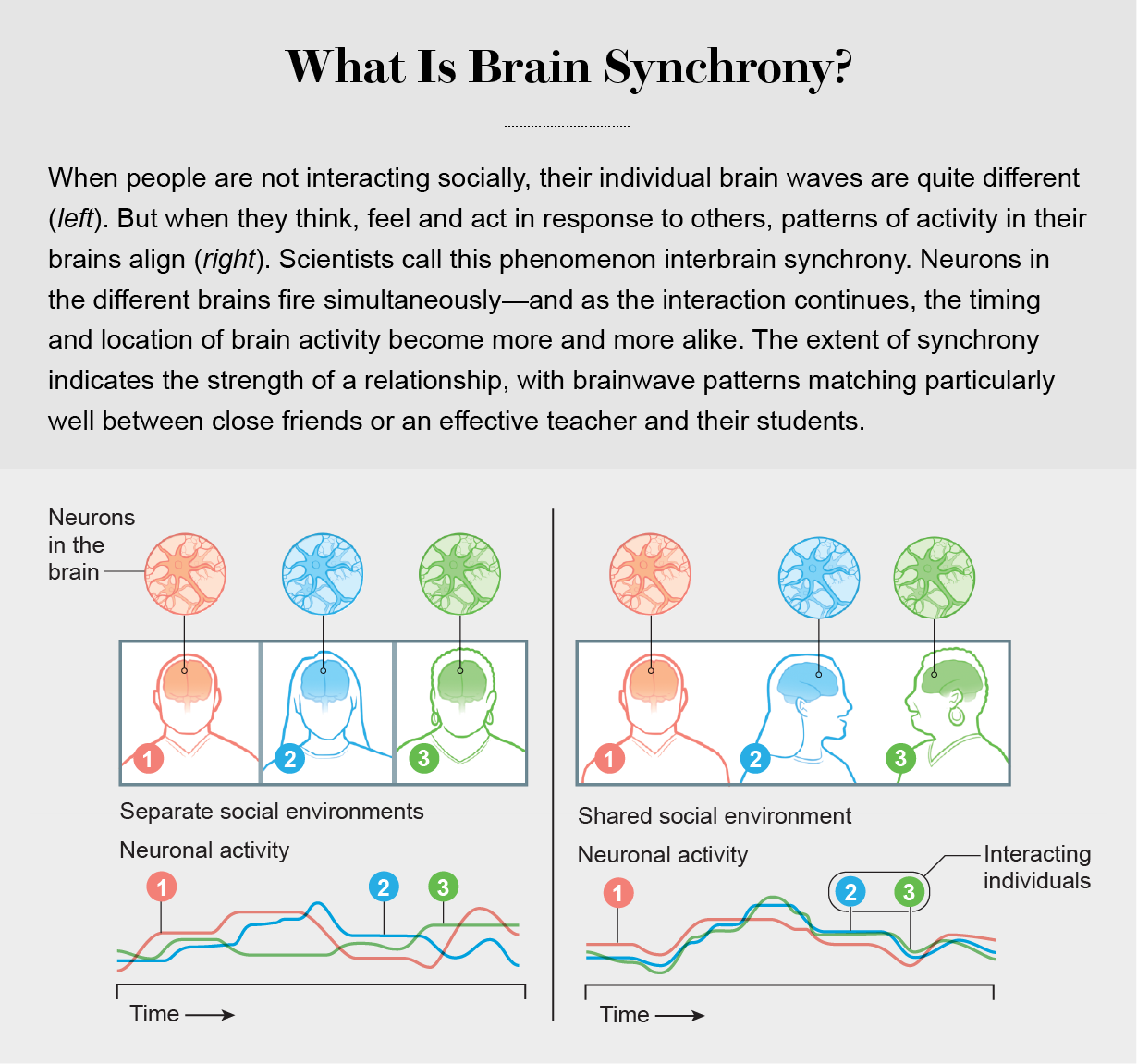
Collective neuroscience, as some practitioners call it, is a rapidly growing field of research. An early, consistent finding is that when people converse or share an experience, their brain waves synchronize. Neurons in corresponding locations of the different brains fire at the same time, creating matching patterns, like dancers moving together. Auditory and visual areas respond to shape, sound and movement in similar ways, whereas higher-order brain areas seem to behave similarly during more challenging tasks such as making meaning out of something seen or heard. The experience of “being on the same wavelength” as another person is real, and it is visible in the activity of the brain.
Researchers are discovering synchrony in humans and other species, and they are mapping its choreography—its rhythm, timing and undulations—to better understand what benefits it may give us. They are finding evidence that interbrain synchrony prepares people for interaction and beginning to understand it as a marker of relationships. Given that synchronized experiences are often enjoyable, researchers suspect this phenomenon is beneficial: it helps us interact and may have facilitated the evolution of sociality. This new kind of brain research might also illuminate why we don’t always “click” with someone or why social isolation is so harmful to physical and mental health.
In the beginning of learning it, FIML may also disrupt or alter brain synchrony.
Altered synchrony is probably the reason FIML is difficult to learn and understand at first.
When FIML practice is accepted as a natural form of speech—and partners have trained themselves in it—a more accurateand powerful synchrony will emerge. ABN
from article linked above
When we interact socially, what we fundamentally do is display and receive semiotics. We share them to greater or lesser extents.
What we do not do nearly enough is investigate this sharing at the level of real-time micro and meso semiotics.
FIML does precisely this and you do not need fMRI to do it.
From a Buddhist point of view, FIML is the dynamic sharing and analysis of subtle and very subtle states of mind.
The synchronies you share with your FIML partner will be deeper and richer than any others because you have worked and trained at fully understanding them. ABN
After years of clearing up my mind, I noticed that my inner voice sometimes uses short phrases to bring negative trains of thought to an end. It was a habit I was aware of but had never given any thought to.
The phrases are not pretty; e.g. “I hate them all,” “fuck them,” “who cares about assholes like that,” etc.
My guess is this kind of inner speech is not uncommon. I was using it to end various lines of thought that had wandered into painful territory.
Having a clearer mind today or at least believing I did, I decided that when phrases or words like that came up again, I would not let them shut off my thoughts as I had been doing. Rather I would let the thoughts continue, explore what was there.
What I found is a bunch of old memories and emotions that were fairly easy to clean up. They were not so much repressed as not having been visited for many years. The nasty phrases were like labels in an old, unused filing cabinet.
About half the material was out of date and easy to toss. Another one-quarter was pertinent but was stuff I had dealt with in other ways and was thus redundant.
Only about a quarter of the material lying behind those nasty phrases deserved more thought.
In some of the most interesting cases, I realized that I was letting someone off too easy by hiding their behavior inside a neutral memory. They actually had been horrible but I had been too young to understand (narcissists, for example). Analyzing that stuff over again in a more mature mind was a bit of a chore, but the results have been good, even refreshing.
The process is ongoing. It does resemble cleaning an attic or an old filing cabinet. The stuff I found behind those nasty phrases was not all the stuff from my past. It was just stuff where I was blaming someone or feeling angry about something or had been harmed by someone. The bad stuff I’ve done is elsewhere in my mind.
I am struck by several things concerning those phrases and what lay behind them. One is a lot of that material dates back to childhood and early adulthood. It was not so much unconscious as not having been visited for a long time. Though most of it does not have strong emotional valence, some of it is very revealing because it brings together memories that had been disconnected, leading me to understand dramas or aspects of experience I had not understood before even though I had lived them. I also notice that it was just a few words that closed off those “files.”
The power of words to command silence in the mind is enormous.
I had been dismissing all that material with just a few words whenever I didn’t feel like going there, which was every time. After not going there for many years, it was refreshing to poke around and rearrange those parts of my mind. I am quite sure I freed up some memory space and removed some snags in my thinking by dealing with that stuff. I also see new patterns within my general sense of my past, patterns with better explanatory power, both truer and more concise.
I see our minds as having a structure sort of similar to language or a forest. Trees of ideas, memories, and feelings grow and change. It’s good to remove some of them sometimes, put the space to better use. Buddhist practice is very helpful in endeavors like this. Rather than get all worked up with Freudian passions and delusions, we can simply observe, dismiss, refile, erase, upgrade, or reimagine as needed based on our capacities and understanding of what’s best.
Our bhavanga or “storehouse consciousness” contains memories, pictures, ideas, words., explanations They flow along with us, in many ways are us. When the mind is clear, a lot of that material can be rearranged for the better. There aren’t many rules for that. Just do your best.
Personally, I see all of the Abrahamic religious variations as being unwise and potentially dangerous.
All religions and extremist politics, such as communism and woke, occupy the top cognitive levels of the mind; and for that reason lend themselves to fanaticism and consensus bias.
Christian-Zionists and many evangelical sects have been infiltrated by Jewish Supremists, who even dare to change the Bible and its Christian interpretations.
Buddhism has its problems, but three features of Buddhism are very wise and largely protect the tradition: 1) Buddhism does not take any written words to be God’s words, and thus subject to fanatical misinterpretations. 2) The Buddha always said he was just a man and not a god. 3) It is considered very bad conduct for Buddhists to claim to be enlightened when they are not.
As for Buddhism being ‘Godless’, that’s not true. Buddhism holds the position of ‘having no belief’ about the nature of Ultimate Reality because to do so is to retreat from it. Humans are not smart enough to say what it is but can experience it.
Buddhism is a rich and ancient philosophy. It is the foundation of Greek skepticism, but not limited to skepticism’s intellectual paradigm. Pyrrho took what he could understand from Buddhist monks in Bactria about 100 years after the Buddha’s passing.
Buddhism: No scriptures claiming to be the Word of God. No proselytizing, only welcoming those who come on their own. Strong focus on individual responsibility, which prevents the weakness Buddhists perceive in Christians or the craziness we see in religious fanatics of all stripes.
I’m just one person. What I have written is an extemporaneous response to the videos above and how they capture a slice of the terrifying nonsense in the world today.
I know a good deal about Jewish Supremacy, so I write about it often. Gaza and the public assassination of Charlie Kirk, and now the Epstein files and war with Iran, have shown millions how our world really works, how evil has burrowed so deeply into all of our institutions. ABN
And distorted motives warp human interactions, which in turn degrade individual psychology.
There is no way around it—the ways almost all people communicate are much cruder than their brains are capable of.
And that is the cause of most of what we now call (non-biological) “mental health” problems.
Here is an example: I want to say something very complex to my primary care doctor. I can give her the gist in a minute or two but I do not want to have that go on my medical record.
So I ask her if I can start a discussion that she will promise to keep off my record.
She says, “I’ll think about it.”
A week later I get a letter from her nurse saying she is not willing to do what I asked.
No reason why was given. Do rules prevent her from doing that? I have heard of doctors allowing patients to keep some concerns off the record, but who knows what the reality is? Do you?
If I insist, will that go on my record? Did what I asked in the first place go on my record? My doctor is trapped within or is voluntarily following some guideline that is most decidedly not in my best interests.
This same sort of thing can happen interpersonally. If I raise a topic that is psychologically important to me with even a close friend, I have to wonder will they understand? Will they allow me to expand the subject over a few weeks or months or longer? Will my initial statements change our friendship?
The basic problem is how do you discuss complex psychological subjects with others?
One of my friends works in alternative health care. She knows what I want to bring up with my doctor and admits that even in her professional setting where patients have an hour to open up, there is not enough time.
Back to my primary care doctor. I saw her again a year later and she asked if I remembered her. I said, “Of course I remember you.” She said no more and neither of us raised the off-the-record topic. An intern was with her.
I wonder what she thinks of me. Did she interpret my slightly nervous behavior when I first asked as a “sign” of something? Does she think I am volatile or bipolar or just nuts? (I am not.)
I am 100% sure that she cannot possibly know what I wanted to bring up with her. In this case, I have all of the information and I want to give it to her but she cannot or will not allow that unless my initial fumblings toward a complex subject are made public.
Even a close friend could find themselves in a similar position. And I wonder if I have done that myself to someone. Most people most of the time are not able to scale those walls that divide us.
On either side of the wall is a complex person capable of complex understanding, but one or both persons cannot scale the wall. My doctor is smart enough to have become an MD and yet I cannot tell her about a complex medical condition that is of great importance to me.
I know that I do not want to open the subject and risk a shallow public label (a common hindrance to many potential communications). I honestly do not know what my doctor is thinking. Maybe I will try again the next time I see her.
One year later: I didn’t try again. After much thought, I decided to switch doctors. And I will not bring this subject up with my new doctor. It’s a sad reality that trying at all ruined (in my mind) my relationship with my first doctor and convinced me that the topic is not one I can discuss with any medical professional in a professional setting and maybe in any setting.
__________
UPDATE: I first posted the above a few years ago. The world has changed. What I wanted to discuss with my doctor is the attacks I have suffered at the hands of Jewish Supremists. ABN.
By this I mean our deepest levels of meaning, emotion, and intention are either implied or more often concealed from the person(s) we are speaking with.
In professional and formal settings (school, clubs, church, etc.) this is pretty much how it has to be since there is not enough time to delve more deeply and no good reason to do so in most cases.
Problems arise, however, when the arm’s length habits of formal settings are imported into intimate private settings such as close friendships, marriages, families.
Arm’s length communication is effective in formal settings, but its use of reduced messaging techniques in private settings invariably enters gray areas followed by conscious lying.
I think people do this in their private communications mainly because they don’t know how to communicate in any other way. Humans are basically somewhat smart apes who have a fairly complex (for us) communication/language system grafted onto the instincts of a wild animal.
When the inevitable ambiguities and lies of arm’s length communications build up within the intimate communications of couples or close friends, the result will be explosive emotions or alienation and apathy.
The simple arm’s length system is a primitive, basic system for communicating obvious things. To be honest, if you enjoy your communications at work or the clubhouse more than at home, you are basically showing how primitive you are.
In formal settings communication is entirely based on predetermined mutual agreement concerning values, beliefs, etc.
Private settings require much more nuance and thus a much more nuanced communication technique.
FIML is designed for private, intimate communication. It allows partners to open their minds to much richer and much healthier interactions.
You cannot achieve optimum psychological health if you engage only in arm’s length communication. You can only do so by using a technique like FIML that allows you and your partner to consciously share the profound world of interpersonal subjectivity.
FIML takes some time and practice but it is no harder than learning how to ski or cook or play a musical instrument moderately well.


 American Buddhist Net