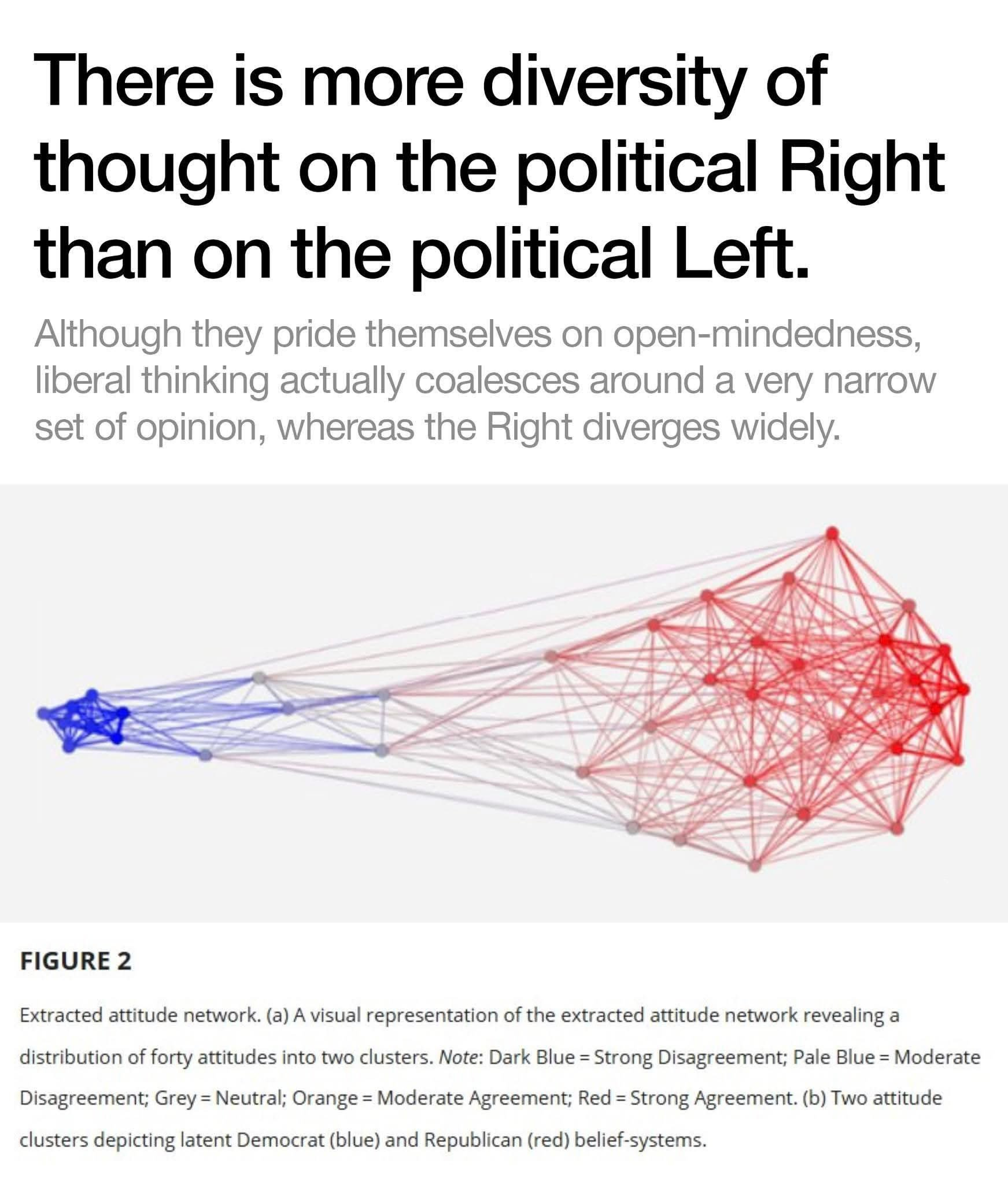
This is a civilization-wide problem across the West (and the world). It rests on a psycholinguistic feature or flaw inherent in human beings.
This feature or flaw is used in mind-control and self-actuating mind-control.
Once this feature has been tapped as a flaw, it works on its own in a majority of people, thus producing pathological hive-mindedness.
To be brief, psycholinguistic arrays tend to cluster around core concepts. The nature of trained-in core concepts is they become reified and ‘root’ the mind firmly against distractions, deviations and suasion.
This is good when you are training to be an electrician. This is bad when you are training to be a psychotherapist.
All cultures and subcultures are formed around core concepts (and psycholinguistics) through training and imitation.
It takes a better than average mind to see above this or around it.
Learn and understand FIML and you will see this in great detail within yourself and understand why it is both a feature and a flaw in all human language use.
It is not solely a psychological thing, which is why I often use the term psycholinguistics. ABN
Interpersonal communication errors can occur for many reasons during acts of listening, cogitating, and/or speaking.
For example, in a conversation involving two people (A & B), person A may mishear (listening error) what B said; and/or person A may misunderstand or miscogitate what they heard; and/or person A may misspeak.
Errors in any part of that communication process will cause some sort of confusion between A and B. Errors can be of many types. The speaker may mispronounce, misenunciate, use the wrong word, be inadvertently misleading, hit a wrong tone of voice, etc. In turn, the listener may mishear, be inattentive, be overly attentive to one aspect of what the speaker is saying, not know a word or a reference, etc. Next, even if the listener heard correctly, they may misunderstand or miscogitate by making wrong associations, drawing wrong conclusions, etc. Any unconscious error in hearing or cogitating will probably lead the listener to misspeak when it is their turn.
Errors of these sorts if not corrected will compound and cause the conversation to become unsatisfying or confusing.
It is the goal of FIML practice to catch these errors as soon after they arise as possible. FIML partners should strive to be perfect with each other in all three of these communication areas–listening, cogitating, and speaking. The best way to do this is to pay close attention to yourself. If you feel an emotional jangle, be sure to confirm with your partner (by doing a FIML query) that your jangle is justified. If it is not, you have discovered an error. Correct the error and continue.
One very simple and common jangle involves feeling irritated (even very, very slightly) at your partner because they did not understand what you said (probably not so clearly). Take it as a given that our uses of language are frequently less than perfect. You must expect that a good many of the things you say will not be stated as clearly as they could be; many more of them, though clear enough, will contain ambiguities or misleading word choices. If as a speaker you become irritated at your partner for something that is inevitable in your own speech, you are making a huge mistake.
Another common jangle involving cogitation is feeling stupid or inattentive when your partner makes an association that you did not get even though you heard all of their words correctly. This jangle could also involve thinking your partner is stupid or not making sense because you did not get what they said. Either way, it is crucial that both FIML partners know that these kinds of mistakes in cogitation are quite common. Identify them when they occur–as soon as you can–and correct them.
A third common jangle, this time involving hearing, is attributing a wrong emotion or intention to the speaker’s tone of voice. The human speech apparatus is not that highly developed. To speak, we have had to re-purpose our teeth, lips, and tongues, which other animals use for eating, to make noises that convey sometimes sophisticated meaning to other people. How could things not go wrong with that? We also breathe, vomit, kiss, and do other stuff with that same oral cavity. FIML partners must recognize that we are working with a primitive “wind instrument” when we talk and that this instrument may blow too hard, get clogged with phlegm, or experience many other kinds of mishaps that can distort the sounds of our voices. A person with a high, soft voice can easily be misunderstood as being a light-weight, while a person with a deep voice and large lungs can easily be misheard as being aggressive when they are not. Each one of us should be aware of how our voices might be misunderstood and then apply this level of detail to understanding, at least, our partner’s voice.
Another common listening jangle/error that can occur, even if you clearly understand all of the above, is a speaker’s tone of voice can be seriously misunderstood if we think it refers to us when it is referring to the subject at hand. For example, you say something about the car needs fixing and your partner responds in an irritated tone of voice. If you hear that irritation as referring to you when your partner is just sick of the damn car, you will be making a serious mistake. If you say nothing, you may simmer with wrong bad feelings for some time, which often leads to yet more bad feelings. If you do say something, you may start an argument and/or otherwise greatly compound the original problem. All that actually had happened was your partner expressed a fairly primitive emotion (irritation at the damn car) which you misunderstood to mean irritation at you. Your partner used our crude speech apparatus to grunt irritation at a very common problem and you used your crude ears and listening abilities and crude tendency to think everything applies to you to make a big mistake, one that will only add to the original problem.
As you and your partner continue doing FIML practice, you will get better and better at finding and correcting these kinds of errors the moment they arise. It’s not always easy, but it is always very satisfying if you discuss the matter long enough for both of you to achieve a real resolution.
I’ll probably have more to say on this subject, but for now let me just say I am delighted to have found a psychotherapy that is highly compatible with FIML practice.
Indeed this psychotherapy is based on the same principles as FIML, though the approach is different.
In FIML unwanted psychological reactions are discovered in real-world, real-time situations with a partner.
In Coherence Therapy—the psychotherapy I just discovered—unwanted psychological reactions are called schemas. Schemas are transformed through memory reconsolidation in a way that is theoretically very similar to FIML practice.
Here is a video that explains the process of memory reconsolidation that is achieved through Coherence Therapy:
Coherence Therapy (CT) requires a therapist, while FIML does not.
In a nutshell, CT uses three steps (as described in the video) to achieve results. I will list them below in bold font and explain briefly how FIML differs and is also very similar.
1) CT: Reactivate the target schema as a conscious emotional experience. This is done with the help of a therapist.
FIML: In FIML, harmful or unwanted schemas are encountered in real-life with a participating partner. No therapist is needed, though prior training in the technique is helpful.
2) CT: Guide a contradictory experience. This juxtaposition unlocks (de-consolidates) the target schema’s memory circuits. (“Mismatch”/”prediction error” experience)
FIML: The “contradictory experience” is discovered in real-life through the FIML query. The partner’s answer to the FIML query provides the “juxtaposition” that unlocks or de-consolidates the encountered schema. In FIML, we have been calling this process the discovery and correction of a contretemps or mix-up.
3) CT: Repeat contradictory experience in juxtaposition with target schema. This rewrites and erases target schema.
FIML: Repetition of the contradictory experience happens in real-life whenever it next happens if it happens again. Generally, most schema or unwanted reactions are corrected within 5-10 recurrences. Serious unwanted schemas may take more repetitions.
Since CT uses a therapist as a guide, it is better than FIML for very serious problems and for people who are unable to find a partner to do FIML with.
Since FIML does not use a therapist, it is better for dealing with a very broad range of many unwanted schemas, not just the most serious or ones discovered by a therapist.
I am quite sure that CT will be very effective for many kinds of psychological agony. If a problem is acute, I would recommend CT based on my experience with FIML.
A shortcoming of FIML is it requires a caring partner and the transformations it induces are generally all induced in the presence of that partner. Much good comes of that and most transformations can be extrapolated to other people and other situations, but for serious problems like panic or deep anxiety, a CT therapist may be more helpful.
FIML is best for two people who want to optimize their psychologies. Partners will discover and correct many unwanted schemas and many bad communication habits.
If you can understand CT, you should be able to do FIML. If you have already done CT and had good results and now you want to go further and optimize your psychology, FIML will help you do that.
I believe the core theory of CT is sound. If that is so, it should be clear that bad schemas arise constantly in life. We start new ones all the time. Bad schemas are like trash that inevitable accumulates and must be cleaned away. FIML does this job very well.
Today, I want to explain how that take on modern psychology fits very well with Buddhist practice.
Buddhist practice is best understood by understanding the Noble Eightfold Path:
Right View, Right Intention, Right Speech, Right Action, Right Livelihood, Right Effort, Right Mindfulness, and Right Samadhi.
If the Noble Eightfold Path is followed diligently, it will erase all dysfunctional schema from the mind. The complete erasure occurs in the eighth element of the path, Right Samadhi.
Right Samadhi is an elixir of the mind. It bathes and cleanses the mind like nothing else. Right Samadhi erases all delusion, all suffering, all dysfunctional schema. Right Samadhi is one part of the Noble Eightfold Path and also it can be understood as a culmination of the Path, the ultimate or penultimate reward of Buddhist practice.
On this site, I add something to the Noble Eightfold Path that, in my opinion, makes it even better. What I have added is FIML practice. FIML can be understood to be an addition to Right Speech and Right Mindfulness. FIML works by getting us to pay close attention to what we hear as well as what we say. When we do that using the tools FIML provides we also greatly improve our Right Mindfulness.
I deeply hope readers of this site will improve their understanding of Buddhism and learn how to do FIML.
The hardest thing about FIML practice is finding a Right Partner, someone who is able to understand the practice and willing to do it with you. The second hardest thing is overcoming a very deep-seated, instinctive human speech prohibition which prevents us from quickly shifting from talking to talking calmly and wisely about the minutia of the talking and listening that just occurred.
If you have a suitable partner, learning how to do FIML is much easier and more fun than finding a suitable therapist. Like Buddhism itself, FIML works directly with the unique reality of the lives of you and your partner. ABN
We all know fight, flee, freeze, and fawn as instinctual reactions to stress or confrontation. I believe freezing can be cultivated to become equanimity. It may even be the case that a good deal of freezing is fundamentally natural or spiritual equanimity. ABN
I’ve hidden my hand my whole life. I wear long sleeves and haven’t seen a doctor about it since I was a toddler. My right hand is completely normal. On my left hand, my pinky, ring, and middle fingers are normal. The issue is only with the thumb and index finger they are the same length and to the side.
It’s not painful or limiting physically but it’s always affected my confidence which is why I hide it.
I mentioned the other day that Reddit has small subs that can be intellectually stimulating. The post linked above, including many of its comments, shows what the title says. One conclusion from this is that the shame and self-induced ‘need’ to hide that shame has wide applications across all stigmatisms and psychological conditions, which often are reified as stigmatisms. By hiding shame or stigmatism we give it an overblown life of its own. By not hiding it, we remove its power to shame us. A physical stigma is simply the luck of the draw and, while someone may be to blame for it, in the end you have to live with it. Psychological abuse or trauma is not so different. At the end of the day, it’s your cross to bear. If FIML is done with this in mind, both partners can use the FIML method to gradually bite off small pieces of whatever shame or trauma or confusion they are experiencing. Doing this repeatedly, over months and years, will slowly reveal the trauma to both partners. And this will provide a wondrous level of freedom. Psychological trauma always leaves evidence in the mind much as physical abnormalities can rarely be fully corrected. Nonetheless, both conditions benefit greatly from exposure to the sunlight of objective consciousness. And this can lead to a state of unperturbedness as the stoics say or enlightenment/ nirvana as the Buddhists say. ABN
New details have emerged about Virginia Giuffre‘s final moments after she was found unresponsive in a rural town in Western Australia – as those closest to her break cover at the family’s $1.9million mansion in Perth.
Ms Giuffre, who was trafficked by Jeffrey Epstein as a teenager, took her own life at her farmhouse in Neergabby on Friday night.
She was one of the most prominent accusers of convicted sex offenders Epstein and his former girlfriend Ghislaine Maxwell, who she said kept her as a sex slave while flying her around the world and offering to their powerful associates ‘like a platter of fruit’.
She alleged they trafficked her to the Duke of York when she was 17 and was three times sexually assaulted by him – a claim which Prince Andrew has denied. The prince reached an out-of-court settlement with her in 2022.
A WA Police Force spokesperson told Daily Mail Australia preliminary findings indicated the death was ‘not suspicious’ and that paramedics had provided ’emergency first aid’ shortly after arriving at the home.
‘About 9.50pm Friday 25 April, emergency services received a report a woman had been located unresponsive at a residence in Neergabby,’ they said.
‘Police and St John WA attended and provided emergency first-aid. Sadly, the 41-year-old woman was declared deceased at the scene.
Anxiety isn’t just one thing—there are different types, each with its own causes and treatments
Unfortunately, doctors often treat it as if it’s all the same, frequently giving medications that make it far worse. As a result, despite the billions being spent on treating anxiety, the condition affects more and more people.
In many cases, anxiety can only be treated if you understand the root cause of it.
This article dives into the different types of anxiety and their causes so you can seek the correct treatment and avoid the harmful therapies frequently prescribed by rushed physicians.
One of the most common treatments for anxiety are benzodiazepines. Unfortunately, these drugs have many severe side effects, including being highly addictive. As a result, once individuals are started on them, they often cannot stop.
In contrast, many natural therapies exist for anxiety which work in harmony with the body and do not create the immense issues benzodiazepines often do.
FIML is both a practice and a theory. The practice is roughly described here and in other posts on this website.
The theory states (also roughly) that successful practice of FIML will:
Greatly improve communication between participating partners
Greatly reduce or eliminate mistaken interpretations (neuroses) between partners
Give partners insights into the dynamic structures of their personalities
Lead to much greater appreciation of the dynamic linguistic/communicative nature of the personality
These results are achieved because:
FIML practice is based on real data agreed upon by both partners
FIML practice stops neurotic responses before they get out of control
FIML practice allows both partners to understand each other’s neuroses while eliminating them
FIML practice establishes a shared objective standard between partners
This standard can be checked, confirmed, changed, or upgraded as often as is needed
FIML practice will also:
Show partners how their personalities function while alone and together
Lead to a much greater appreciation of how mistaken interpretations that occur at discreet times can and often do lead to (or reveal) ongoing mistaken interpretations (neuroses)
FIML practice eliminates neuroses because it shows individuals, through real data, that their (neurotic) interpretation(s) of their partner are mistaken. This reduction of neurosis between partners probably will be generalizable to other situations and people, thus resulting a less neurotic individual overall.
Neurosis is defined here to mean a mistaken interpretation or an ongoing mistaken interpretation.
The theory of FIML can be falsified or shown to be wrong by having a reasonably large number of suitable people learn FIML practice, do it and fail to gain the aforementioned results.
FIML practice will not be suitable for everyone. It requires that partners have a strong interest in each other; a strong sense of caring for each other; an interest in language and communication; the ability to see themselves objectively; the ability to view their use of language objectively; fairly good self-control; enough time to do the practice regularly.
In mathematics, a ‘computation’ is the process of performing mathematical operations on one or more inputs to produce a desired output. A problem in analyzing human psychology arises when we understand that human psychology cannot be reduced computationally. The ‘computational irreducibility’ of human psychology does not mean, however, that there is no way to probe it and understand it. In the following essay, I show how FIML practice can greatly enhance our understanding of our own psychologies and, by extension, the psychologies of others.
Rather than rely on tautological data extractions or vague theories about human psychology, FIML focuses on small interpersonal exchanges that can be objectively agreed upon by at least two people. These small exchanges correspond to what Wolfram calls ‘specific little pieces of computational reducibility’. When we repeatedly view our psychologies from the point of view of specific little pieces of computational reducibility, we begin amassing a profoundly telling collection of very good data that shows how we really think, speak, and act.
FIML is a method of inquiry that deals with the computational irreducibility of humans. It does this by isolating small incidents and asking questions about them. These small incidents are the “little pieces of computational reducibility” that Stephan Wolfram remarks on at 42.22 in this video. Here is the full quote:
One of the necessary consequences of computational irreducibility is within a computationally irreducible system there will always be an infinite number of specific little pieces of computational reducibility that you can find.
This is exactly what FIML practice does again and again—it finds “specific little pieces of computational reducibility” and learns all it can about them.
In FIML practice, two humans in real-time, real-world situations agree to isolate and focus on one “specific little piece of computational reducibility” and from that gain a deeper understanding of the whole “computationally irreducible system”, which is them.
When two humans do this hundreds of times, their grasp and appreciation of the “computationally irreducible system” which is them, both together and individually, increases dramatically. This growing grasp and understanding of their shared computationally irreducible system upgrades or replaces most previously learned cognitive categories about their lives, or psychologies, or how they think about themselves or other humans.
By focusing on many small bits of communicative information, FIML partners improve all aspects of their human minds.
I do not believe any computer will ever be able to do FIML. Robots and brain scans may help with it but they will not be able to replace it. In the not too distant future, FIML may be the only profound thing humans will both need to and be able to do on their own without the use of AI. To understand ourselves deeply and enjoy being human, we will have to do FIML. In this sense, FIML may be our most important human answer to the AI civilization growing around us. ABN
FIML is both a practice and a theory. The practice is roughly described here and in other posts on this website.
The theory states (also roughly) that successful practice of FIML will:
Greatly improve communication between participating partners
Greatly reduce or eliminate mistaken interpretations (neuroses) between partners
Give partners insights into the dynamic structures of their personalities
Lead to much greater appreciation of the dynamic linguistic/communicative nature of the personality
These results are achieved because:
FIML practice is based on real data agreed upon by both partners
FIML practice stops neurotic responses before they get out of control
FIML practice allows both partners to understand each other’s neuroses while eliminating them
FIML practice establishes a shared objective standard between partners
This standard can be checked, confirmed, changed, or upgraded as often as is needed
FIML practice will also:
Show partners how their personalities function while alone and together
Lead to a much greater appreciation of how mistaken interpretations that occur at discreet times can and often do lead to (or reveal) ongoing mistaken interpretations (neuroses)
FIML practice eliminates neuroses because it shows individuals, through real data, that their (neurotic) interpretation(s) of their partner are mistaken. This reduction of neurosis between partners probably will be generalizable to other situations and people, thus resulting a less neurotic individual overall.
Neurosis is defined here to mean a mistaken interpretation or an ongoing mistaken interpretation.
The theory of FIML can be falsified or shown to be wrong by having a reasonably large number of suitable people learn FIML practice, do it and fail to gain the aforementioned results.
FIML practice will not be suitable for everyone. It requires that partners have a strong interest in each other; a strong sense of caring for each other; an interest in language and communication; the ability to see themselves objectively; the ability to view their use of language objectively; fairly good self-control; enough time to do the practice regularly.
In mathematics, a ‘computation’ is the process of performing mathematical operations on one or more inputs to produce a desired output. A problem in analyzing human psychology arises when we understand that human psychology cannot be reduced computationally. The ‘computational irreducibility’ of human psychology does not mean, however, that there is no way to probe it and understand it. In the following essay, I show how FIML practice can greatly enhance our understanding of our own psychologies and, by extension, the psychologies of others.
Rather than rely on tautological data extractions or vague theories about human psychology, FIML focuses on small interpersonal exchanges that can be objectively agreed upon by at least two people. These small exchanges correspond to what Wolfram calls ‘specific little pieces of computational reducibility’. When we repeatedly view our psychologies from the point of view of specific little pieces of computational reducibility, we begin amassing a profoundly telling collection of very good data that shows how we really think, speak, and act.
FIML is a method of inquiry that deals with the computational irreducibility of humans. It does this by isolating small incidents and asking questions about them. These small incidents are the “little pieces of computational reducibility” that Stephan Wolfram remarks on at 42.22 in this video. Here is the full quote:
One of the necessary consequences of computational irreducibility is within a computationally irreducible system there will always be an infinite number of specific little pieces of computational reducibility that you can find.
This is exactly what FIML practice does again and again—it finds “specific little pieces of computational reducibility” and learns all it can about them.
In FIML practice, two humans in real-time, real-world situations agree to isolate and focus on one “specific little piece of computational reducibility” and from that gain a deeper understanding of the whole “computationally irreducible system”, which is them.
When two humans do this hundreds of times, their grasp and appreciation of the “computationally irreducible system” which is them, both together and individually, increases dramatically. This growing grasp and understanding of their shared computationally irreducible system upgrades or replaces most previously learned cognitive categories about their lives, or psychologies, or how they think about themselves or other humans.
By focusing on many small bits of communicative information, FIML partners improve all aspects of their human minds.
I do not believe any computer will ever be able to do FIML. Robots and brain scans may help with it but they will not be able to replace it. In the not too distant future, FIML may be the only profound thing humans will both need to and be able to do on their own without the use of AI. To understand ourselves deeply and enjoy being human, we will have to do FIML. In this sense, FIML may be our most important human answer to the AI civilization growing around us. ABN




 American Buddhist Net