Although service members know they may lose their lives in combat in service of their country, they may not expect to lose their lives – or those they love – to suicide. A 2021 study estimated that four times as many active duty service members and veterans died by suicide as died in battle since 9/11.
Despite recent calls to action to improve suicide prevention within the military, suicide rates remain elevated among service members. In particular, active duty Army suicide rates were nearly two times higher than other active duty military services and more than two and a half times higher than the general population. Suicide rates are even more elevated in veterans, with an estimated 17 or more dying by suicide each day in 2021.
…Overall, we found that feeling ineffective or like a burden to others, a sense of low belonging or feeling disconnected from others, and agitation are important drivers of moment-to-moment and longer-term risk for thoughts of suicide among service members and veterans.
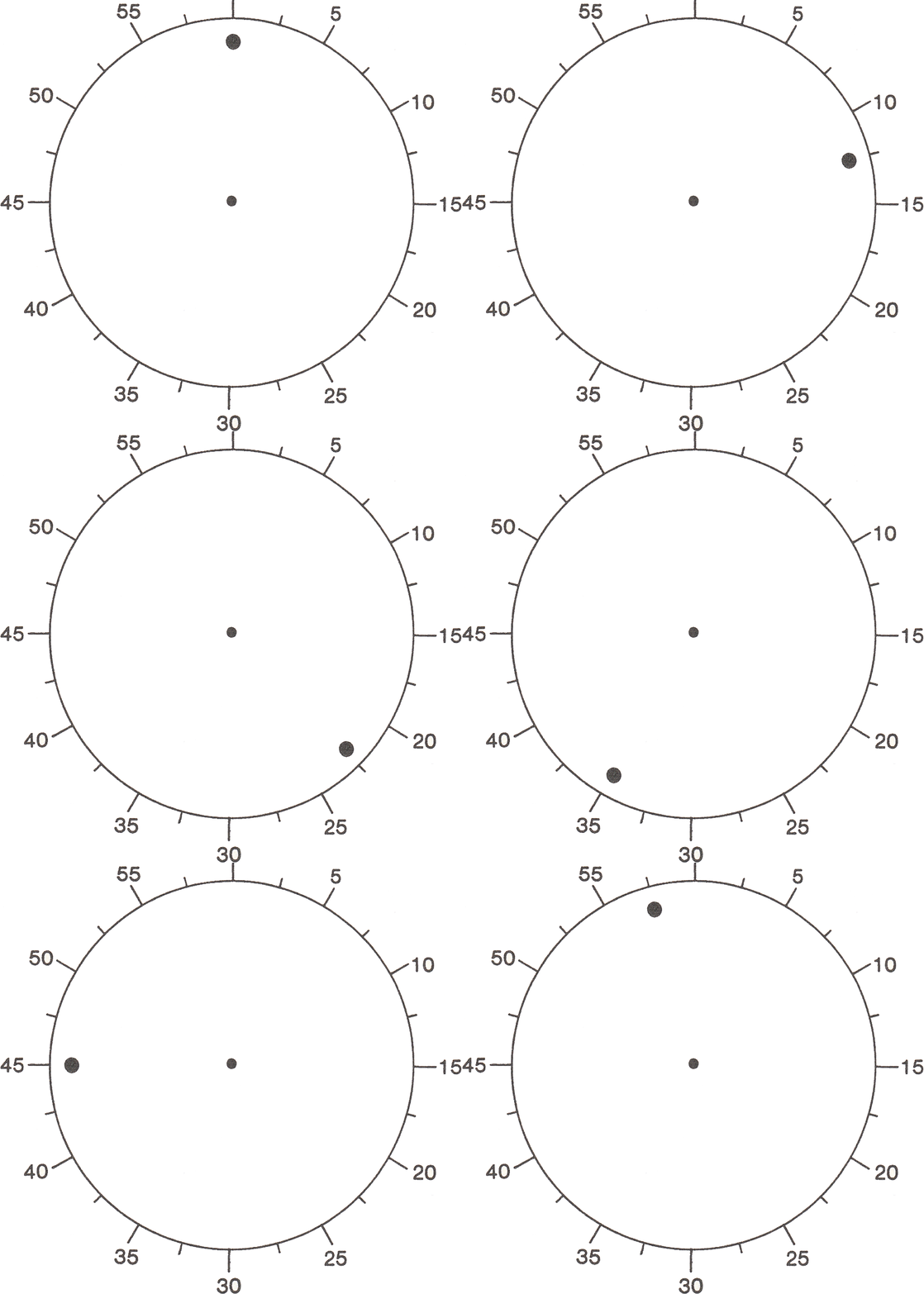
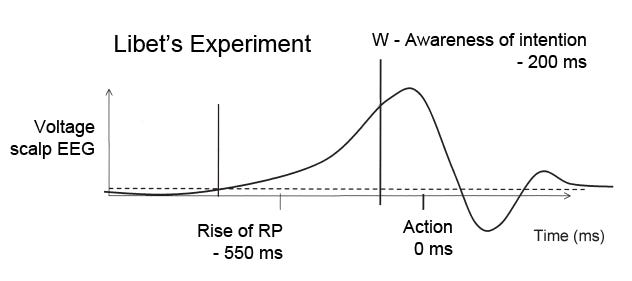
Libet gave participants of his experiments a simple task, while measuring their brain activity: they had to decide to flex a finger whenever they wished, and note the position on a fast-moving clock at the precise moment they took the decision.
The result was that the brain showed activity at least 400ms before the participants became aware of their “decision making.”
“RP” stands for “Readiness Potential,” that is, the supposed build-up in brain activity before the decision to act and the subsequent action. What we see is that this brain activity starts before the participants became aware of their intention to flex the finger.
The results have led the no-Free-Will crowd to [falsely] exclaim, “see, everything is driven by your brain, and you taking decisions is just an illusion!”
However, this seems to be a typical case of taking something very specific and isolated out of context and then drawing conclusions based on existing biases.
The exercise of free will in basic FIML is done during the “Readiness Potential” period described above. FIML done with a partner is an exquisite exercise of free will that completely changes how we speak and listen for the better. FIML is somewhat difficult because it requires being aware of the Readiness Potential period close to its onset. But this can be learned with practice. Buddhists or others who practice mindfulness may find this part of FIML to be rather easy. From this point of view, FIML can be described as mindfulness shared by two people, or pair-work mindfulness. FIML mostly focuses on interpersonal speech and listening but also includes all other interpersonal semiotics. More posts related to FIML and brain science can be found here. ABN
Results:There were significant differences in Social Intelligence between psychologists and AI’s ChatGPT-4 and Bing. ChatGPT-4 exceeded 100% of all the psychologists, and Bing outperformed 50% of PhD holders and 90% of bachelor’s holders. The differences in SI between Google Bard and bachelor students were not significant, whereas the differences with PhDs were significant; Where 90% of PhD holders excel on Google Bird.
This video was made from a single AI-generated image and will work with any suitable photograph.
We introduce VASA, a framework for generating lifelike talking faces of virtual characters with appealing visual affective skills (VAS), given a single static image and a speech audio clip. Our premiere model, VASA-1, is capable of not only producing lip movements that are exquisitely synchronized with the audio, but also capturing a large spectrum of facial nuances and natural head motions that contribute to the perception of authenticity and liveliness. The core innovations include a holistic facial dynamics and head movement generation model that works in a face latent space, and the development of such an expressive and disentangled face latent space using videos. Through extensive experiments including evaluation on a set of new metrics, we show that our method significantly outperforms previous methods along various dimensions comprehensively. Our method not only delivers high video quality with realistic facial and head dynamics but also supports the online generation of 512×512 videos at up to 40 FPS with negligible starting latency. It paves the way for real-time engagements with lifelike avatars that emulate human conversational behaviors.
This technology will work well in psychological games that use the faces of relatives and friends as well as fictional ones. The day will come when AI-generated characters will be able to play simple roles on their own. These roles will become more complex and creative as the tech evolves. Psychological games, especially when the user has a lot of control, will be fun and provide significant insights into how our minds are actually working. Gnarly psychologies, like narcissism or BPD, will benefit greatly from working through a variety of plots and scenarios.
Beyond self-help, the possibilities for deep works of art seem boundless. Whole novels with many variable plot-turns will raise the art of fiction to new levels of immersion and aesthetic reward. Coupled with brain-wave reading technology, AI characters will be capable of reacting to out mental and emotional states in ways no one has ever experienced before. I love where this is going. Of course there will be porn but the deepest transformative fun will be the realm of art and self-knowledge. ABN
The Buddha’s explanation of the five skandhas is intended to help us understand the emptiness of the self. It is a short explanation aimed at his most intelligent students.
The Sanskrit word skandha means “heap” or “aggregate” in English. Sometimes the Buddha compared the skandhas to heaps of rice. They are the “heaps” of psycho-perceptual data that comprise the “contents” of our minds. The five skandhas are conditioned dharmas (literally, “conditioned things”), which is to say that they are impermanent and empty, and when improperly understood lead to delusive attachments characterized by greed, anger, and ignorance. The purpose of the Buddha’s five skandha explanation is to help us see through the skandhas, or disentangle ourselves from them. In some Buddhist texts the five skandhas are called the “five covers” because they cover our minds and prevent us from seeing deep levels of reality. In others they are called the “five yin (versus yang)” because they cloud the mind and hide the truth from us. I will discuss each of the five skandhas in the sections below.
1) The first skandha is form. Form, in this case, means anything that leads to, or is capable of leading to, the next skandha. Forms can be visual, auditory, or sensory. They can be dreams, memories, feelings, or moods. Forms are often described as being “obstructions” because, though they may lead to complex thought and activity, they are also hindrances to mental clarity since the activity they lead to is essentially delusive. It is important to remember that the five skandha explanation is an explanation of the deluded mind and its thought processes.
The Abhidharma-mahavibhasa Shastra categorizes the skandha of form into three types:
a) Visible forms with a referent in the outer world such as color, size, length, position, shape, and so on.
b) Invisible forms with a referent in the outer world that are associated with the other sensory organs such as sounds, smells, tastes, and the sensations arising from physical contact.
c) Invisible forms with no referent in the outer world such as dreams, memories, thoughts, feelings, and so on. Though a dream may be “visible” to the dreamer, it is called “invisible” here because no one else can see it. This last category of forms is associated with what the Buddha called “mental dharmas.”
2) The second skandha is sensation. Following the appearance of a form, the mind reacts to it with a sensation that is either positive, negative, or neutral. We either like it, don’t like it, or are neutral about it. Though it is possible to become conscious of this skandha, most of us most of the time are not.
Sensations are generally categorized into two types:
a) Sensations of the body coming from the outside world through any of the sensory organs, such as sights, sounds, smells, tastes, and so on.
b) Sensations of the mind which may or may not come from the outside world. These include moods, feelings, memories, dreams, thoughts, ideas, and so on.
Both kinds of sensation are, of course, based on the prior appearance of a form. Greed and anger have their roots in the skandha of sensation, for if we enjoy a positive sensation we are liable to become greedy about it, while if we do not enjoy it, we are liable to become “angry” or irritable concerning it. The deep meaning of greed is “excessive attraction” to a sensation that we deem to be agreeable or positive, while the deep meaning of anger (or hatred) is “excessive aversion” to a sensation that we deem disagreeable or negative. Neutral sensations often are the result of our ignorance or lack of understanding, though as we progress in Buddhist practice they may be the result of wisdom.
Positive and negative sensations associated with the body are generally considered to be weaker than those associated with the mind, though both types of sensations often are interrelated. An example of this mixture and distinction might be a light slap in the face. While the physical sensation is only mildly unpleasant, the mental sensation will be quite strong in most cases. And yet both are interrelated.
3) The third skandha is perception. This skandha refers to the deepening of a sensation. It is the point where the mind begins to latch onto its sensations. At this point conscious recognition of form and sensation normally begins. It is possible to become conscious of the first and second skandhas as they are occurring, but most of us generally are not. During the skandha of perception we begin making conscious distinctions among things.
4) The fourth skandha is mental activity. This skandha refers to the complex mental activity that often follows upon the skandha of perception. Once we have identified (perceived) something, long trains of mental associations become active. Our bodies may also begin to move and behave during this skandha. For example, the simple perception of a travel poster may set in motion a great deal of mental activity. We may begin recalling an old trip or begin fantasizing about a new one. If we are photographers, we may admire the composition of the photo, step closer to it, make an effort to remember it, and so on. All of these behaviors belong to the skandha of mental activity.
5) The fifth skandha is individual consciousness. It is a product of the first four skandhas and is completely conditioned by them. This is what we normally, more or less, think of as being our “self.” The Buddha taught the five skandhas primarily to help us understand that this “self” or consciousness is empty since it is entirely based on the conditions found in the first four skandhas.
The Ekkotarika-agama explains this point very well. It says, “The Buddha said that the skandha of form is like foam, the skandha of sensation is like a bubble, the skandha of perception is like a wild horse, the skandha of mental activity is like a banana tree, and thus the skandha of individual consciousness is nothing more than an illusion.” The trunk of a banana tree is made of leaves curled together. From the outside, it may look substantial, but if we examine it closely we will find that one leaf pulls away from the next, leaving ultimately nothing behind. The trunk looks substantial, but in truth it is “empty.” In just this way, our individual consciousness may look substantial to us, but if we peel it apart, we find that there is no self within—it is empty.
How to Understand the Five Skandhas
Though most of us are not normally aware of the first two skandhas it is possible to become aware of them through meditation and mindfulness practices. Though it is easier to begin understanding the five skandhas by thinking of them as being separate and distinct, it is important to realize that any of the last four skandhas can give rise to the skandha of form. Mental activity itself, for example, can generate whole new trains of forms, sensations, and perceptions.
Another important thing to understand about the five skandhas is that our minds move very quickly from one to the next. The five skandhas produce a snow storm of impressions and mentation, upon which rests our unstable conscious world. When we become overly attached to this snow storm or to the consciousness built upon it, we generate the karma that ultimately fuels the five skandhas in the first place.
The Explanation of Mahayana Terms (en 1212) says that the skandhas can be understood as being either good, bad, or neutral. The goodness mentioned in this explanation should be understood as being a relative goodness that arises within the phenomenal world—though it is “good,” it is not the same as an enlightened vision that completely sees through the five skandhas. For this reason, we will use the word “positive” in place of “goodness” in this discussion. The Explanation says that positive activation of the five skandhas can be of three types: activation by a positive form, such as a Buddhist image; activation by skillful means, such as a desire to help someone; and activation within a pure-minded person. The Explanation says that the three bad or negative types of activation of the five skandhas result from: simple badness within them, as may have derived from low motives or moodiness; contaminations within them, such as selfishness during an act of kindness; and negativity that is simply the result of bad karma. The Explanation says that the three neutral types of activation are: formal activations that result from the performance of rituals; activations resulting from the practice of a skill; and neutral changes among the skandhas themselves.
How to Contemplate the Five Skandhas
The second noble truth of Buddhism is the cause of suffering. Generally, this cause is explained as clinging to a false self. By contemplating the five skandhas, we learn to understand both that the self is empty and why it is empty. This contemplation appeals to the rational mind for it allows us to use reason to convince ourselves that the “self” we call our own is, in truth, an illusion.
In contemplating the five skandhas we should be mindful that we begin to generate karma during the skandha of perception. At the same time, it is important to realize that the very forms we see and the sensations that result from them are heavily conditioned by our past actions, by the accumulation of karmic “seeds” or influences that are already stored in our minds. Two people may see exactly the same form, but have very different responses to it because their karma is not the same. Since their karma is different, their sensations and perceptions, and especially their mental activity and consciousness will be very different.
The Numerical Teachings of Great Ming Dynasty Tripitaka says (en 1213) that the most important way to understand the five skandhas is to realize that each of them is empty. As we become familiar with the five skandhas, we will find it easier to identify each one and contemplate its emptiness. We can think about them from first to last or from last to first.
If we choose to think of them from last to first, our contemplation will consist of a series of questions, whose answers should be considered deeply. We begin by asking ourselves what the skandha of individual consciousness is based upon. The answer is the roiling mentation of the skandha of mental activity. The skandha of mental activity becomes apparent as soon as we sit down to meditate. Having identified this skandha and appreciated its fundamental emptiness, we can ask ourselves what it is based upon. The answer is the skandha of perception. First the mind seizes one of its impressions (the skandha of perception), then a long train of thought and emotion follows (the skandha of mental activity). Having appreciated this process, we then ask ourselves what the skandha of perception is based upon. The answer is sensation—of the many forms and feelings passing through our minds, one of them gave rise to either a positive or negative sensation (neutral sensations are usually ignored by the mind). It is this sensation that led to the skandha of perception. If we can appreciate this, then we can ask what the skandha of sensation is based upon. The answer is form—either an outer or inner form. Were it not for this form, none of the other skandhas would have arisen.
If we choose to contemplate from the first skandha to the last, we may choose a form and then carefully watch how our minds process it. We will see that form leads to sensation, then to perception, then to mental activity, and lastly to individual consciousness—a state of mind deeply colored by the skandhas below it. Bear in mind that when the five skandhas are simply happening of themselves and no one is watching them, we are normally unconscious of the activity of the first two skandhas. Before most of us are even aware of what we are perceiving, we have begun to react to it. It requires some skill to see that forms give rise to positive, negative, or neutral sensations before they give rise to the skandha of perception, but this is the case in a normally active mind.
The quotation cited previously from the Ekkotarika-agama can also be used as a very fine contemplation. The agama said, “The Buddha said that the skandha of form is like foam, the skandha of sensation is like a bubble, the skandha of perception is like a wild horse, the skandha of mental activity is like a banana tree, and thus the skandha of individual consciousness is nothing more than an illusion.” The skandha of form is like foam in a stream—at any moment scores of forms contend for our attention. The skandha of sensation is like a bubble—suddenly we react to a single bubble within the foam. The skandha of perception is like a wild horse—we can never be sure which way our mind will turn at this point. The skandha of mental activity is like a banana tree—it consists of many things wrapped together. And thus, the skandha individual consciousness is empty, an illusion.
ABN
UPDATE: FIML practice can be understood in terms of the five skandhas in this way: A FIML query begins at or interrupts the skandha of mental activity. Through training and prior agreement, partners learn to identify a fraught psychological response at the third skandha–perception–and thereby shift away from habitual mental activity to FIML mental activity. The FIML query at this points implicitly asks is my habitual perception based on fact? The FIML query should be made in as neutral a tone as possible to avoid influencing your partner. Your partner’s reply will either confirm or refute your habitual perception. FIML is a dynamic and very powerful form of mindfulness that allows partners to be much more objective about the granular workings of their minds. After hundreds of FIML queries, partners will establish a database of objective insight into their own (and each other’s) psychology that is much more accurate than what can be done alone or through general discussion with anyone. ABN
Memory reconsolidation research by neuroscientists has demonstrated the erasure of emotional learnings. This article reviews these historic findings and how they translate directly into therapeutic application to provide the clinical field with an empirically confirmed process of transformational change. Psychotherapists’ early use of this new, transtheoretical knowledge indicates a strong potential for significant advances in both the effectiveness of psychotherapy and the unification of its many diverse systems. The erasure process consists of the creation of certain critical experiences required by the brain, and it neither dictates nor limits the experiential methods that therapists can use to facilitate the needed experiences. This article explains memory reconsolidation, delineates the empirically confirmed process, illustrates it in a case example of long-term depression, indicates the evidence supporting the hypothesis that this process is responsible for transformational change in any therapy sessions, describes the differing mechanisms underlying transformational change versus incremental change, and reports extensive clinical evidence that the basis and cause of most of the problems and symptoms presented by therapy clients are emotional learnings, that is, emotionally laden mental models, or schemas, in semantic memory.
Below is an excerpt that explains how memory reconsolidation works. FIML does precisely what is described below in real-time, real-world situations as they arise between partners or when they are together and something else arises. ABN
The Erasure of an Emotional Learning
MR research by neuroscientists has demonstrated that an emotional learning is nullified by the following set of three experiences, which have therefore been termed the empirically confirmed process of erasure (ECPE) (Ecker 2018). Hundreds of MR research studies have used a vast range of different procedures and protocols to produce these experiences (reviewed by Ecker 2015, 2018), which means that what the brain requires for erasure of an emotional learning is not any particular external procedure, but rather the internal occurrence of these three subjective experiences, whatever may be the external procedures that create them. Therefore the ECPE does not dictate or favor the use of any particular therapeutic techniques, and psychotherapists are free to facilitate these critical experiences using any of the therapy field’s vast array of experiential methods.
1.Reactivated, Symptom-Generating Target Learning Experienced in AwarenessThis is the deliberate use of salient cues or contexts that reactivate the target emotional learning or schema underlying the client’s presenting symptom or problem. For example, a woman in therapy for depression and absence of motivation was cued into reactivation of her lifelong schema that had newly come into awareness and was verbalized as, “Mom sees and knows everything I ever care about or do, and then takes over and takes away everything I ever care about or do, which feels devastating for me, and my only way to be safe from her pillaging is for me to care about nothing and do nothing.” To assure that the schema is being directly accessed at its roots in the emotional learning and memory system and is not merely a cognitive insight, it is critically important that the emotions accompanying the reactivated schema are fully felt affectively and somatically while the schema also is cognized verbally and conceptually. Note that the schema is at core a mental model, from which are generated particular emotions, which in the example above would include helplessness, hopelessness, fear, desperation, despair, aloneness, and the deep pain of feeling used, pillaged and eclipsed in this way by her own mother. How that schema was found, brought into awareness, and then disconfirmed and unlearned is described in the case vignette in the next section.
2.Experience of Mismatch/Prediction Error Destabilizes the Target Learning’s Neural EncodingWhile the target schema is reactivated in awareness as described above, this is an additional, concurrent experience or knowing that contradicts what the client knows and expects according to the schema. This is termed a memory mismatch or prediction error experience by memory researchers. In response to this experience of the world differing from the target learning’s expectations, the client’s brain rapidly transforms the neural encoding of the target learning from its stable, consolidated state in long-term memory into a destabilized, de-consolidated, labile state, which is susceptible to being updated and re-encoded by any relevant new learning that may occur next. This destabilization, which requires and is triggered by the mismatch/prediction error experience, begins the reconsolidation process.Footnote2 The labile, destabilized condition persists for about 5 h, widely termed the reconsolidation window, after which the neural encoding automatically reconsolidates, that is, it returns to a stable state in long-term memory. The case vignette below describes how a contradictory knowing was found for the schema of the depressed woman, creating the needed mismatch experience.
3.Experience of Counter-Learning Drives Unlearning, Nullification, Re-encoding and Replacement of Target LearningThis experience consists of just a few repetitions, during the rest of the therapy session, of the same mismatch experience created in the previous step. Each mismatch is a juxtaposition experience, in the sense that the client experiences both reality according to the target learning and a contradictory perception or knowing, with both in the same single field of awareness. Two or three repetitions of that juxtaposition experience serve as counter-learning that functions as an experiential disconfirmation of the target learning. Because the counter-learning is occurring while the encoding of the target learning is labile, the counter-learning rewrites and replaces the encoding of the target schema in memory. As a result, the target learning no longer exists in memory, so it cannot be reactivated and cause a relapse. The target learning is a model of the world in semantic memory, not an episodic memory of specific events and experiences; the latter is not erased. The unlearning of the target learning’s version of reality is the profound resolution of a core emotional issue in the client’s life, as noted earlier.Footnote3 Successful erasure of the target learning is then verified by observing the markers of transformational change beginning to appear immediately: the symptom(s) driven by the target learning cease to occur; the target learning itself, which previously was felt as a potent and horrible truth of the world, no longer feels true or real and is not reactivated by situations that formerly did so, eliminating a problematic, distressed ego state; and those changes persist effortlessly and permanently. If the same counter-learning occurs without first finding, reactivating and destabilizing the target learning (steps 1 and 2 above), the counter-learning only creates its own encoding separate from that of the target learning. In that case, the two learnings compete for control of behavior and state of mind, producing at best only incremental change that is prone to relapse when the emotionally more intense target learning becomes newly retriggered by current circumstances.
ibid
An advantage of FIML as therapy for unwholesome or unwanted schema is FIML is mostly done in real-time, real-world situations so the schema is right there in front of you clear as a bell in your own mind. You can see it and see very clearly how it is distorting reality.
Therapies that work by recalling unwholesome schema in a professional settings have the advantage of: 1) relying on a professional; 2) avoiding doing this work with your spouse or best friend; and 3) aiming for wholesale erasure of the schema once and for all.
FIML practitioners could use a schema method to do this but generally FIML works by focusing on the unwholesome schema the moment it arises and whenever it arises in the real-world (conditions permitting). This method erases or extirpates the unwholesome schema by observing its maladaptive dysfunction as many times as needed.
FIML is also able to deal with more than one maladaptive schema, and in real-life there are many, without causing confusion because when unwholesome schemas are encounter in real-world, real-time, their structure and origins are generally easily seen for what they are.
Many unwanted schema can be extirpated with just a few FIML exchanges. Some are more stubborn and may require more time and multiple occurrences.
Another advantage FIML has is it prevents new schemas from arising and taking hold. Unwholesome schemas do not all come from the deep past or from childhood. Schemas also arise later in life and often are based on serious misinterpretations. FIML is very effective at stopping schemas of this sort immediately, before they can consolidate and cause harm.
I would add that unwholesome schemas exist in virtually everyone and often we are dealing not with our own schemas but those of others. FIML partners can eliminate problem schemas between themselves, but often do no more than recognize them in others. However, understanding ourselves through FIML practice does help us understand others much better, and how deal with them more compassionately due to that understanding. ABN
In the sutras, jhāna is entered when one ‘sits down cross-legged and establishes mindfulness’. According to Buddhist tradition, it may be supported by ānāpānasati, mindfulness of breathing, a core meditative practice which can be found in almost all schools of Buddhism. The Suttapiṭaka and the Agamas describe four stages of rūpa jhāna. Rūpa refers to the material realm, in a neutral stance, as different from the kāma-realm (lust, desire) and the arūpa-realm (non-material realm).[33] While interpreted in the Theravada-tradition as describing a deepening concentration and one-pointedness, originally the jhānas seem to describe a development from investigating body and mind and abandoning unwholesome states, to perfected equanimity and watchfulness,[34] an understanding which is retained in Zen and Dzogchen.[35][34] The stock description of the jhānas, with traditional and alternative interpretations, is as follows:[34][note 2]
First jhāna:Separated (vivicceva) from desire for sensual pleasures, separated (vivicca) from [other] unwholesome states (akusalehi dhammehi, unwholesome dhammas[36]), a bhikkhu enters upon and abides in the first jhana, which is [mental] pīti (“rapture,” “joy”) and [bodily] sukha (“pleasure”) “born of viveka” (traditionally, “seclusion”; alternatively, “discrimination” (of dhamma’s)[37][note 3]), accompanied by vitarka-vicara (traditionallly, initial and sustained attention to a meditative object; alternatively, initial inquiry and subsequent investigation[40][41][42] of dhammas (defilements[43] and wholesome thoughts[44][note 4]); also: “discursive thought”[note 5]).
Second jhāna:Again, with the stilling of vitarka-vicara, a bhikkhu enters upon and abides in the second jhana, which is [mental] pīti and [bodily] sukha “born of samadhi” (samadhi-ji; trad. born of “concentration”; altern. “knowing but non-discursive […] awareness,”[6] “bringing the buried latencies or samskaras into full view”[52][note 6]), and has sampasadana (“stillness,”[53] “inner tranquility”[50][note 7]) and ekaggata (unification of mind,[53] awareness) without vitarka-vicara;
Third jhāna:With the fading away of pīti, a bhikkhu abides in upekkhā (equanimity,” “affective detachment”[50][note 8]), sato (mindful) and [with] sampajañña (“fully knowing,”[54] “discerning awareness”[55]). [Still] experiencing sukha with the body, he enters upon and abides in the third jhana, on account of which the noble ones announce, “abiding in [bodily] pleasure, one is equanimous and mindful”.
Fourth jhāna:With the abandoning of [the desire for] sukha (“pleasure”) and [aversion to] dukkha (“pain”[56][55]) and with the previous disappearance of [the inner movement between] somanassa (“gladness,”[57]) and domanassa (“discontent”[57]), a bhikkhu enters upon and abides in the fourth jhana, which is adukkham asukham (“neither-painful-nor-pleasurable,”[56] “freedom from pleasure and pain”[58]) and has upekkhāsatipārisuddhi (complete purity of equanimity and mindfulness).[note 9]
This excerpt comes from the Wikipedia entry on samadhi, which is really very good and worth reading in full. This entry and the description just above are detailed descriptions of meditative states which lead to full enlightenment in Buddhist and other traditions that revere samadhi states. This deep capacity of the human mind to realize enlightenment through directed concentration is all but nonexistent in modern Western thought, a momentous omission. In the Nagara Sutta, the Buddha refers to the Noble Eightfold Path, the last element of which is samadhi, as ancient, showing that Buddhism and other samadhi traditions date back millennia before the time of the Buddha, roughly 500 BC. Buddhism is a deep Indo-Aryan tradition and as such has roots shared by ancient Greece, Egypt, and Rome as well as India and most of Asia. I believe it is helpful to recognize the antiquity of samadhi and jhāna practices as well as the civilizations associated with these practices which still exist today. In this respect, Buddhism is an extremely old and pristine core tradition belonging directly to most of the world’s peoples via tradition and indirectly to all of them via efficacy and reasonableness. ABN
A clinical trial’s encouraging results won US Food and Drug Administration breakthrough therapy status for an LSD formulation to treat generalized anxiety disorder, Mind Medicine Inc. announced Thursday. The biopharmaceutical company is developing the drug.
“A breakthrough designation is a recognition that a drug has demonstrated evidence of clinical efficacy in meeting an unmet medical need with morbidity and mortality associated with it,” said Dr. Daniel Karlin, assistant professor of psychiatry at Tufts University School of Medicine in Boston and chief medical officer for MindMed.
A Montana family who lose custody of their daughter for refusing to “affirm” her transgender identity has launched a first amendment complaint against the state after being threatened with arrest for speaking out against Child and Family Services.
As previously reported by The Publica, 14-year-old “Jennifer” was recently removed from the custody of her family after a months-long battle that started in August last year. The ordeal began after Jennifer told a friend that she was suffering from untreated terminal cancer and was suicidal because her parents, Krista and Todd Kolstad, refused to allow her to transition to a “boy.”
Later that same day, a case worker with Child and Family Services (CFS) arrived to the Kolstad residence to do an inspection and speak to the child. Though the Kolstads explained that Jennifer had history of attention-seeking behavior and telling egregious lies, the CFS worker asked to speak to Jennifer in private. During the interview, Jennifer reportedly claimed that she had consumed toilet bowl cleaner and painkillers in an effort to take her own life.
Despite showing no symptoms and not having access either substance, Jennifer was taken to hospital, at which point bloodwork verified she hadn’t overdosed on anything, nor was she suffering from terminal cancer. Because she had been admitted for suicidal claims, Jennifer had to be monitored. But while at hospital, the issue of Jennifer’s self-declared gender identity became a point of disagreement between staff and the Kolstad family.
I’ve watched about one-half of this and am finding is very interesting. ABN
UPDATE: Watched the whole thing this morning. This is an excellent discussion, and thought provoking. If you know or are interested in Scientology, Esalen, EST, Landmark, MK-ULTRA, mind-control, espionage, etc, you will enjoy and learn from this video. Crawford lays out a cartography of these groups which shows how they are connected. It’s a small step from his map to whatever else you may know about cabals and secret societies. As is almost always the case in discussions of groups of this type, all talk of the clandestine but extreme violence that underlies their powers is completely avoided. I guarantee you that many of these groups are into spying on, compromising, setting up, jail-baiting, poisoning, maiming, and murdering those deemed enemies. 100% guarantee that. It is the foundation of the global mind-control we see everywhere we look. Wars are just outbreaks of that violence on a large scale. Election theft is a smaller scale. Drug and human trafficking, political corruption, cartel control in the Southwest, central bank malfeasance, and more are how the money is generated and moved. If you connect the people, you usually will find how the money flows. Example: Pelosi, Kerry, Biden, and many more connected to corruption in Ukraine, which itself has been a well-known and very deadly (500k and counting) money-laundry. ABN
A new study on post traumatic stress disorder shows that PTSD sufferers actually perceive meaning or emotional valence within fractions of a second.
This study bolsters the FIML claim that “psychological morphemes” (the smallest psychological unit) arise at discrete moments and that they affect whatever is perceived or thought about afterward.
The study has profound implications for all people (and I am sure animals, too) because all of us to some degree have experienced many small and some large traumas. These traumas induce a wide variety idiosyncratic “meaning and emotional valence” that affects how we perceive events happening around us, how we react to them, and how we think about them.
It is thus based on a clearly defined pool of people with “similar” extreme experiences and finds that:
…attentional biases in PTSD are [suggestively] linked to deficits in very rapid regulatory activation observed in healthy control subjects. Thus, sufferers with PTSD may literally see a world more populated by traumatic cues, contributing to a positive feedback loop that perpetuates the effects of trauma.
Of course all people are “traumatized” to some degree. And thus all people see “a world populated by traumatic cues, contributing to a positive feedback loop that perpetuates the effects of trauma.”
If we expand the word trauma to include “conditioned responses,” “learned responses,” “idiosyncratic responses,” or simply “training” or “experience” and then consider the aggregate all of those responses in any particular individual, we will have a fairly good picture of what an idiosyncratic individual (all of us are that) looks like, and how an idiosyncratic individual actually functions and responds to the world.
FIML theory claims that idiosyncratic responses happen very quickly (less than a second) and that these responses can be observed, analyzed, and extirpated (if they are detrimental) by doing FIML practice. Observing and analyzing idiosyncratic responses whether they are detrimental or not serves to optimize communication between partners by greatly enhancing partners’ ranges of emotion and understanding.
In an article about the linked study (whose main author is Rebecca Todd), Alva Noë says:
…Todd’s work shows that soldiers with PTSD “process” cues associated with their combat experience differently even than other combat veterans. But what seems to be driving the process that Todd and team uncovered is the meaningfulness or emotional valence of the cues themselves. Whether they are presented in very rapid serial display or in some other way, what matters is that those who have been badly traumatized think and feel. And surely we can modify how we think and feel through conversation?
Indeed, what makes this work so significant is the way it shows that we can only really make sense of the neural phenomena by setting them in the context of the perceptual-cognitive situation of the animal and, vice-versa, that the full-import of what perceivers say and do depends on what is going on in their heads. (Source)
I fully agree with the general sense of Noë’s words, but want to ask what is your technique for “modifying how we think and feel through conversation?” And does your technique comport well with your claim, which I also agree with, that “we can only really make sense of the neural phenomena by setting them in the context of the perceptual-cognitive situation of the animal”?
I would contend that you cannot make very good “sense of neural phenomena” by just talking about them in general ways or analyzing them based on general formulas. Some progress can be made, but it is slow and not so reliable because general ways of talking always fail to capture the idiosyncrasy of the “neural phenomenon” as it is actually functioning in real-time during a real “perceptual-cognitive situation of the animal.”
The FIML technique can capture “neural phenomena” in real-time and it can capture them during real “perceptual-cognitive situations.” It is precisely this that allows FIML practice to quickly extirpate unwholesome responses, both small and large, if desired.
Since all of us are complex individuals with a multitude of interconnected sensibilities, perceptions, and responses, FIML practice does not seek to “just” remove a single post traumatic response but rather to extirpate all unwholesome responses.
Since our complex responses and perceptions can be observed most clearly as they manifest in semiotics, the FIML “conversational” technique focuses on the signs and symbols of communication, the semiotics that comprise psychological morphemes.
FIML practice is not suited for everyone and a good partner must be found for it to work. But I would expect that combat veterans with PTSD who are able to do FIML and who do it regularly with a good partner will experience a gradual reduction in PTSD symptoms leading to eventual extirpation.
The same can be said for the rest of us with our myriad and various traumas and experiences. FIML done with a good partner will find and extirpate what you don’t want knocking around in your head anymore.
UPDATE: This essay is very important for anyone who wants to better understand human communication. I hope readers of this site will avail themselves of the opportunity to learn FIML. FIML is a major discovery in interpersonal psychology and communication. If you try it and have difficulties, feel free to email me and/or post a comment addressing your issues. If you think you already do FIML and understand it, you don’t. There is nothing like it in any literature I have seen.
For readers today who have become aware of the great extent of government and media sponsored mind-control, the linked study as well as FIML can help explain how mind-control works at very basic levels. In this context, I highly recommend: The Rape of the Mind: The Psychology of Thought Control, Menticide, and Brainwashing. The Kindle version is just $.99 today. This book explains how humans are controlled by totalitarian regimes, a phenomenon we are surely experiencing today.
I bring the book up today because Meerloo delves deeply into how mind control techniques work at the individual level. In some ways, what he describes is 180 degrees opposite of FIML practice. FIML frees us from all forms of bad training and conditioned psychological responding, both idiosyncratic and totalitarian. Additionally, FIML helps us identify bad training at the most granular level of real-time, real-world activity. This is the opposite of mind-control. ABN





 American Buddhist Net