Do your best. Speak the truth.

Suddenly, everywhere you look, the Jews are disappearing.
You feel it like a slow moving pressure system, an anxiety of exclusion and downward mobility. Maybe you first noticed it at your workplace. Or maybe it hit when you or your children applied to college or graduate school. It could have been something as simple as opening up the Netflix splash page. It’s gauche to count but you can’t help yourself: In academia, Hollywood, Washington, even in New York City—anywhere American Jews once made their mark—our influence is in steep decline.
For many Jews, the first instinct is to look inward: We blame intermarriage, assimilation, the loss of the immigrant work ethic. This is, of course, a cope. Because the most significant cause of the decline isn’t Jews themselves, but that American liberalism, our civic religion, has turned on us. Where Jewish success was once upheld as a sign of America’s strength and progress over its prejudices, Jewish “overrepresentation” is again something to be solved, not celebrated.
link
Urban Christian Academy is a private, K-8 school with an enrollment of 100 that describes itself as providing “a tuition-free, high-quality, Christ-centered education for low-income students.”
The school’s mission statement has always stressed inclusivity in general terms, noting that following Jesus “opens up doors and makes room at the table.” But last year it added a paragraph to its website, which read in part, “We are an affirming school. We stand with the LGBTQIA+ community and believe in their holiness. We celebrate the diversity of God’s creation in all its varied and beautiful forms.”
According to the school, that update prompted donors to stop contributing, many of them citing their interpretation of Christianity as the reason. Now, UCA has announced it will close at the end of the school year due to the loss of financial support.
Kalie Callaway-George, UCA’s executive director and co-founder, said this new language “is kind of what started the backlash from our donor base, which we anticipated. It was just that we anticipated a 50% loss in funding and made adjustments for that. We had an 80% loss in funding and that was too much to overcome.”
link
Fundamentally a religion is held together by a vocabulary. The vocabularies of many religions have overlapping meanings or mutually understandable interpretations. This does not mean they are the same but it does mean that today and throughout human history, religions have more or less aimed at similar ideals and goals while also differing about what those are and how to get them. Religion is a top-level meaning which determines the meanings of words (and values, beliefs, etc) beneath it. In this sense, atheism is a religion, scientism is a religion, as are many political movements and sometimes science itself.
For some, gender, sexual, or racial identities are also religious. This shows how strong the power of top-level vocabularies can be in that they can be based simply on physical attributes or imagined ones. It would be good if more people understood that no person knows what God is or what happens after death or what the Buddha meant by never discussing these issues because to describe them is to reify them in ways harmful to experiential religious understanding. I wish more people would see religion as described here because this illuminates religion’s: 1) enormous importance; 2) its ever-present variety; 3) its depths of possibility; and 4) its universal nature. Fundamentally, a human language (with attendant beliefs, values, etc) cannot exist without a religion. ABN
‘There is clearly only one way to think in this district’
What is happening is the school has established sacred psycholinguistic categories, sacred categories of thought, feeling, and speech. This is the same as establishing a religion, a violation of the First Amendment. ABN
A Florida megachurch is asking its congregation to sign a pledge denouncing homosexuality, warning them they will be kicked out of the church if they do not sign the document affirming their beliefs ‘in a sexually confused world.’
First Baptist Church in Jacksonville decided in October to make all of their 3,500-strong congregation sign the statement by March 19. If they refuse, they ‘will be considered by the church to have resigned their membership.’
The pledge states: ‘As a member of First Baptist Church, I believe that God creates people in his image as either male or female, and that this creation is a fixed matter of human biology, not individual choice.
‘I believe marriage is instituted by God, not government, is between one man and one woman, and is the only context for sexual desire and expression.’
link
A 46-year-old actor who starred alongside Kevin Costner in Dances With Wolves gained trust with tribes across America as a ‘healing medicine man’ before his arrest for allegedly running a cult which sexually abused young indigenous girls.
Nathan Chasing Horse, 46, who played Smiles a Lot in the 1990 Oscar-winning film, was taken into custody in the afternoon near the North Las Vegas home he is said to share with his five wives.
Known for his role as the young Sioux tribe member Smiles a Lot in the Oscar-winning Kevin Costner film, Chasing Horse gained a reputation among tribes across the United States and in Canada as a so-called medicine man who performed healing ceremonies and spiritual gatherings.
‘Nathan Chasing Horse used spiritual traditions and their belief system as a tool to sexually assault young girls on numerous occasions,’ an arrest warrant reads, adding that his followers believed he could communicate with higher beings and referred to him as ‘Medicine Man’ or ‘Holy Person.’
link
It’s worth noting that the pantheon of gods and goddesses in the Lithuanian paganism was not fixed, many local gods and goddesses were also venerated by different regions and tribes.
More about Žemyna
Žemyna is a goddess of the earth and fertility in Lithuanian paganism. She was one of the most important and widely worshipped goddesses in pre-Christian Lithuanian religion. She is often depicted as a nurturing and protective mother figure, who provides bountiful harvests, fertile land, and protects the people from drought and famine.
In addition to her role as a fertility goddess, Žemyna was also associated with the land, its fertility, and the well-being of the people who lived on it. She was believed to have the power to heal and protect animals, plants, and people. She was also associated with the natural cycles of the earth, such as the changing of the seasons and the cycles of growth and decay.
Žemyna was often invoked in rituals and ceremonies related to agriculture, such as planting and harvesting, as well as in rituals related to birth and marriage. She was also associated with the household, and was sometimes invoked to protect the home and its inhabitants.
After the introduction of Christianity in Lithuania, the worship of Žemyna and other pagan gods and goddesses was discouraged, but many people continued to venerate her and other deities in secret, and many of her attributes and associations were absorbed into Christian saints and holy figures.
More about Perkūnas
Perkūnas is the god of thunder and lightning in Lithuanian paganism. He is one of the most important and widely worshipped gods in pre-Christian Lithuanian religion. He was believed to be the ruler of the sky and the heavens and was associated with the natural phenomena of thunder and lightning.
Perkūnas was also considered as a god of justice, and was associated with law and order. He was believed to have the power to punish those who broke the moral and social laws of the community. In this role, he was seen as a defender of the community against chaos and disorder. He was also associated with war, and was sometimes invoked by warriors before going to battle.
Perkūnas was often depicted as a powerful and fearsome figure, wielding a hammer and a thunderbolt. He was also associated with the oak tree, which was believed to be sacred to him.
In rituals and ceremonies, offerings were made to Perkūnas, such as bread, meat, and alcohol. These offerings were made to appease him and gain his favor, particularly during times of drought or other natural disasters.
Like other deities of the Lithuanian pagan pantheon, Perkūnas worship was discouraged after the arrival of Christianity, but many people continued to venerate him in secret, and many of his attributes and associations were absorbed into Christian saints and holy figures.
[These entries were generated by ChatGPT. I think they are interesting. ABN]
Continue reading “The main gods and goddesses of Lithuanian paganism before the introduction of Christianity”Try reading the following paper while keeping the Mind Only Buddhist interpretation of our world in mind.
In 2005, an essay was published in Nature asserting that the universe is mental and that we must abandon our tendency to conceptualize observations as things. Since then, experiments have confi rmed that — as predicted by quantum mechanics — reality is contextual, which contradicts at least intuitive formulations of realism and corroborates the hypothesis of a mental universe. Yet, to give this hypothesis a coherent rendering, one must explain how a mental universe can — at least in principle — accommodate (a) our experience of ourselves as distinct individual minds sharing a world beyond the control of our volition; and (b) the empirical fact that this world is contextual despite being seemingly shared. By combining a modern formulation of the ontology of idealism with the relational interpretation of quantum mechanics, the present paper attempts to provide a viable explanatory framework for both points. In the process of doing so, the paper also addresses key philosophical qualms of the relational interpretation. (Making Sense of the Mental Universe)
Edit: The explanation offered in the linked paper, without saying as much, provides a very reasonable way to see Buddhist rebirth occurring without there being any soul or pudgala being reborn. Nothing need fly out of the body or transmigrate anywhere.
Instead, the classic Buddhist description of karma alone giving rise to a new life works perfectly. Rather than conceive of ourselves as fundamentally material beings, we can conceive of our personal individuality as being (a part of a “mental universe”) enclosed within a Markov blanket.
If there is still karma, a new Markov blanket or bodily form will be “reborn” or rearise after the extinction of its prior existence. In Kastrup’s way of putting it, our physical bodies are themselves Markov blankets causing or allowing us to arise as forms separate from the wholeness of the mental universe.
I suppose we might venture to say that enlightenment occurs when the karma, or reason for our separation in a Markov blanket, is gone and “we” remain the whole (of the mental universe) without being reborn (in a body).
first posted JANUARY 29, 2020
The religion and its followers faced persecution in the 4th century from Christianization, and Mithraism came to an end at some point between its last decade and the 5th century. Ulansey states that “Mithraism declined with the rise to power of Christianity, until the beginning of the fifth century, when Christianity became strong enough to exterminate by force rival religions such as Mithraism.”[151] According to Speidel, Christians fought fiercely with this feared enemy and suppressed it during the late 4th century. Mithraic sanctuaries were destroyed and religion was no longer a matter of personal choice.[152][ae] According to Luther H. Martin, Roman Mithraism came to an end with the anti-pagan decrees of the Christian emperor Theodosius during the last decade of the 4th century.[6]
Clauss states that inscriptions show Mithras as one of the cults listed on inscriptions by Roman senators who had not converted to Christianity, as part of the “pagan revival” among the elite in the second half of the 4th century.[af] Beck states that “Quite early in the [fourth] century the religion was as good as dead throughout the empire.”[154] Archaeological evidence indicates the continuance of the cult of Mithras up until the end of the 4th century. In particular, large numbers of votive coins deposited by worshippers have been recovered at the Mithraeum at Pons Sarravi (Sarrebourg) in Gallia Belgica, in a series that runs from Gallienus (r. 253–268) to Theodosius I (r. 379–395). These were scattered over the floor when the mithraeum was destroyed, as Christians apparently regarded the coins as polluted; therefore, providing reliable dates for the functioning of the mithraeum up until near the end of the century.[4]: 31–32
link
There is a theory that elite Mithraists became elite Christians who founded and maintained the Catholic Church. The rapid decline and disappearance of Mithraism parallels the rise of Christianity. Since it is today now clear, in my view, that Christianity is not going to be able to guide the West forward, and indeed will impede its development, I think we should consider the possibility that Christianity never was what people thought it was. That what it really was was an elite cult of mind-control and subjugation of the West. ABN
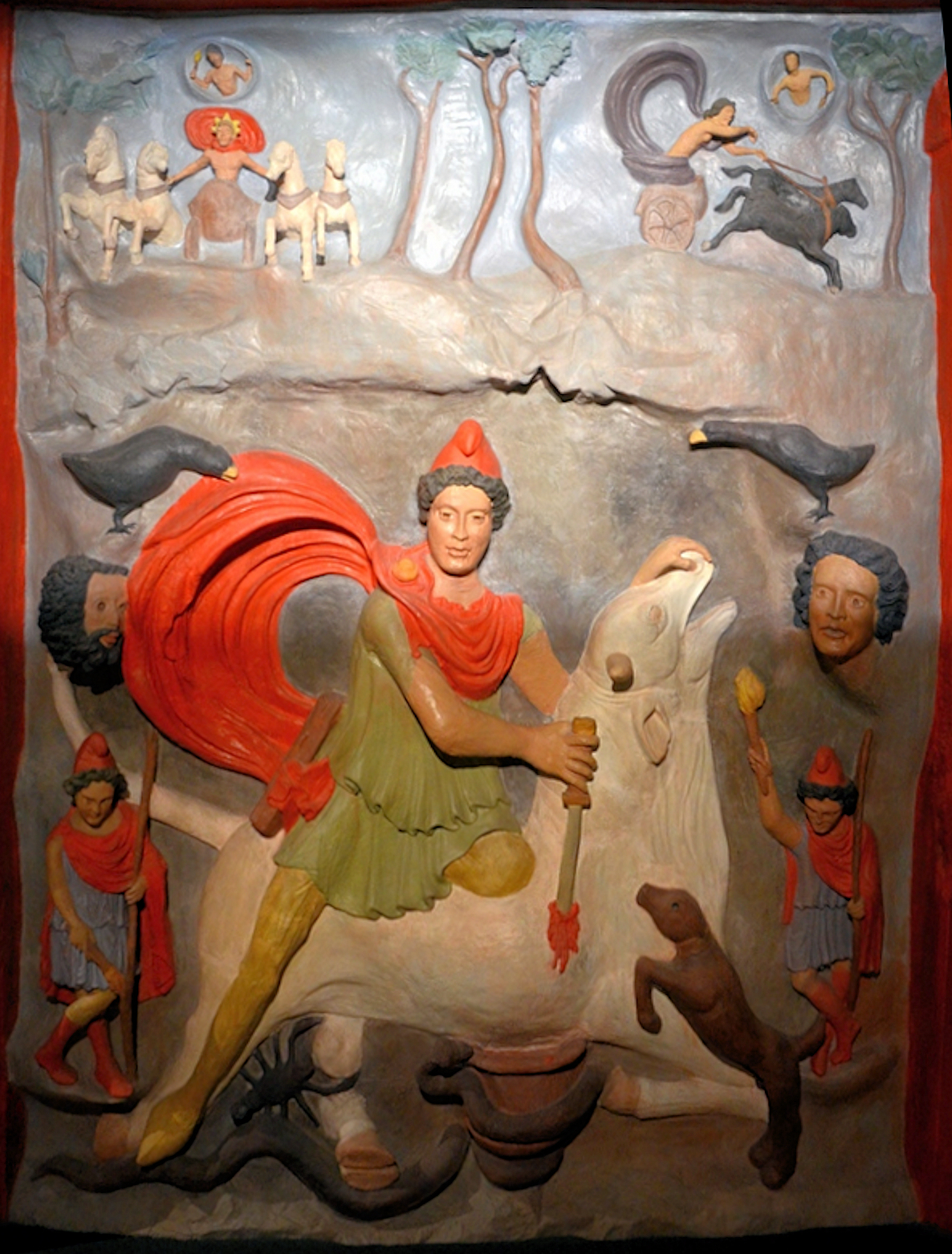
Mithraic relief with original colors (reconstitution), c. 140 CE–160 CE; from Argentoratum. Strasbourg Archaeological Museum.
“Mithraism had backing from the Roman aristocracy during a time when their conservative values were seen as under attack during the rising tides of Christianity.”[177] ~ link. If so, this provides a good reason for the Roman aristocracy to quietly switch over from Mithraism to Christianity thus retaining or even increasing their control of Roman culture. ABN
Laurent Guyénot is an original thinker able to convey his ideas with great clarity. He is also a French intellectual, polite yet fearless, erudite and also down to earth. I highly recommend this video and all of his work. The ideas presented in this video will blow your mind if you have never been exposed to them before. They completely rewrite the history of Europe over the last 2,000 years. ABN
I watched more than half of this last night. It is quite interesting for the first one-third or so, especially if Green’s ideas are new to you. Around the halfway point it declines into a spat over the existence of God. I stopped five minutes into that; may watch more of it later because the topic is interesting. Better to stage this kind of thing as a discussion rather than a debate. ABN
 American Buddhist Net