Buddhism and poetic consilience

Poetic justice is a small slice of poetic consilience. Buddhist practice is luminous, light and light-filled, consilient. It receives poetic and spiritual resonance in unexpected places and at unexpected moments.

Trains of thought, tributaries of the mind-stream, encounter other trains of thought from somewhere else and a magnificent blending or realization occurs. Sometimes we can barely hold it because it is so much brighter and realer than anything else; it becomes a glimpse, an inkling, a part of our deepest and most important memory.

Buddhism is a subjective science we do on ourselves. It has principles and rules we would do well to follow. Much of it can be bent and interpreted in our own way; much of it should be bent and interpreted in our own way; the Buddha even said that. That is good Buddhism.

But not all of it can be bent and interpreted in our own way. At its core Buddhism is a moral existential philosophy that is practiced as a subjective science. Karma is what we do well or badly in this respect.

Wholesome thoughts and behavior lead away from delusion toward enlightenment or purity of mind. Unwholesome thoughts and behaviors lead away from enlightenment or purity of mind toward delusion, toward clinging to a false self which will lead to suffering.

Wholesome and unwholesome can be defined in those terms. Pursuing wholesome thoughts and behaviors yields spiritual victory. Failing to pursue them or, worse, pursuing their opposite, yields spiritual defeat.

That is what Buddhism is. That is how you do it.

‘Don’t do bad. Do good always. Purify your mind. These are the teachings of all Buddhas.’
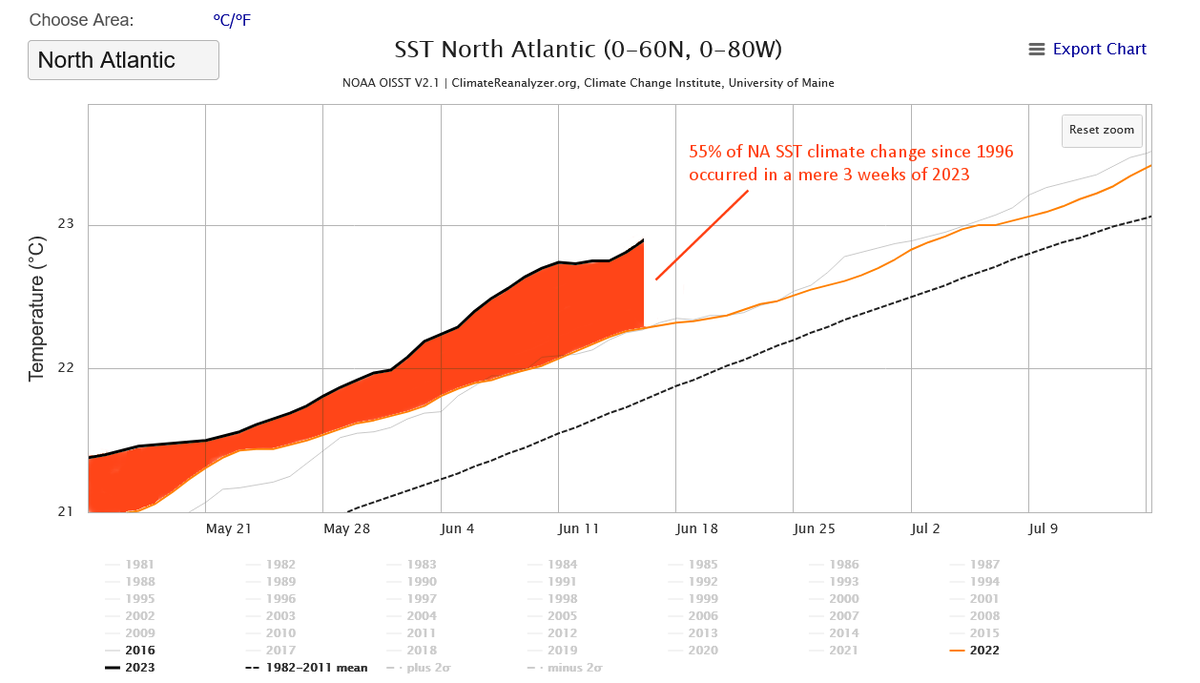
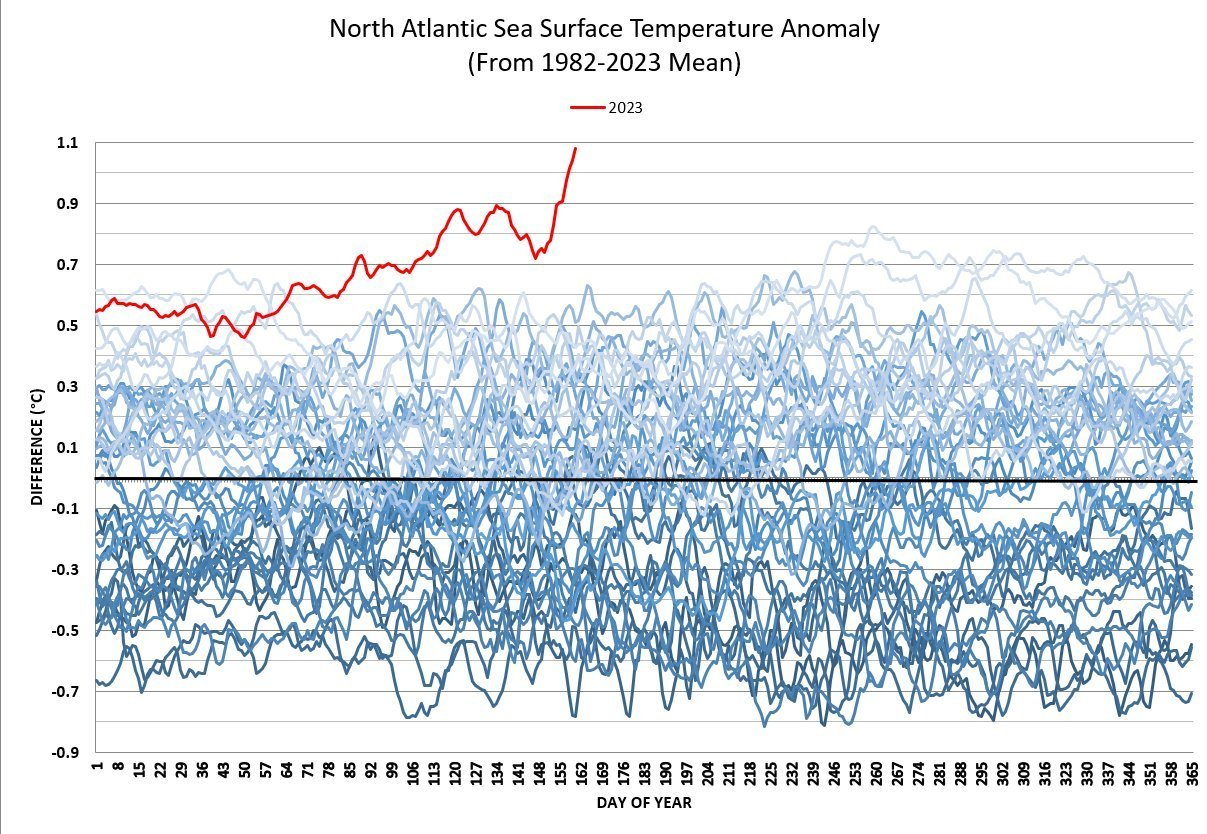
For decades this area has been kept relatively cool by sulfur emissions from ships… but this changed in 2020

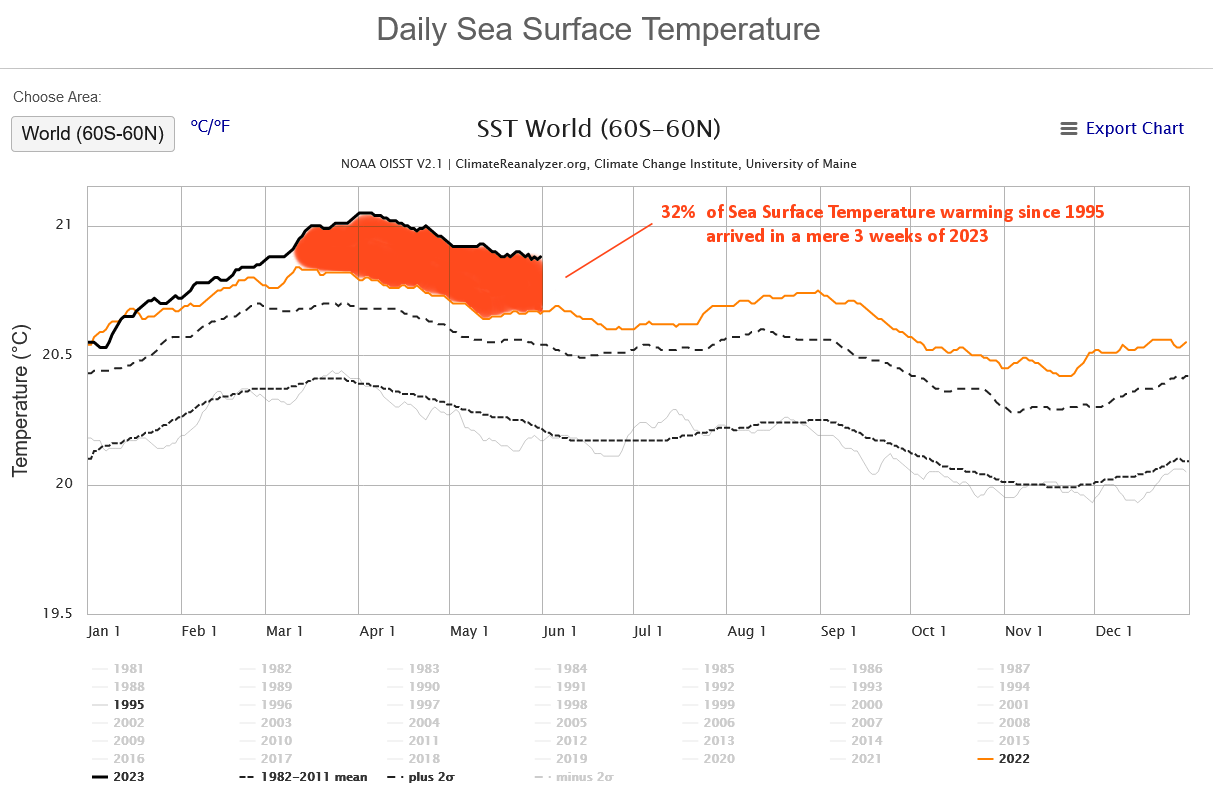
More from Leon Simons: Climate Impact of Decreasing Atmospheric Sulphate Aerosols and the Risk of a Termination Shock. Simons is focusing on shipping lanes and sulfur emissions while others are saying that though this is true an even larger factor which has appeared in the past few years is deep sea warming through volcanic activity or, in other words, exothermic emissions from the earth’s core. The topic of CO2 has receded as ocean temperatures continue rising. A basic problem in solving the ocean heat anomaly is we know very little about what is happening in the deep ocean, very little. Obviously, rising ocean heat is a very big deal and figuring it out will require real dialog and real science. I hope we do not go through another dumbfuk anti-science period as we have been with covid bullshit. ABN

Antarctic Sea Ice Is at Record Lows. Is It an Alarming Shift?

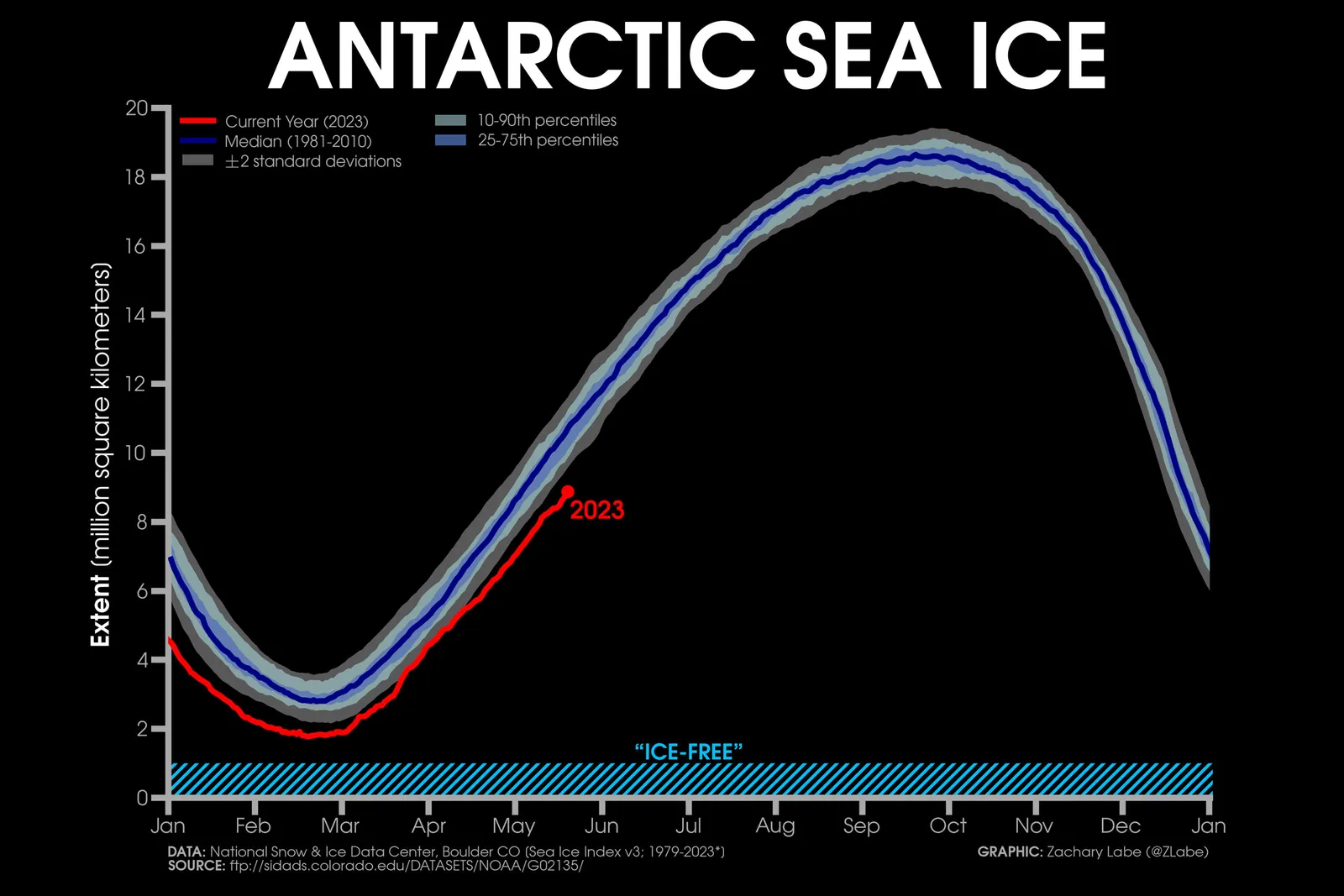
“Every single day so far in 2023, we’ve observed sea ice that’s been below average,” says climate scientist Zachary Labe of Princeton University and the National Oceanic and Atmospheric Administration, who created the graph below. The dark-blue line shows the median area of sea ice between 1981 and 2010, a figure called the “extent” that researchers measure in millions of square kilometers. The red line below all the others is the extent so far in 2023.

“In fact,” Labe continues, “it broke its lowest point ever recorded in the satellite era. Which was striking, because last year, we also had broken that record.”

link

How to understand why Buddhist rebirth does not require a self or soul

The basic reason no self or soul is reborn is neither exists independently of the mental universe that gave rise to our illusion of selfhood.

The mental universe within which we all exist is dynamic and so are we. In Buddhist terms, this dynamism is action or karma.

Buddhism does not say we do not exists. It only says that our selves are empty, that they do not ultimately exist. When we die our karma, the mental activity of this life, reconstitutes as a new being ensconced within the larger mental universe.

No one explains this better in modern terms than Bernardo Kastrup. In his essay Making Sense of the Mental Universe, he does not write about rebirth but rather about the conditions of our existence within the mental universe.

Nonetheless, his explanation of a “mental universe” shows precisely how rebirth can occur without there being any soul or pudgala or anything else that flies from the body upon death to transmigrate to another one.

I highly recommend reading the essay linked above. I have no idea if Kastrup is a Buddhist thinker. It’s even better if he is not, if his thinking arrived independently at a place consonant with original Buddhist thought.

Most Buddhists know that even Buddhists have trouble understanding how someone can be reborn without having a soul, self, or pudgala. What did the Buddha even mean by that? I know more than one university professor of Buddhist studies who explains Buddhist rebirth by saying, there is no such thing and neither is there such a thing as karma.

Those professors explain away karma and rebirth by claiming those fundamentals of Buddhist thought are nothing more than the Buddha “using the concepts of his day” to teach his moral doctrines and what amounts to his “atheistic Stoic” philosophy.

I mean no disrespect for the professors. It is hard to understand how something can be reborn and yet be empty of any perduring self or soul.

The essay linked above provides an excellent explanation of how that happens. I strongly encourage Buddhists or people who teach Buddhism or are interested in it to read Kastrup’s essay when you are in a good mood and want to learn something new and really interesting.

This essay can give you another angle on Kastrup’s thinking: Matter is nothing more than the extrinsic appearance of inner experience.

And here are some of my comments on Kastrup’s essay Making Sense of the Mental Universe.

first posted APRIL 2, 2020

A new search for extraterrestrial life has scientists looking toward the center of our galaxy

Could intelligent aliens be lurking at the heart of the Milky Way? 

A new search for extraterrestrial life aims to find out by listening for radio pulses from the center of our galaxy. Narrow-frequency pulses are naturally emitted by stars called pulsars, but they’re also used deliberately by humans in technology such as radar. Because these pulses stand out against the background radio noise of space, they’re an effective way of communicating across long distances — and an appealing target to listen for when searching for alien civilizations. 

Scientists described the alien-hunting strategy in a new study, published May 30 in The Astronomical Journal. Researchers led by Cornell University graduate student Akshay Suresh developed software to detect these repetitive frequency patterns and tested it on known pulsars to be sure it could pick up the narrow frequencies. These frequency ranges are very small, at about a tenth of the width of frequencies used by a typical FM radio station. The researchers then searched data from the Green Bank Telescope in West Virginia using the method. 

“Until now, radio SETI has primarily dedicated its efforts to the search for continuous signals,” study coauthor Vishal Gajjar of the SETI Institute, a nonprofit organization dedicated to the search for intelligent life in the universe, said in a statement. “Our study sheds light on the remarkable energy efficiency of a train of pulses as a means of interstellar communication across vast distances. Notably, this study marks the first-ever comprehensive endeavor to conduct in-depth searches for these signals.”

link

So far they have not found anything but the technique and aim of it is interesting. ABN

Researchers are acquitted for showing that most rapes in Sweden are committed by migrants

Many have taken for granted that research in Sweden is free. So did the research doctor Kristina Sundquist – until she became the subject of a criminal investigation for having conducted prohibited research on who commits rape in Sweden. After living with a criminal stamp on him for two years, the investigation is now closed. However, Sundquist does not receive any apology or compensation for how she was affected.

Kristina Sundquist is a doctor in general medicine. By chance, she discovered in connection with a research project that there is a large over-representation of migrants as perpetrators of rape and chose to draw attention to this. She wouldn’t have done that.

The fact that this information was not withheld was not looked upon with kindly eyes higher up in the research world. The Appeals Board for Ethics Review (Önep) decided on its own initiative to report Sundquist for “unethical” research and thus put an end to it.

“Not permission” to research

According to the report, Sundquist “did not have permission” to mention such things in his research and the case was handed over to prosecutors for criminal investigation. For two years, she has been forced to live with a degrading criminal label on her in the world of research, with the consequences for her career.

But now the yoke is lifted from Sundquist’s shoulders, at least partially, when Eva-Marie Persson, chief prosecutor at the Public Prosecutor’s Office’s development centre, announces that the investigation is closed. However, this does not happen because it has been concluded that it is not possible to prove that Sundquist committed any crime.

The reason is instead that the prescription period has expired. This means that Sundquist will never be completely washed clean and receive redress. This may mean that she may also find it difficult to conduct research in the future.

link

The original article is in Swedish. The excerpt above is from a Google translation of the article. This kind of repressive official behavior (even in the sciences) is due to centuries of clan-busting policies first from Catholics and then other Christians. The result is a society incapable of understanding most of the rest of the world which is societally clan-based. Western peoples are for the most part incapable of defending themselves against clan-based aggression, infiltration, takeover, domination. You can see for yourself how bad this situation is by simply raising this topic within a group of Westerners. Chances are you will be socially censured immediately and ostracized if you repeat the behavior. Just as clannishness has been ingrained into most human beings for tens of thousands of years, so clannishness has been extirpated from Westerners who now react violently against it. Shows that cultural conditioning is a big deal. At the bottom somewhere is a strong instinct. ABN

Observations show that Antarctic ice shelves GAINED 661 Gt of ice mass over the past decade

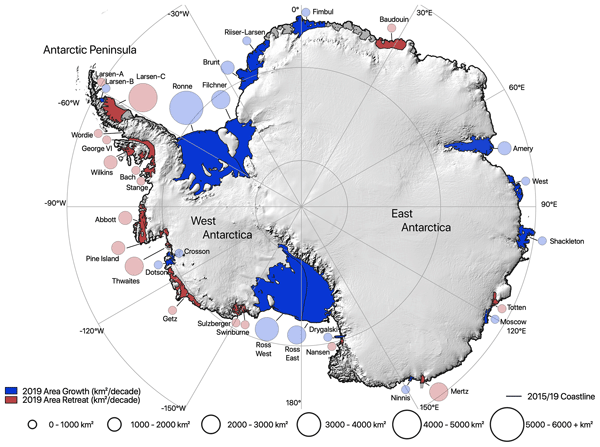
Antarctic ice shelves provide buttressing support to the ice sheet, stabilising the flow of grounded ice and its contribution to global sea levels. Over the past 50 years, satellite observations have shown ice shelves collapse, thin, and retreat; however, there are few measurements of the Antarctic-wide change in ice shelf area. Here, we use MODIS (Moderate Resolution Imaging Spectroradiometer) satellite data to measure the change in ice shelf calving front position and area on 34 ice shelves in Antarctica from 2009 to 2019. Over the last decade, a reduction in the area on the Antarctic Peninsula (6693 km2) and West Antarctica (5563 km2) has been outweighed by area growth in East Antarctica (3532 km2) and the large Ross and Ronne–Filchner ice shelves (14 028 km2). The largest retreat was observed on the Larsen C Ice Shelf, where 5917 km2 of ice was lost during an individual calving event in 2017, and the largest area increase was observed on Ronne Ice Shelf in East Antarctica, where a gradual advance over the past decade (535 km2 yr−1) led to a 5889 km2 area gain from 2009 to 2019. Overall, the Antarctic ice shelf area has grown by 5305 km2 since 2009, with 18 ice shelves retreating and 16 larger shelves growing in area. Our observations show that Antarctic ice shelves gained 661 Gt of ice mass over the past decade, whereas the steady-state approach would estimate substantial ice loss over the same period, demonstrating the importance of using time-variable calving flux observations to measure change.

Change in Antarctic ice shelf area from 2009 to 2019

‘We do not know what can happen if we set up countless wind turbines’

In an interview, the renowned expert has now again asked uncomfortable questions about what he considered possible connections between the strong expansion of wind energy and warming of the climate. The answers that Ganteför gave to the „ Nordkurier “ will not please everyone – and will therefore be largely ignored in the sometimes very one-sided debate about a sensitive topic.

Summarized in one sentence, the physicist warns: „ We currently do not know what can happen if we continue to set up countless wind turbines. “

link

The original article is in German with a link to an English translation. When we take energy from the wind, we slow the wind with several possible ramifications including increasing warming while also diminishing rainfall. ABN