Scientists have begun work on a controversial project that aims to create human DNA from scratch. World’s largest medical charity, the Wellcome Trust, has donated Rs 117 crore (10 million pounds) to start the project, which involves scientists from universities including Oxford, Cambridge and Imperial College.
“The sky is the limit. We are looking at therapies that will improve people’s lives as they age, that will lead to healthier ageing with less disease as they get older,” Dr Julian Sale, of the MRC Laboratory of Molecular Biology in Cambridge, who is part of the project, told the BBC.
“We are looking to use this approach to generate disease-resistant cells we can use to repopulate damaged organs, for example, in the liver and the heart, even the immune system,” he said.
As per Professor Matthew Hurles, director of the Wellcome Sanger Insititute, studying how genes and DNA regulate our bodies could help us pinpoint when they go wrong and ultimately develop better treatments.
“Building DNA from scratch allows us to test out how DNA really works and test out new theories, because currently we can only really do that by tweaking DNA in DNA that already exists in living systems,” said Mr Hurles.
This isn’t just another UFO mystery. What Greer said in Mexico about the sphere’s materials, movement, and possible alien inscriptions, will blow your mind.
1/ Dr. Steven Greer flew to Mexico for one reason: To examine the Buga Sphere up close. After seeing it, he didn’t hold back:
“This is clearly an anomalous object with multiple possible origins.”
2/ Greer didn’t jump to conclusions. He brought a team of scientists to test the sphere using isotope-level metal analysis and Carbon-14 dating. To determine if it’s from Earth, or from deep space.
3/ They found a polymer embedded in the sphere, near its equator. It contains carbon, and if it’s thousands of years old, then this isn’t a modern object. It predates industrial civilization.
4/ Now here’s where it gets exciting! Inside the Buasphere are microscopic fiber optics which according to Dr. Steven Greer are molded into the structure itself. That’s not 20th-century tech, that’s integrated photonics before we even knew what that was.
5/ Greer says this kind of fabrication doesn’t match anything known from Earth, unless a long-lost civilization once had access to tech we can’t even replicate today.
The Discovery of life on Mars, and by extension, the stars, could be proven by discovery of a single living microbe on the Red Planet. But, at the same time, a mass of independently derived data all indicating a finite probably of life, indicating Occam’s Razor as a factor, can also form the basis for the following Inductive Reasoning: 1. The Conditions on Early Earth, where life appeared, and Early Mars, have now been found to be basically identical; therefore, based on the Principle of Mediocrity, the probability of life is estimated to be PL =0.5 on Mars, an estimated 50% probability. 2. Complex organic matter has been found in recently formed aqueously altered terrains on Mars, and in both ancient and young meteorites from the Red Planet, in aqueously deposited minerals found within them, suggesting a further probability of biological origin versus abiotic of PL =0.5. 3. Reexamination of the Viking Life Experiment results, given new knowledges of both Mars surface chemistry and biologically generated super-oxides on Earth, strongly support the conclusions of Levin that life was found in 1976, 4. The seasonal variations of two biologically produced gases, O2 and CH4 recently discovered, are consistent with widespread microbial life on Mars, and along with the Life Experiment results, again can be estimated to indicate a PL =0.5 for each test. In the article we will explore these four findings holistically and draw the overall Inductive Conclusion that the simplest interpretation for this body of data is that Life began and persists on Mars as surely as it does on Earth. We assume here that, using a probabilistic model, the probability of Mars being sterile is PS =(1-PL)N+1 and yields an estimated probability of Life on Mars as 97%. Life on Mars is thus discovered. This conclusion, similar to a court case built on circumstantial evidence, can also be likened to a Second Copernican Revolution, wherein the Earth is now displaced from the center of the Biological Universe, just as it was formerly displaced from its geometric center.
At around 15 min, the video describes the effects of this observation of those who observed it. Worth watching from the beginning, but I mention that to show it goes somewhere human and very interesting. Filing this one under both ‘science’ and ‘Buddhism’. ABN
Observed anomalies that are not let go are the heart and soul of investigative science. There have been many theories about why the Towers fell — nano-thermite, energy weapons, mini nukes. If DARPA is 30-50 years ahead of what the public knows, which it surely is in many realms, it makes sense that we still do not know what caused the fall of the Towers or the other major events of 9/11. It surely was not crashing airplanes, which themselves are four separate events, each rife with unique anomalies: The plane that disappeared into a hole in the ground in PA; the plane that flew at an impossible speed into the Pentagon; the two planes that supposedly struck the Twin Towers, also flying at impossible speeds and seemingly disappearing into the Towers unlike any airplane crash in history. ABN
Another former Bush administration official is exposing the elites’ fear of the upcoming geophysical event on Tucker Carlson’s show.
She says much of the stolen black budget money ended up being used to build underground doomsday bunkers and infrastructure.
Watch this segment about what the elite is afraid of, and why we should start preparing too—because they’re not going to tell you what’s coming. Follow this thread for more information!
She says ‘solar minimum,’ but what she really means is the Grand Solar Minimum. They are afraid of the Grand Solar Minimum, when the Sun becomes less active and its magnetic field weakens. Combined with the decreasing strength of Earth’s magnetic field, this will expose us to increased cosmic rays and radiation from outside the solar system.
There are studies indicating that the Sun will enter a ‘Grand Solar Minimum’ sometime between 2030 and 2040. So that is why you are hearing a lot about the year 2030.
…Over time, humans went from an anthropocentric to a geocentric to a heliocentric and eventually to a more universal view of the world, and each step constituted scientific progress.
Yet the crux is that there is at least one important phenomenon that resists such objectivization or “de-perspectivization,” and that is consciousness itself. If we accept that the core of consciousness is subjective experience, then consciousness is the ultimately subjective phenomenon. The core of my consciousness lies in the fact that I find myself in a world in which there are first-personal facts. I am conscious, I have certain experiences, I am in a particular perceptual state, and so on. First-personal facts are irreducibly subjective. They are “centred” around my perspective as an experiencing subject, and unlike objective facts, they are not invariant under shifts in perspective.
Crucially, each of us is inextricably tied to our own conscious perspective. I can reflect about your experiences and empathize with you; I can hypothetically try to place myself in your shoes; I can try to simulate in my mind what things must be like for you. But I cannot literally leave my own conscious perspective. It is an essential fact about me that I experience the world from my perspective and not from anyone else’s. To be conscious, one might say, is to have a subjective perspective around which some first-personal facts are centred.
…The lesson, I think, is that the attempt to “objectivize” consciousness – to represent it as an ordinary property that can be found in the objective world, like gravity and electromagnetism – fails to do justice to the irreducibly subjective nature of the phenomenon. Physicalist theories of consciousness are not alone in running into that problem; standard versions of dualism face the same problem too. We will better understand consciousness only if our scientific and philosophical theories fully come to terms with the existence of first-personal facts and recognize that reality may not be captured by a single objective book of the world, but only by a library of subjective ones.
This is a good essay. It provides an overview of consciousness studies to frame the worthy assertion that: ‘We will better understand consciousness only if our scientific and philosophical theories fully come to terms with the existence of first-personal facts’. This kind of thinking fits well with Buddhism, and especially well with the Buddhist emphasis on samadhi states, which are deeply subjective. A Buddhist might say samadhi is describable and sharable with someone else who knows it. Or a Buddhist might not say that. The full essay is 2,578 words long and worth reading because the point is well made and the overview fits it very well. It’s quality information briefly stated. ABN
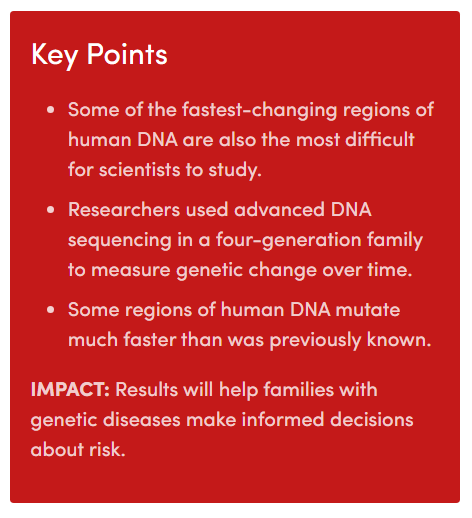
Knowing how human DNA changes over generations is essential to estimating genetic disease risks and understanding how we evolved. But some of the most changeable regions of our DNA have been off-limits to researchers—until now.
A team of researchers from University of Utah Health, University of Washington, PacBio, and other institutions has used multiple DNA sequencing technologies to develop the most comprehensive atlas yet of genetic change through generations.
The new investigation revealed that parts of the human genome change much faster than was previously known, laying the foundations for new insights into the roots of human disease and evolution.
“It’s mutations that ultimately differentiate us from other species,” says author Lynn Jorde, PhD. “We’re getting at a very basic property of what makes us human.”
Astronomers claim to have seen the strongest evidence so far for life on another planet. But other astronomers have urged caution until the findings can be verified by other groups and alternative, non-biological explanations can be ruled out.
“These are the first hints we are seeing of an alien world that is possibly inhabited,” Nikku Madhusudhan at the University of Cambridge told a press conference on 15 March.
Astronomers first discovered the exoplanet K2-18b in 2015, and soon established that it was a promising place to look for life. About eight times as massive as Earth and orbiting a star 124 light years away from us, the planet sits in the habitable zone of its star, where liquid water can exist. Further observations, in 2019, found evidence of water vapour, which led to suggestions that the planet may be covered in oceans sitting under a hydrogen-rich atmosphere, though not all astronomers agreed.
Earth rotates, the Sun rotates, the Milky Way rotates – and a new model suggests the entire Universe could be rotating. If confirmed, it could ease a significant tension in cosmology.
The Universe is expanding, but exactly how fast is a contentious question. Two different methods of measurement return two very different speeds – and as the measurements become more precise, each becomes more certain. This discrepancy is known as the Hubble tension, and it’s reaching crisis levels in physics.
So for a new study, physicists in Hungary and the US added a small rotation to a model of the Universe – and this mathematical massage seemed to quickly ease the tension.
“Much to our surprise, we found that our model with rotation resolves the paradox without contradicting current astronomical measurements,” says István Szapudi, an astronomer at the University of Hawaii.
“Even better, it is compatible with other models that assume rotation. Therefore, perhaps, everything really does turn.”
Ben Lamm is a serial entrepreneur and the founder and CEO of Colossal Biosciences, a company dedicated to genetic engineering and de-extinction projects. Colossal’s mission includes bringing back extinct species like the woolly mammoth and advancing conservation efforts through cutting-edge biotechnology. https://www.colossal.com
He’s actually right even if this is jarring for some to hear. The whole world should be thanking white people for our inventions not just in science, medicine, and technology, but also in economics, politics, philosophy, psychology, arts & letters, agriculture, engineering, law, you name it. We’ve taken decades of abuse (and reasonable criticism) with great patience (another white virtue). The shame now lies with other races who only criticize whites while benefitting enormously from our contributions in virtually every field of human endeavor there is. ABN
While the legacy media often reports that the world is rapidly transitioning away from fossil fuels to renewable energy, a new report from J.P. Morgan shows that narrative is simply not correct. Since 2010, $9 trillion has been spent globally on wind, solar, electric vehicles energy storage, electrification and power grids, but despite this expensive effort — mostly at taxpayer expense — the share of final energy consumption by carbon-free energy sources is advancing by approximately a scant 0.3% to 0.6% per year.
Michael Cembalest, Chairman of Market and Investment Strategy for J.P. Morgan, explains in “Heliocentrism,” the 15th annual energy paper by the investment firm, that the reason fossil fuels remain the dominant source of energy is that modern prosperity is tied to certain kinds of industrial products, including chemicals, steel, cement, food and paper. Approximately 80% of the energy inputs for these products are fossil fuels. JPMorgan Chase is the world’s fifth largest bank by total assets, with $3.9 trillion as of 2023.
“As things stand now, modern prosperity is highly reliant on fossil fuels,” Cembalest said in a podcast on the report. Dr. Roger Pielke, Jr., retired professor of environmental studies at the University of Colorado at Boulder, estimates on his “The Honest Broker” Substack that at the current pace, the world will not be carbon free until sometime after the year 2200.
“There’s a lot of people that are so focused on the growth in solar power that they believe that solar power, typically bolted on with some energy storage, can represent the dominant share of where we get our energy from,” Cembalest said.
Solar accounts for approximately 6% of global electricity generation. However, electricity is only about 33% of the total energy people consume, according to the paper, and by some estimates it’s only about 20%. Translating all that solar power to a share of final energy consumption, which includes all forms of energy, solar is only 2% of total final energy and will grow to 4% to 5% by the end of the decade.
“While that’s impressive growth from a low base, we obviously need to be more focused on the other 95% of where we’re going to get our final energy consumption from and rather than just the solar on its own,” Cembalest said.

 American Buddhist Net