Poland’s Prime Minister today warned ‘we are closer to war than any time since World War Two’ after his country was forced to shoot down Russian drones that violated its airspace.
Polish media is now reporting that Donald Tusk has requested the triggering of NATO’s Article 4, where member countries can bring an issue to the attention of the North Atlantic Council. Poland’s security council will also meet to discuss an ‘appropriate response’.
More than eight million Poles were ordered to hide in their homes as the drones flew overhead, with debris from one shot-down device crashing into a house. The full force of NATO’s fighter planes was unleashed to shoot down the drones.
After the organisation’s patriot defence systems detected the drones with their radars, Polish F-16 fighter jets, Dutch F-35, Italian surveillance aircraft, and NATO’s MRTT mid-air refuelling aircraft all came together to counter the drones.
The downing of Russia’s unmanned aerial vehicles marked the first-ever direct engagement between Moscow and NATO. It has long insisted it wants no confrontation with Putin. Kyiv has accused Russia of deliberately invading Poland’s airspace with 24 UAVs to test the West’s defences.
Multiple Russian drones leaving Ukraine airspace into Poland’s
On Wednesday, Tusk held an extraordinary meeting with top officials after Russia’s actions. Senior army officials are present at the gathering.
He said a number of drones that posed direct threats to Russia were shot down in a joint effort with NATO allies, and warned that Poland is ready to react. The prime minister added that he was in communication with allies.
Tusk also spoke in parliament and said some of the drones flew in from neighbouring Belarus, a staunch ally of Russia. He also confirmed that three or four of the nineteen drones were shot down.
UPDATE: The reasons for this are decidedly ambiguous. Could be to provoke NATO, to test Poland’s defenses, to prepare for negotiations or just to flex. How we interpret it is a psychosemiotic challenge. I doubt Putin wants war and also I doubt he would back down from war if provoked. It is very possible Poland or NATO has provoked Russia in some way we do not know about. Navrotsky said yesterday: ‘I’m not going to give my consent to send the Polish military to Ukraine’. I wonder if his views on that will change now. Another possibility is Zelensky sent doctored drones from Ukraine to provoke Poland against Russia. ABN
After you have a done a good deal of FIML, you will start to see semiotics as things, similar to words or memories.
FIML facilitates this process by forcing us to pay close attention to the ways we use semiotics and the ways they affect us.
Our identities, such that they are, are based on our closeness to or need for semiotics that define us, assure us, make us feel at home, tell us who we are.
Our use of semiotics in that way is very common but it is hard to grasp if we have no other basis for our identity, which few of us do.
FIML practice provides a different basis for identity than “extrinsic” semiotics, the conscious and unconscious semiotics of culture, upbringing, media, advertising, schooling, what we may think others think.
FIML partners, by constantly paying attention to the play of interpersonal semiotics, gradually will shift the bases of their identities from largely static extrinsic signs to dynamic intrinsic, or interpersonal, processes. This is what makes semiotics start looking like things rather than abstract elements of linguistic analysis.
Semiotics are things as much as words are. They differ in that there is no dictionary of them; we have to see them for ourselves and understand how they have been formed and why they affect us as they do.
Once partners do this through FIML practice, they will eventually notice that their habitual extrinsic semiotics will start to slough off, to fall away from them. This happens very naturally as a rich dynamic realm of largely error-free communication develops between them.
The falling away of habitual extrinsic semiotics that had been used to define or maintain the identity is accompanied by delightful feelings of freedom and lightness, independence and assuredness that one’s being is better served by the intimate communication of FIML than the inculcated beliefs and values of the past.
FIML is a specific semiotic, but it also says interesting things about the general semiotics of all languages and communication systems.
As a specific semiotic, FIML influences individual psychology, behavior, and thought. Since FIML rules can be generalized and taught, FIML also shows something about all languages and their uses.
FIML is a way that two people can check the specific semiotics that exists between them. Without FIML, or something like it, individuals cannot do this.
If an individual does not do FIML or something very similar in their primary relationship, that relationship will be characterized by semiotics extrinsic to the relationship and/or by illusions.
I don’t want to overemphasize the semiotic content of FIML practice, but a basic sense of how signs and symbols are interpreted can be a great help to understanding FIML.
In FIML practice, your partner can explain the “text” of what they said much better than you can interpret it. This can only happen if both partners are honest and trust each other and the interpretation/explanation of the “text” is brought up quickly enough that little or nothing has been forgotten by either partner.
As for honesty and trust, it is my guess that these areas can be a problem for people because we humans are almost always required to interpret what is said to us without any possible recourse to a better explanation. There are three major reasons for this: 1) convention, habit; 2) timing; and 3) emotion.
Taking the second reason first, timing makes it very difficult to get good information about what a speaker means because when we ask quickly enough for them to actually still be able to remember, we will appear confrontational or rude. The speaker will become flustered and often answer with an excuse rather than an explanation.
This happens due to factor three, emotion. Language evolved in hierarchical societies. To question someone quickly about what they said is to seem to question them, to doubt them. In hierarchies, we do not question the orders we are given. We wait our turn, we let the speaker finish, we don’t interrupt, etc. Yet, if we don’t act quickly—within a few seconds—the speaker will have forgotten the fullness of their mind at the moment they spoke. Their explanation for the “text,” for what they said, will be lost forever, even if we have a video recording of it.
Due to the quickness of human emotion, virtually all societies everywhere have constructed rules for listening and speaking that completely preclude a FIML-type inquiry. Most beginning FIML partners will, therefore, experience some difficulty getting used to FIML queries. Our moods, emotions, mental states, thoughts, and more have all been long conditioned by social forces that constrain us in the very place where we need more freedom—getting the real explanation from our partner to replace our interpretation.
You would never want to run a business or do an engineering project based on ambiguous interpretations, but most of us conduct our love lives and friendships in just that way.
FIML is a specific semiotic in that it deals with the communications between two specific individuals. FIML does not tell these individuals what to think, say, or believe. It merely provides a technique for them to fully explore the semiotics and all ramifications of those semiotics that occur between them. A general semiotic is one that says something about all languages. FIML fixes a general weakness that occurs, to the best of my knowledge, in all human languages.
Experimental research in mice has linked the derived allele to a number of traits, including greater hair shaft diameter, more numerous sweat glands, smaller mammary fat pad, and increased mammary gland density.[6] A 2008 study stated that EDAR is a genetic determinant for hair thickness, and also contributed to variations in hair thickness among Asian populations.[7] Derived variants of EDAR are associated with multiple facial and dental characteristics, such as shovel-shaped incisors.[8][9][10][11] This mutation is also implicated in ear morphology differences and reduced chin protrusion.[12]
A 2013 study suggested that the EDAR variant (370A) arose about 35,000 years ago in central China, a period during which the region was then quite warm and humid.[13] A subsequent study from 2021, based on ancient DNA samples, has suggested that the derived variant became dominant among Ancient Northern East Asians shortly after the Last Glacial Maximum in Northeast Asia, around 19,000 years ago. Ancient remains from Northern East Asia, such as the Tianyuan Man (40,000 years old) and the AR33K (33,000 years old) specimen lacked the derived EDAR allele, while ancient East Asian remains after the LGM carry the derived EDAR allele.[14][15]
It has been hypothesized that natural selection favored this allele during the last ice age in a population of people living in isolation in Beringia, as it may play a role in the synthesis of Vitamin D-rich breast milk in dark environments.[16][17][18] One study suggested that because the EDAR mutation arose in a cool and dry environment, it may have been adaptive by increasing skin lubrication, thus reducing dryness in exposed facial structures.[19]
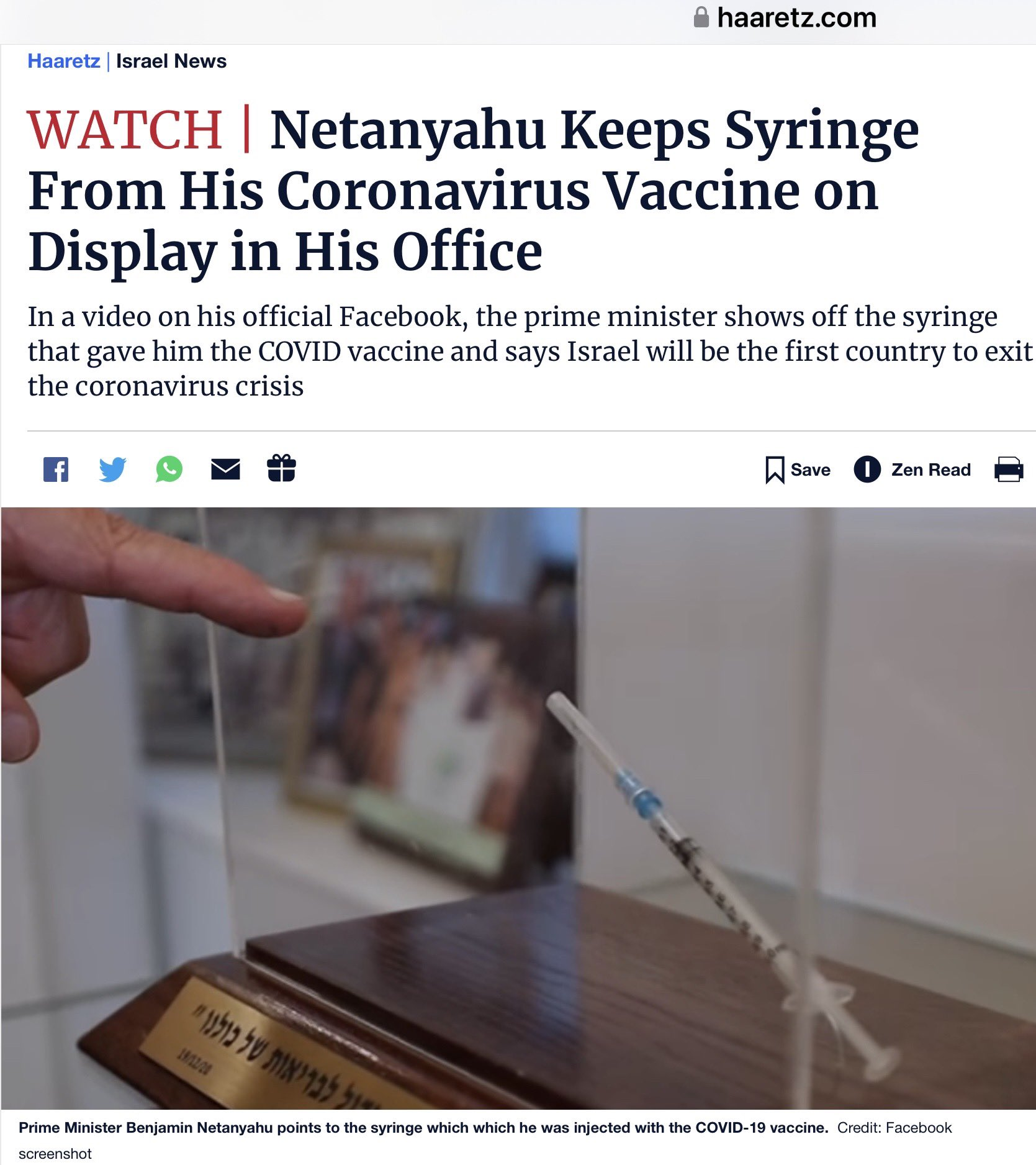
IF Israel gave fake covid shots to its population and IF Israel fudged all of its covid health data and IF it is true Israel is the only highly vaxxed nation in the world to show no decline in healthy pregnancies and births, while all others show alarming declines, one could assume this needle is displaying the gloating of a psychopath over his bioweapon. ABN
Listening to the ranting of a friend who has Borderline Personality Disorder (BPD), I am struck by two things:
he gives reasons for his anger
his reasoning or abstract understanding of his predicament is ridiculous
(His rant was recorded and sent to me by a third party who is trying to help.)
With that as a starting point, consider the various ways abstract reasoning or solid abstract paradigms can compensate for or mask mental illness. Not all of it is pretty.
For example, serial killers often mask their illnesses for decades by holding fast to the appearance of normalcy while secretly indulging their madness.
Less bad are career criminals who act with savagery in less direct ways, through hit men, poisons, theft, fraud, and so on.
There is a wide spectrum between serial killers and normally inoffensive people.
It is reasonable to see all cultures as fundamentally abstract paradigms that mask and allow for madness among large groups of people.
A culture, after all, is nothing more than a Lowest-Common-Denominator system of communication; an LCD semiology. Consider how many cultures are grotesquely narcissistic.
Personality is much the same whether it conforms well or not to whichever cultural semiology it inhabits.
From this point of view, enshrining diversity only ensures a wider array of mad people. Identity politics is the same; just more ways for mad people to function, more room for them to run free; more abstract paradigms to mask their underlying chaos.
That is a decent modern restatement of the First and Second Noble Truths: life is suffering because we are crazy.
The Third and Fourth Noble Truths tell us that the way out of being crazy is to use our reason better; to understand why we are crazy; that clinging to LCD semiologies can’t ever work.
A philosophical psychologist might rightly say that a mad mind open to reason will gradually become well.
My friend with BPD can reason, but his reasoning is really bad. It’s selfish, marinated in anger, and not open to contrary views. But even he can do it if he clings to reason and evidence.
Abstract reasoning and paradigms such as Buddhism, science, other religions, atheism, psychology, or philosophy can lead us out of madness if we use them diligently.
Diligence or perseverance is one of the most important virtues in Buddhist practice. Wisdom is the most important. Compassion is probably the most famous Buddhist virtue but compassion without wisdom or diligence is not good and can even be dangerous.
Indeed, my BPD friend frequently and loudly demands unreasonable compassion from others. And that is one of the most obvious flaws in the way he thinks about himself, the way he reasons.
The sudden popularity of these dance routines is signaling a significant change in USA society; it’s a healthy sign. Our beautiful damsels are awakening. ABN
The survey asked participants how often they felt optimistic about the future, useful, relaxed, had dealt with problems well, had thought clearly, felt close to others and were able to make up their own minds when required.
What the researchers found was that those who experienced verbal abuse as children were 1.64 times more likely to report poor mental well-being as adults. Meanwhile, individuals exposed to physical abuse were 1.52 times more likely to have compromised mental health later in life, and those who experienced both verbal and physical maltreatment were 2.15 times more likely to have negative mental health outcomes.
There’s a growing body of evidence that demonstrates how verbal and emotional abuse in childhood has long-term impacts, even changing the brain as it’s developing. Nonetheless, it’s often viewed as less harmful than other forms of maltreatment. In this study, the researchers found that while physical abuse had decreased – from around 20.2% of children born in the 1970s to 10% of those born in 2000 or later – verbal abuse has steadily increased.
Mind-control is a paramount form of verbal abuse, both by what it forces us to say and what it forbids us to say.
We all know the abusiveness of the silent treatment; mind-control uses the silent treatment very often.
They won’t say it and neither can you, so silence spreads like a psycholinguistic contagion.
Some even believe silence is a sign of maturity, so they succumb proudfully.
Early, middle and late education is also rife with mind-control verbal abuse. They even test your levels of indoctrination.
Intelligent humans are highly susceptible to psycholinguistic mind-control and semiotic hypnosis.
A medical setting is but one example of semiotic hypnosis, and it includes medical personnel. Schools are similar, and there are many other examples. ABN






 American Buddhist Net