I believe Trump feared for his life if he went against Bibi and that is the bottom-line reason for this war. Hardcore Jewish Supremacists will rejoice if all of the world turns into Gaza as long as they alone survive. ABN
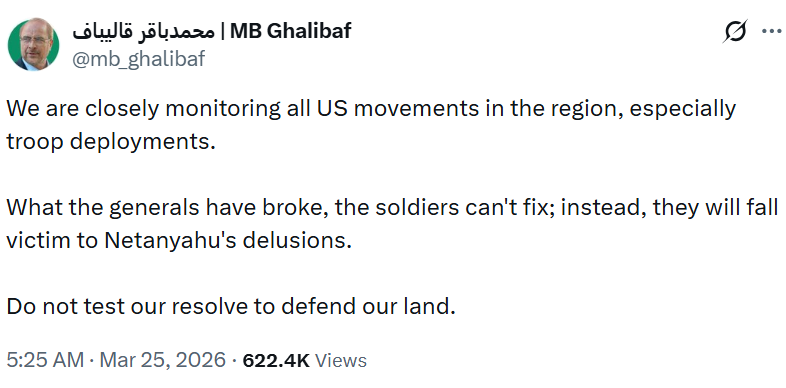
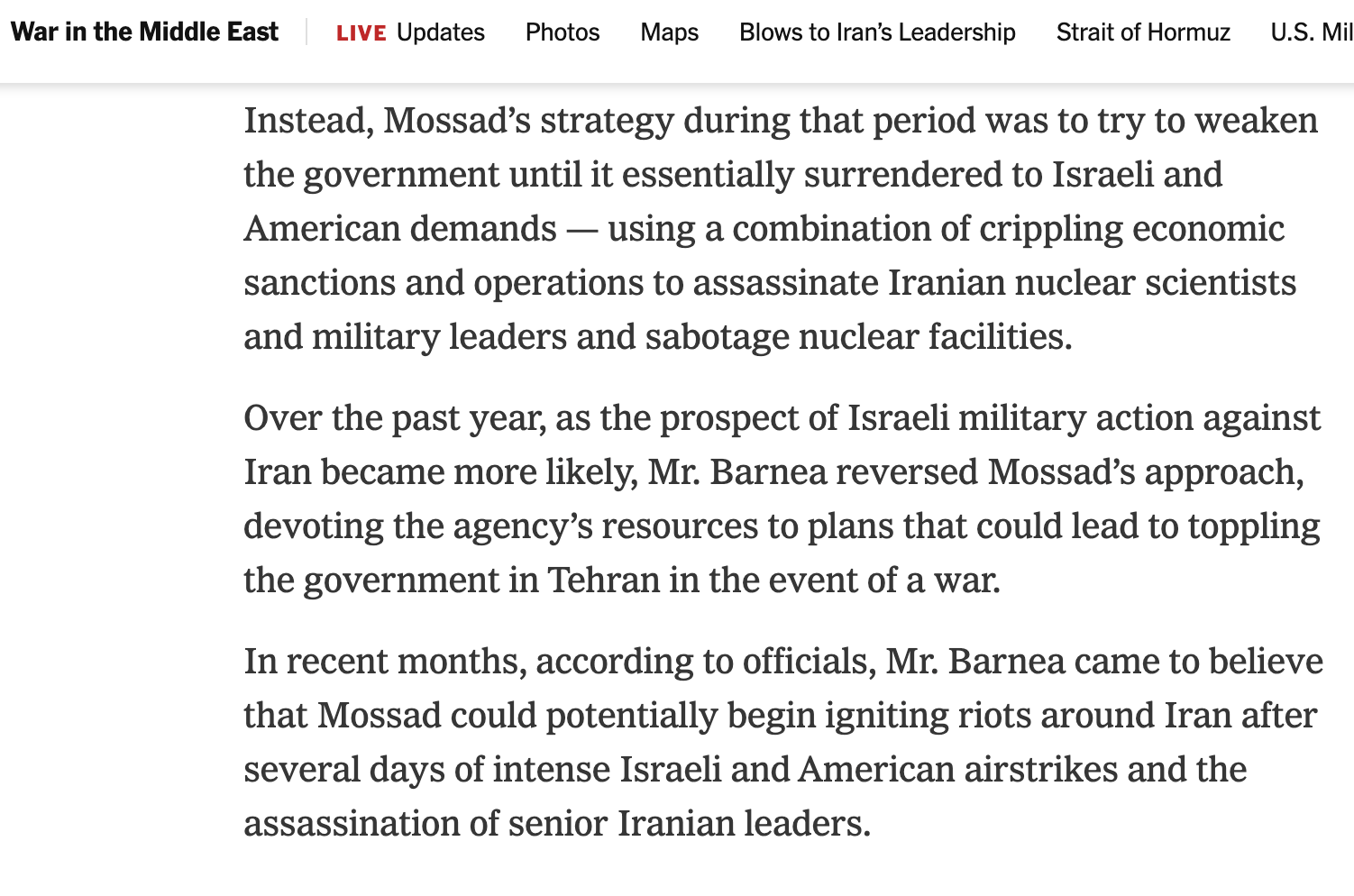
NY Times has essentially confirmed that Israel played a role in stimulating the violent regime change riots that left around 3000 dead in Iran this January 8 and 9, but which were marketed in the West as pro-democracy protests.
It was well understood by the Mossad that those riots would help stimulate military action by Trump.
Israeli intel merely needed to convince the feeble-minded president that a wave of decapitation strikes would unleash a massive upheaval to immediately topple the Islamic Republic. The January riots were presented to Trump as a preview of what was to come.
Western media, including the NY Times and The Guardian, played a central role in legitimizing Israel’s deception by falsely characterizing the violent regime change riots as mere protests, massively inflating the death toll and covering up the fact that many were murdered by the Israel-backed rioters themselves
The whole of Western media and the Western human rights industrial complex deliberately misrepresented the real character of those riots. But now that the war they helped to instigate is going badly for the US and Israel, that same media is now free to reveal a few kernels of truth.
The Ukrainian-American entrepreneur, who acquired OnlyFans in 2018, passed away peacefully on March 20 in Pompano Beach, Florida, after a long illness, the company confirmed Monday. Radvinsky, worth up to $8 billion, turned the platform into a revenue machine that paid creators billions and delivered him over $700 million in dividends last year alone. His family has asked for privacy, leaving the company’s future leadership uncertain as reactions pour in from shock to tributes for his business achievements.
__________
Radvinsky reportedly was the top donor to AIPAC. ABN
Donald Trump has halted all strikes on Iranian energy infrastructure after what he described as ‘very good conversations’ aimed at ending the war, even as Tehran rejects his claim that peace talks are underway.
The President said that the US and Iran had ‘very good and productive conversations regarding a complete and total resolution of our hostilities’ over the last two days.
Trump said he had ordered the Defense Department ‘to postpone any and all military strikes against Iranian power plants and energy infrastructure for a five day period.’
He warned that the cessation of the strikes was ‘subject to the success of the ongoing meetings and discussions.’
Iranian state media pushed back on Trump’s claims of ceasefire talks, insisting that no direct or indirect negotiations with the US have taken place.
A regime source taunted Trump by claiming after ‘hearing that our targets would include all power stations in West Asia, he backed down.’
Trump’s ceasefire announcement comes after he threatened over the weekend to bomb Iran’s electricity grid unless the regime reopened the Strait of Hormuz with 48 hours.
US CENTCOM chief says Iran targeting civilians out of ‘desperation’
__________
Both pieces of news—one from Trump and one from CENTCOM—sound like empty war propaganda, with the same dubious points repeated many times. If there is to be a winner, I hope it is USA. Starting this war appears to have been a massive error stemming from Jewish Supremist control of Trump, Congress, US media and finance, to name but a few of the top players. The best result of this war so far is Jewish Supremacy and its stranglehold over USA and the West is blatantly on display and tens of millions of Americans and others worldwide are seeing it. ABN
Israel’s veiled threat to Moscow came just after Russian media warned traffic cameras in Moscow were vulnerable to the same exploits that Israel reportedly used to monitor Ayatollah Khamenei’s residence before assassinating him.
Israeli military spokeswoman Anna Ukolova has drawn outrage in Moscow after threatening that Russian authorities who “wish Israel ill” could be subject to “elimination,” while suggesting Israel could hack into Russian closed-circuit television cameras to identify and track targets.
Asked by a journalist with Russian radio broadcaster RBC whether Israel had access to Russian traffic cameras, Ukolova declined to answer directly but warned that “Khamenei’s elimination shows our capabilities are serious” and that “no one who wishes us harm will be left aside.”
She added, ominously, “I hope Moscow does not wish Israel ill right now – I’d like to believe that.”
Ukolova’s statements came just days after it was revealed that a large number of Russian CCTVs were potentially using BriefCam – an Israeli video analysis software that closely matches the description of a program the Netanyahu regime reportedly deployed to track Iranian movements outside the home of Iran’s Supreme Leader before they assassinated him during their February 28 sneak attack.
UPDATE: Below is a thoughtful comment I found under the article above. It describes precisely how a great deal of mind-control works. Define the terms, commandeer the psycholinguistics and you will control entire civilizations, and move them in any direction you like. ABN
1. Humans are highly cogno-linguistic. We perceive reality largely by the language that we use to describe it. Most everyone believes and presumes that you have to be able to think something before you can say it. The more dominant-reality is that, above a certain base-level of perception and communication, you have to have the words, language, grammar, and comprehensive-concordance-syntax by which to say something before you can think it. Whosoever controls language – controls the mind – for better or for worse.
2. The world is ever-increasingly controlled and administered by people who genuinely believe whatever is necessary for the answer they need. Administrative agents of broadly-defined entrenched-financial-power have solved the criminal-law enigma of mens rea or guilty-mind by evolving or devolving (take your pick) into professional-schizophrenics who genuinely believe whatever they need to believe for the answer they need, and who communicate among themselves subconsciously by how they name things, and by how things are named for them. They suffer a cogno-linguistically-induced diminished-capacity that renders them largely-incapable of perceiving reality beyond labels.
3. Their core business-model or modus operandi is called a systematized-delusion:
“A “systematized delusion” is one based on a false premise, pursued by a logical process of reasoning to an insane conclusion ; there being one central delusion, around which other aberrations of the mind converge.” Taylor v. McClintock, 112 S.W. 405, 412, 87 Ark. 243. (West’s Judicial Words and Phrases (1914)).
Iran fired two ballistic missiles at a joint US-UK military base in the Indian Ocean just hours after Keir Starmer gave the green light for Donald Trump to use UK-based bombers threatening the Straits of Hormuz.
The move prompted Tehran to warn the Prime Minister he had placed British lives ‘in danger’ by consenting to Trump’s request to use B-52s and other aircraft flying out of RAF Fairford and Diego Garcia to blast Iranian missile sites in the strategically important waterway.
Multiple US officials confirmed to the outlet that neither missile had struck the base. Two sources said one of the missiles failed in flight, while the other was intercepted by a US warship, but the action is a concerning development in the third week of the US-Israeli war on Iran.
Two deep points worth mentioning: 1) Trump is doing Netanyahu’s bidding because he fears Jewish Supremists will kill or harm him or members of his family; and 2) Starmer, who appears to be a Jewish Supremist, is purposely destroying Britain through the mass invasion of migrants. Starmer is Jewish but you do not need to be Jewish to be a Jewish Supremist. Some 50 million Zionist Christians in USA are fundamentally Jewish Supremists. They are at the bottom of the JS pyramid, but they are JS nonetheless and will be harmed or killed like Charlie Kirk if they turn against JS. This is the deep fact at the heart of what is now WW3 destroying the world economy. The more people understand this, the better our chances for a better world. JS do not care about anyone else’s blood, treasure or land. They only care about their own blood, treasure and land, which is ultimately, in their fantasies, the entire world once everyone else is killed or enslaved. ABN
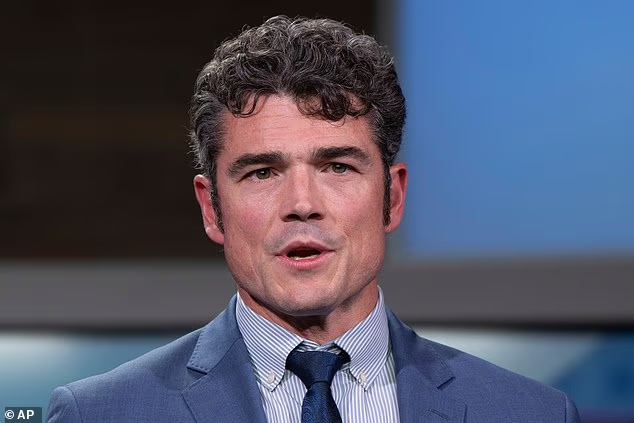
Joe Kent said the same in his interview with Tucker, below. Trump surely also fears for his family. Recall, Netanyahu gifted an Israeli-made cellphone to Trump. That was a blatant threat. He also gave a bunch of US Congress people Israeli-made cellphones some months ago. McGovern says these threats against Trump [and all of the US elite, I would add] are the real story here. Yes, it is. That’s the real story. A Jewish Supremist gang controls when and where USA goes to war and everyone at the top is afraid of being killed if they disagree. ABN
This may become a spiritual battle that will change the world. Some 50 million American Christians are Zionists, meaning they believe the modern state of Israel is fulfilling scriptural prophecy. ABN
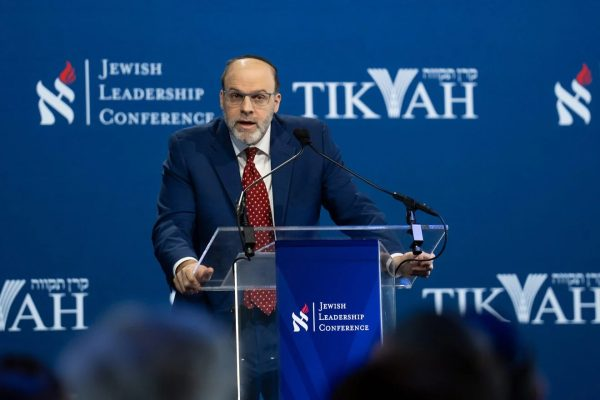
The battle for the soul of the American Right is no longer fought in whispers. It has erupted into open warfare, with a taxpayer-funded Jewish organization demanding that Tucker Carlson be purged from conservative media and banished from President Donald Trump’s coalition entirely.
Days after the United States and Israel launched military operations against Iran in early March 2026, the Tikvah Fund released a podcast episode that laid bare the neoconservative establishment’s fury at populist opposition to the war. Former CIA Director and Secretary of State Mike Pompeo declared that conservatives must “wholeheartedly” reject Tucker Carlson and Candace Owens over their “nuttiness” and “anti-Semitism.” Pompeo insisted the “isolationist” wing of MAGA does not represent “the Trump that I worked for.”
Hudson Institute senior fellow Michael Doran went further. “I want to see Tucker Carlson dethroned,” Doran told Tikvah’s Jonathan Silver. “I would like to see him become an embarrassment to JD Vance. I would like to see Donald Trump attack him. Not just call him kooky from now and then but really make him off-limits to everybody in the administration.”
Chris Menahan of Information Liberation called attention to the podcast and how the Tikvah Fund is subsidized by gentile taxpayers: “Keep in mind as you watch that this is Trump admin/US taxpayer-funded cancel culture.”
…The frantic campaign to purge figures like Tucker Carlson from the American Right reveals the inherent fragility of Jewish influence. By attempting to use the coercive power of the state to suppress rising populist dissent, organized Jewish power inadvertently accelerates the very instability it fears. This escalation into state-sponsored censorship is a desperate bid to maintain control, yet it serves only to deepen the rift with the gentile population. As the ideology of the current establishment begins to turn against its own Jewish architects, this current conflict represents merely the latest chapter in an unavoidable and predictable civilization struggle between gentiles and Jews for civilizational primacy.
Jewish Supremacy, funded by USA taxpayers, out in the open attacking free speech and entirely reasonable dissention from their arrogant and groundless supremacist views. JS caused this wanton war. To what extent Trump agrees with them or is forced to play along or is even a crypto Jew or JS himself, is hard to tell. One thing is certain, this is a terrible way to run a country. As Trump said they other day, ‘it is a habit’ of USA to do JS bidding. ABN
Donald Trump‘s top counterterrorism official has resigned in protest over the Iran war, accusing Israel of pressuring the US into a conflict he says was built on lies.
Joseph Kent, Director of the National Counterterrorism Center, said Iran posed no imminent threat and the war was started ‘due to pressure from Israel and its powerful American lobby,’ adding: ‘I cannot in good conscience support the ongoing war.’
Kent, who served under Director of National Intelligence Tulsi Gabbard, accused the President of reneging on the non-interventionist principles he campaigned on.
‘Until June of 2025, you understood that the wars in the Middle East were a trap that robbed America of the precious lives of our patriots and depleted the wealth and prosperity of our nation,’ the former Army Special Forces soldier wrote in his resignation letter.
‘The time for bold action is now. You can reverse course and chart a new path for our nation, or you can allow us to slip further toward decline and chaos. You hold the cards.’
Trump’s top counterterrorism official has resigned in protest over the Iran war, accusing Israel and its ‘powerful American lobby’ of pressuring the US into a conflict he says was built on lies
Kent, who deployed to combat 11 times and lost his wife Shannon in what he calls a war manufactured by Israel, is closely aligned with the populist ‘America First’ wing of the Trump administration, including Gabbard and Vice President JD Vance, who have both warned against new Middle East entanglements.
His resignation lays bare a widening split inside Trumpworld. Kent accused high-ranking Israeli officials and members of the American media of running a ‘misinformation campaign’ to deceive the President into believing Iran posed an imminent threat, drawing a direct parallel to the lead-up to the Iraq war.
This is a major upside of this war for Israel — every day more Americans become aware of the danger of Jewish Supremist infiltration throughout our government and society; their bribery, blackmail and murder. Trump’s cabinet have all bowed and scraped before the Jewish Supremists. A possible good side of that is at least some of them are covert true patriots waiting for right conditions to disarm JS power over USA. ABN



 American Buddhist Net