A reclusive tribe in the Amazon finally got hooked up to the internet, thanks to Elon Musk — only to be torn apart by social media and pornography addiction, elders complain.
Brazil’s 2,000-member Marubo tribe has been left bitterly divided by the arrival of the Tesla founder’s Starlink service nine months ago, which connected the remote rainforest community along the Ituí River to the web for the first time.
The Marubo are a chaste tribe, who even frown upon kissing in public — but Alfredo Marubo (all Marubo use the same last name) said he is anxious that the arrival of the service, which delivers super-fast internet to far-flung corners of the planet and has been billed as a game-changer by Musk, could upend standards of decorum.
Alfredo said many young Marubo men have been sharing porn videos in group chats and he has already observed more “aggressive sexual behavior” in some of them.
From evening drives to navigating a house or a park in the dark, there are so many situations where it’d be handy to slip on a simple pair of night-vision lenses and the world that’s beyond human optical perception could be illuminated like never before. This vision could be a reality, with a technology breakthrough that could deliver this elusive view to everyday consumers, with an ultra-thin film or lens the width of cling wrap.
Researchers from the ARC Centre of Excellence for Transformative Meta-Optical Systems (TMOS) in Australia have been on a quest to make night vision accessible and wearable, doing away with bulky and expensive headsets and lens attachments.
Their new findings allow all the complex light processing to take place along a simpler, narrower pathway, which essentially means the tech can be packaged up as a night-vision film that weighs less than a gram and can be placed across existing lensed frames.
Having an everyday pair of night-vision spectacles, that look much the same as reading or driving glasses, could change the way we work and play after dark. There’s so much potential, from finding your off-leash dog in the park on a late-night walk, to enhanced safety behind the wheel and on foot.
Carlo Acutis, whose body now rests in a glass-sided tomb in a corner of Santa Maria Maggiore, is set to become the Catholic Church’s first millennial saint.
The bare facts of his life go like this: he was born at the Portland Hospital in London on May 3, 1991, an only child to an Italian mother, Antonia, now 58, and a half-English, half-Italian father, Andrea, now 60, whose work as a merchant banker had brought them to the capital temporarily.
Carlo was baptised at the Church of Our Lady of Dolours in Chelsea, West London.
When he was three months old, his family returned to Milan, where over the years Carlo became a deeply religious child — despite neither of his parents being especially pious. He made his first Holy Communion aged seven (not unusual for Italian children) and tried to attend Mass every day (which is).
Despite a privileged background, Carlo preferred to live a simple life, donating pocket money to the poor and volunteering in a soup kitchen. He loved animals, owning two cats, four dogs and many goldfish.
At a Build conference event on Monday, Microsoft revealed a new AI-powered feature called “Recall” for Copilot+ PCs that will allow Windows 11 users to search and retrieve their past activities on their PC. To make it work, Recall records everything users do on their PC, including activities in apps, communications in live meetings, and websites visited for research. Despite encryption and local storage, the new feature raises privacy concerns for certain Windows users.
“Recall uses Copilot+ PC advanced processing capabilities to take images of your active screen every few seconds,” Microsoft says on its website. “The snapshots are encrypted and saved on your PC’s hard drive. You can use Recall to locate the content you have viewed on your PC using search or on a timeline bar that allows you to scroll through your snapshots.”
At first glance, the Recall feature seems like it may set the stage for potential gross violations of user privacy. Despite reassurances from Microsoft, that impression persists for second and third glances as well. For example, someone with access to your Windows account could potentially use Recall to see everything you’ve been doing recently on your PC, which might extend beyond the embarrassing implications of pornography viewing and actually threaten the lives of journalists or perceived enemies of the state.
Despite the privacy concerns, Microsoft says that the Recall index remains local and private on-device, encrypted in a way that is linked to a particular user’s account. “Recall screenshots are only linked to a specific user profile and Recall does not share them with other users, make them available for Microsoft to view, or use them for targeting advertisements. Screenshots are only available to the person whose profile was used to sign in to the device,” Microsoft says.
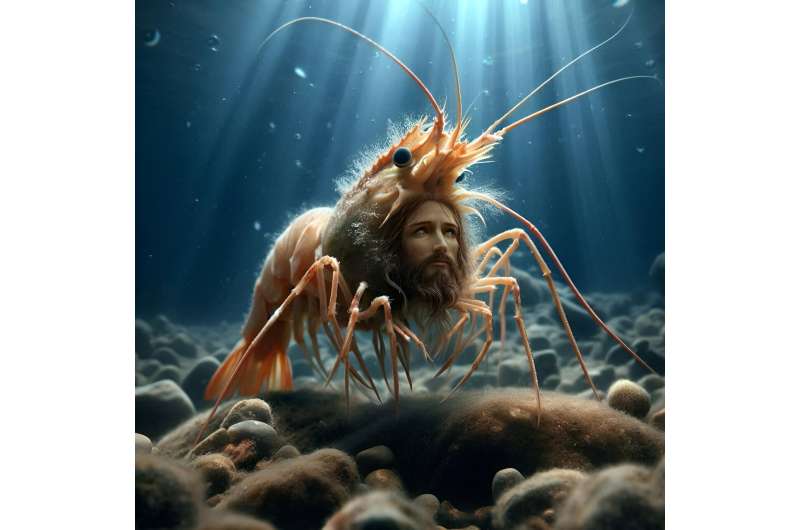
An example of a shrimp Jesus image on Facebook with no caption or context information included in the post. Credit: Facebook
If you search “shrimp Jesus” on Facebook, you might encounter dozens of images of artificial intelligence (AI) generated crustaceans meshed in various forms with a stereotypical image of Jesus Christ.
Some of these hyper-realistic images have garnered more than 20,000 likes and comments. So what exactly is going on here?
The “dead internet theory” has an explanation: AI and bot-generated content has surpassed the human-generated internet. But where did this idea come from, and does it have any basis in reality?
What is the dead internet theory?
The dead internet theory essentially claims that activity and content on the internet, including social media accounts, are predominantly being created and automated by artificial intelligence agents.
These agents can rapidly create posts alongside AI-generated images designed to farm engagement (clicks, likes, comments) on platforms such as Facebook, Instagram and TikTok. As for shrimp Jesus, it appears AI has learned it’s the current, latest mix of absurdity and religious iconography to go viral.
But the dead internet theory goes even further. Many of the accounts that engage with such content also appear to be managed by artificial intelligence agents. This creates a vicious cycle of artificial engagement, one that has no clear agenda and no longer involves humans at all.
Our manual analysis shows that ChatGPT produces incorrect answers more than 50% of the time. Moreover, ChatGPT suffers from other quality issues such as verbosity, inconsistency, etc. Results of the in-depth manual analysis also point towards a large number of conceptual and logical errors in ChatGPT answers. Additionally, our linguistic analysis results show that ChatGPT answers are very formal, and rarely portray negative sentiments. Although our user study shows higher user preference and quality rating for human answers, users make occasional mistakes by preferring incorrect ChatGPT answers based on ChatGPT’s articulated language styles, as well as seemingly correct logic that is presented with positive assertions.
The thing about trade wars is they really stop you from trading…
Reports have piled up about how Big Tech companies have turned on their money hoses to poach top AI talent from each other. They’ve also turned on the charm — both OpenAI’s Sam Altman and Meta CEO Mark Zuckerberg have reportedly been personally involved in courting candidates and offering lavish salaries. But a larger and more intractable talent war is brewing between the US and China.
U-S-A-I
China has had a habit of overtaking the US in technology, like EV adoption or 5G rollout. But when it comes to the hype-beast of generative AI, the US holds the reins. That’s partly because of how the tech industry is set up — Big Tech companies are developing AI in-house, but they’re also forging partnerships with startups like OpenAI, Anthropic, and France-based Mistral AI, because the cloud and computing infrastructure needed to run AI models is dominated by Microsoft, Amazon, and to a lesser extent, Google.
Meanwhile, the US wants to box China out of AI development, arguing that it might use it for military or otherwise nefarious purposes. Its ever-escalating chip trade war is aimed at depriving China of physical infrastructure, and the US is reportedly considering banning exports of AI models (although that seems a little nonsensical). The US is even fighting by proxy: The New York Timesreported in November that US officials were feverishly dissuading Dubai-based G42 to cut its AI links to Chinese businesses.
In another example of how truth is often stranger than fiction, scientists have taken a significant step towards turning the sci-fi concept of “warp drives” into a feasible reality.
New research, led by Dr. Jared Fuchs from Applied Physics and published in the prestigious Classical and Quantum Gravity journal, presents a new solution to one of the long-standing challenges in realizing warp drive technology.
Applied Physics researchers identified a new way in which warp technology might one day be possible. The team introduced the concept of a “constant-velocity subluminal warp drive” aligned with the principles of relativity.
The new model eliminates the need for exotic energy, using instead a sophisticated blend of traditional and novel gravitational techniques to create a warp bubble that can transport objects at high speeds within the bounds of known physics.
“This study changes the conversation about warp drives,” said lead author Dr. Fuchs. “By demonstrating a first-of-its-kind model, we’ve shown that warp drives might not be relegated to science fiction.”
I'm Ashton Forbes, the world's leading expert on the MH370 videos. I have researched every historical detail regarding the plane that disappeared without a trace in 2014.
Among adventure-touring bikes, it has seemed like most of the action in recent years has happened in the middleweight segment. The Aprilia Tuareg, the Yamaha Ténéré 700, and the Honda Transalp are just a few examples of excellent middleweights that have drawn new attention to the class. The stats back up that impression.
The MIC breaks down the adventure class into three displacement categories, and the 601-900 cc class is where the growth is happening, with sales up 13.1%. Meanwhile, sales were down 16.4% in the over 900 cc class and down 32.7% in the much smaller 600 cc and under class. Consumers really are migrating from the big adventure-touring motorcycles to the new middleweight entries that are lighter, less expensive, and still very versatile and capable. Sounds like a smart move to me.
U.S. motorcycle sales, which grew little in the decade between the financial crisis and COVID-19, and were then turned upside down by the disruptions of the pandemic, now appear to be returning to the stagnation and patterns we experienced before.
This vid is a bit silly but it may be worth watching because vastly improved IVF technology is inevitable. And so are other forms of gene manipulation. Today, there are already many reports of women in China and India using Northern European gametes for IVF pregnancies. Given a choice, people will choose the best genes available for their offspring. The dawning age of ‘digital babies’, which will allow extensive gene selection, will profoundly change our sense of what our lineage, tribe, nation, heritage even is. I believe we can be hopeful about what is coming since new technologies will surely raise the IQs of people across the world. Higher intelligence generally leads to better ethical behavior. The main downside I see is higher intelligence can also result in more intelligent criminals, or worse, groups of more intelligent criminals, or politicians. ABN
UPDATE: Here’s another take on this topic. I do not see the harm in spreading good genes worldwide nor is it possible to stop this technology from spreading and improving. Given the choice, parents will opt for the best for their children. ABN
Denmark Selling 'Aryan Trait' Sperm, Eggs To China, India & Other Non-European Countries
Many European White nations are now selling their most precious asset to the rest of the world, their genetics. pic.twitter.com/GuBxaULM9u


 American Buddhist Net