Do organs have a mind of their own?

Story at a Glance:
•Organ transplant recipients often experience inexplicable personality changes and memories that appear to come from donor of the organ.

•In many of those cases, it appears that emotions which were trapped in the donor (e.g., because of the donor’s sudden traumatic death) transfer into the recipient.

•This transference provides critical insights into both the nature of consciousness and ways to mitigate many of the struggles transplant recipients face.

source

What limits speech? In a word: Fear

If we consider speech with only one listener and look firstly at the micro level, we find it is fear of wrong word choice, wrong gesture, expression, demeanor, or tone of voice that limits our speech because a misstep with any one of these may transgress interpersonal limits.

At the meso level, it is either fear of offending or embarrassing (our understanding of) the “personality” of our listener or the fear of an actual flareup from our listener.

At the macro level, it is the fear of introducing a largish idea with sociological or career implications that might disturb, embarrass, or anger our one listener.

With two or more listeners, the analysis is much the same though the numbers of people make it more complex, until we get to so many people we are speaking to an audience. Then it becomes simpler in some ways because the micro and meso levels will be less prominent due to distance between speaker and audience and there being no clear single target of our tone of voice or phraseology.

On the other hand, an audience’s response can be more complex and problematic because more than one person can become angry at us.

Human beings thus are stuck in a game that is controlled by how most of us listen most of the time.

Stated differently, human beings have magnificent speech and communicative capabilities, but rarely get to use them to their full, best effect because one or more of the many speech limits outlined above will cause us either to hold our tongues or else risk creating a disruption in the mind(s) of our listeners.

This seems like a Big Problem to me. I do not want to spend my life constrained by those rules. FIML can help us overcome this problem but even FIML cannot do it all.

We must also recognize that our very comprehension of meaning itself is grounded in fear.

first posted SEPTEMBER 23, 2019

UPDATE: This is a main area where I have some disagreement with traditional Buddhist practice which tends to put the onus of right speech entirely on the speaker. This makes sense in many contexts but in many other contexts it can cause speakers to withhold or be timid when they should not. Or it can cause listeners to believe that speakers must always keep in mind their weaknesses and that they (listeners) are being entirely proper when they misinterpret or mis-react to someone’s speech. This kind of thinking too often leads to overly emotional responses, a greatly reduced scope of discussable topics, and an overall pettiness that constrains everyone. Placing the onus for right speech always on the speaker and never requiring right mindfulness of the listener leads to a kind of hierarchy of speech or a totalitarian view of what is right and wrong to say. In the world today, we can clearly see how speech is constrained in this way through censorship, shadow-banning, muting, shaming, deplatforming, cancelling and more with almost no good purpose ever being served except elitist control of the masses. At interpersonal levels, our speech is too often limited by the narcissistic sensibilities of listeners or what we fear those sensibilities might be. None of this is optimal good speech. In Buddhism we want to optimize speech, thought, mindfulness, and listening. It is good to be mindful of what we say, when we say it, and to whom. But it is not good to always tread in fear every time you open your mouth. ABN

More on Lahaina

He asks the right questions but in cases like this why default to the tone that conspiracy theories are weird? Why do we even refer to this mind-control reference point which has held sway since JFK’s assassination? I did it myself just below. Conspiracy theories are just other possible explanations than those imposed by the MainStream Mind-Control Complex (MSMCC). And since JFK, they have often proved to be right, including many of the JFK ones. ABN

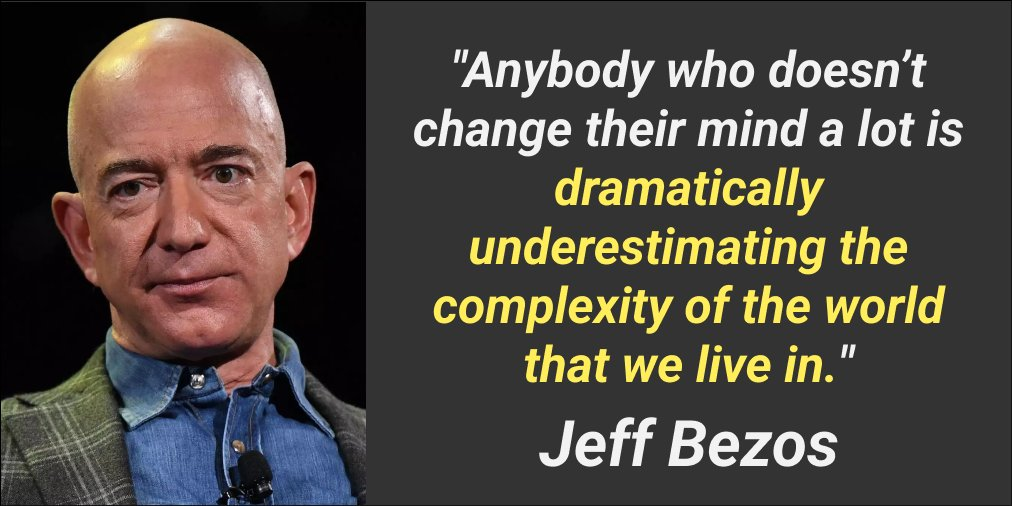
Jeff Bezos business advice

Jeff Bezos is worth $162 billion.

He shared all of his core principles in 24 letters to shareholders.

I’ve read them all.

Here are 12 powerful lesson everyone in business should memorize:

source

My sense is Amazon has lost it’s strong focus on customer experience since Bezos left. I’ve posted about this before. Pretty sure Bezos learned a lot about business from Deming, who had a huge influence on Japanese business practices. ABN

How we process big ideas and the semiotics behind this

I want to discuss a few big ideas with the intention of showing how our internal or culturally underlying semiotics determine how easy or hard they are to accept.

Most thinking people can accept the possibility of atheism. And most atheists can accept the possibility of there being a God or gods or other realms. Atheists who are staunch physicalists may find it harder to do this, but most of them can.

Most thinking people can accept the theory of evolution.

Most thinking people can and do accept the scientific method. Fewer, but many, people understand the limitations of the scientific method.

The theory of evolution and the scientific method can both be stated briefly and in simple language. They are not hard to understand. The limitations of the scientific method require a bit more thought as do the nuances of evolution, but a crude understanding of either is not hard to achieve. Similarly, physicalism is not hard to state or understand.

The simulation argument (that we are living in a computer simulation) can also be stated briefly and is not hard to understand. Many people now accept this argument and admit that it is possible that we are living in a sim. In fact, some physics departments are actually studying the idea. Here is one example: Scientists plan test to see if the entire universe is a simulation created by futuristic supercomputers.

For most educated people in industrialized regions of the world, it is not difficult to accept or seriously consider any of the above theories or ideas.

All of the above ideas can be very revolutionary if you go from not accepting them to accepting them. They revolutionize our metaphysics, our sense of existential reality, our sense of what kind of a world or universe we are living in.

In contrast, ideas that are socially revolutionary are harder for many people to accept, or even consider.

It can be hard to have a calm discussion about inherent problems in the American capitalist system, for example. Or to have a reasonable discussion about the anomalies of 9/11. These subjects, though fascinating, are difficult for many people because they fundamentally threaten the power-and-money hierarchy upon which their social and psychological beings rest.

FIML is an idea that, like the ideas above, can be stated briefly in simple language. This does not mean it is not revolutionary. And this does not mean that FIML will not be difficult for many people to accept. It can be difficult because FIML practice revolutionizes interpersonal relations. I know that if it is done correctly it will bring about a revolutionary improvement. But viewed from a distance or as a mere idea, I also know that it will appear threatening or trivial to many people.

The sim idea was dismissed as trivial by many people just a few years ago. It has gained much wider acceptance since then. It is a delightful idea and not threatening or dangerous at all. It can renew your sense of who you are and where you are.

FIML practice is much like that. It is delightful and not threatening or trivial at all. It will renew your sense of who you are and how you relate to other people in wonderful ways. Just because an idea looks simple does not mean it does not have deep implications. If a new idea challenges our sense of who we are socially or psychologically, it will be more difficult to accept than if it challenges “only” our metaphysical or existential sense of who and where we are.

first posted DECEMBER 17, 2012

Compelling evidence suggests that many insects are sentient and feel pain

…The ethical implications of these and other data on sentience are obvious because of how insects and countless other animals are used and abused in research and conservation projects because some people think it’s impossible that they are sentient beings or they casually write them off as so-called “pests.” Nonetheless, detailed data show they feel morally relevant pain.

Knowing that animals are sentient should—and must—make a difference in how we view, represent, and treat them. The details—the breadth and depth—of the Birch et al. and Gibbons et al. research set an excellent example for future comparative research on many other animals. I look forward to seeing what these studies yield about the biodiversity of sentience and I’m sure that more “surprises” will be uncovered. Who’d have thought that small-brained flies, mosquitoes, cockroaches, and termites would show strong evidence of pain? In fact, they do.

source

Indeterminacy of translation and FIML

I betray my poor education by admitting that I had never heard of W. V. Quine’s “indeterminacy of translation” until last week. My ignorance is especially egregious as I have worked as a professional translator for many years.

Maybe I had heard about it but had forgotten. I am being self-reflective because FIML practice is deeply, fundamentally concerned with the “indeterminacy” of translating one person’s thoughts into another person’s head.

Quine’s thesis is not just about translating from one language to another, though there is that. It is much more about the fundamental impossibility of determining what anything means well enough to “translate” it into another context, a next sentence, into another person’s mind, or even “translating” your own speech from the past into the context of your mind today.

If I had known about Quine, I probably never would have thought of FIML because his ideas and the slews of papers written on “indeterminacy of translation” surely would have made me believe that the subject had been worked through.

As it was, I have plodded along in a delightful state of ignorance and, due to that, maybe added something practical to the subject.

In the first place, I wholeheartedly believe that speech is filled with indeterminacy, which I have generally called ambiguity or uncertainty. In the second place, I have confined my FIML-related investigations mainly to interpersonal speech between partners who care about each other. I see no solution to the more general problem of indeterminacy within groups, subcultures, or linguistic communities. Until brain scans get much better, large groups will be forced to resort to hierarchical “determinacy” to exist or function at all.

For individuals, though, there is much we can do. FIML practice does not remove all “indeterminacy.” Rather, it removes much more than most people are aware is possible, even remotely aware is possible. My guess is FIML communication provides a level of detail and resolution that is an order of magnitude or two better than non-FIML.

That is a huge improvement. It is life-changing on many levels and extremely satisfying.

FIML does not fix everything—and philosophical or “artistic” differences between partners are still possible—but it does fix a great deal. By clearing up interpersonal micro-indeterminacy again and again, FIML practice frees partners from the inevitable macro-problems that micro-ambiguity inevitably causes.

Moreover, this freedom, in turn, frees partners from a great deal of subconscious adhesion to the hierarchical “determinacy” of whichever culture they are part of. Rather than trapping themselves in a state of helpless acceptance of predefined hierarchical “meaning,” FIML partners have the capacity to sort through existential semiotics and make of them what they will with far less “indeterminacy,” or ambiguity, than had been possible without FIML practice.

first posted DECEMBER 7, 2014

Reality vs Trans Ideology | Peter Boghossian & Helen Joyce

Having Catholicism or Christianity fundamentally occupy the category of religion is a major reason Westerners fail to appreciate Buddhism and/or many of the world’s other religions. It is also a major reason Westerners mistakenly see a fairly strict duality between religion and reason/science/logic. The delusions of people and tribes, as discussed in this video, who are socially bound to deny reason and logic has already been worked out by Buddhists in great detail. In fact, Buddhism is itself fundamentally anti-identity, fundamentally anti-tribal, fundamentally at odds with the ignorance of crowds. A basic Buddhist insight, taught by the Buddha himself, is that ‘even the Dharma’ is empty, devoid of own being, a thing to be used for pragmatic purposes and no more. The Dharma itself is the raft that is abandoned once the river has been crossed. These are just a few ideas that occurred to me as I watched this discussion, which I recommend. The misuse or perverse use of language is another type of delusion long recognized by Buddhists. Lastly, I should add that delusion is understood by Buddhism to be a fundamental part of the human realm and the main reason humans suffer and also the main reason Buddhists do Buddhism. ABN

How to think about the mind?

It is not linear, though a spoken sentence has conspicuous linear features and can often be profitably analyzed linearly.

It is a network where many parts connect robustly with other parts and where some parts connect only weakly. Unconnected parts can arise but usually they are rapidly incorporated into the network, even if only weakly, even if only to be rejected from it.

The mind in many ways resembles the system of language. Add semiotic codes and the resemblance grows stronger. Add random and not-so-random associations between semiotic and linguistic elements and the resemblance seems even better.

Emotions, except in their most primal form, have to be defined by language, semiotics, or associations to have impact or “meaning.”

Charles Peirce doubted the value of linear logical notation, preferring notation employing two or three dimensions. His existential graphs became the basis of model theory. (Interestingly, his work in this area was ignored until 1964, long after his death.)

While the human mind may be more than just a network, much about it can be explained by thinking of it as an associative network. While many mental associations are not logical, or even rational, in a formal sense, virtually all of them make subjective sense to the mind experiencing them. My associations with snow will be different from yours, but if we cared to we could compare them and come to a better understanding of each other.

A key to grasping how our minds work is to approach the very rich subjective network of mental associations—both logical and not—through the linearity of language, especially short bursts of language spoken in real-world situations.

Grasping our minds in this way probably cannot be done in a laboratory and outcomes will rarely, if ever, repeat themselves even outside of the lab.

Most science is based on repeatability and controls, such as a laboratory setting. Yet, clearly, not all investigations—even very rational, logical ones—can be pursued in those ways.

FIML practice uses the linear “logic” of short bits of real-world conversation to access the large associative network of the mind as it is actually functioning in a real-world situation.

In this sense, FIML practice does something that cannot be done in any other way. No theory can embrace everything you say and no theory can capture the complex interplay of feeling, speech, meaning, biology, and circumstances that actually comprise the most significant moments of our lives.

FIML, thus, is a sort of science of the moment, a shared science that allows two people to analyze their minds as they actually are functioning in the real world.

first posted FEBRUARY 20, 2014

Genes, behavior, intelligence and how they are linked

This subject can no longer be avoided by anyone interested in anything.

Here is the best brief overview of this subject I have ever seen: 10 Replicants in Search of Fame.

The author, James Thomson, has very capably summarized a longer paper: Top 10 Replicated Findings From Behavioral Genetics.

Both papers are worth reading, but Thomson’s is the better place to start for most people. Here is a sample:

Rather than asking whether a monolithic factor like parental control is primarily responsible for non-shared (unique) effects, it might be necessary to consider many seemingly inconsequential experiences that are tipping points in children’s lives. The gloomy prospect is that these could be idiosyncratic stochastic experiences. However, the basic finding that most environmental effects are not shared by children growing up in the same family remains one of the most far-reaching findings from behavioral genetics. It is important to reiterate that the message is not that family experiences are unimportant, but rather that the salient experiences that affect children’s development are specific to each child in the family, not general to all children in the family.

Here is another:

More than 100 twin studies have addressed the key question of co-morbidity in psychopathology (having more than one diagnosed disorder), and this body of research also consistently shows substantial genetic overlap between common disorders in children and in adults. For example, a review of 23 twin studies and 12 family studies confirmed that anxiety and depression are correlated entirely for genetic reasons. In other words, the same genes affect both disorders, meaning that from a genetic perspective they are the same disorder.

first posted MARCH 7, 2017

To add a Buddhist point of view to this, we must bring in karma, rebirth, and our earthly lineages. All three are deep and ultimate factors in determining our conditions and how we deal with them. Years ago a Chinese friend’s father invited me to watch him burn incense at his family altar in their home in Taipei. As I saw it, his was an act of ancestor reverence more than worship, though either term is fine. The act recalls a deep and ultimate side of Chinese culture that reaches above and below Western psychology and genetic research. Thich Nhat Hanh spoke and wrote about our ancestral lineages and their importance in how our karma and conditions resolve and are understood. These factors are deep in that they ground our psychologies and affect how we comprehend life; and they are ultimate in that they also hinge on the highest and most transcendent aspects of all conscious life.

I respect Western psychology and also find much of it cramped and vulgar due to its intense focus on the single life (no rebirth or lineage) and a select number of factors that can be abstracted from that or from dubious data based on aggregates of many single lives similarly conceived. Due to this sciencey focus most Westerners are trapped in a middle or mundane layer of spiritual understanding, self-isolated between the deep and the ultimate. The usual Western way out of this entrapment is through stories, which are raised to heights they do not deserve and which reduce Westerners to childlike listeners confined to stock responses. The Western cartography of the pathological mind is very good though and greatly enriches Eastern thought. A healthy personality is as much a part of spiritual growth as is lineage and karma. ABN