President Trump’s latest two messages via Truth Social present an interesting geopolitical approach with multiple enmeshed aspects.
First, some background context is needed. Treasury Secretary Scott Bessent and USTR Jamieson Greer are in Paris to meet with Chinese government officials ahead of a scheduled meeting between Chairman Xi Jinping and President Trump.
The main objective of the pre-summit assembly before President Trump goes to Beijing, is to hammer out the actionable agreement details that can be signed off by Xi and Trump. Bessent and Greer are looking to put a deal together with their Chinese counterparts so that Trump and Xi can announce mutually beneficial outcomes during their summit.
Second, President Trump has already indicated the March 31/April 1 meeting with Xi will be all business. The traditional pomp and splendor will not be present, and Trump will only be visiting Beijing – no sidelines.
Third, Secretary Rubio will be accompanying Trump on this trip to Beijing, which might seem ordinary were it not for the fact that in 2020 China sanctioned and banned Rubio from entering China for criticizing Xinjiang and Hong Kong.
Fourth, there are rumors that President Trump is going to announce a significant weapons deal with Taiwan at some point immediately following the trip. If those rumors are true, it would be a top priority for the Chinese advance team in Paris to stop that from happening.
Regardless of what happens in the next few weeks, President Trump will be meeting with Chairman Xi with full Eagle eye confrontation toward the returning dragon stare. There will be no panda mask on this trip whatsoever; this face to face is an apex predator showdown, while the world watches intently.Everything President Trump does between now and his arrival in Beijing, should be contemplated through this adversarial position. With strong moves in Venezuela and Iran President Trump has already pulled Chairman Xi into the jianshu1circle, showing the soul of his blade.
Iran said Saturday that all countries besides the US and Israel may pass through the Strait of Hormuz, in a desperate attempt at coalition busting less than a day after the US bombed military targets on its oil-critical Kharg Island.
“As a matter of fact, the Strait of Hormuz is open,” Iranian Foreign Minister Abbas Araghchi said.
“It is only closed to the tankers and ships belong[ing] to our enemies, to those who are attacking us and their allies. Others are free to pass,” Araghchi told MS NOW.
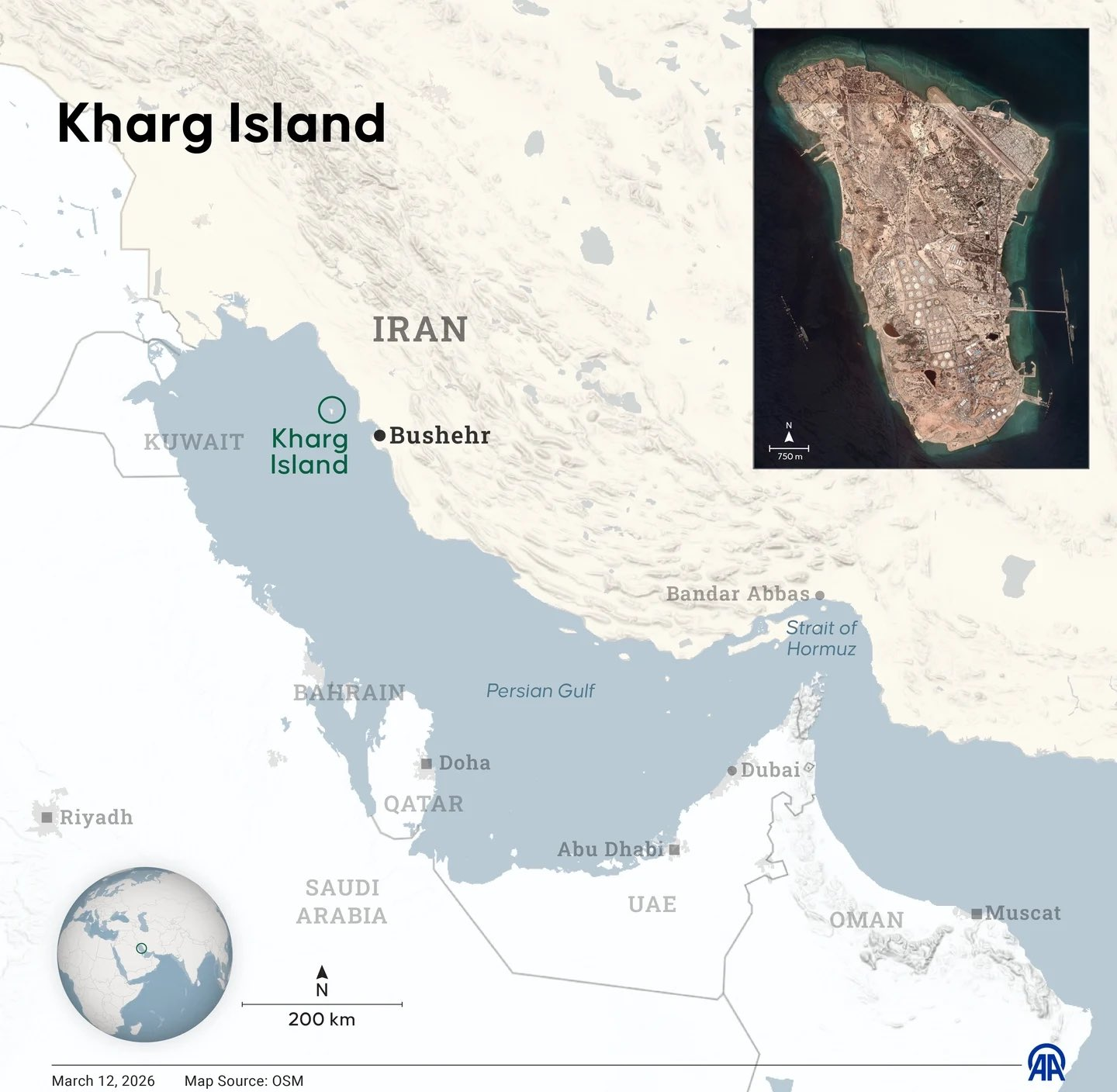
There’s a lot of talk about the Marines taking Kharg Island.
But the truth is the USS Tripoli, an America-class amphibious assault ship that carries the embarked 31st MEU, can’t get anywhere near the island—the Strait of Hormuz is closed.
To even try and enter the Persian Gulf is the kind of suicidal venture former Marine Commandant, General David Berger, warned about in his 2019 Commandants Planning Guidance, where he noted that “our Nation’s ability to project power and influence beyond its shores is increasingly challenged by long-range precision fires; expanding air, surface, and sub-surface threats; and the continued degradation of our amphibious and auxiliary ship readiness. The ability to project and maneuver from strategic distances will likely be detected and contested from the point of embarkation during a major contingency…it would be illogical to continue to concentrate our forces on a few large ships. The adversary will quickly recognize that striking while concentrated (aboard ship) is the preferred option.”
And yet here we are, seven years later, a prisoner of legacy doctrine and systems.
If Marines are to attempt to take Kharg Island, it will have to be an assault launched from ashore, not from the sea. Marines and their Osprey tilt-rotor aircraft will need to deploy to Kuwait or Bahrain, both of which are currently under attack from Iranian missiles and drones, and from their attempt an air assault.
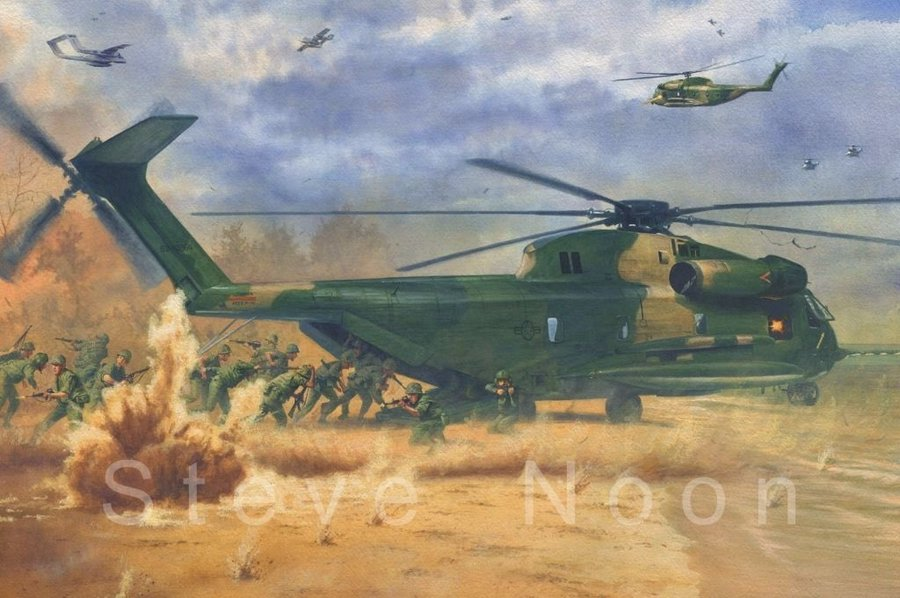
If this sounds familiar, it’s because in May 1975, US Marines carried out a similar vertical envelopment on Koh Tang island in the Gulf of Thailand. Conceived as a rescue mission to free US merchant marine sailors taken prisoner by the Khmer Rouge, the Marines instead found no prisoners, but lots of dug in Khmer Rouge fighters who ended up shooting down three of the eleven helicopters used in the initial landing, and heavily damaging five others. In the end, 38 Marines and US Air Force personnel were killed, and another 50 killed before the Marines had to be extracted under heavy fire. In the confusion of the final evacuation, three Marines were left on the island, and were subsequently captured and executed by the Khmer Rouge.
Any attempt to land Marines on Kharg Island will end in a disaster that would make Koh Tang island look like child’s play.
General David Berger knew this.
I wonder what the current Commandant, General Eric Smith, has to say about this? Back in 1990 the Marine Corps Commandant, General Al Gray, formed an ad hoc planning cell to challenge the plans being put together by General Norman Schwarzkopf to liberate Kuwait.
Does General Smith (@CMC_MarineCorps) possess the kind of intelligence and courage that General Gray had in standing up to bad ideas, or will he stand by silently as history repeats itself in the Persian Gulf, where the 31st MEU may find itself in a repeat of the Koh Tang debacle so Donald Trump can falsely declare victory over Iran.
Moments ago, at my direction, the United States Central Command executed one of the most powerful bombing raids in the History of the Middle East, and totally obliterated every MILITARY target in Iran’s crown jewel, Kharg Island. Our Weapons are the most powerful and sophisticated that the World has ever known but, for reasons of decency, I have chosen NOT to wipe out the Oil Infrastructure on the Island. However, should Iran, or anyone else, do anything to interfere with the Free and Safe Passage of Ships through the Strait of Hormuz, I will immediately reconsider this decision. During my First Term, and currently, I rebuilt our Military into the Most Lethal, Powerful, and Effective Force, by far, anywhere in the World. Iran has NO ability to defend anything that we want to attack — There is nothing they can do about it! Iran will NEVER have a nuclear weapon, nor will it have the ability to threaten the United States of America, the Middle East or, for that matter, the World! Iran’s Military, and all others involved with this Terrorist Regime, would be wise to lay down their arms, and save what’s left of their country, which isn’t much! Thank you for your attention to this matter. President DONALD J. TRUMP
Donald Trump has deployed thousands of US Marines to the Strait of Hormuz amid mounting fears that America is set to put troops on the ground as the world’s oil supply is strangled.
Secretary of War Pete Hegseth approved a request by US Central Command for the deployment of a Marine expeditionary unit, typically including several warships and 5,000 troops, three officials told the Wall Street Journal.
The Japan-based USS Tripoli, an amphibious assault ship, and its attached Marines are now headed for the Middle East, where they join other Marines already in the fight, the officials said.
The war spiraled on Friday as the US death toll climbed to 13 troops, domestic gas prices soared to $3.60 per gallon and Iran‘s security chief Ali Larijani defiantly taunted Trump on the streets of Tehran.
The bolstered deployment comes as the Trump administration weighs seizing Iran’s Kharg Island, around 16 miles off the mainland in the Persian Gulf, which handles 90 percent of the Islamic regime’s fuel exports.
Trump told Fox News Radio Friday about taking control of the island: ‘It’s not high on the list, but it’s one of so many different things, and I can change my mind in seconds.’
I have talked to some Israeli officials and read a good deal of Israeli media. Here is how the war in Iran is perceived there so far:
1) On a tactical level, they believe it has gone very well and Israel has destroyed more of the Iranian military capability than expected. 2) They are disappointed that the regime has not been weakened as much as expected and that they remain in firm control. In particular the lack of a “rise up” among the population is a cause of concern. 3) They are finding Trump to be unreliable. While Israel favors a prolonged campaign to ensure total dismantlement of threats, Trump has signaled a desire to end the war “soon,” creating a potential rift in war aims. 4) Hezbollah is stronger than expected. It has hit Israel with drones and missiles and killed soldiers. They have recovered better than expected. 5) The inability of Ben-Gurion airport to withstand closing and chaos has shown fragility in Israeli social cohesion. 6) They are disappointed in the lack of support from Gulf States who want an end to the war rather than the escalation Israel wants. 7) Israel accepts that the regime in Tehran will survive and just hopes that this weakens them in preparation for the next round. 8) There is a growing fear among Israeli strategists that they are winning the war but losing the region. While military targets are being obliterated, the civilian infrastructure damage is causing a backlash. 9) The war is proving very expensive. The need to divert NIS 28 billion ($9 billion) to the military has forced the government to freeze social projects, leading to the first significant anti-government protests since the war began, specifically from the middle class bearing the tax burden. 10) They are aware that the war is very unpopular in the US and that Israel is being blamed. They are concerned about the ramifications for the alliance.
While Netanyahu is painting this as a huge success, it really doesn’t look like one to Israeli strategic planners. The public knows it as well.


 American Buddhist Net