
A 17th-century Spanish nun is said to have appeared to members of the Jumano tribe, who lived in present-day Texas. The Lady in Blue was said to have the power of bilocation.
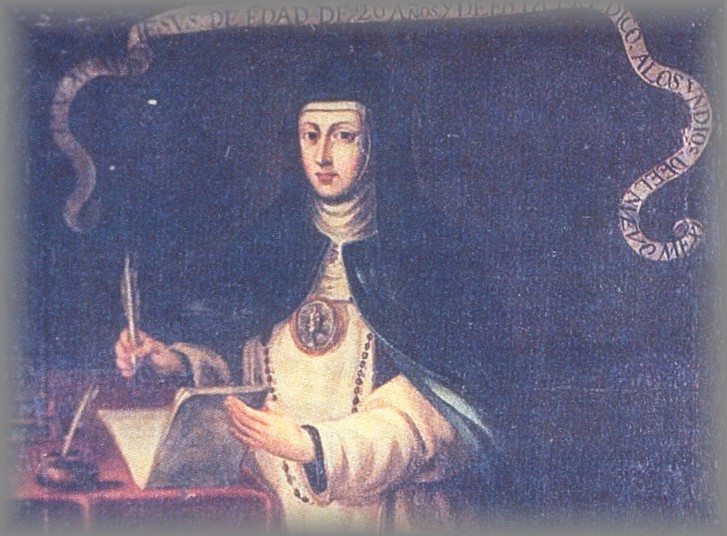
One of the most important figures in Texas’ religious history never set foot in Texas at all. She never in her life traveled beyond her tiny village in Spain, yet she stirred religious fervor from the Concho River to the headwaters of the Rio Grande.
Our story begins in 1602 when Maria was born in the pueblito de Ágreda. She was a lovely child born to Catholic parents of noble rank. Barely beyond her toddler years, Maria showed an unusual devotion to a life of prayer and piety.
When she was ten, she already wanted to join a convent. When she was 12, her parents finally blessed her wish to join the Discalced Carmelite Nuns of Tarazona. Before that could be arranged, though, Maria’s mother had a vision in which God instructed her to convert their mansion into a convent. She and her daughter would both become nuns. Her father would join a local monastery, following in the footsteps of his sons who were already friars. In four years, this all came to pass.
At 18, Maria took her vows and became Maria de Jesus – Mary of Jesus de Ágreda. The habit of her order was a dark cobalt blue. Now a nun, she spent more time than ever alone in prayer. Maria’s religious devotions intensified. Her sisters worried about her frequent fasting, frail health, and life of extreme deprivation. Yet for her it was a glorious time: she said God had given her a divine gift. It was the gift of bilocation. She could be in two places at once. Through meditation she could appear to God’s children in faraway lands and teach them about Jesus. She said she first appeared to the Jumano tribes of present day Texas in the 1620s. She did this for about ten years, from the time she was 18, to 29. And according to legend, the Jumano Indians of the time confirmed that the Woman in Blue, as they called her, had come among them.
The first proof is offered in the story of 50 Jumano Indians appearing on their own at the San Antonio de la Isleta Mission near present-day Albuquerque, asking the Franciscan priests to teach them about Jesus. When asked how they knew of him, the men said that the Lady in Blue had come to them and taught them the gospel. She had instructed them to go west to find holy men who could teach them more about the faith and baptize them. They, as the legend goes, pointed to a painting of a nun in the mission and said, “She is like her, but younger.”
I have complained about the faults of the Abrahamic religions as they are manifesting in the Middle East today, but many aspects of all of them are worthy and this story of Mary of Jesus de Ágreda is a good example. Buddhism has many stories like this as well. This shows, to my eye, that there is a ‘ground’ for all or most religions that is more fundamental than their doctrinaire teachings, than unquestioning loyalty to clergy or rigid credos. I am a Buddhist because it has a rich and very practical philosophy which also wisely and explicitly teaches that even the Dharma must not be clung to. Even the Dharma can prevent enlightenment if our attachment to it is unwholesome. Long before I became a Buddhist, I had profound spiritual experiences that did not in my mind fit into any tradition I knew. This made me realize, even when I was very young, that religious traditions do not and cannot describe or include everything. They are like cliff notes on the spiritual reality of living in the human realm. Some of those notes are beautiful and worthy, some are not so good. This story of Mary of Jesus de Ágreda is one of the beautiful and inspiring ones. ABN

 American Buddhist Net