In Thailand, Cambodia and Sri Lanka, Buddhists see strong links between their religion and country, as do Muslims in Malaysia and Indonesia
As some practices and philosophies related to Buddhism have become more commonplace in the United States and other Western countries, many Americans may associate Buddhism with mindfulness or meditation. In other parts of the world, however, Buddhism is not just a philosophy about mind and body – it is a central part of national identity.
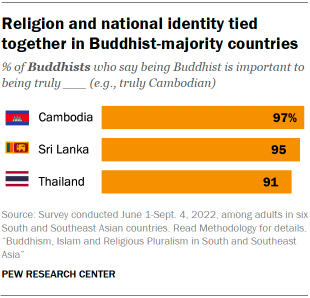
In Cambodia, Sri Lanka and Thailand – countries where at least 70% of adults are Buddhist – upward of nine-in-ten Buddhists say being Buddhist is important to being truly part of their nation, according to a 2022 Pew Research Center survey of six countries in South and Southeast Asia.
For instance, 95% of Sri Lankan Buddhists say being Buddhist is important to be truly Sri Lankan – including 87% who say Buddhism is very important to be a true Sri Lankan.
Although most people in these countries identify as Buddhist religiously, there is widespread agreement that Buddhism is more than a religion.1 The vast majority of Buddhists in Cambodia, Sri Lanka and Thailand not only describe Buddhism as “a religion one chooses to follow” but also say Buddhism is “a culture one is part of” and “a family tradition one must follow.”
Most Buddhists in these countries additionally see Buddhism as “an ethnicity one is born into” – 76% of Cambodian Buddhists hold this view, for example.


 American Buddhist Net