…One promising model proposed in 2023 described an inner core that in the past had spun faster than Earth itself, but was now spinning slower. For a while, the scientists reported, the core’s rotation matched Earth’s spin. Then it slowed even more, until the core was moving backward relative to the fluid layers around it.
At the time, some experts cautioned that more data was needed to bolster this conclusion, and now another team of scientists has delivered compelling new evidence for this hypothesis about the inner core’s rotation rate. Research published June 12 in the journal Nature not only confirms the core slowdown, it supports the 2023 proposal that this core deceleration is part of a decades-long pattern of slowing down and speeding up.
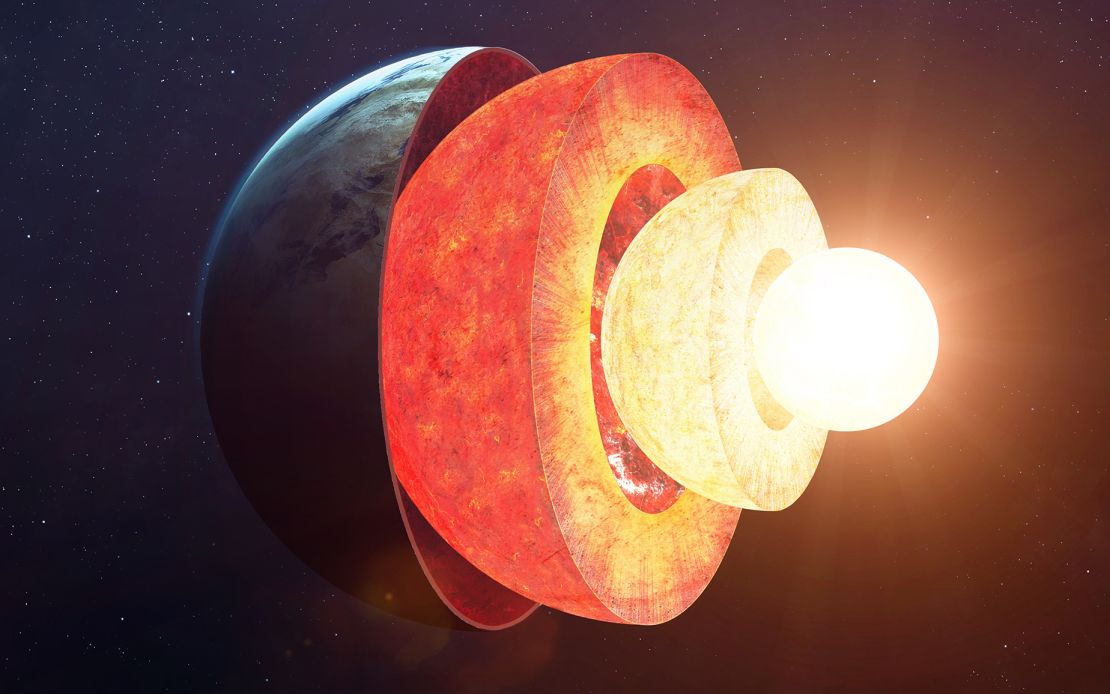
Scientists study the inner core to learn how Earth’s deep interior formed and how activity connects across all the planet’s subsurface layers. forplayday/iStockphoto/Getty Images
The new findings also confirm that the changes in rotational speed follow a 70-year cycle, said study coauthor Dr. John Vidale, Dean’s Professor of Earth Sciences at the University of Southern California’s Dornsife College of Letters, Arts and Sciences.
“We’ve been arguing about this for 20 years, and I think this nails it,” Vidale said. “I think we’ve ended the debate on whether the inner core moves, and what’s been its pattern for the last couple of decades.”
But not all are convinced that the matter is settled, and how a slowdown of the inner core might affect our planet is still an open question — though some experts say Earth’s magnetic field could come into play.
The argument that global warming is coming from heat transfer in the core-mantle region is illuminated by this section from the article: The mysterious region where the liquid outer core envelops the solid inner core is especially interesting, Vidale said. As a place where liquid and solid meet, this boundary is “filled with potential for activity,” as are the core-mantle boundary and the boundary between mantle and crust.
“We might have volcanoes on the inner core boundary, for example, where solid and fluid are meeting and moving,” he said.ABN


 American Buddhist Net