China’s aircraft carrier program has continued to make accelerated progress, with the country having completed eight carrier warships while having at least two more, both of them supercarriers, under construction, positioning its naval aviation capabilities to rival those of United States in the 2030s.
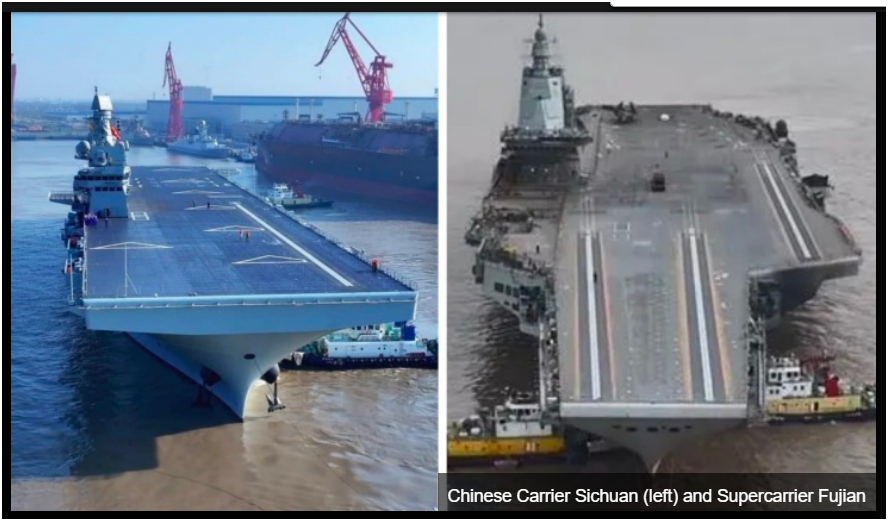
Nine days after the commissioning of China’s first supercarrier the Fujian on November 5, the country’s eighth carrier and first of the Type 076 class, the Sichuan, began its first sea trails on November 14, with the two ships having highly complementary capabilities and roles in the Navy.
The Fujian and the Sichuan are two of the world’s first three aircraft carriers alongside the U.S. Navy supercarrier USS Gerald Ford to integrate electromagnetic catapult systems. This new technology allows the ships to provide considerable energy to aircraft upon launch to facilitate higher takeoff weights, which is expected to be a common feature of all future Chinese aircraft carriers.
Where the Fujian is an 85,000 ton vessel capable of generating very rapid sorties by launching up to three aircraft simultaneously, the Sichuan is a much smaller 50,000 ton ship that blurs the line between an amphibious assault ship, like the lighter Type 075 class on which its design is based, and a full aircraft carrier. The Sichuan was designed to accommodate a smaller air wing, which is expected to be comprised largely if not entirely of unmanned aircraft, including new types of unmanned stealth fighters such as the GJ-11.


 American Buddhist Net