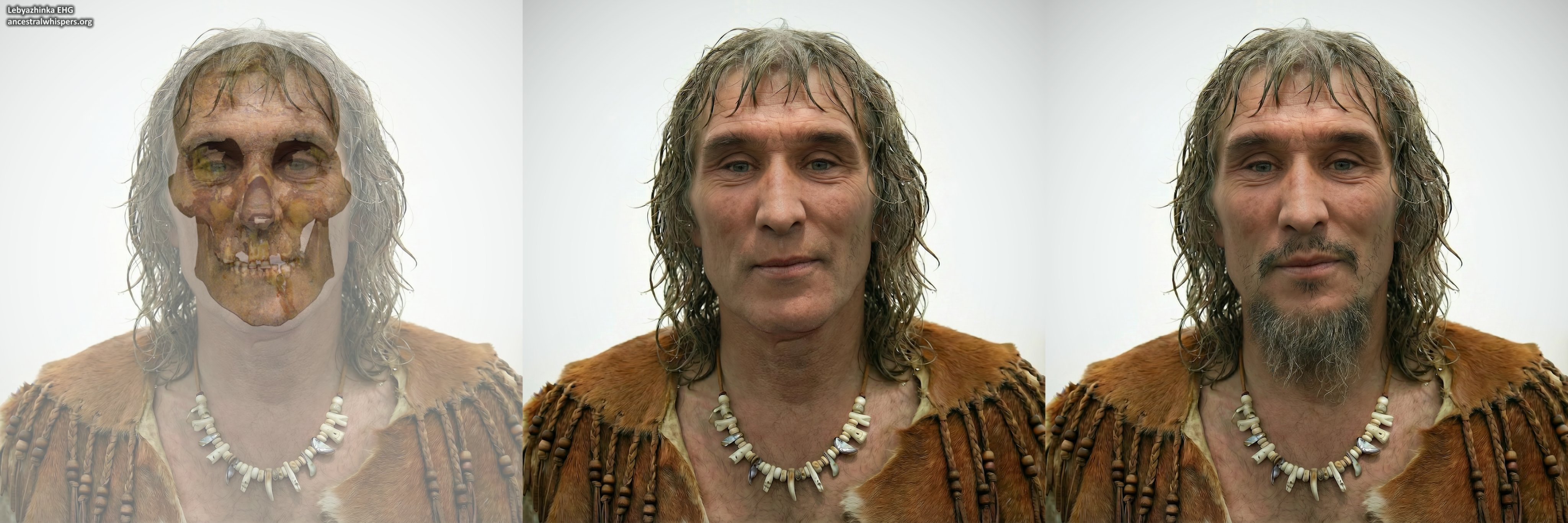
This Eastern Hunter-Gatherer individual was found in the Samara region. His Y-DNA was R1b-P297, and his mtDNA U5a1d. Pigmentation analysis indicates that he carried genes for light skin, light hair, and blue eyes. His cranial measurements include a medium-large cranial length of 181 mm, a medium-small cranial width of 135 mm, and a large cheek width of 137 mm.
The idea of a distinct Sub-Ural population stratum emerging in deep antiquity was developed on the basis of Early Neolithic skulls recovered from burials near the villages of Chekalino and Lebyazhinka in the Samara region. This population was classified as belonging to what is termed the Ancienturalic race. [Khokhlov, 2017]
The concept of the Ancienturalic race was introduced by anthropologist Viktor Bunak. He proposed that a unique anthropological formation arose in the Ural region during the Neolithic, possibly as early as the Paleolithic. This group possessed a set of traits intermediate between Caucasoids and Mоngolоids, yet developed independently of both, originating from a very ancient, autochthonous layer. The male skull from Lebyazhinka IV, associated with the Elshan culture, like many other individuals belonging to the EHG cluster, exhibits precisely this combination of features.



 American Buddhist Net