Using mathematics in a novel way in neuroscience, the Blue Brain Project shows that the brain operates on many dimensions, not just the three dimensions that we are accustomed to.
For most people, it is a stretch of the imagination to understand the world in four dimensions but a new study has discovered structures in the brain with up to eleven dimensions – ground-breaking work that is beginning to reveal the brain’s deepest architectural secrets.
Using algebraic topology in a way that it has never been used before in neuroscience, a team from the Blue Brain Project has uncovered a universe of multi-dimensional geometrical structures and spaces within the networks of the brain.
The research, published today in Frontiers in Computational Neuroscience__, shows that these structures arise when a group of neurons forms a clique: each neuron connects to every other neuron in the group in a very specific way that generates a precise geometric object. The more neurons there are in a clique, the higher the dimension of the geometric object.
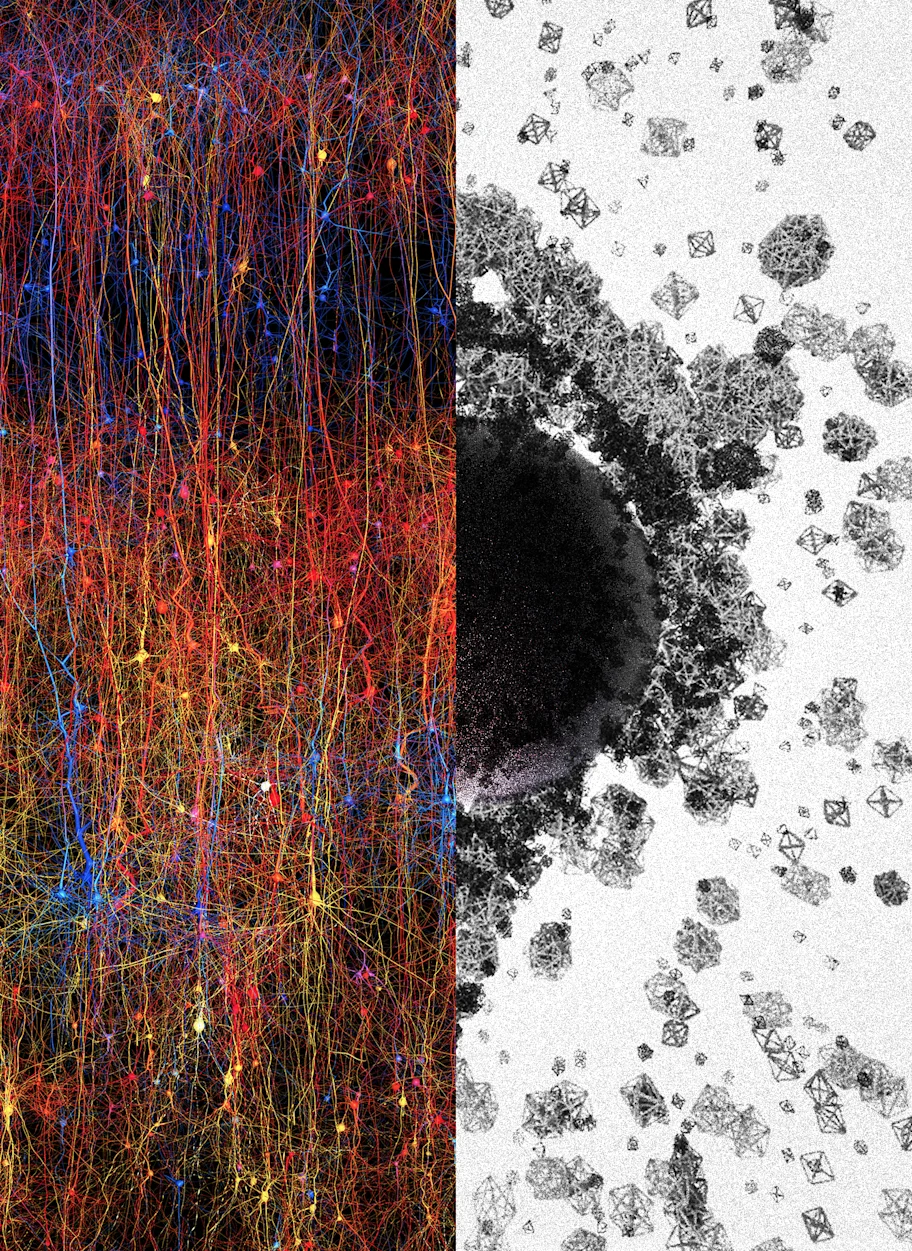
Topology in neuroscience: The image attempts to illustrate something that can not be imaged – a universe of multi-dimensional structures and spaces. On the left is a digital copy of a part of the neocortex, the most evolved part of the brain. On the right are shapes of different sizes and geometries in an attempt to represent structures ranging from 1D to 7D and beyond. The “black-hole” in the middle is used to symbolise a complex x of multi-dimensional spaces, or cavities. Courtesy of the Blue Brain Project
When the researchers presented the virtual brain tissue with a stimulus, cliques of progressively higher dimensions assembled momentarily to enclose high-dimensional holes, that the researchers refer to as cavities. “The appearance of high-dimensional cavities when the brain is processing information means that the neurons in the network react to stimuli in an extremely organized manner,” says Levi. “It is as if the brain reacts to a stimulus by building then razing a tower of multi-dimensional blocks, starting with rods (1D), then planks (2D), then cubes (3D), and then more complex geometries with 4D, 5D, etc. The progression of activity through the brain resembles a multi-dimensional sandcastle that materializes out of the sand and then disintegrates.”
Sent by an alert reader. This describes what probably happens when a FIML query interrupts a stimulus, thus preventing an erroneous interpretation, either habitual or just arising, to flourish in the mind. If the querier’s interpretation is correct, a FIML query will confirm that to the benefit of both partners. If it is incorrect, the wrong interpretation can be corrected, also to the benefit of both partners. Hundreds of FIML queries increasingly establish a very secure ground for communication and mutual psychological understanding. There is not another way to get there but through FIML practice. FIML will completely change how you understand human psychology because the practice is based on real-world, real-time objective (agreed upon by both partners) data. ABN


 American Buddhist Net