

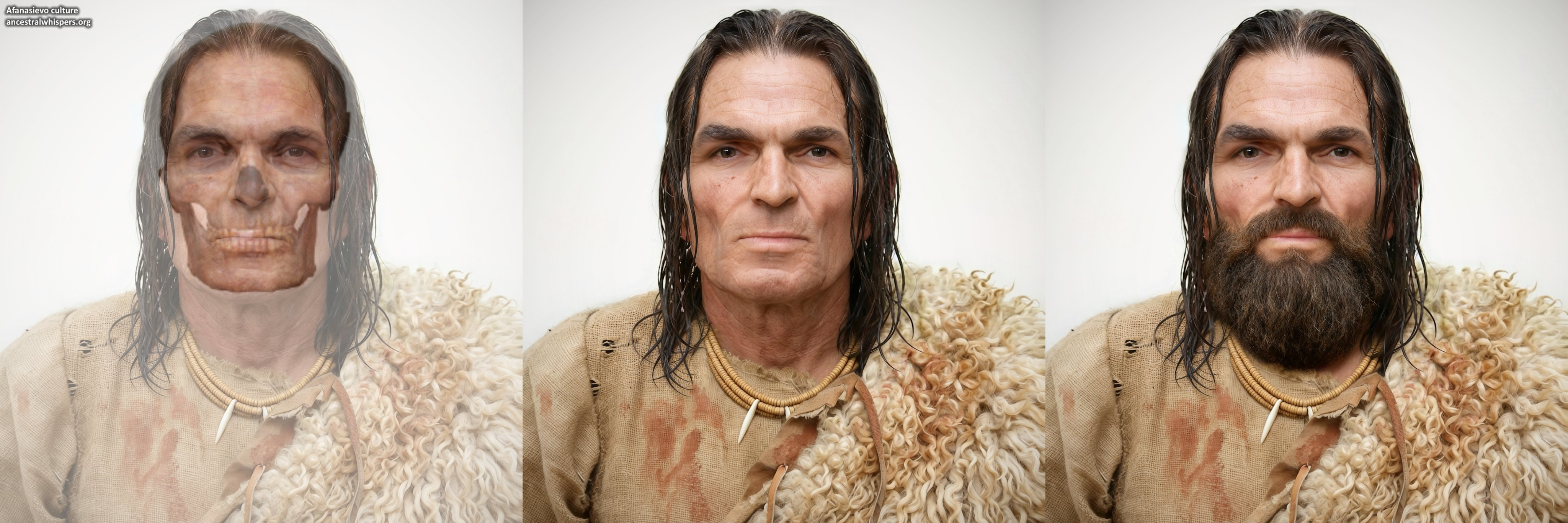
Facial reconstruction of a 5,100-year-old Afanasievan from Mongolia with Yamnaya-like auDNA
He carried Y-DNA haplogroup J1a2b and mtDNA U5a1. His maternal lineage, associated with European hunter-gatherers, was widespread among Indo-Europeans. His paternal lineage, J1a2b, has been previously detected in the Khvalynsk culture; a downstream of this haplogroup also dominates the Y-DNA of the Kura-Araxes culture, possibly suggesting a dispersal of J1a2b from the Caucasus into the Steppe, where a related branch persisted and became the main haplogroup of the Kura-Araxes culture.
The man, belonging to the Paleoeuropoid/Protoeuropoid type, stood roughly 180 cm tall (498mm femur length) and possessed a notably massive and robust skull, with a very long cranial length of 193 mm, massive cranial width of 151 mm, and a very broad cheekbone width of 147 mm.
In Inner Asia, the Bronze Age begins with the emergence of the Afanasievo culture, which spread across vast regions of southern Siberia and Central Asia. Its sites are known from western and central Mongolia, eastern Kazakhstan, the Dzungarian Basin, and even the Middle Zarafshan, though the highest concentration lies in the Altai and the Minusinsk Basin. AMS radiocarbon dates place the Afanasievo horizon between 3300–2500 BCE. Both anthropological and ancient DNA evidence indicate that the Afanasievo culture arose from a migration of populations from Eastern Europe, specifically from the Yamnaya cultural sphere (Solodovnikov et al. 2023).
The Altai Afanasievo individuals rank among the tallest ancient populations of Eurasia (Solodovnikov et al. 2018). A similarly tall stature is seen among Afanasievo individuals from central Mongolia, based on limited material from the Shatar-Chuluu cemetery (where the reconstructed individual was found) near the Khangai range (Tumen 1978; Solodovnikov, Erdene 2022).
Two published Afanasievo individuals have been identified as fifth-degree relatives. One was buried at Inskaya Dol in the northwestern Altai (I11752, BARN-039) [Narasimhan et al. 2019], and the other at the Shatar-Chuluu cemetery in central Mongolia (SHT002, AT-25 (I6221, the reconstructed individual)) [Jeong et al. 2020; Ringbauer et al. 2023]. Although these sites lie 1,410 km apart, both individuals share the characteristic Afanasievo/Yamnaya genetic profile and cluster closely with other Afanasievo samples. Their biological relationship implies that at least one ancestor in their family line must have traveled several hundred kilometers within their lifetime.


__________
Please be sure to visit the original post for more high quality work like this. ABN

 American Buddhist Net
Not even close to aligned.