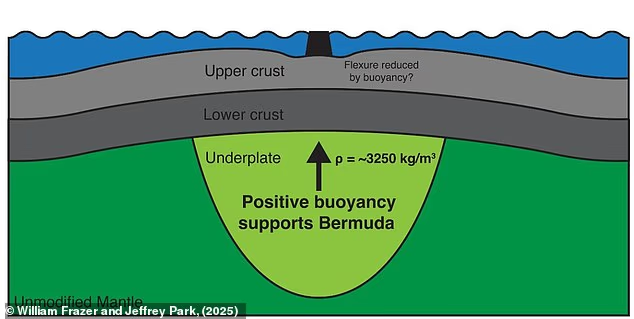
The 12.4 mile (20km) layer of rock sits underneath the ocean crust below Bermuda.
No structure this thick has ever been found before, according to the team – who say it could help to answer one of the biggest questions about the famous island.
Bermuda sits on a raised area of ocean crust known as an ‘oceanic swell’, which lifts it above the surrounding area.
These formations are typically associated with volcanic activity, but there is no evidence to show that a volcano is to blame for Bermuda’s strange geology.
There hasn’t been an eruption on the island for more than 31 million years, and any volcanic swelling should have subsided over that time.
The new discovery suggests the last eruption injected molten rock into the crust where it froze into a raft, lifting the island 500 metres (1,640 ft) out of the sea.
Researchers found a 12.4–mile–thick (20 km) layer of rock that sits underneath the ocean crust below Bermuda and lifts the island 500 metres (1,640 ft) out of the sea


 American Buddhist Net