
Public anomaly-triage map for Medicaid providers and tract hotspots.
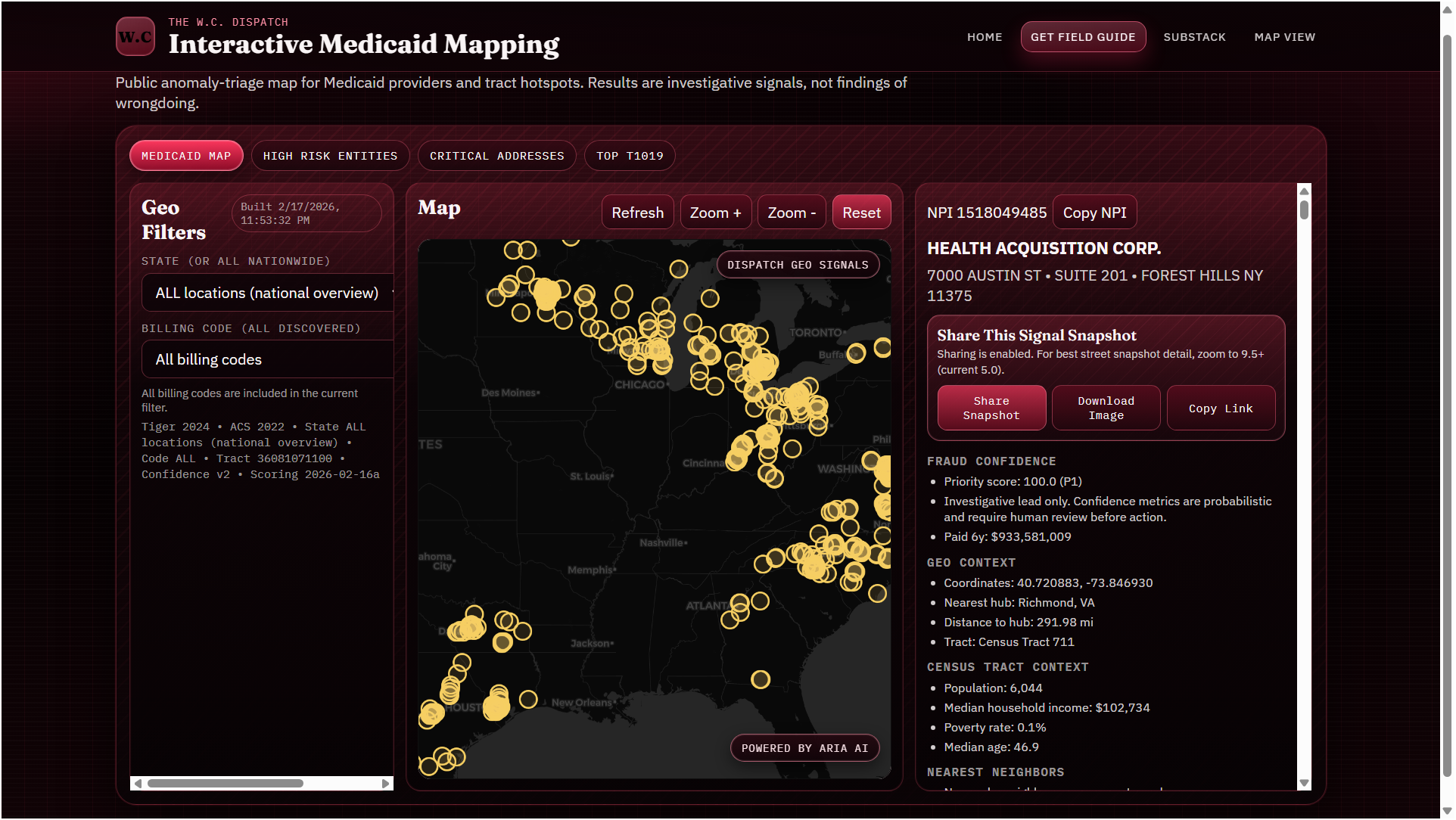
Right now, the live Medicaid intelligence map covers all 50 states and includes 208 discovered billing codes, with 11 high-priority codes currently enabled for focused monitoring.
The national map view currently includes 4,167 unique provider lead points and 350 hotspot tracts, with deeper investigative views tracking 3,530 high-risk entities, 1,797 T1019-focused leads, and 2,874 critical address clusters.
Each lead is ranked with a confidence score and priority tier so teams can triage faster and focus on the highest-impact signals first.
The scoring is based on a multi-signal model that looks at payment scale, utilization intensity, concentration patterns, network/address overlap, and trend behavior over time, with uncertainty baked in so results are interpreted as investigative guidance, not automatic conclusions.
All of this is backed entirely by the HHS dataset, standardized provider and billing-code normalization, geospatial context, and quality-control checks like deduplication and consistency validation across states.

 American Buddhist Net