The planet is essentially recycling carbon from its massive oceanic reservoir to its parched terrestrial landscapes. It’s a self-regulating system of incredible complexity and beauty — Peter Clack
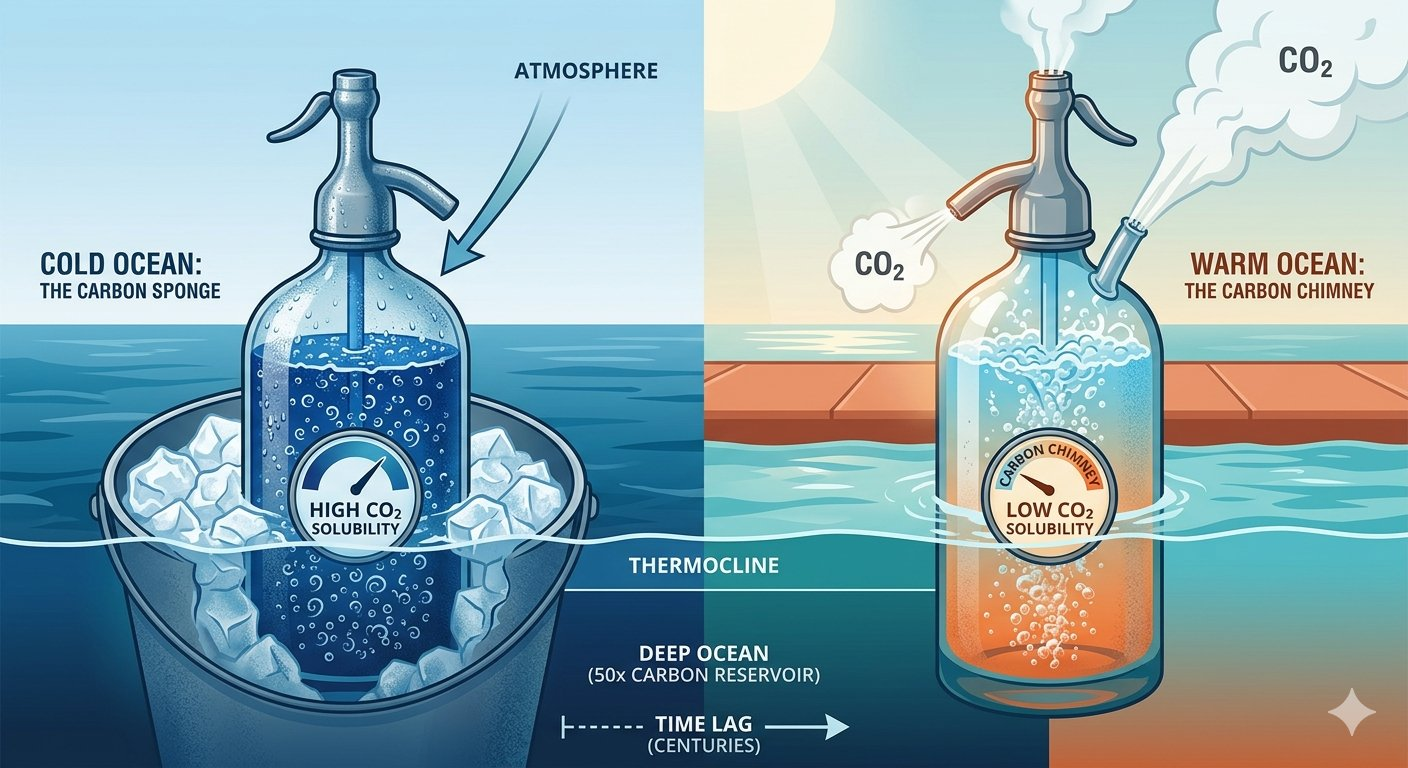
To understand why CO₂ levels rise and fall over millennia, look at a glass of sparkling water.
When it’s cold, it stays fizzy. When it warms up, it goes flat as the CO₂ escapes into the air. The Earth’s oceans work exactly the same way. This is the principle of a solubility pump.
Cold water is a carbon sponge; warm water is a carbon chimney. Because the oceans hold 50 times more carbon than the atmosphere, even a tiny change in sea temperature causes a massive shift in atmospheric CO₂. This explains the time lag seen in ice core data.
Historically, temperature rises first, and CO₂ follows centuries later. Why? Because it takes a long time for the deep, cold thermal flywheel of the ocean to warm up enough to start releasing its stored carbon.
When the oceans finally warm—driven by those million-year Milankovitch cycles—they exhale CO₂. This natural outgassing is a primary driver of the atmospheric shifts we see in the geological record.
It is a biological and physical response to a warming world, not a trigger for a crisis.
The planet is essentially recycling carbon from its massive oceanic reservoir to its parched terrestrial landscapes. It’s a self-regulating system of incredible complexity and beauty.


 American Buddhist Net