…The authors of this study argue that physical sensations form the core of any emotional experience. When people feel an emotion, they experience interoceptive states, which are the brain’s internal perceptions of signals from inside the body, like a racing heart or a tense stomach. The researchers wanted to map these self-aware, physical feelings, known as somatosensory experiences, to see what a state of political anger or political hope actually feels like in the human body.
Understanding these bodily sensations can shed light on how political contexts alter basic psychological responses. To explore these physical patterns, the researchers conducted a study with 992 adult participants from the United States. The sample was designed to be nationally representative in terms of age, gender, ethnicity, and political party affiliation. The median age of the participants was 46 years, and the group included exactly 50 percent women.
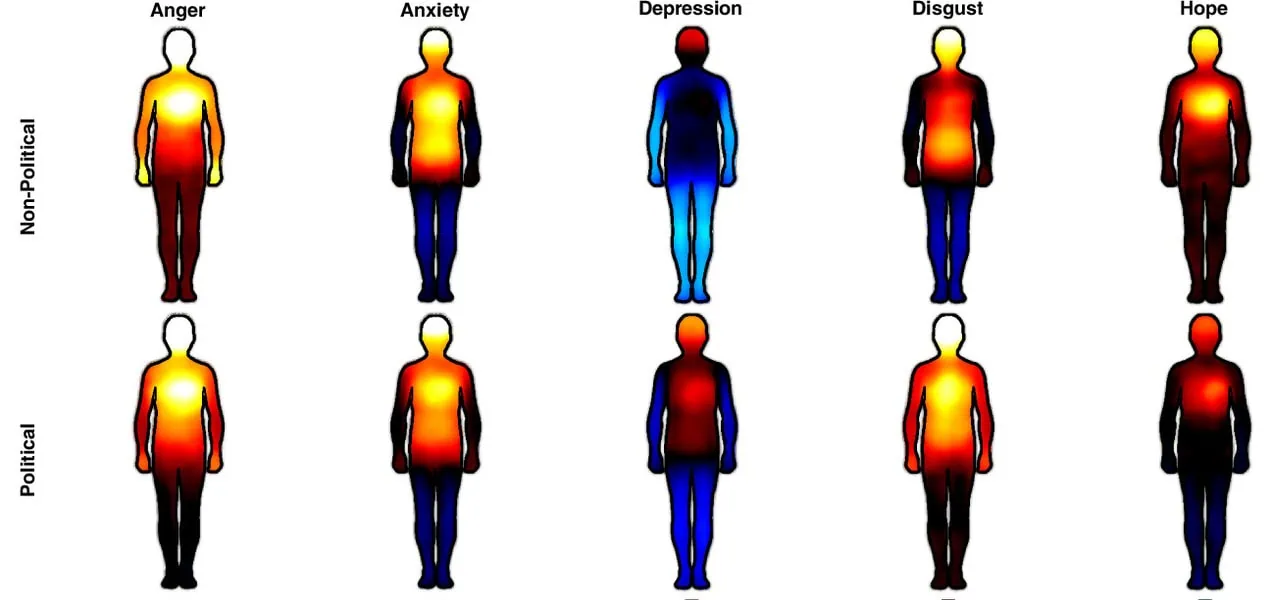
The scientists used a validated digital mapping technique called the emBODY tool to measure physical reactions. During the experiment, participants viewed digital silhouettes of the human body and used a coloring tool to indicate exactly where they felt physical sensations. They painted regions red to show increased activation, such as warmth or tension, and they used blue to show decreased activation, such as numbness or physical heaviness.
Political disgust produced an entirely different physical map compared to everyday disgust. Everyday disgust, such as the natural physical reaction to spoiled food, tends to be felt heavily in the stomach and throat. When participants mapped political disgust, the physical sensation looked remarkably similar to anger, with high activation concentrated in the head and upper body.
Democrat-leaning participants reported stronger bodily sensations for negative political emotions compared to Republican-leaning participants. For political anger, anxiety, depression, and disgust, Democrat-leaning individuals showed much higher physical activation, primarily concentrated in the head and upper torso.


 American Buddhist Net