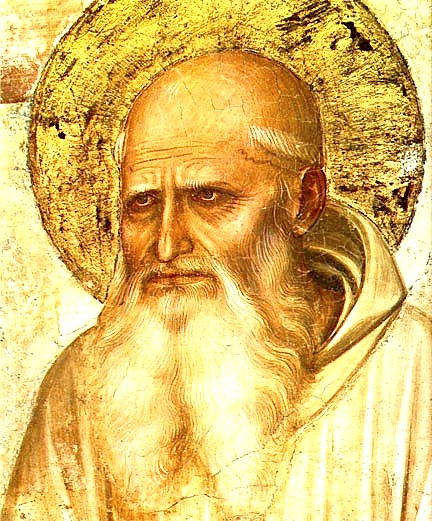
Romuald (Latin: Romualdus; c. 951 – traditionally 19 June, c. 1025/27 AD)[1] was the founder of the Camaldolese order and a major figure in the eleventh-century “Renaissance of eremiticalasceticism“.[2] Romuald spent about 30 years traversing Italy, founding and reforming monasteries and hermitages.
Romuald was able to integrate these different traditions and establish his own monastic order. The admonition in his rule Empty yourself completely and sit waiting places him in relation to the long Christian history of intellectual stillness and interior passivity in meditation also reflected in the nearly contemporary Byzantine ascetic practice known as Hesychasm.
Sit in your cell as in paradise. Put the whole world behind you and forget it. Watch your thoughts like a good fisherman watching for fish. The path you must follow is in the Psalms — never leave it.[9]
St Romuald’s empty yourself completely and sit waiting is an instruction in how to enter deep samadhi. Samadhi states are the experience of spiritual truth, whether it be Buddhist or Christian. Buddhism emphasizes samadhi as the eighth element of the Noble Eightfold Path and as the third training of the Three Trainings — ethics, samadhi, and wisdom. ABN
UPDATE: It’s worth noting that Christian monasteries (and by extension Western universities) were modelled on Tibetan Buddhist Viharas, as were Islamic madrasas. I did not post this entry on St Romuald for that reason or to connect Christian ascetic practices with Buddhism, but rather to show that samadhi states, by whatever name, are practiced in many wisdom traditions. They are the most fundamental base of being a conscious human. Samadhi can be described as deeply knowing or contemplating the artesian well of consciousness that bubbles up or flows constantly in each and every one of us. They are dynamic yet still states that can be experienced when we devoutly empty ourselves and wait. ABN


 American Buddhist Net