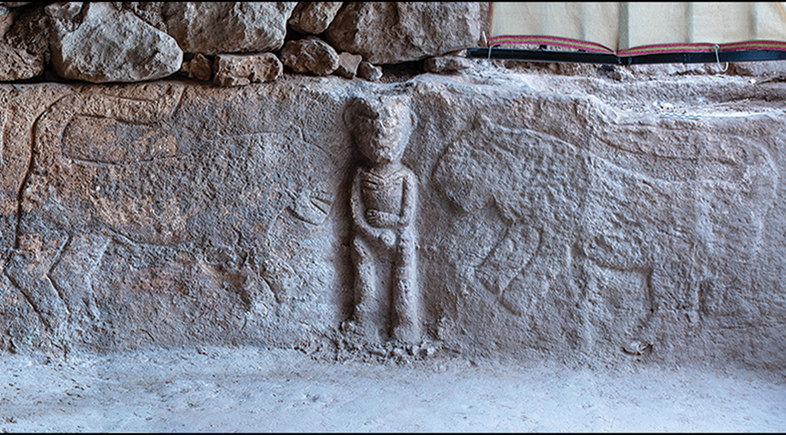
At Sayburç in southeastern Turkey, a few miles from the world-famous megalithic site of Gobekli Tepe, a very ancient engraved stone panel was excavated in 2021. The panel shows, from left to right, a charging wild bull, a man holding a serpent sitting or falling back before the bull, and a seated man holding his penis and flanked by two leopards.
After our flight to Istanbul took off from Baghdad International Airport I opened my laptop and re-read a research paper on the panel by Turkish archaeologist and art historian Dr Eylem Özdoğan. Titled The Sayburç reliefs: a narrative scene from the Neolithic, the paper, was published in the authoritative peer-reviewed journal Antiquity in 2022 and contained a photograph of the eponymous scene which is carved into the vertical aspect of a knee-high stone bench. Dated to around 8500 BC, the scene has the “narrative integrity of both a theme and a story in contrast to other contemporaneous images,” says Dr Özdoğan. Indeed in her view it “represents the most detailed depiction of a Neolithic ‘story’ found to date in the Near East, bringing us closer to the Neolithic people and their world.”1
In the same folder where I’d filed Dr Özdoğan’s paper I’d filed the high-resolution photograph of the complete panel which the photographer, B. Kosker, had kindly released on Creative Commons:2


 American Buddhist Net