When China got a break: Deng Xiaoping imported the Japanese high growth formula
After nearly three decades of ideological campaigns on the people of China, and likely more than 60 million people killed in the process, even the died-in-the-wool communists had after the death of strongman Mao become tired of party-political programmes (see Part I for more on those). Consequently, it was an uphill battle for Mao’s chosen heir, Hua, to generate any enthusiasm and support. Instead, a growing majority in the upper echelons of the Chinese Communist Party felt keenly that continuity was not attractive, as things had not panned out that well. Instead, the decision-makers ordained that it was time for a change in direction, namely by allowing a reality-oriented pragmatist to take the helm who would focus on delivering results – such as economic development, strengthening the nation and making the Chinese people better off.
Every so often there are moments in world history when the senior decision-makers over nations are neither incompetent agents serving foreign agendas, nor evil, genocidal psychopaths.
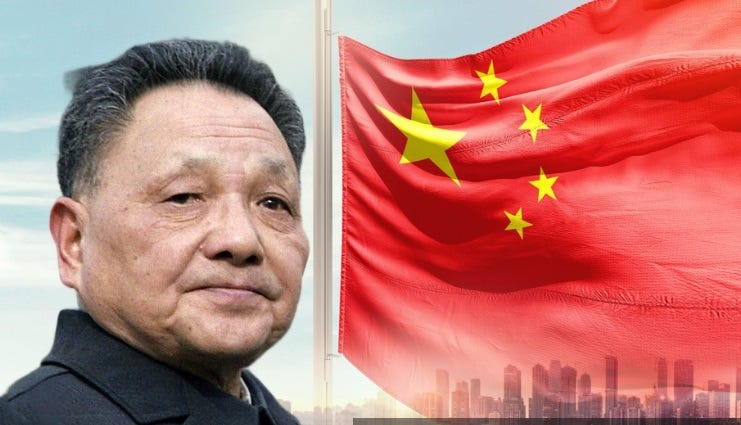
The time was ripe for Deng Xiaoping, who had joined the early Communist Party of China in the 1920s and had been on Mao’s Long March in1934. Moreover, he had already been in positions of influence before, but had been unceremoniously deposed several times, sent to labour camps or had otherwise been suppressed. Known as a calm, able and even-handed administrator who had not been involved directly in the cynical anti-human policies of the previous decades, Deng was rehabilitated in 1977 and appointed Vice Chairman of the CCP. He was also appointed Vice Premier of the State Council and member of the Politburo.
Deng picked up the pieces and restored economic order. He was now generally supported, especially as Hua’s unsuccessful attempt to pin the blame for the biggest policy disasters on particular people, such as the “Gang of Four”, had merely driven home the realisation that China had lost many years, even decades in terms of prosperity.
The remainder of 1977 and much of 1978 were a time of preparation for Deng Xiaoping. Then, in December 1978, he gave a key speech, which has since been interpreted as Deng officially taking over the leadership in China.


 American Buddhist Net