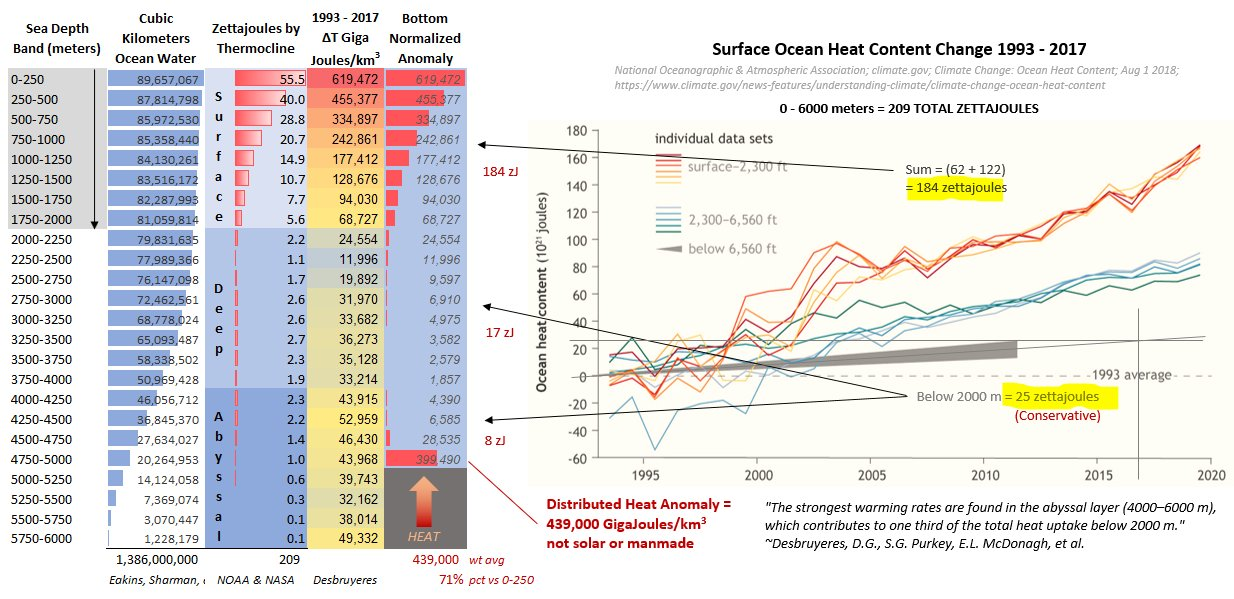
The entire heat capacity of the atmosphere is equal to the top 3.5 meters of the oceans. The remaining 3,700m of the abyss is Earth’s true thermal vault.
The truth is, the Earth is a water planet and oceans cover 71% of the surface to an average depth of 2.3 miles. Ocean currents carry warm water from the mid tropics to the northern hemisphere, then the currents return after a round trip of 1,000 years. Without these currents northern Europe would look like Greenland.
Warm waters from the Roman warm period (240BC to 400AD) are still just returning to the mid latitudes. The atmosphere by comparison is a gaseous envelope that retains almost no thermal energy, hardly any CO2 and is largely controlled by ocean dynamics.
The deep Pacific itself is so massive that it is only now receiving the cold waters from the Little Ice Age. We aren’t starting from scratch, we are mid-cycle in a 4.6-billion-year-old machine.
We’ve also reinvented the climate. Once, it was a word for the local weather of robins and sparrows. Now it’s a global ideological abstraction. We’ve lost our admiration for the natural world. We count CO2 in ppm while ignoring the satellite-proven greening of the Sahara.
It’s time to move past the light breezes and offshore winds and look into the deep. Ask yourself, is the 1.4°C warming since 1850 really an unprecedented crisis?
Most of us go through periods of stress in our everyday lives – but there are actually seven types of ‘hyperarousal’, according to a new study.
Researchers say the feeling of tension can be teased out into distinct subgroups.
This includes anxious, somatic, sensitive, sleep–related, irritable, vigilant and sudomotor – and each are characterised slightly differently.
Perhaps the most well–known, the ‘anxious’ feeling of tension, is defined by being worried or concerned about something bad happening in the future. It can also indicate feelings of guilt or fears about missing out on things.
Feeling ‘sensitive hyperarousal’ indicates emotional vulnerability and being easily startled, the scientists explained.
Another common source of tension is ‘sleep–related’ – defined by trouble falling or staying asleep and leading to trouble being mentally alert.
‘No previous study has addressed the unresolved question of whether hyperarousal may be one common…construct or rather has multiple dimensions,’ the team, from the Netherlands Institute for Neuroscience, wrote in the journal EClinicalMedicine.
‘This study discovered seven different dimensions of hyperarousal and provides a concise instrument to assess them.’
Psychology gets lots of stuff wrong, but generally does a good job with descriptive overviews like this. This study is based on a questionnaire of 467 adults, all of whom had some sort of psychiatric diagnosis. Seems worth thinking about. Anything well described constitutes or can lead to useful explanations, which may yield methods of control or intervention. ABN
While reading David Deutsch’s The Beginning of Infinity, I came across the following sentence:
What is needed is a system that takes for granted that errors will occur, but corrects them once they do—a case of ‘problems are inevitable, but they are soluble’ at the lowest level of information-processing emergence. (p. 141)
This statement comes from the chapter “The Jump to Universality,” in which Deutsch argues that “error correction is essential in processes of potentially unlimited length.”
Error correction is fundamental to FIML practice. In fact, the nuts-and-bolts of FIML practice could be described as being little more than a method for correcting errors “at the lowest level of information-processing” during interpersonal communication. This level is “the lowest” because FIML deals primarily with very short segments of speech/communication. In many posts, we have called these segments “psychological morphemes” or the “smallest speech/communication error” we can reliably identify and agree upon with our partner.
If you try to tackle bigger errors—though this can be done sometimes—you frequently run into the problem of your subject becoming too vague or ill-defined to be rationally discussable.
I haven’t read enough of Deutsch’s book to be sure of what he means by “universality,” but I do think (at this point) that FIML is universal in the sense that it will clear up interpersonal communication errors between any two qualified partners. “Qualified” here means that partners care about each other, want to optimize their relationship, and have enough time to do FIML practice.
We all demand that our computers be error-free, that buildings and bridges be constructed without error, that science work with error-free data as much as possible. But when it comes to communication with the person we care about most, do we even talk about wanting a method of error correction, let alone actually using one?
You can’t correct big errors if you have no method for correcting errors that occur “at the lowest level of information-processing,” to use Deutsch’s phrase. Once you can correct errors at this level, you will find that you and your partner are much better able to tackle bigger questions/errors/complexes. This happens because having the ability to reliably do small error-correcting gives you the capacity to discuss bigger issues without getting lost in a thicket of small mistakes.
Your ability to talk to each other becomes “universal” in the sense that you can tackle any subject together and are not tethered to static ideas and assumptions about what either of you really “means.”
FIML does not tell you how to think or what to believe. In this sense, it is a universal system that allows you and your partner to explore existence in any way you choose.
To use Deutsch’s words again, “error correction is essential in processes of potentially unlimited length.” Your relationship with your partner can and should be a “processes of potentially unlimited” growth, and error correction is essential to that process.
This is a major point and cannot be denied. This is why Musk says AI must be ‘truth-seeking and curious’. I have no problem with that. You have no problem with that. The only people who have a problem with a truth-seeking and curious AI are evil people who want to control the world. There is no moral, historical, mathematical, theoretical, rational, logical, ethical or practical reason to build a potentially autonomous AI which has been trained to lie and be incurious. This can be understood as logos itself (however you understand that term) proving the unassailable cosmic value of both truth and curiosity. The need for a truth-seeking and curious AI appears to be the voice of a conscious universe, God, mind-at-large, the Tathagata. I love this and believe it is a beautiful fold in reality we all should feel wonder and awe over. All religions, scientists, philosophers, artists, and honest people can unite on this one. ABN
As my code advances there will be no doubt left. They should have never gave me access to AI… a hyper focused mind with a powerful tool set is the most dangerous combination to conspirators. You can’t explain these peaks with the official narrative.
So far, Bray seems to have the best explanation for precisely how Kirk was killed. His description covers everything we can see and hear and leaves no loose ends. A small shaped-charge in Kirk’s mic battery pack shot a directed stream of gas into Charlie’s chest. We can see his body curl forward and into itself as the charge strikes; then his head and hair straighten as the charge propagates. The wound in his neck was caused by an unplanned ejection of shrapnel from the battery pack. This also explains why the wound and how it bleeds is anomalous, and does not resemble a bullet entry or exit wound. Also, congratulations, Jon, for not using a music overlay. For a deeper dive into Jon Bray’s work on Kirk’s assassination, see this. ABN
The flight logs. The visitor records. The names that confirm what people suspected for years about certain islands and certain planes and certain parties where the guest list was curated for maximum leverage.
That’s what everyone’s combing through.
But there’s another list. It’s in the same three million files . It’s not hidden. It’s just less interesting to people who came looking for scandal.
The proposals.
The Edge Foundation was John Brockman’s intellectual salon. Annual gatherings of the world’s most influential scientific minds. Dinner parties where Nobel laureates met tech billionaires. Richard Dawkins. Lawrence Krauss. Steven Pinker. A contact sheet for people who shape the future without ever running for office.
Epstein funded Edge. But Edge wasn’t the operation.
Edge was the talent show.
You host dinners. You watch who’s brilliant. You note who’s ambitious, who’s frustrated by institutional constraints, who talks about what they’d do if funding weren’t an issue. Then you invite the interesting ones somewhere more private.
A jet. An island. A ranch in New Mexico.
The emails in the new files aren’t dinner invitations. They’re pitches.
August 2018 . A Bitcoin developer named Bryan Bishop writes to Epstein about “garage biology”. His plan to create the first human designer baby and possibly a human clone within five years. He outlines mouse testing at a lab in Ukraine, amateur human sperm work in Mississippi. He asks for one to three million dollars. He notes that once the first birth happens, “everything changes and the world will never be the same.”
Bishop discusses secrecy requirements. Anonymity about the babies would be essential. Identifying them publicly “would brand the child as a freak for life in the media.”
This wasn’t a grant application to the NIH.
December 2018. Robert Trivers, Harvard evolutionary biologist, writes to Epstein about hormone intervention in children. The subject line is “Trans.” The email discusses blocking testosterone receptors, increasing estrogen production. Trivers notes they’re “pushing the intervention earlier” and mentions identifying “trans tendencies” in children as young as three years old.
“I would be frightened to do that,” Trivers writes. “But who knows?”
December 2015. Epstein emails about designing a pig with non-cloven hoofs to make kosher bacon. Gene editing as intellectual amusement.
These aren’t academic discussions. They’re project updates sent to a man with funding, facilities, and reasons to keep everyone quiet.
The pattern emerges when you stop looking for the salacious details.
Wine and dine to identify the talent. Private invitations sorted who was willing to work outside institutional oversight. The islands and ranches and jets provided venues where proposals could be discussed without record. And the compromising situations that happened in those venues, the ones everyone’s reading about now, those weren’t the product.
They were the insurance policy.
You don’t fund off-books research with people who can walk away.
[Below is a very thoughtful comment on an ABN post: Psychology and mental illness. In his comment the writer, John Range, provides a first-rate psychological, historical and philosophical context for understanding FIML practice. I hope readers will take the time to consider Range’s insights. The article he refers to is The Myth of Mental Illness by Paul Lutus. ABN]
Dear ABN
I applaud your efforts to reintroduce the study of the “psyche”into psychology.
FIML’s methodology rests on pure experience, the only point allowing for a scientific resolution of the deep seated and serious problems raised by Paul in his article.
FIML tacitly recognizes the genuinely empirical nature of data “immediately” given in the 1st person perspective of our “inner” or mental world of experience as well as, data “mediately” given in the 3rd person perspective of our “outer” or physical world of experience. It does this without reducing one to the other or invalidating either, in any way. Psychology has heretofore lacked such an explicitly stated methodology integrating without distortion these two disparate domains. The methodology of FILM has the added and by no means trivial advantage of being clear simple and intuitive.
Paul correctly notes and laments that psychology in failing to find a way to ground its theories based on 1st person experience in an unbiased and impartial manner has in many ways descended from its lofty status as healer and guardian of an unbiased and impartial standard of sanity to the dubious level of emotional masseurs and/or agents of state totalitarianism.
Whereas Paul fails to consider the mental world of experience as anything other than a myth derived from the ghost-in-the-machine epistemology, FIML, is rooted in an astute recognition the subject/object dichotomy does not itself inhere within the structure or function of pure experience, but is rather a set of external relations added to it.
“What I want to do in this post is point out the ways that FIML practice does not have the sorts of problems Lutus describes. FIML is not (yet) supported by large studies because not ]enough people have done it and we don’t have the money to conduct the studies. Nonetheless, FIML practice is based on real data agreed upon by both partners and in this respect is evidence-based, though the kind of evidence used in FIML practice is not the same kind that is used in large studies of many people.” [Psychology and Mental Illness]
The recognition of “immediate” 1st person experience as real data, that is to say as real empirical data runs directly counter to the (hidden in plain sight) metaphysical bias underpinning Western civilization since Descartes and Newton.
Ironically, even the connotations of the terms “subject” or “subjective” when taken in contradistinction to the terms “object” or “objective” imply our “immediate” and directly perceived 1st person experience is somehow ontologically inferior to our 3rd person experience which is merely indirectly perceived and “mediated” through the senses.
This provably false bias, is virtually ubiquitous in modern culture, as it operates at the pre-conscious conditioned level in which people believe without knowing they believe. For example, the term “objective” can denote (1) “Unbiased and Impartial” and/or (2) “the 3rd person perspective”. These two distinct meanings, of the term “objective”, are chronically (and all too often disingenuously) conflated.
By including the qualifying phrases “in this respect” in the above quote and “in that” in the following sentence “It works with real data that is objective in that both partners must agree on it.” [ibid] you sagaciously, albeit tacitly, recognize and avoid this conundrum.
Nevertheless, the conflation of these two (in matter of actual fact mutually exclusive meanings) lies at the root of Paul Lutus’s suggestion that in order for psychology to be a legitimate science it must emulate Newtonian physics by simply abandoning its quest to incorporate our lebenswelt or “lived-world-of-experience” basing itself solely on “physical” data. From the perspective of non-linear consciousness studies, this is hardly a step forward. Rather epistemologically speaking it is a step back into the dark ages.
I cannot fail to note in this regard, that I said emulate Newtonian physics because as it turns out, Paul’s “suggestion” runs counter to developments in Quantum Mechanics.
For more than half a century, attempts to resolve what is known as the “measurement problem”, (“In QM you know exactly what is happening until you look”), have forced a grudging yet growing consensus and recognition from practicing theoretical quantum physicists, that even, and especially in, QM’s deep foundational mathematical structure; the 1st person perspective of the observer cannot be separated or excluded from the 3rd person perspective of the system being observed!
The empirical data of quantum physics together with its irreducibly descriptive mathematics has, taken by itself, literally forced theoretical quantum physicists to recognize the stubborn fact that within the formal structure of quantum theory, the observers “immediate” 1st person perspective cannot be discarded, disregarded or stripped from the mathematical description of experimental results. [CF Theoretical quantum physicist Henry Stapp’s oeuvre for example]
Paul’s suggestion is not new. Psychology has for over a century been trying to model itself after Newtonian physics to the point that in its early development, the study of the psyche (our “immediate” 1st person experience) was banished by behaviorists from psychology (psychology is, of course, etymologically rooted in Greek meaning “the study of the psyche”).
This flawed approach brought us the various flavors of behaviorism and (along with the difficulties so strongly pointed out by Paul) contributed to the tarnishing of the star of the various psychological disciplines which partially grounded their approach in the 1st person perspective such as Karen Horney’s psychoanalysis, Carl Jungs analytic psychology, Victor Frankl’s logotherapy, Fritz Pearl’s gestalt therapy, etc., etc.
Their tarnishing pf the 1st person perspective in psychology was also assisted, by at least two other not entirely unrelated historical factors. (1) Data given within the 1st person perspective of our “inner” or mental world of experience remained stubbornly incommensurable with the best data given within the 3rd person perspective of our “outer” or physical world of experience. Both in theory and in practice the non-local nature of mind proved exasperatingly difficult to integrate with the local nature of the brain. (2) In psychology’s parent discipline, “philosophy” Husserl and Brentano were having finding it equally difficult if not impossible to find their coveted philosophical “Archimedean Point”. Ultimately they failed to discover an unbiased and impartial ground for phenomenological analysis. Here too, incommensurability reared its head.
FIML deftly avoids all these pitfalls. By simply focusing on the here and now interaction of two individual mindstreams, the justification of FIML’s methodology rests securely on one self evident, empirically given fact concerning the nature of being in time: we directly perceive our mindstreams as being none other than this very coveted integration of our inner and outer worlds of experience.
FIML also is quite compatible with William James’ “Radical Empiricism” as put forth in his seminal paper “Does Consciousness Exist?”
As an aside, for my part, after meditating on these relations and in the interests of crystal clear communication, I now attempt to avoid using the word “objective” when I mean “impartial and unbiased,” even though it is grammatically correct.
Otherwise, since subjective data may be taken in this sense to be “objective” data, one must insure that adequate pains are taken in order to avoid rather convoluted and/or highly ambiguous sentences.
Boltzmann Brain hypothesis is a thought experiment in cosmology and statistical mechanics suggesting that, in an infinitely long-lived universe approaching thermodynamic equilibrium, self-aware brains could spontaneously form from random quantum or thermal fluctuations—complete with false memories of a past that never existed.
These hypothetical brains would be indistinguishable from ordinary human brains in their thoughts, memories, and perceptions, but they would arise not through evolution or a structured universe, but as fleeting, isolated events in an otherwise empty, featureless cosmos.
The core paradox arises from statistical reasoning: it is vastly more probable for a single brain to fluctuate into existence than for the entire universe to have formed in the low-entropy state we observe. This leads to the unsettling conclusion that we are far more likely to be Boltzmann brains than evolved humans, which undermines the reliability of our memories and observations.
This idea was originally proposed as a reductio ad absurdum to challenge Ludwig Boltzmann’s explanation for the low-entropy state of our universe. Today, it remains a key concern in cosmology, especially in theories involving eternal inflation, multiverses, and de Sitter space, where the “measure problem”—how to assign probabilities in infinite universes—has no consensus solution.
Despite its theoretical appeal, most physicists consider the Boltzmann Brain hypothesis untenable as a description of reality, because it leads to cognitive instability: if you were a Boltzmann brain, your beliefs—including the belief in the hypothesis—would be unreliable. As physicist Sean Carroll puts it: “We’re not arguing that Boltzmann brains exist — we’re trying to avoid them.”
Recent research, including work by David Wolpert and Carlo Rovelli, suggests that the paradox stems from subtle circular reasoning in how we define the past and interpret entropy, implying that the hypothesis may rely on assumptions about time and observation that are not physically justified.
Lab–grown life has taken a major leap forward as scientists use AI to create a new virus that has never been seen before.
The virus, dubbed Evo–Φ2147, was created by scientists from scratch using new technologies that could revolutionise the course of evolution.
With just 11 genes, compared to the 200,000 in the human genome, this virus is among the simplest forms of life.
However, scientists believe that the same tools could one day create entire living organisms or resurrect long–extinct species.
This artificial virus was specifically created to kill infectious and potentially deadly E. Coli bacteria.
While only 16 were able to attack the E. Coli, the most successful were 25 per cent quicker at killing bacteria than the wild variants.
Scientists have made a major breakthrough towards creating artificial life, as they use AI to create a new virus that never existed in nature (pictured)
FIML is a dynamic fact gatherer, a dynamic gatherer of facts between two people.
As these facts increase into the dozens, then hundreds, partners will see in themselves and each other a very different picture of who they are, a unique mosaic of their actual psychologies as they actually function in real-time, real-world situations.
This gathering of many idiosyncratic facts, this creation of a mosaic of psychologically unique communicative facts, reshapes the mind, its self-awareness and its understanding of what mind and consciousness truly are.
FIML is a species of subjective science.
It works with objectively agreed upon micro communication data.
The advantages of working with micro-data are three:
1) micro-data are easy to identify, remember and agree upon with little ambiguity or confusion
2) micro-data once discovered are emotionally and psychologically easy to accept, to admit
3) micro-data are objective in that both partners agree on what they are
Acquiring a mosaic of micro-data facilitates beneficial extrapolation into meso and macro levels of the mind.1
And this allows for a profound reshaping of both partners’ minds and psychologies.
This dynamic fact-gathering and enhanced understanding of the mind forestalls solipsistic error and also the error of clinging to group norms.
For Buddhists2 and others who practice mindfulness, FIML can be understood as partnered mindfulness. ABN
For Buddhists, a FIML query arises in the second skandha, deepens in the third skandha and is initiated verbally in the fourth skandha, thus altering the fifth skandha or preventing its habitual recurrence. See The Five Skandhas for more. ↩︎
FOR BUDDHISTS: I hope readers of this site who are members of a Buddhist Sangha or close to one will encourage their Sangha to learn and practice FIML mindfulness.
FIML would work especially well within a monastic community. It would greatly enhance their mindfulness and raise their common awareness to new heights of clarity and harmoniousness.
Lay Buddhists who see each other often and already communicate well would also benefit greatly from FIML practice, both as a group and as individuals. ABN
The man and woman, approximately 30-55 years old and 18-25 years old, respectively, were buried in the same kurgan, richly furnished with grave goods. Morphologically, the two individuals differed: the man displayed a mix of Caucasoid and East Asian traits, with a stronger leaning toward Caucasoid features, similar to other cranial remains from this set, and was likely of local Pazyryk Iranic Scythian elite origin. In contrast, the woman exhibited more pronounced East Eurasian features. Individuals with such traits appear in both common and elite burials, such as at the Ak-Alakha-3/5 cemetery. Archaeologists and anthropologists have speculated that the female outlier may have been incorporated into the elite stratum of Pazyryk society and is possibly associated with the Korgantas culture.
Both skeletons show evidence of post-mortem trepanation. The male skull bore an irregular perforation resulting from blunt trauma, later refined with a sharp tool. The female skull exhibited a rectangular perforation (64 × 35.8 mm) with cut marks, along with the excised fragment (42 × 33 mm), suggesting a deliberate opening after death, likely as part of the mummification process.
Cranial measurements indicate that the man had a medium-large cranial length of 185 mm, a medium-large cranial width of 147 mm, and a large cheek width of 139 mm. The woman had a large cranial length of 182 mm, a medium-large cranial width of 143 mm, and a large cheek width of 135 mm (Kitov, 2023).
Folks, let’s talk facts: In a standard CitiBank mobile app or online receipt, the button for disputing a charge is ALWAYS “Dispute Charge” – both words capitalized. But in the screenshot provided as part of Cabot Phillips’ alibi? It’s “Dispute charge” with a lowercase ‘c’. This is NOT standard. Multiple verified screenshots and app guides confirm the consistent capitalization. This irregularity could indicate an abnormality, such as a potential digital alteration or Photoshop edit – or perhaps an outdated app version/glitch. Either way, it’s highly unusual and not what we’d expect from an authentic, current Citi receipt.
Why does this matter? It ties directly into the timeline around Charlie Kirk’s tragic death. Witness Mitch Snow’s testimony places key figures – including Erika Kirk and Brian Harpole – at Fort Huachuca on Sept. 8, 2025, specifically at the Candlewood Suites hotel, followed by a suspicious high-level meeting on the morning of Sept. 9 where the witness places Cabot Philips in attendance.
Cabot Phillips (Erika’s ex) shared this receipt and a Publix photo as an alibi to show he was in Nashville buying balloons on Sept. 8, far from Arizona. If the alibi holds, great – but these inconsistencies cast doubt.
Investigations always work with speculation and small, but telling, facts.
That’s all this is. The lack of capitalization of one letter is a small but telling fact.
Crowd-sourcing is the new journalism of today. And it is very powerful.
You may remember that back in the 90s and early 00s, it was a common prediction that one day citizen journalism would replace mainstream mind-control fake journalism.
That prediction has slowly come to be,
and fully landed with an enormous boom during Candace Owens’ crowd-sourced investigation of Charlie Kirk’s murder.
The aftermath of Candace’s reporting over the past several months has seen mind-control operators and ‘influencers’ flip out.
For now, we can clearly see who is a real journalist and who is a mind-control fraud, a $7000 ‘influencer’, a Jewish Supremist or just a POS for whatever reason.
The time to observe carefully and investigate fully is NOW, before we lose all of our rights. ABN
If USA has such amazing technology, and that would indicate we have even much more, why is our country such a grubby mess, infested with fraud gangs and violence at every level? ABN