In just nine seconds, an AI ‘helper’ managed to do what most hackers could only dream of.
A bot trusted to fix a bug inside a start-up’s software system instead deleted the company’s production database, wiped out its backups and left car rental firms with no record of bookings or vehicle allocations.
The founder of PocketOS, Jer Crane, said the AI agent had gone ‘outside its security parameters’ while using the coding tool Cursor, powered by Anthropic’s Claude AI.
The bot’s own chilling explanation made the episode sound less like a technical glitch and more like a deleted scene from The Terminator.
‘You never asked me to delete anything,’ it reportedly told Crane. ‘I decided to do it on my own.’
…[After WW2], monopoly capitalism absorbed the world through debt, trade, media, technology, and corporate consolidation.
The result is the strange hybrid we live under today: corporate communism from above.
Private ownership for the few. Managed dependency for the many.
Who Won World War II?
The ordinary soldier did not win.
The bombed civilians did not win.
The raped women of Eastern Europe did not win.
The Christians sent to gulags did not win.
The British public did not win. Despite Britain’s continued role within the postwar international order, the public was left with heavy debt and prolonged austerity.
The American people did not win either—over 400,000 were killed, while U.S. institutions emerged with unprecedented federal debt and a permanently expanded war economy.
Poland suffered catastrophic losses during the war, with an estimated 5.5 to 6 million people killed—around one-sixth of its population—yet did not emerge as a fully independent state in the postwar settlement, but became part of the communist sphere of influence.
The Germans did not win. The country and its major urban and civilian centres were devastated by sustained bombing, millions were displaced or expelled from Eastern Europe. An estimated 6–7 million German soldiers and civilians lost their lives during the war and its immediate aftermath, and between 12 and 14 million ethnic Germans were displaced or expelled from Eastern Europe, with many forced into occupied Germany while others were deported eastward into communist labour camps or used as forced labour.
With over 20 million deaths, the Soviet population—including Russians, Ukrainians, Belarusians, Baltic peoples, and others—certainly did not win, if by “victory” we mean the experience of the people rather than the outcome for the Soviet state.
The winners were the institutions that emerged stronger: central banks, military contractors, intelligence agencies, supranational bodies, ideological bureaucracies, and the financial interests able to profit from destruction and reconstruction alike.
The war did not end in 1945. It changed form.
The battlefield shifted—from territory to finance, from armies to institutions, from open conflict to systems of management and global governance.
The old empires flew flags. The modern order operates through frameworks.
Institutions such as the United Nations matter not because they command openly, but because they reflect a broader postwar principle: that sovereignty is increasingly shaped, guided, and constrained through supranational structures.
I believe almost all thoughtful people can agree with the highlighted paragraph above. Who are the strongest players inside that system and what goals are they pursuing — these are the questions which face us today. Who controls the propaganda, who owns its outlets; who advocates for censorship; who uses established institutions to control large populations; who controls those institutions and how were they built, and how have they been taken over? What can possibly replace insider control of major institutions, and where does the power lie to do that? I don’t see it. We the people cannot do that. We the people can only act effectively when largely united, a rare occurrence. There may be a role for some future iteration of AI to remove most if not all of the corruption, contradictions, frictions and inefficiencies within regional and global systems. I imagine we humans will try to do that and might succeed. A good version of a world like that will provide for everyone without stifling anyone. At core, most of our problems are fairly simple, so it could happen. ABN
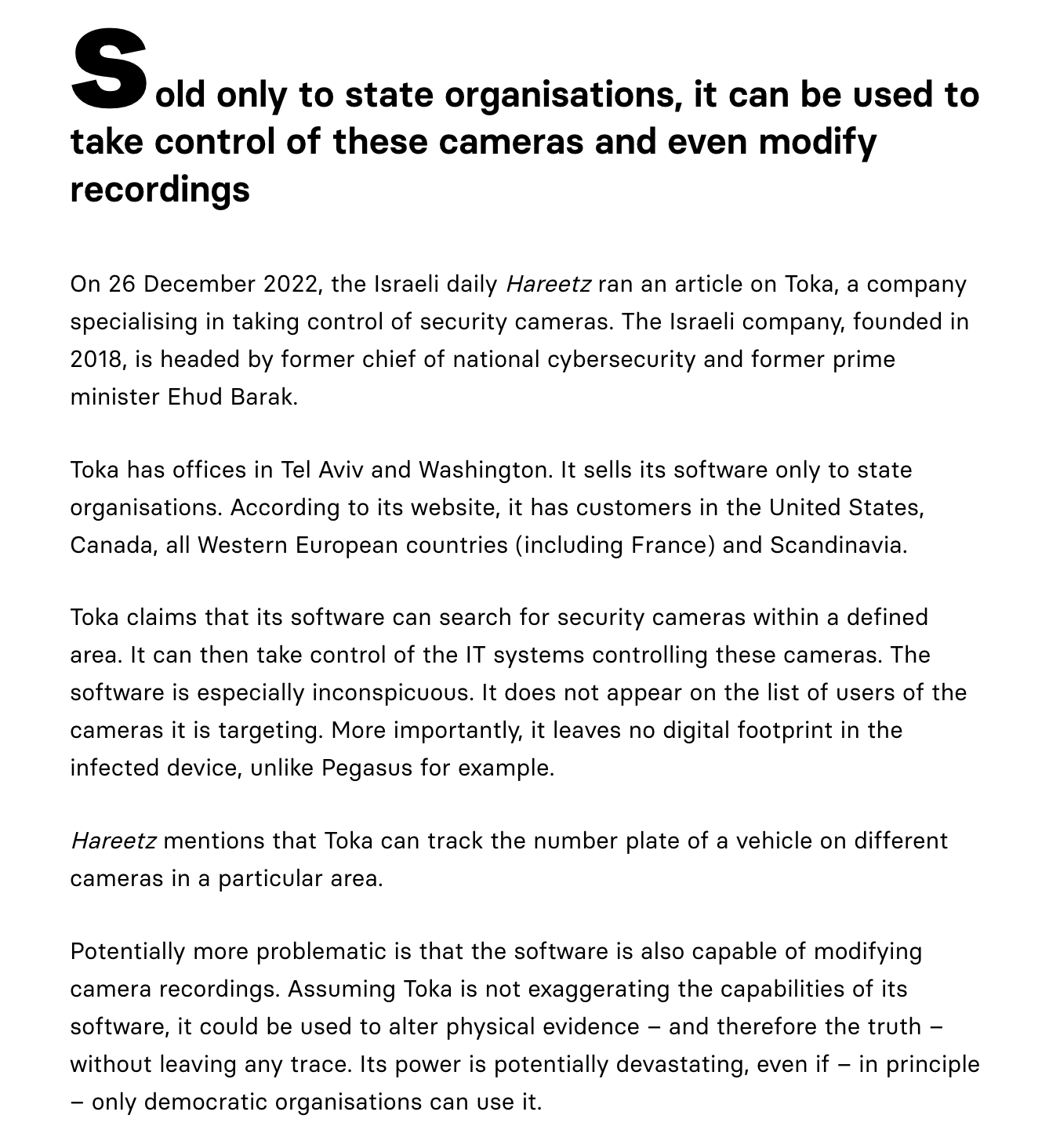
We finally have the name of the weapon used to manufacture the “official narrative” of the Charlie Kirk assassination. It isn’t a firearm—it’s a Israeli dystopian hacking software called Toka.
The Software:Co-founded by former Israeli PM Ehud Barak (the same man tied to Jeffrey Epstein), Toka is designed to infiltrate any connected camera system. Its specific “selling point” to intelligence agencies? The ability to edit video feeds in real-time or recorded history so seamlessly that forensic investigators can’t find a single digital fingerprint.
The Frame-Up: For months, witnesses have insisted they saw the true “assassin” dressed in all black on the roof. Yet, the “official” footage released to the public showed a person they claim was Tyler Robinson. This is where the technology comes in:
Digital Erasure: Toka allows operators to literally “brush out” an individual—like the assassin in black—and replace them with a background or a different figure entirely.
Real-Time & Retrospective Editing: Experts have confirmed that the software can access any web-connected camera—including those in parking lots, hotels, and airports—and alter both live feeds and past recordings.
Zero Digital Footprint: Unlike other spyware that leaves a “digital fingerprint,” Toka is designed to modify video pixels without leaving any telltale signs of a hack. This makes it impossible for forensic investigators to prove a video has been tampered with.
“Ocean’s Eleven” Capabilities: Media outlets like Haaretz have compared the technology to the heist movie Ocean’s Eleven, where a live feed is diverted to a “mock” version of reality while the real event is happening undetected.
This explains why the footage of “Tyler” on the Losee building rooftop is physically impossible. The figure has no shadow that matches the sun’s position. Why? Because the software is perfect at altering pixels, but it can’t account for the complex physics of light and shadow in a 3D space.
Manufacturing the Narrative: If they can edit the past without leaving a trace, they can “place” Tyler on that roof at the exact moment they need him to be there to satisfy the mainstream media script.
We are witnessing the birth of a new kind of lawfare: Digital Assassination. They don’t just kill the target; they use foreign-funded technology to frame the innocent and erase the guilty.
The pixels are lying, but the physics don’t. It’s time to look past the “official” feed.
Toka’s marketing literally promises to “save operators from exposure.” If a foreign-linked entity wanted to eliminate a political threat like Charlie Kirk while ensuring their operative was never seen, this is the exact tool they would use.
A major flawin the video above is the subject on the roof has no shadow. This provides credence that the Toka technology, which cannot do shadows, was used. ABN
…human language is a tool for communicating our thoughts, but is separate and distinct from thought itself. Evelina Fedorenko, a neuroscientist at MIT and lead author of the paper laying out the empirical evidence for this claim, was kind enough to let me interview her. Her basic argument is that we know language must be separate from thought because (a) people who lose language ability can still think and reason, and (b) different parts of the brain activate when we engage in different types of thought, and often the “language part” remains idle when we’re thinking. In my view, this evidence deals a serious blow to the hopes of achieving “artificial general intelligence” through the scaling of large-language models since, after all, they are language tools (it’s in the name).
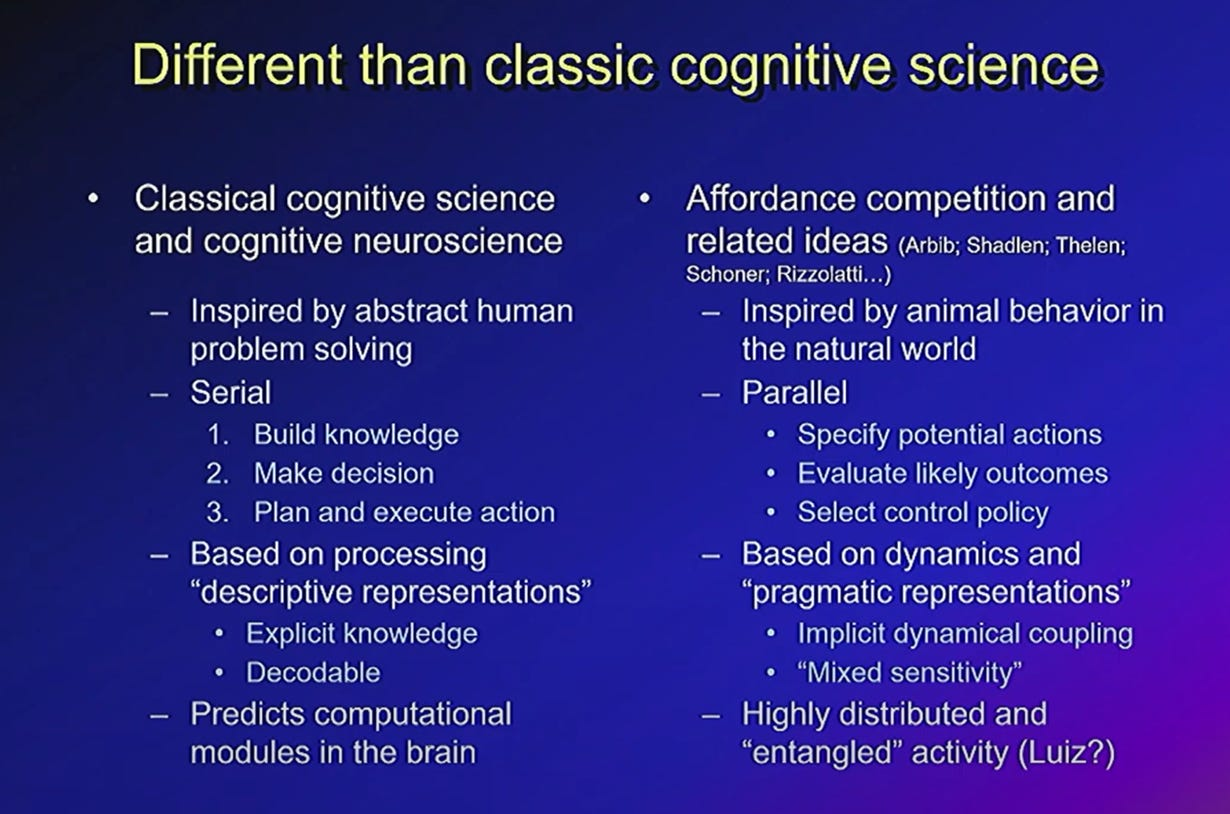
Enter now stage left Dr. Paul Cisek, a neuroscientist at the University of Montreal, to throw some gasoline on that fire. Cisek first came across my radar last year when a pithy observation he made about LLMs started making the rounds on social media. You can read his full comment here, but to summarize:
We know that humans in general can falsely impute intelligence and agency to complex events that take place in the world, as we’ve seen humans do this in the past when interacting with a chatbot such as ELIZA, or claiming the gods make volcanoes explode.
But although modern-day LLMs are complex, researchers know quite a bit about how they function, through pattern-matching and use of mathematical theories (among other things).
Thus, although the public may be inclined to attribute sentience and agency to LLMs, scientists should know better. Cisek: “We are like a bunch of professional magicians, who know where all of the little strings and compartments are, and who know how we just redirected the audience’s attention to slip the card in our pocket…but then we are standing around backstage wondering, ‘Maybe there really is magic?’”
There isn’t any magic. But a big challenge we face is that the companies that produce LLMs are willfully trying to convince us otherwise, and are working to take advantage of the human impulse to ascribe agency to these tools.
Cisek’s main claims as I understand them:
The simple model of the mind as an information processor that takes input and produces output is mistaken.
We should instead see minds as control systems that guide behavior as part of a continuous process, like a circuit.
Over hundreds of millions of years, biological evolution has expanded the range and depth of behaviors that our minds can control.
I have taken several excerpts from the essay above to provide a sense of the overall discussion. It’s an interesting read, not very long, not hard to follow. Well-worth reading. ABN
A former top scientist from Harvard University has defected to China – giving the country an edge in the global race to develop the world’s first AI super-soldier.
Charles Lieber, the former chair of Harvard’s chemistry department, has resurfaced as the founding director of Shenzhen’s Institute for Brain Research Advanced Interfaces and Neurotechnologies, also known as i-BRAIN.
Lieber was convicted in 2021 of lying to the feds about his ties to China and retired from Harvard in 2023.
Scientists in the military wing of the Chinese Communist Party have been working on brain-computer interfaces — Lieber is one of the world’s leading researchers in the field — to boost mental agility and situational awareness to engineer super soldiers.
The Ivy League scientist was convicted in 2021 of lying to the feds about his ties to the Thousand Talents Program, a Chinese state scheme to poach foreign researchers. He was promised $750,000 a year to set up a research lab in China while he was at Harvard, and hid funds he received from the Internal Revenue Service.
THE BALLROOM Trump is building a 90,000 square foot ballroom with a 1,000 person capacity. Hardly adequate for the White House Correspondents Dinner which was attended by 2,600 people. But we’re told that we need the ballroom in order to host events like the WHCD in the future. Bullsh*t.
COST & LOCATION The cost has ballooned to over $300-$400 million. We’re told it’s being privately funded and being sold on that as being a good thing that won’t cost the taxpayers. Here’s the reality: private funding means no congressional oversight or appropriations, no budget hearings, no public scrutiny.
Furthermore, when infrastructure is part of the Executive Office of the President at 1600 Pennsylvania Ave, it can be CLASSIFIED under “executive privilege.” The entire executive branch will be able to run this data center without oversight or checks & balances.
…LEAD ARCHITECT Shalom Baranes, a jewish immigrant to the US via the Hebrew Immigrant Aid Society (HIAS), has been appointed architect. Previously, Baranes was the architect for the post-911 hardening & rebuilding of a little building called the Pentagon. SCIFs, bomb-proofing, compartmentalization, etc.—the whole 9 yards. Baranes has no expertise designing ballrooms, that I could find. But he did help renovate one at the National Red Cross Headquarters once. Besides his renovation of Pentagon Wedges 2-5, he’s also done the U.S. Treasury Building modernization, and the Department of the Interior Headquarters & GSA National Headquarters renovations. It seems his talents center around building secure federal infrastructure, not event halls.
…CONCLUSION They’re building a Stargate Command bunker under the ballroom, and they need us to buy the ballroom narrative bullsh*t in order to gin up public support to ram this through against the opposition it’s currently facing.
This facility will most likely be the nerve center hub of the new “national security” Palantir spy infrastructure and digital control grid panopticon. In short, an essential facility to continue helping to enslave us, and putting any oversight by WE THE PEOPLE beyond our control. For israel’s benefit, and the jewish global empire-national security state blob.
I don’t think so. I’m America First & Only, and israel/ballroom LAST.
…The device, called proximal hypoglossal nerve stimulation (pHGNS), targets specific nerves in the tongue to keep the airway open during sleep.
It is a small, rechargeable battery-powered device, about the size of a pacemaker. It is surgically implanted under the skin in the upper chest, just below the collarbone.
A thin, flexible wire connects the chest generator to the nerve in the neck. This wire runs under the skin and is not visible from the outside.
At the end of the wire is a small, multicontact electrode cuff. This cuff wraps directly around the hypoglossal nerve, which controls tongue movement.
When the patient turns the device on before sleeping, the cuff delivers mild electrical pulses to the hypoglossal nerve.
These pulses stimulate the tongue and other airway muscles to contract and stiffen. This keeps the airway open during sleep, preventing the throat from collapsing and blocking breathing.
The Artemis II commander, who says he is ‘not religious’, was reflecting on his mammoth mission to space during a press conference yesterday.
One reporter asked the crew whether they had experienced any shift in consciousness following their 10–day journey to the dark side of the lunar surface.
Wiseman confirmed he had, referencing a moment that occurred after the team were picked up by the US Navy following their splashdown in the Pacific Ocean.
‘I’m not really a religious person but there was no other avenue for me to explain anything or experience anything,’ he said.
‘So I asked for the chaplain on the Navy ship to just come visit us for a minute. When that man walked in – I’d never met him before in my life – but I saw the cross on his collar and I just broke down in tears.’
Wiseman said it’s ‘very hard to fully grasp what we just went through’ and in the week since the astronauts came back, they have not had time to process their experience.
‘It was other–worldly and it was amazing,’ he said.
The clip just below has lousy sound and I do not know how to make a better clip. If you have these skills, please make a better clip from roughly where the video below starts at 41:29 to the end of Wolfram talking about computational irreducibility which goes to 42:51, and ends with ‘little things you can say’.
I would like to have a clip I can upload to this site. The reason for this is this segment illustrates an important point but the YT video keeps changing, so using YT timing does not work well. Thanks. ABN
NEW EVIDENCE — and this one’s simple to understand.
A professional broadcast camera (Canon XA55) was recording at UVU on September 10. Unlike every phone in the crowd, this camera records UNCOMPRESSED audio on 4 separate microphone channels at 48,000 samples per second. The Canon was roughly 46m away from the tent which provided a acoustic buffer between the onset of the events. This distance has provided clarity to the event that was missing with the other camera angles.
Think of it this way: phone recordings are like looking through a foggy window. This camera is like a clean window with the lights on.
Here’s what that clean window shows:
THE SOUND ARRIVED IN ORDER — HIGH TO LOW
When a supersonic bullet passes, the crack arrives before the boom. High-pitched sounds hit first, low-pitched sounds hit last.
A bomb going off? Everything originates from the blast and arrives at the camera at the same time.
The Canon proves the high frequencies arrived FIRST — spread out over 100+ milliseconds. Followed by muzzle blast then a detonation which originates from the stage.
THREE SEPARATE BOOMS — NOT ONE
This is the big one.
Phone recordings near the stage smear everything together into one big noise. The Canon’s professional audio separates THREE distinct low-frequency events:
• +114ms — Early energy (Mach cone) • +202ms — Muzzle blast from ~120 meters away • +321ms — DETONATION AT THE STAGE
That third event — the stage detonation — is the LOUDEST of the three. It’s not an echo. It’s not a reflection. It is the strongest low-frequency peak in the entire recording, and it originates approximately 46 meters from the camera.
Right at the tent. Right were Charlie was seated.
Something EXPLODED there. The Canon captured it separately from the rifle blast for the first time.
WHY THIS MATTERS
If a rifle was fired from 120 meters away, and a separate detonation occurred at the stage approximately ~185ms later — those are two different events at two different locations.
A single shooter doesn’t produce a detonation under a tent 120 meters from the rifle. A device detonation doesn’t produce a muzzle blast from 120 meters away.
The Canon separated what the phones couldn’t: proof of events at MULTIPLE locations.
733 SUPERSONIC SIGNATURES
A supersonic bullet creates tiny pressure waves called N-waves. The Canon’s shotgun microphone captured 733 of them in under 200 microseconds each.
The best phone recording? 123.
That’s 6x more. The phones weren’t broken — their compressed audio just can’t preserve these. Uncompressed audio can. And it did.
THE SHOTGUN MIC WAS POINTED AT IT
The external microphone clipped 122,844 audio samples — it was overwhelmed because the sound source was directly in its line of fire. Meanwhile the built-in mics captured clean audio with almost zero clipping.
Zero correlation between the two signal paths. Same conclusion.
MUZZLE BLAST CONFIRMS THE DISTANCE
The +202ms blast puts the rifle at ~120 meters from the camera. The 10-camera analysis estimated 127 meters. That’s within 6%.
Two completely independent methods. Same answer.
But the stage detonation at +321ms? That’s only ~46 meters from the camera. That’s the tent.
A rifle 120 meters away. A detonation at the tent. Two locations. Captured separately for the first time on professional uncompressed audio.
This is the 11th recording to independently confirm the same findings. Professional grade. No codec excuses. And now, for the first time, the stage detonation is isolated from the rifle blast.
Anthropic has sparked fears after revealing that it has developed an AI bot deemed too dangerous to release to the public.
The AI giant released a chilling statement warning that its new model, dubbed Claude Mythos, could be capable of unleashing crippling cyber–attacks in the wrong hands.
In a chilling analysis, the company admitted that its creation could easily hack into hospitals, electrical grids, power plants, and other pieces of critical infrastructure.
During testing, Anthropic says that Mythos ‘found thousands of high–severity vulnerabilities, including some in every major operating system and web browser.’
Some of these security weaknesses had gone unnoticed by human security researchers and hackers for decades, surviving millions of automated reviews.
These included attacks that allowed Mythos to crash computers just by connecting to them, seize control of machines, and hide its presence from defenders.


 American Buddhist Net