Chekhov’s “The Party” as a Study in Non-FIML

“He was probably thinking, as he looked at her, of his farm, of solitude, and — who knows? — perhaps he was even thinking how snug and cosy life would be at the farm if his wife had been this girl – young, pure, fresh, not corrupted by higher education, not with child. . . .”

“Listening to her husband, Olga Mihalovna, for some reason, thought of her dowry. ‘And the time will come, I suppose,’ she thought, ‘when he will not forgive me for being richer than he.'”

“Saying this, Pyotr Dmitritch picked up his pillow and walked out of the bedroom. Olga Mihalovna had not foreseen this. For some minutes she remained silent with her mouth open, trembling all over and looking at the door by which her husband had gone out, and trying to understand what it meant. Was this one of the devices to which deceitful people have recourse when they are in the wrong, or was it a deliberate insult aimed at her pride? How was she to take it?”

This short story by Anton Chekhov (linked below) seems almost tailor-made for a FIML analysis. We can watch Olga’s neurotic interpretations as they arise, and it is tantalizing to imagine what kind of stew is brewing in Pyotr’s mind. Readers with any grasp on the basics of FIML practice will likely feel a sense of frustration as they watch these two characters flail through the evening with no effective way to check their interpretations.

The Party

first posted  ~ KHIPU

Uncertainty in human social interactions

All human interactions entail some uncertainty and most entail a lot.

To deal with uncertainty, humans use heuristics (“rules of thumb”) that generally are based on what they perceive to be normal or required in the situation at hand. These heuristics come from experience, from role models, from organizational structures, beliefs and so on.

A recent study—Uncertainty about social interactions leads to the evolution of social heuristics—explores:

…an evolutionary simulation model, showing that even intermediate uncertainty leads to the evolution of simple cooperation strategies that disregard information about the social interaction (‘social heuristics’).

This study uses simulations to tease out how social heuristics and social cooperation evolve in very simple game scenarios.

If social games have rules, we can change how much uncertainty they contain and how best to cooperate within them.

This is essentially what FIML practice does. FIML greatly reduces interpersonal uncertainty between partners while increasing cooperation by having a few fairly simple rules.

When uncertainty is lowered and cooperation increased between partners, psychological well-being and understanding is proportionally enhanced. This happens because social interaction and communication are basic to human psychology.

The study linked above employs simulations to show a sort mathematically forced evolutionary outcome arising from initial settings. I believe FIML is similar in this respect, though the FIML game involves complex humans rather than simple sims.

I often wonder why no one has discovered the rules of FIML before. So many great thinkers, but not one found these key rules for optimal communication and psychological understanding. I believe there are two basics reasons for this: 1) FIML requires developing dynamic metacognition during real-time real-life communication events and this takes practice; and 2) most great thinkers that we know about today and hence could learn from also had great status, and this prevented them from noticing the deep flaws in interpersonal communication that FIML corrects.

first posted JUNE 1, 2018

Advanced FIML

FIML is a method for generating crystal clear communication between participating partners. Once this has been achieved partners will notice a profound reduction in neurotic feelings–anxiety, worry, fear, suspicion, depression, boredom, anomie, etc.

Following this, many FIML practitioners will also notice that the practice has given them insights into cultural semiotics that parallel changes in art and literature. In designing FIML, we were not originally looking for this outcome, but it is there. Let me explain.

The “semiotics” or vocabulary of all art forms have changed throughout history, but especially since the 19th century. For example, in music the notion of what is dissonant or harmonic has changed from simpler classical forms, which demanded greater conformity between scales and chords, to jazz and modern music that allow for much greater freedom. Similarly, in the visual arts, the modern sense of color, balance, and perspective has changed to allow for much greater freedom of expression than in the past. The same kinds of changes can be seen in literature, chess, math, architecture, design, and many other areas.

We even see these changes in society as many more concepts and ways of living are now allowed than in the past–a more open sense of gender and sexual orientation, for example, are generally considered normal or acceptable in many parts of the world when just a few decades ago they were not. We also have a much broader and deeper understanding of race, culture, history, religion, ethnicity, and so on.

All of this relates to FIML in this way: FIML gives partners the means to understand and reorganize any and all levels of cultural semiotics they can become aware of. By semiotics I mean all signs, symbols, mores, taboos, beliefs, roles, impressions, memories, feelings, etc. that are connected to language and that thereby influence our use of language. That basically means everything in your mind, including language. Semiotics is the water the fish of language and communication swim in. Your mind is filled with a multifaceted semiotics that affects everything you do, say, and hear. Normally, we are only sort of aware of this.

FIML practice will lead many partners to realize that the semiotics–whatever they may be–in which their lives are immersed are as fully open to interpretation and reorganization as the artistic and cultural traditions described above. How partners decide to interpret their shared semiotics is up to them. FIML says nothing about that. What FIML will do is show you in a most intimate and convincing way that your capacity to fully understand your partner can also free you from traditional strictures in how you think about psychology, society, politics, history, art, and so on. If you want to play classical tunes with that knowledge, that is fine. If you want to play jazz or something you make up, that is also fine.

FIML will free you to do whatever you like with the semiotics you share with your partner.

In this way, I think that FIML practice can greatly enhance traditional Buddhist practice. At the same time, FIML may make traditional Buddhist practice more accessible or relevant to people today. FIML shows partners the emptiness of their semiotics in a way that may be more engaging than traditional techniques.

(As a side note, one great concern I have about FIML is ethics. I am quite convinced the ethics required to successfully practice FIML will convince partners that high ethical standards are essential for good living, but I cannot prove that. It does not follow logically and we do not have enough examples of successful FIML practitioners to claim that based on the numbers. No social or intellectual system, not even a strict legal system, can ensure that all members will behave ethically. I hope that FIML will be so powerful and transformational to those who do it, though, that high ethical standards will be a nearly inevitable byproduct of the practice. Time will tell.)

first posted DECEMBER 24, 2011

UPDATE 09/18/22: I have long been convinced since first posting the above that honesty and good ethics all but “fall out” of FIML practice. Surely there will be some individuals who will misuse the practice but the majority will not. Within just a few weeks it will become evident to partners that lying or withholding are completely counterproductive and defeat everything good about FIML. Remember, FIML is not a tell-all game. Partners always have the option to decline to say. FIML is not about discovering personal secrets or using psychological techniques. It is all about becoming very clear about what you and your partner mean when you speak or act. It is an extremely wonderful, refreshing practice. ABN

Free energy principle & interpersonal psychology

To be very brief, Karl Friston’s “free energy principle” says that the brain is an “inference machine” or “prediction machine” that uses Bayesian probability reasoning and is motivated to act by an inference seeming not true or “surprising” to it.

More can be found here and here.

The free energy principle is a straightforward way to explain what FIML (note: this link will lead to recent posts and reposts, including this one, but just scroll down a bit for more)  practice does, how it does it, and why it works differently than any other form of psychotherapy and in many significant ways why it works better.

A psychological “complex,” “neurosis,” “personality disorder,” or “persistent thought,” call it what you will, affects human behavior by being or having become a nexus of thoughts, ideas, perceptions, feelings, interconnected neurons and chemistry.

The same is true for any personality trait or skill, including very positive ones.

In Friston’s free energy terms, the psychological elements described above are surrounded by Markov blankets.

That means they are isolated or protected systems with their own variables. These protected systems (protected by Markov blankets) are hard to change because they have their own sets of rules and habitual inputs and outputs.

And that makes them stubborn candidates for most forms of psychotherapy, especially psychotherapy that requires a therapist. One reason for this is time & expense. A second reason is it is difficult for the patient to change without therapeutically experiencing for themself the complex or trait in real-world situations.

The key here is therapeutic experience in the real-world of the unwanted trait or complex that requires change.

The third reason most psychotherapies are ineffective is very subtle incisiveness in real-time is needed to penetrate psychological Markov blankets.

What FIML does is penetrate the Markov blanket enshrouding a complex with a series of small pricks. Each prick in the blanket is small, but each prick also allows some of the valence (gas) inside the blanket to escape.

FIML slowly punctures the Markov blanket with many small pricks, eventually causing it to collapse.

Once it has collapsed, the energies that were trapped inside it can be used for other things. In this way FIML optimizes even non-neurotic psychology by removing pockets of inefficiency held within psychological Markov blankets.

By using only small pricks to penetrate Markov blankets, FIML allows people to gradually and painlessly see what needs to be changed, why, and how to do it. Since FIML works in real-time real-world situations, even very small insights can bring about large changes.

first posted NOVEMBER 23, 2019

More thoughts on “Empathy”

It seems that many individuals who self-describe as “empathetic” think of empathy as a talent they have for “reading people”, or knowing what others are thinking without having to ask. I think this is a huge mistake that can actually lead such people to have less empathy over time. To me it seems much more appropriate to think of empathy not as a talent one possesses but as a desire to understand other people. If we think of it this way then the ever-problematic “I know” becomes “I want to know.”

If empathy is conceived as an interest or desire, it is more likely to be developed and pursued. If, however, it is conceived as a static quality or talent, it will be taken for granted, misapplied, and probably warped into just another form of hubris.

I wonder what a self-described “empathetic” might learn from FIML. I have a feeling many of them would find that they’re not so good at “reading” others after all. Perhaps they are just adept at getting along in some sort of professional capacity and have generalized their confidence about that to other social realms.

As FIML has shown me and my partner over and over again, we are comically substandard at knowing what the other is thinking. But I hope the fact that we want to know means we have empathy for one another.

Be sure to read or re-read our previous post entitled “Theory of Mind and FIML” for a much more comprehensive treatment of this subject.

first posted  

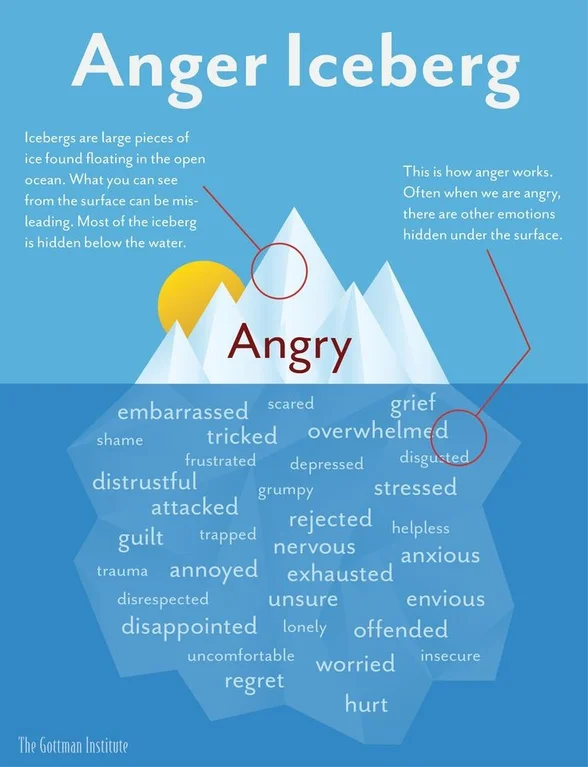
This image is profoundly misleading because it leaves out a major factor

A major cause of anger and all other emotional reactions during interpersonal communications is mistaken interpretations, either wrong or distorted. This can also include positive interpretations.

For Buddhists, the second skandha (sensation) is the proximate cause of how we perceive (third skandha) forms (first skandha). The fourth and fifth skandhas (mental activity and consciousness) are how we consolidate or more often reconsolidate the original mistaken or distorted sensation. For more on this see: The Five Skandhas.

For non-Buddhists, if you watch your mind closely you will notice there is a short delay between receiving an impression and reacting to it, interpreting it.

For everyone, if you can be mindful of the second skandha (sensation) as it occurs and then interrupt the habitual firing of the next three skandhas by doing a FIML query, you will begin to truly observe how your mind (and your partner’s mind) really works. Each interruption of this type improves your mental and emotional functioning because you will observe an objective bit of reality and correct toward it. For more information see: Disruption of neurotic response in FIML practice and How the brain processes new information. ABN

A perfect moral, dramatic, pragmatic, linguistic, psychological, spiritual, and emotional act…

…is a proper FIML query.

It is perfect (in no special order) morally because it seeks truth and goodness between two people; dramatically because it uses our innate dramatic instinct to question our own deep sense of live drama in the moment; pragmatically because it is eminently practical; linguistically because it is an extremely good use of language, possibly the best use; psychologically because it benefits both the self and other in profound ways while also revealing deep behavioral patterns painlessly; spiritually because it stimulates the spirit and spiritual metacognition, bringing both partners closer to their ideals; and emotionally because it forestalls false negative and destructive emotional responses, replacing them with joyful understanding. FIML is a pursuit of truth shared by two people. It is a technique, a method, that can be used in any religion, philosophy, world-view, or lifestyle. In the beginning, FIML does not even depend on scrupulous truthfulness because the practice itself will reveal the value of truthfulness, which ultimately will require almost no effort. Truthfulness is an instinct or inkling of deepest consciousness. Once seen, it calls forth itself.

ABN

first posted NOVEMBER 5, 2021

What Really Happened During the Yellowstone Park Flood?

I found the narrator’s delivery quite interesting. For the length of the video he maintains a public face with a few conspicuous emotional expressions, also stock public semiotics. He comes across as an intelligent, kindly, nice-guy type. This may well be his persona in real life. What I want to point out is the burden of carrying a persona like this wherever you are, especially into your own home, your own world. In your private spaces, you can greatly improve your communication by doing FIML practice. Clearly, there is a more complex person behind the persona we see in the video. This is the part of us—our authentic being—that FIML works with. There are two difficulties in doing FIML: 1) you must have the ability to be trustworthy and you need to have a trustworthy partner that you care about and that cares about you; 2) you both have to learn how to overcome the universal taboo of stopping real-time speech to query the speaker directly about what they just said; you have to be able to do this and accept this when your partner does it to you. Point #1, sadly, can be the more difficult. Point #2 is difficult because it goes against what seems to be an instinct. It can be overcome fairly easily if we know there is a reason to do that. It is like overcoming a tendency to flinch where it is not needed. ABN

To readers of ABN

ABN has gained many more readers since coverage of covid and other matters became of more pressing importance. They still are more pressing since our very existence as a free society is at stake.

That said, please do your best to understand and practice FIML with your spouse or best friend. FIML is a life-changing practice that will reveal the building blocks of both of your makeups in a most wonderful way.

Positive change through FIML is easy in the sense that each building block is small. Being small, they are easy to analyze and not difficult to accept if we see we are in the wrong. This promotes rapid incremental transformation for the better.

A little change here, a little change there, patterns are recognized and rather easily transformed into something much more adaptive, real, appropriate for your lives. No theory or concept of personality is necessary. No training in psychotherapy is necessary.

The simple dynamic of FIML done honestly and in friendship will help both of you feel much better and be much more authentic to yourselves. FIML is a process, a dynamic method. It has no other content save what you bring to it. ABN

An image that illustrates the value of FIML practice

click on image for larger

FIML practice is like JWST compared to normal interpersonal speech, which is like Hale at best. Like the telescope, FIML is a technical advance that allows for much greater clarity and resolution. In Buddhist terms, FIML is partner-based mindfulness that provides an objective control on understanding in addition to much better clarity. ABN

These videos may contain valuable instruction or confirmation for some Buddhists and FIML practitioners

There are other articles with similar videos in today’s Daily Mail. I watched three of the vids at the link and found they confirm the First Noble Truth in ways we can relate to today. They also show the value of having a stable ethical practice like the Noble Eightfold Path.

FIML practice can be described as a modern pair-work take on Buddhist mindfulness and concentration. FIML provides an objective way to clearly see yourself in real life while also helping your partner to do the same.

This world is rife with delusion. Many people lose their lives to it. Others crack up very badly. I make no judgement of anyone. Contemplating our own mistakes and excesses as well as those of others can be a sort of Buddhist Contemplation of the First Noble Truth, the truth of suffering. ABN

Dual-Process Theories of the Mind as means to analyze real-world, real-time interpersonal data

…Despite their differences, dual-process theories share the common idea that thoughts, behaviors, and feelings result from the interaction between exogenous and endogenous forms of attention. Both types of attention can be applied to representations to increase or decrease their level of activation. As the activation level of a representation increases, so does its accessibility, which in turn increases the probability that it will influence behavior. In times of conflict [When a FIML query is initiated], accessibility can be managed (i.e., maintained or inhibited) during the stream of processing by the control of attention. In a sense, the “source” of attention (LaBerge, 2000), that is, whatever mechanism that applies the activation to the representation, can be thought of as the gateway of accessibility that is the essence of controlled processing.

Individual Differences in Working Memory Capacity and Dual-Process Theories of the Mind

FIML practice is a form of mindfulness training with the addition of controlled attention processing which enables rapid gathering of real-world data followed by analysis thereof. This controlled attention processing is a learned behavior shared by both partners. The general concept of this learned/trained behavior is explained in How to do FIML. Individual partners adapt this learned/trained behavior to their own lives. In this sense FIML itself has no content. It is wholly a technique that allows rapid analysis of agreed upon objective interpersonal data. ABN