Inventing your own communication system

If you know a system well and change parts of it to make it more efficient, that system will work better.

Evolution works this way “mindlessly” in the sense that we assume today that there is no plan behind evolutionary change. If something works better it tends to replace that which it works better than.

Another “mindless” example is AI systems that invent their own languages:

An artificial intelligence system being developed at Facebook has created its own language. It developed a system of code words to make communication more efficient. The researchers shut the system down as it prompted concerns we could lose control of AI. (Researchers shut down AI that invented its own language)

The linked article mentions other AI system that have similarly invented their own communication systems. These systems work but humans are not able to understand them.

All of this shows that communication systems have their own logic and that they can be made more efficient by pursuing that logic.

This is what FIML does through the use of a few new rules for speaking and listening.

FIML emphasizes and provides techniques for:

  • analysis of real-time communication
  • much greater accuracy in real-time communication
  • much greater mutual understanding, efficiency, and satisfaction

By improving your communication system(s) and removing error from it, FIML greatly enhances psychological well-being.

FIML works with the communication system(s) you already have. FIML does not tell you what to think.

first posted JULY 27, 2017

Belief, knowledge, and well-being

Belief means you are mostly convinced but not completely sure. Knowledge is more certain. These two words can be used as follows—I believe the universe probably started with the Big Bang, but I know the earth revolves around the sun.

We derive a degree of intellectual well-being from the beliefs and knowledge afforded us by modern science and engineering. But knowing that the earth revolves around the sun or that the Big Bang is the most likely explanation we now have does not provide us with very much emotional or psychological well-being.

We need more, or we need something different, to achieve a deep state of emotional well-being.

To achieve a deep state of emotional well-being we need to know that we can really believe at least one other person. That person should be our primary interlocutor, the person we deal with the most. If we cannot believe that person and/or they cannot believe us, we can’t achieve a deep state of emotional well-being.

To the best of my knowledge, there exists no common communication system (or even uncommon one) that allows us to deeply know and believe someone else, except the FIML system.

The reason this is so is all other human communication systems rely too much on implication, interpretation, and assumed shared beliefs.

When you do any of those things with your primary interlocutor you will necessarily make mistakes and/or be uncertain about what they are saying or how they are understanding you. Mistakes and uncertainty create shadowy feelings and wrong or multiple interpretations in the mind. Rather than have a clear knowledge of what your partner thinks or understands, you will be guessing.

Even if you are right every time you guess (and this is not possible), you will still have no way of being certain. You will not know if you are right or not. And your partner will have the same problem with you.

Emotional well-being depends on the quality of our communication with our primary interlocutor. There are substitutes—careers, religions, political causes, money, power, sex, etc.—but none of these will ever equal the emotional well-being that comes from very high-quality communication with your primary interlocutor. To have high-quality communication, you and your partner must have a system that removes doubt and uncertainty and replaces them with knowledge and belief.

first posted JULY 12, 2012

Consciousness, Big Data, and FIML

Modern neuroscience does not see humans as having a discrete consciousness located in a specific part of the brain. Rather, as Michael S. Gazzaniga says:

The view in neuroscience today is that consciousness does not constitute a single, generalized process. It involves a multitude of widely distributed specialized systems and disunited processes, the products of which are integrated by the interpreter module. (Source)

Computer and Big Data-driven sociology sees something similar. According to Alex Pentland:

While it may be useful to reason about the averages, social phenomena are really made up of millions of small transactions between individuals. There are patterns in those individual transactions that are not just averages, they’re the things that are responsible for the flash crash and the Arab spring. You need to get down into these new patterns, these micro-patterns, because they don’t just average out to the classical way of understanding society. We’re entering a new era of social physics, where it’s the details of all the particles—the you and me—that actually determine the outcome.  (Source)

Buddhists may recognize in these insights close similarities to core teachings of the Buddha—that we do not have a self; that all things arise out of complex conditions that are impermanent and changeable; that the lion’s share of “reality” for any individual lies in being attentive to the moment.

Notice how similar Pentland’s insights are to Gazzaniga’s—the whole, or the common generalities (of society), can be far better understood if we can account for the details that comprise them. Is an individual mind a fractal of society? Do these complex systems—societies and minds—both use similar organizational processes?

I am not completely sure how to answer those questions, but I am certain that most people are using similar sorts of “average” or general semiotics to communicate and think about both minds and societies. If we stick with general averages, we won’t see very much. Class, self, markets, personalities don’t give us information as sophisticated as the detailed analyses proposed by Gazzaniga and Pentland.

Well then, how can individuals cognize Gazzaniga’s “multitude of widely distributed specialized systems and disunited processes” in their minds? And how can they understand how “the products” of those processes are actually “integrated” into a functional “interpreter module”?

And if individuals can cognize the “disunited processes” that “integrate” into a conscious “interpreter,” how will they understand traditional psychological analyses of the self, personality, identity, biography, behavior?

I would maintain that our understanding of what it is to be a human will change deeply if we can learn to observe with reliable clarity the “disunited processes” that “integrate” into a conscious “interpreter.” That is, we will arrive at a completely new understanding of being that will replace the “self” that truly does not exist in the ways most societies (and people) understand it.

FIML practice shows partners how to observe with great clarity the “disunited processes” that “integrate” into a conscious “interpreter.” Once these process are observed in detail and for a long enough period of time, partners will realize that it is no longer necessary to understand themselves in the “average” terms of self, personality, identity, biography, behavior, and so on.

Partners will come to understand that these terms denote only a more detailed version of a naive, static view of what a person is. Most psychology is largely a more detailed version of a naive, static view of what a person is.

We see this in Gazzaniga and Pentland’s findings that are derived from complex analyses of what is actually happening in the brain or in the multitude of real transactions that actually comprise a society. We can also see very similar insights in the Buddha’s teachings.

It is my contention that FIML practice will show partners the same things—that their actual minds and actual interactions are much more complex (and interesting) than the general semiotic averages we normally use to understand them.

From a Buddhist point of view, when we “liberate” ourselves from “attachment” to “delusive” semiotic generalities and averages and are truly “mindful” of the “thusness” of the ways our minds actually work, we will free ourselves from “suffering,” from the “ignorance” that characterizes the First Noble Truth.

first posted SEPTEMBER 1, 2012

You can’t say what they don’t already know

The main problem with culture is, in virtually all cases, “you can’t say what they don’t already know.”

Some very small cultures of just a few people are exceptions to this rule, but no large culture with anonymous and/or not-well-known members is.

Cultures demand constant authorization and reauthorization from their members. To stray from established norms is to weaken group authorizations.

In the world today, you cannot escape the above truth about culture. You will find it prevails no matter where you go.

In your private life you can escape the above truth by doing FIML practice. The whole point of FIML is to speak about things you don’t already know.

first posted JUNE 29, 2016

Contretemps and FIML

In FIML practice, we use the word contretemps to indicate a mix-up of meanings between partners. When partners are thinking, speaking, and/or listening from incommensurate perspectives, they are experiencing a contretemps. This causes mental confusion and can quickly lead to emotional reactions that are out of proportion to the situation. As we have seen in other posts, when you do not resolve a contretemps to the satisfaction of both partners (and to the satisfaction of what is true), you will cause a division, however, small in your shared understanding of each other. You cannot fully resolve a contretemps without doing a FIML dialog about it.

Some of the common ways that contretemps are generated:

  • you are dealing with a new subject
  • you are dealing with a different aspect of a familiar subject
  • one of you is saying something close to but not the same as what the other is hearing
  • one of you out of curiosity wants to revisit a subject but to the other it sounds argumentative
  • one of you is not getting sufficient confirmation from the other about what you said, so the point gets repeated

Notice that the origin of all of these contretemps is mental; that is, not terribly emotional. Once the mind becomes confused, however, even if only slightly, it begins to mishear and misspeak, thus compounding the problem while adding emotional elements to it. This happens because interpersonal communication is a complex system. By complex system, I mean it is a system that changes very rapidly and which is characterized by initial starting points not providing sufficient data to predict later outcomes.

Once you understand these points, it should become clear why interpersonal relationships can be so difficult without FIML practice. In non-FIML speech, even very simple contretemps can, and often do, lead to deep frustration and strong emotions. Whether those emotions are expressed or not, they exist. Partners may feel resentment, anger, blame, self-blame and so on due simply to a mix-up of very trivial meaning.

Let me give an example. This morning I noticed that we had very few clean dishes (of a certain type) in our cupboard. They were all in the dishwasher. In my memory, that was the smallest number of clean dishes of that type I had ever observed in our kitchen. I felt curious about it and asked my partner why she thought there were so few. She said it did not seem unusual to her. I asked again, she repeated her answer and we went on to other matters. Sometime later, I became curious about the dishes again and asked her again if she knew why we had so few clean ones. This is where the contretemps began. When she answered, either she had an unconscious tone of impatience or I mistakenly heard a tone of impatience (neither of us is sure). Whatever the case, I thought she was probably feeling that I was blaming her and so my voice rose slightly with the vague intention of putting out a fire before it got going. I wanted to emphasize that I was just curious. Of course, that tone did not work at all but only made matters worse. At this point we began a FIML discussion and within a few minutes established a mutual understanding that was satisfactory to both of us concerning what had just happened.

The basic type of contretemps that led to that discussion was the second-to-last one of the bullet points listed above: one of you out of curiosity wants to revisit a subject but to the other it sounds argumentative.

I hope it is clear to readers that even small stuff like that can cause problems. And I hope it is also clear that you really have to take the time to figure it out with a FIML discussion. If you don’t, both of you will draw wrong conclusions from the incident or at least be vague about it. If we had done as most people do and just dropped the subject when it got a little out of control, I might have concluded that my partner was mad at me for being petty or blaming her for something when, in truth, I was only curious about a small domestic anomaly. She might have thought I was angry about something else and was using the dishes as a way to get in a dig. Even more to the point, neither of us would have had any way to be sure we understood each other or the incident in question. Most couples would probably go on about their day, ignoring the issue while waiting for positive feelings to arise again.

But that doesn’t work so well. It’s an OK way to go once in a while and for some situations, but if you do that a lot, you will develop deeper and much more serious contretemps in the way you relate to each other. In engineering, I believe, there is a saying that cracks never get better but only worse. In interpersonal relations, contretemps similarly don’t usually get better because they almost always lead to further mistaken interpretations. She is too sensitive. You are too argumentative. Etc. Fill in your own blanks. Once the contretemps develop and are not addressed through FIML practice, at least some of them will get worse.

To repeat: almost any particular contretemps is in itself trivial. But if we do not figure it out and resolve it, it stands a good chance of having deleterious effects on our relationship. Interpersonal communication is a complex system. It is dynamic and moves very quickly. We ourselves are often not aware of why we said something, let alone why our partner did. If we do not deal intelligently with those levels of communicative reality, we will run into problems, many of which will not later be soluble.

I can’t think of any other way to successfully deal with the complexity of interpersonal speech than FIML. Even if we have a video and a perfectly accurate transcript of what was said, when we play it back or read it, there will not be any way we can be sure of what was in someone’s mind as they spoke. The really deep and true—the most valid—level of interpersonal communication can only be accessed by quickly recalling the few seconds of speech that have just passed. Then, these few seconds must be discussed using FIML techniques. With practice, slightly longer time-frames can be accessed, and narrative and episodic memories can also be accessed and used, but that can be difficult and won’t work if the basic FIML technique is not part of your interpersonal foundation.

This is one area where I have a fairly serious disagreement with the way Buddhism is often practiced today—with it’s overly strong emphasis on being inoffensive when we speak. If I had done that when I became curious the second time about the dishes, I probably would not have said anything. But if I had not said anything, I would have not done so because I was falsely assuming my partner was overly sensitive and I would have been falsely assuming that my curiosity was somehow wrong or that I would not be able to make myself clear to her. That would have constituted a silent contretemps, a crack in our understanding of each other. On some later day, secure in my conclusion that my partner is overly sensitive, I might have widened the crack by withholding something else from her.

The preeminent virtue in Buddhism is always wisdom, not compassion, not being inoffensive, not necessarily being silent when you aren’t sure. I think FIML gives us a way to do wise Buddhist practice with our partners without resorting to external semiotics or judgements, or misapplied slogans.

By the way, the example of the dishes is a pretty good example of something that might prompt a FIML discussion. It was a trivial incident that, like so many others, might have seemed to be of no special importance. But it was also sort of a trap, one half of which was the incident and the other half of which was our, we humans, poor abilities at speaking, feeling, and thinking. If the incident is so trivial, it ought to be easy to figure out, right?

first posted JANUARY 30, 2012

Honest feedback: Barriers to receptivity and discerning the truth in feedback

Abstract

Feedback is information provided to recipients about their behavior, performance, or understanding, the goal of which is to foster recipients’ self-awareness, and behavioral reinforcement or change. Yet, feedback often fails to achieve this goal. For feedback to be effective, recipients must be receptive and accurately understand the meaning and veracity of the feedback (i.e., discern the truth in feedback). Honesty is critically important for both receptivity and discerning the truth in the feedback. In this article, we identify barriers to receptivity and discerning the truth in feedback and illustrate how these barriers hinder recipients’ learning and improvement. Barriers can arise from the feedback itself, the feedback-giver, and the feedback-recipient, and both parties share responsibility for removing them.

link

This paper provides useful insights into how to give and receive feedback and what can prevent that from happening successfully. FIML practice, which can be thought of as a form of micro interpersonal feedback, overcomes all barriers mentioned in the paper. FIML works well because partners: 1) make a prior agreement to do it and how to do it; 2) ask for feedback that is immediately useful to them; 3) ask immediately upon noticing the need for feedback; 4) ask for very specific information residing solely in their partner’s working memory; 5) all of the preceding points contribute to small and easily kept honest bits of very reliable feedback. Since the topic of the feedback is very small and mutually agreed upon by both partners is can be understood as a significant kind of objective reality that exists between the two of them. This greatly promotes interest in the practice and honesty between partners. ABN

Game theory and trust

The game linked below explains some basics of game theory and also some basics of why FIML practice works so well.

The game can be found at this link: The Evolution of Trust.

I highly recommend playing this game. It takes about thirty minutes to finish.

For the first part of it, I was only mildly interested though the game is reasonably engaging.

When it got a point where communication mistakes are factored in, I sat up and took notice.

The game is a very simple computer model of some very simple basic choices human beings make all the time. Without giving away too much, even this simple model shows something I bet most of us can already see.

And that is: zero-sum games do not give rise to trust. Win-win games do.

What was most interesting to me is the game also shows that communication mistakes foster trust if there are not too many of them.

Accepting mistakes in communication requires trust. Mistakes happen. When two people accept that in each other and in themselves, trust grows.

This is a very important point and a foundation of FIML practice.

In fact, I would say that mistakes foster trust even more in FIML than other communication games. This happens because in FIML mistakes are isolated in such a way that they can be fully recognized and understood for what they are.

This provides a method for solving immediate problems while also building a foundation for the inevitable occurrence of future ones. Moreover, the kinds of mistakes people make become less stupid.

In many respects, the game of FIML is largely one of recognizing communication mistakes or potential mistakes as soon as they arise, within seconds of their onset.

By doing that FIML shows us how our deep psychology is actually functioning in real-life. Multiple insights into this aspect of psychology are transformational.

first posted FEBRUARY 11, 2020

Bad communication leads to ulterior motives and pointless suffering

I believe most people in the world are all but forced to resort to ulterior motives when dealing with others or being dealt with by them.

Furthermore, I believe most people are in this position so often they don’t just resort to hidden motivations, they expect them, are habituated to them, rely on them, and even enjoy them even though they cause immense suffering.

This situation arises due to fundamentally bad communication and the mistrust and uncertainty that devolve from it.

If communication is fundamentally bad (ambiguous, misleading, can’t be cleared up), there is no one you can trust but yourself. No one else you can rely on.

You are all but forced to conceal what your really think, feel, or want because you probably won’t be understood if you try to explain yourself honestly. Worse, you  may get played.

Your interlocutor may genuinely misunderstand and cause you harm by that or they may feign interest and honesty when they are just gathering dirt to use against you.

Can anyone deny this happens very often? And that normal people have no recourse but to play that game?

An ulterior motive is one that is concealed. A motive that is different from what is being communicated. We all know what that means and how destructive it can be.

Ulterior motives arise because we do not use our communication systems (mainly speech and listening) at all well. Instead of communicating honestly, we try to “read” the other person while at the same time calculating to what extent or how they are “reading” us.

This is a disgusting situation for people to have put themselves in.

This problem can be fixed with one other person, so you can have at least one friend who does not do this to you and to whom you do not do it either. That makes two people who can escape the deadening, anti-life maze of ulterior motivation madness.

The way to do it is through FIML. I do not believe there is any other way.

If many people do FIML, eventually many of us will see the problems of bad communication clearly. Many of us will realize that virtually all people are trapped in a system that all but forces them to lie to others while suffocating themselves.

____________________________

Edit 10/07/17: Here is a pop culture analysis of how to tell if someone is lying: 9 WAYS TO SPOT A LIAR. Scroll down to the list and notice how crude and dubious these tells are, but this is what many people work with. It’s all we have. With a good partner, FIML can lead you to levels of truth far higher and deeper than this. In this world, we really have to develop FIML relationships to fully explore our own psychology and human psychology in general. Without FIML, you are permanently locked out of your own depths by being trapped in ordinary communication which is accurately characterized by the shallowness of the linked article.

first posted OCTOBER 6, 2017

Fourth wave cognitive behavior therapy

The third wave of cognitive behavior therapy is a general term for a group of psychotherapies that arose in the 1980s, inspired by acceptance and commitment therapy (ACT).

To me, third wave therapies seem more realistic than older therapies because they accept emotions as they are and pay close attention to how they function in the moment.

The link above is well-worth reading. The frames of these therapies are also well-worth considering.

FIML, which I am calling a “fourth wave cognitive behavior therapy,” differs from third wave therapies in that FIML does not use a professional therapist. Instead, partners become their own therapists.

Moreover, how FIML partners frame their psychologies or generalize their behaviors is entirely up to them. Similarly, their psychological goals and definitions are entirely in their own hands.

At its most basic, FIML “removes wrong interpretations of interpersonal signs and symbols from the brain’s semiotic networks.”

This process of removal, in turn, shows partners how their minds function in real-time real-world situations. And this in turn provides the tools and perspectives to reorganize their psychologies in whichever ways they like.

FIML is based on semiotics because semiotics are specific and with practice can be clearly identified and understood. They give partners “solid ground” to stand on. Words, tone of voice, gestures, and facial expressions are some of the major semiotics partners analyze.

Using real-world semiotics as an analytical basis frees FIML from predetermined frameworks about personality or what human psychology even is. With the FIML tool, partners are free to discover whatever they can about how their minds communicate interpersonally (and internally) and do whatever they like with that.

first posted DECEMBER 21, 2017

Chekhov’s “The Party” as a Study in Non-FIML

“He was probably thinking, as he looked at her, of his farm, of solitude, and — who knows? — perhaps he was even thinking how snug and cosy life would be at the farm if his wife had been this girl – young, pure, fresh, not corrupted by higher education, not with child. . . .”

“Listening to her husband, Olga Mihalovna, for some reason, thought of her dowry. ‘And the time will come, I suppose,’ she thought, ‘when he will not forgive me for being richer than he.'”

“Saying this, Pyotr Dmitritch picked up his pillow and walked out of the bedroom. Olga Mihalovna had not foreseen this. For some minutes she remained silent with her mouth open, trembling all over and looking at the door by which her husband had gone out, and trying to understand what it meant. Was this one of the devices to which deceitful people have recourse when they are in the wrong, or was it a deliberate insult aimed at her pride? How was she to take it?”

This short story by Anton Chekhov (linked below) seems almost tailor-made for a FIML analysis. We can watch Olga’s neurotic interpretations as they arise, and it is tantalizing to imagine what kind of stew is brewing in Pyotr’s mind. Readers with any grasp on the basics of FIML practice will likely feel a sense of frustration as they watch these two characters flail through the evening with no effective way to check their interpretations.

The Party

first posted  ~ KHIPU

Uncertainty in human social interactions

All human interactions entail some uncertainty and most entail a lot.

To deal with uncertainty, humans use heuristics (“rules of thumb”) that generally are based on what they perceive to be normal or required in the situation at hand. These heuristics come from experience, from role models, from organizational structures, beliefs and so on.

A recent study—Uncertainty about social interactions leads to the evolution of social heuristics—explores:

…an evolutionary simulation model, showing that even intermediate uncertainty leads to the evolution of simple cooperation strategies that disregard information about the social interaction (‘social heuristics’).

This study uses simulations to tease out how social heuristics and social cooperation evolve in very simple game scenarios.

If social games have rules, we can change how much uncertainty they contain and how best to cooperate within them.

This is essentially what FIML practice does. FIML greatly reduces interpersonal uncertainty between partners while increasing cooperation by having a few fairly simple rules.

When uncertainty is lowered and cooperation increased between partners, psychological well-being and understanding is proportionally enhanced. This happens because social interaction and communication are basic to human psychology.

The study linked above employs simulations to show a sort mathematically forced evolutionary outcome arising from initial settings. I believe FIML is similar in this respect, though the FIML game involves complex humans rather than simple sims.

I often wonder why no one has discovered the rules of FIML before. So many great thinkers, but not one found these key rules for optimal communication and psychological understanding. I believe there are two basics reasons for this: 1) FIML requires developing dynamic metacognition during real-time real-life communication events and this takes practice; and 2) most great thinkers that we know about today and hence could learn from also had great status, and this prevented them from noticing the deep flaws in interpersonal communication that FIML corrects.

first posted JUNE 1, 2018

Advanced FIML

FIML is a method for generating crystal clear communication between participating partners. Once this has been achieved partners will notice a profound reduction in neurotic feelings–anxiety, worry, fear, suspicion, depression, boredom, anomie, etc.

Following this, many FIML practitioners will also notice that the practice has given them insights into cultural semiotics that parallel changes in art and literature. In designing FIML, we were not originally looking for this outcome, but it is there. Let me explain.

The “semiotics” or vocabulary of all art forms have changed throughout history, but especially since the 19th century. For example, in music the notion of what is dissonant or harmonic has changed from simpler classical forms, which demanded greater conformity between scales and chords, to jazz and modern music that allow for much greater freedom. Similarly, in the visual arts, the modern sense of color, balance, and perspective has changed to allow for much greater freedom of expression than in the past. The same kinds of changes can be seen in literature, chess, math, architecture, design, and many other areas.

We even see these changes in society as many more concepts and ways of living are now allowed than in the past–a more open sense of gender and sexual orientation, for example, are generally considered normal or acceptable in many parts of the world when just a few decades ago they were not. We also have a much broader and deeper understanding of race, culture, history, religion, ethnicity, and so on.

All of this relates to FIML in this way: FIML gives partners the means to understand and reorganize any and all levels of cultural semiotics they can become aware of. By semiotics I mean all signs, symbols, mores, taboos, beliefs, roles, impressions, memories, feelings, etc. that are connected to language and that thereby influence our use of language. That basically means everything in your mind, including language. Semiotics is the water the fish of language and communication swim in. Your mind is filled with a multifaceted semiotics that affects everything you do, say, and hear. Normally, we are only sort of aware of this.

FIML practice will lead many partners to realize that the semiotics–whatever they may be–in which their lives are immersed are as fully open to interpretation and reorganization as the artistic and cultural traditions described above. How partners decide to interpret their shared semiotics is up to them. FIML says nothing about that. What FIML will do is show you in a most intimate and convincing way that your capacity to fully understand your partner can also free you from traditional strictures in how you think about psychology, society, politics, history, art, and so on. If you want to play classical tunes with that knowledge, that is fine. If you want to play jazz or something you make up, that is also fine.

FIML will free you to do whatever you like with the semiotics you share with your partner.

In this way, I think that FIML practice can greatly enhance traditional Buddhist practice. At the same time, FIML may make traditional Buddhist practice more accessible or relevant to people today. FIML shows partners the emptiness of their semiotics in a way that may be more engaging than traditional techniques.

(As a side note, one great concern I have about FIML is ethics. I am quite convinced the ethics required to successfully practice FIML will convince partners that high ethical standards are essential for good living, but I cannot prove that. It does not follow logically and we do not have enough examples of successful FIML practitioners to claim that based on the numbers. No social or intellectual system, not even a strict legal system, can ensure that all members will behave ethically. I hope that FIML will be so powerful and transformational to those who do it, though, that high ethical standards will be a nearly inevitable byproduct of the practice. Time will tell.)

first posted DECEMBER 24, 2011

UPDATE 09/18/22: I have long been convinced since first posting the above that honesty and good ethics all but “fall out” of FIML practice. Surely there will be some individuals who will misuse the practice but the majority will not. Within just a few weeks it will become evident to partners that lying or withholding are completely counterproductive and defeat everything good about FIML. Remember, FIML is not a tell-all game. Partners always have the option to decline to say. FIML is not about discovering personal secrets or using psychological techniques. It is all about becoming very clear about what you and your partner mean when you speak or act. It is an extremely wonderful, refreshing practice. ABN

Free energy principle & interpersonal psychology

To be very brief, Karl Friston’s “free energy principle” says that the brain is an “inference machine” or “prediction machine” that uses Bayesian probability reasoning and is motivated to act by an inference seeming not true or “surprising” to it.

More can be found here and here.

The free energy principle is a straightforward way to explain what FIML (note: this link will lead to recent posts and reposts, including this one, but just scroll down a bit for more)  practice does, how it does it, and why it works differently than any other form of psychotherapy and in many significant ways why it works better.

A psychological “complex,” “neurosis,” “personality disorder,” or “persistent thought,” call it what you will, affects human behavior by being or having become a nexus of thoughts, ideas, perceptions, feelings, interconnected neurons and chemistry.

The same is true for any personality trait or skill, including very positive ones.

In Friston’s free energy terms, the psychological elements described above are surrounded by Markov blankets.

That means they are isolated or protected systems with their own variables. These protected systems (protected by Markov blankets) are hard to change because they have their own sets of rules and habitual inputs and outputs.

And that makes them stubborn candidates for most forms of psychotherapy, especially psychotherapy that requires a therapist. One reason for this is time & expense. A second reason is it is difficult for the patient to change without therapeutically experiencing for themself the complex or trait in real-world situations.

The key here is therapeutic experience in the real-world of the unwanted trait or complex that requires change.

The third reason most psychotherapies are ineffective is very subtle incisiveness in real-time is needed to penetrate psychological Markov blankets.

What FIML does is penetrate the Markov blanket enshrouding a complex with a series of small pricks. Each prick in the blanket is small, but each prick also allows some of the valence (gas) inside the blanket to escape.

FIML slowly punctures the Markov blanket with many small pricks, eventually causing it to collapse.

Once it has collapsed, the energies that were trapped inside it can be used for other things. In this way FIML optimizes even non-neurotic psychology by removing pockets of inefficiency held within psychological Markov blankets.

By using only small pricks to penetrate Markov blankets, FIML allows people to gradually and painlessly see what needs to be changed, why, and how to do it. Since FIML works in real-time real-world situations, even very small insights can bring about large changes.

first posted NOVEMBER 23, 2019

More thoughts on “Empathy”

It seems that many individuals who self-describe as “empathetic” think of empathy as a talent they have for “reading people”, or knowing what others are thinking without having to ask. I think this is a huge mistake that can actually lead such people to have less empathy over time. To me it seems much more appropriate to think of empathy not as a talent one possesses but as a desire to understand other people. If we think of it this way then the ever-problematic “I know” becomes “I want to know.”

If empathy is conceived as an interest or desire, it is more likely to be developed and pursued. If, however, it is conceived as a static quality or talent, it will be taken for granted, misapplied, and probably warped into just another form of hubris.

I wonder what a self-described “empathetic” might learn from FIML. I have a feeling many of them would find that they’re not so good at “reading” others after all. Perhaps they are just adept at getting along in some sort of professional capacity and have generalized their confidence about that to other social realms.

As FIML has shown me and my partner over and over again, we are comically substandard at knowing what the other is thinking. But I hope the fact that we want to know means we have empathy for one another.

Be sure to read or re-read our previous post entitled “Theory of Mind and FIML” for a much more comprehensive treatment of this subject.

first posted  

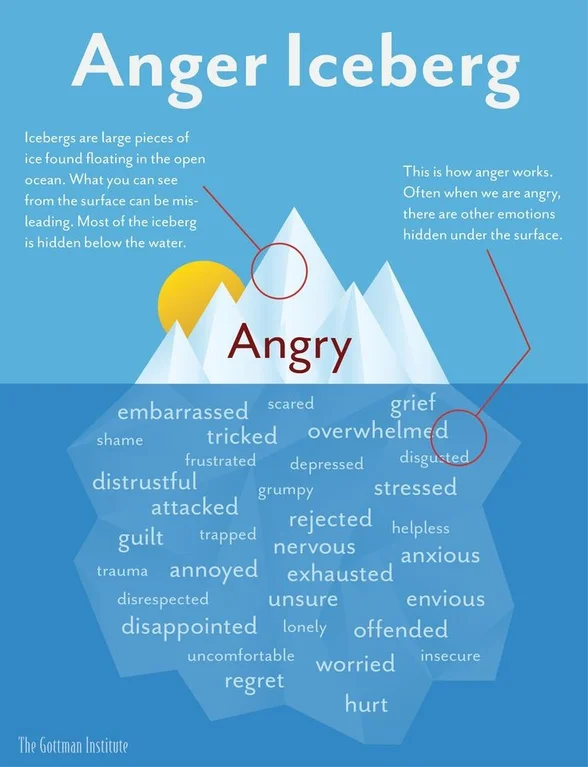
This image is profoundly misleading because it leaves out a major factor

A major cause of anger and all other emotional reactions during interpersonal communications is mistaken interpretations, either wrong or distorted. This can also include positive interpretations.

For Buddhists, the second skandha (sensation) is the proximate cause of how we perceive (third skandha) forms (first skandha). The fourth and fifth skandhas (mental activity and consciousness) are how we consolidate or more often reconsolidate the original mistaken or distorted sensation. For more on this see: The Five Skandhas.

For non-Buddhists, if you watch your mind closely you will notice there is a short delay between receiving an impression and reacting to it, interpreting it.

For everyone, if you can be mindful of the second skandha (sensation) as it occurs and then interrupt the habitual firing of the next three skandhas by doing a FIML query, you will begin to truly observe how your mind (and your partner’s mind) really works. Each interruption of this type improves your mental and emotional functioning because you will observe an objective bit of reality and correct toward it. For more information see: Disruption of neurotic response in FIML practice and How the brain processes new information. ABN