You aren’t at the mercy of your emotions — your brain creates them

Jordan Peterson analyzes a lot of stuff, not just Cathy Newman, and also inadvertently provides an excellent introduction to FIML practice

In this talk, FIML is logos. It uses word to bring order out of chaos. FIML brings  meaning and clarity to primary interpersonal relations and thus also to individual psychology. You need to want to do this, to be a hero for yourself and others. You have to want to bring meaning and order out of chaos. It’s not easy to do FIML but there is nothing else as interesting or worthwhile on the interpersonal level. I hope JP will take up FIML and introduce it to a wider audience. I do not agree with his statements about bringing out the Jungian shadow. I do agree we must discover our essence or authentic being, but this can be done without myths or shadows through FIML practice. As mentioned in other posts, FIML does not tell you how to be or what will happen to you when you practice it but it will show you, eventually, your authentic being, the essence that underlies your social persona. ABN

Arm’s length communication can be dangerous

By arm’s length communication I mean “our deepest levels of meaning, emotion, and intention are either implied or more often concealed from the person(s) we are speaking with.” (see: Communication at arm’s length)

When we do arm’s length communication too much, we retard both psychological and sociological growth. We harm both ourselves and others.

Arm’s length communication is often a type of “sociological communication.” That is, communication that holds cultural, sociological or historical assertions above individual psychological experience. This can be a good thing and it can be a bad thing.

It’s good when it helps us see and bad when it blinds us. Bolsheviks were blinded by sociological fantasies that led them to murder tens of millions. It is good for us to understand that today, especially as our society is being torn apart by arm’s length fallacies.

I will now present an example of this tragedy as it is playing out this morning. What happened is Trump allegedly asked an intelligence analyst of Korean extraction, “Where are you from?”

As someone who has extensive experience with East Asia and Asian-Americans, I am aware that this question drives many of them up the wall. One example:

This makes my blood boil. It must have been so awful to be standing there having her expertise invalidated and trivialized. (Source: asianamerican)

As an ordinary American, I am also aware that this question with precisely that wording was extremely normal well into the 1980s and beyond. A younger friend I discussed this with this morning said she still considers it to be a normal question.

“Where are you from?” means what is your ancestry. When most Americans ask this of each other it means what is your ethnic background, what ethnicity or mix of ethnicities do you identify with or feel close to. It does not mean I think you are a bad person or are not an American. In a nation of many immigrant groups, it is a normal thing to ask. Indeed, it is the quintessential American question. Or used to be before SJWs came along.

Information about your ancestry or ethnicity says something (arm’s length) about your psychology and some levels of your “identity.” Isn’t it ironic that a commenter on an Asian-American site would be incensed that the president asked someone about their identity and then proposed that that identity might well-serve US national interests?

Here is another comment from a South Asian that says the opposite:

Being a Chinese speaking South Asian that type of response isn’t surprising. (Source: AZNIDENTITY)

Having lived in East Asia for a long time, I am well-aware that “Where are you from?” is almost always the first question anyone asks me in that part of the world. Chinese, Japanese, Australians, Europeans, other Americans all ask it. It can become boring to answer when the query is rote arm’s length stuff coming from someone who obviously does not care, but that is nothing to be offended by.

We are in a semiotic pickle and I don’t know what to do about it either. There are many other examples of the above, most of them stemming from identity politics in one way or another.

What is happening is that arm’s length identity concepts are being idiosyncratically defined by identity groups and then the demand is made that those definitions be known and accepted by everyone else or “blood will boil.”

Can’t see the trees for the forest

Examples of not seeing the trees for the forest are flyover assessments of sociological  regions or general assessments of human psychology.

A more detailed example of this pertaining to psychology might be the following description of Borderline Personality Disorder:

People with borderline personality disorder are unstable in several areas, including interpersonal relationships, behavior, mood, and self-image. Abrupt and extreme mood changes, stormy interpersonal relationships, an unstable and fluctuating self-image, unpredictable and self-destructive actions characterize the person with borderline personality disorder. These individuals generally have great difficulty with their own sense of identity. They often experience the world in extremes, viewing others as either “all good” or “all bad.” A person with borderline personality may form an intense personal attachment with someone only to quickly dissolve it over a perceived slight. Fears of abandonment may lead to an excessive dependency on others. Self-multilation or recurrent suicidal gestures may be used to get attention or manipulate others. Impulsive actions, chronic feelings of boredom or emptiness, and bouts of intense inappropriate anger are other traits of this disorder, which is more common among females. (Source)

I have no doubt that this general description of the “forest” of BPD is somewhat useful as a flyover take on a psychic region that seems to have its own reality within American culture. The same link concludes that “there is hope” for personality disorders if we come to “understand that they are illnesses.”

Thus, a general remedy is assigned to a general “illness”; a semiotic contortion is assigned to the category “hope.”

TBH, as a Buddhist  I must say you really should “have difficulty with your own sense of identity” because there is no such thing. Sentience in all its guises is dynamic and ever-changing.

You actually do not need a “self-image” at all. So if the one(s) you keep trying for are “unstable and fluctuating,” you are probably seeing reality more clearly than people whose “self-images” are stable and not fluctuating!

The fundamental problem with BPD and Narcissistic Personality Disorder, two of the most difficult disorders to cure, is in the trees. It is good to see the forest and know where it lies within the terrain of the sufferer’s culture, but the problem of any individual suffering from either of these disorders is always going to be in their trees.

So what are the trees? They are the actual signals received by the person, sent out by the person, and used internally by the person.

Those are the units that best describe what a sentient being is and does. If you can’t fix the trees or treat the trees, the forest will never be healthy.

Psychological optimization

Biologically, human psychology in a vast network of interconnected cells  bathed in blood and chemistry.

Intellectually, we typically reduce this enormously complex system into terms that reflect types of behavior, such as narcissism, anxiety, dark triad, bipolar, OCD, self-esteem, etc.

While these reductions are helpful for understanding human psychology and showing us where to focus our attention, they cannot be expected to optimize our psychology.

To date, the human brain is the most complex thing we know of in the universe.

Once you have seen through your mom’s narcissism and its effects on you and have consequently been able to overcome much of your anxiety, are you then psychologically optimized?

Of course not. At best, you are then able to function better and feel better and, with luck, forgive your mom whose persistence in her narcissism was due to her enormously complex brain, same as yours.

So how do you optimize? Or how could your mom have optimized before you were born?

Clearly, it would have taken her years to correct her narcissism, let alone optimize her psychology. Same goes for you.

This is why all people need a system that works every day for many years. There is no other way to do it because optimizing a complex system requires tinkering at all levels over a long period of time and cannot be done quickly or be based simply on top-down category assessments.

The FIML systems works every day for many years gradually optimizing one part after another of our complex psychological systems. With current technology and understanding, I do not believe there is a quicker or more thorough way to do that.

An impediment to doing FIML is few people realize that their psychology is far from optimized. A sad aspect of doing FIML is realizing that you live in a world like that.

Fourth wave cognitive behavior therapy

The third wave of cognitive behavior therapy is a general term for a group of psychotherapies that arose in the 1980s, inspired by acceptance and commitment therapy (ACT).

To me, third wave therapies seem more realistic than older therapies because they accept emotions as they are and pay close attention to how they function in the moment.

The link above is well-worth reading. The frames of these therapies are also well-worth considering.

FIML, which I am calling a “fourth wave cognitive behavior therapy,” differs from third wave therapies in that FIML does not use a professional therapist. Instead, partners become their own therapists.

Moreover, how FIML partners frame their psychologies or generalize their behaviors is entirely up to them. Similarly, their psychological goals and definitions are entirely in their own hands.

At its most basic, FIML “removes wrong interpretations of interpersonal signs and symbols from the brain’s semiotic networks.”

This process of removal, in turn, shows partners how their minds function in real-time real-world situations. And this in turn provides the tools and perspectives to reorganize their psychologies in whichever ways they like.

FIML is based on semiotics because semiotics are specific and with practice can be clearly identified and understood. They give partners “solid ground” to stand on. Words, tone of voice, gestures, and facial expressions are some of the major semiotics partners analyze.

Using real-world semiotics as an analytical basis frees FIML from predetermined frameworks about personality or what human psychology even is. With the FIML tool, partners are free to discover whatever they can about how their minds communicate interpersonally (and internally) and do whatever they like with that.

Next-level metacognitive control

Experienced FIML practitioners enjoy levels of metacognitive control ordinary humans cannot even dream of.

This control comes after years of diligent FIML practice. It happens because the skills acquired through FIML combined with its metacognitive results allow practitioners to practice FIML on themselves.

FIML practice gradually removes virtually all communication error between partners. This error-removal process is ongoing because all living systems must continually remove waste and error to function optimally.

Successful FIML results in two major achievements:

  • very clear, optimally functioning cognition and metacognition
  • the skill-set needed to attain the above

When these achievements have been realized, FIML practitioners will find they are able to rather easily apply them to their own introspection, their own subjective states while alone.

Ordinary people cannot do this because they have not experienced the metacognitive states brought about by FIML nor have they acquired the skills to quickly remove error from their thoughts.

The FIML skills of quickly removing error from our thoughts cannot be acquired overnight. It must be built upon diligent practice and experience. You cannot imagine it into being.

Once these skills and experiences have become established in the mind as reliable functions, they can be applied to mental states while alone.

Real-life illusions

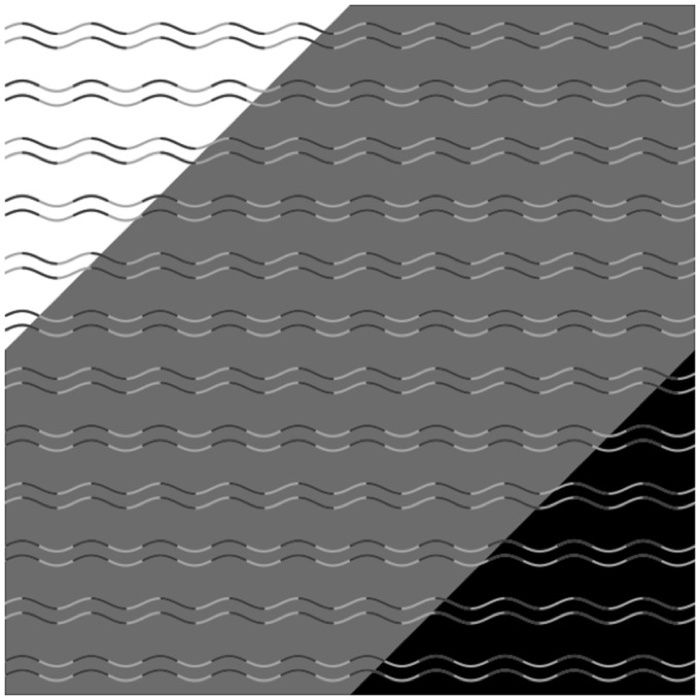
A new optical illusion has been discovered.

All of those lines are the same except for their colors. Most people see zigzags and curves. The zigzags are an illusion.

You can read more about this illusion here: This Crazy New Optical Illusion Shows if You Have ‘Curvature Blindness’.

Vision is our most trusted sense and yet it can be illusory. How much more then can our emotions and even our psychologies be illusory?

This is why FIML practice is essential.


Friendship, reality, psychological health

Psychological health depends on at least one good friendship which is itself based on shared reality.

This shared “reality” is the reality of how the two (or more) good friends actually function. How their speaking, listening, thinking, and feeling actually function and interact in real-time.

They have to know this about each other and even more importantly, they have to want to know this.

If you have or have had that, you will be or become psychologically healthy. If you have never had that, you will not be psychologically healthy.

This “shared reality” is not static and can never be static. It is always changing, adapting. It must be dealt with honestly.

“Aristotle describes three general types of friendship, that of utility, that of pleasure, and that of good or virtue.” (Aristotle on Friendship)

The perfect form of friendship is that between the good, and those who resemble each other in virtue. For these friends wish each alike the other’s good in respect of their goodness, and they are good in themselves; but it is those who wish the good of their friends for their friends’ sake who are friends in the fullest sense, since they love each other for themselves and not accidentally. (same link as above)

If during your formative years, your parents, teachers, and friends did not wish for your goodness for your sake and you have not since formed a good or virtuous friendship, you will not be psychologically healthy. This does not mean you are doomed, it just means you are not psychologically healthy.

To achieve good health, you have to have a “good or virtuous” friend and you have to be that back to them. There is no other way.

If you have an Aristotelian friend of pleasure, you can upgrade this relationship to a good or virtuous one by doing FIML practice. FIML is essential in today’s world because semiotic interactions are so complex, far more complex than in Aristotle’s day.

Good or virtuous friends need FIML to maintain their shared reality.

On rereading, the above sounds harsh to me. But when I consider the world as it is, it also sounds true, realistic. Earth can be a very bad place but it can also be very good.

Why psychometrics and general ideas about personality inhibit psychological optimization

The short answer: psychometrics invariably yield bell curves.

The medium answer: general ideas about personality are derived from psychometrics.

The long answer: probably no one has ever been in the middle of all psychometric bell curves—curves for empathy, perseverance, intelligence, musical talent, athleticism, sexual satisfaction, “extraversion, agreeableness, openness, conscientiousness, or neuroticism.”

If you are on either side of the bell curve for anything that is significant to you, you will be measuring yourself against a standard that is not right for you.

And even if you are in the middle for everything, no one else is.

It’s fine to have a look at what some researchers find on some test, but it would be close-minded, not conscientious. probably neurotic, and highly disagreeable (to you and others) to do more than use those data as a mildly interesting sociological marker that doesn’t tell you all that much.

Without question psychometric data will inhibit your psychological optimization if you take them too seriously.

If you are to the left of any “good” metric, knowing the center of the curve might inspire you to try harder but it might also inspire you to try too hard at something you will never be able to do well. If you are to the right of any “good” metric, the center of the curve may cause you to hold back.

And who gets to say what is a “good” metric? At best some other metric. At worst a soft consensus among experts who have been acculturated into thinking that way.

Psychometrics are helpful for general classifications of individuals who cannot care for themselves or who have no one to turn to or who cannot achieve any happiness on their own.

For individuals who are self-reliant, understanding how your mind actually functions in real-time real-life situations is the only way to optimize your psychology.

Psychology is warped by too much reliance on patterns and types rather than how people actually function

You will never figure yourself out by answering questionnaires or trying to match yourself with a psychological metric or type.

Beyond that, you will absolutely never optimize your psychology and life using those methods.

The right way to grasp and optimize your psychology is to understand how it functions in real-time real-life situations.

To do this you have to take control of your own life and use a technique like FIML that allows you to observe yourself in real-time real-life situations.

I honestly do not think there is any other way.

Anxiety and default brain states

Our brains/minds have default states (plural) that we tend toward for a variety of reasons—pleasure, boredom, habit, even a systems checkup.

Default states are generally based on instincts like hunger, sex, fear, love, anger, disgust, humor, aesthetic joy, etc.

Humans tend to dress default states up. Instead of just eating something when hungry, most of us take time to prepare something good or pay someone to do that for us.

Everybody knows what we do with sex. Love, anger, hate, humor, disgust, fear, curiosity, thoughtfulness and so on are not very different in the many ways we dress them up.

Anxiety can be usefully understood as one of the default states of the brain/mind/body.

Anxiety is based on fear. We need this state in its basic form. If we are attacked by a wild dog, we need to be able to dump adrenaline and cortisol into our system quickly.

In many cases, though, anxiety takes on a life of its own and arises even when we are not in real danger. I think this indicates a default state that we can become habituated to in much the same way that we can become habituated to overeating, drunkenness, hate, anger, or unreasonable trust, love, or desire. Additionally, some bouts of anxiety can be understood as the system simply running a checkup.

People watch horror films because we like feeling afraid. It focuses the mind. We take risks because risks make us feel alive. Like horror films or danger sports, risk-taking focuses the mind.

Anxiety also focuses the mind. I think we like this aspect of it in many cases. It stimulates the brain and body, providing a level of clarity that feels very good, especially if we are hanging from a rock 500 ft above the ground.

Sometimes when we feel anxiety we can go out and do something, go running, ride a motorcycle, go surfing. When we do something that requires high levels of mental focus, we use our anxious state for what nature “intended.”

For myself, I notice that thinking about anxiety helps me put it in its proper place. I also notice that something unexpected—a health scare or good news—can immediately change my mental priorities, greatly demoting anxieties that had seemed so real just moments before.

Poor precision in communication distorts motives

And distorted motives warp human interactions, which in turn degrade individual psychology.

There is no way around it—the ways almost all people communicate are much cruder than their brains are capable of.

And that is the cause of most of what we now call (non-biological) “mental health” problems.

Here is an example: I want to say something very complex to my primary care doctor. I can give her the gist in a minute or two but I do not want to have that go on my medical record.

So I ask her if I can start a discussion that she will promise to keep off my record.

She says, “I’ll think about it.”

A week later I get a letter from her nurse saying she is not willing to do what I asked.

No reason why was given. Do rules prevent her from doing that? I have heard of doctors allowing patients to keep some concerns off the record, but who knows what the reality is? Do you?

If I insist, will that go on my record? Did what I asked in the first place go on my record? My doctor is trapped within or is voluntarily following some guideline that is most decidedly not in my best interests.

This same sort of thing can happen interpersonally. If I raise a topic that is psychologically important to me with even a close friend, I have to wonder will they understand? Will they allow me to expand the subject over a few weeks or months or longer? Will my initial statements change our friendship?

The basic problem is how do you discuss complex psychological subjects with others?

One of my friends works in alternative health care. She knows what I want to bring up with my doctor and admits that even in her professional setting where patients have an hour to open up, there is not enough time.

Back to my primary care doctor. I saw her again a year later and she asked if I remembered her. I said, “Of course I remember you.” She said no more and neither of us raised the off-the-record topic. An intern was with her.

I wonder what she thinks of me. Did she interpret my slightly nervous behavior when I first asked as a “sign” of something? Does she think I am volatile or bipolar or just nuts? (I am not.)

I am 100% sure that she cannot possibly know what I wanted to bring up with her. In this case, I have all of the information and I want to give it to her but she cannot or will not allow that unless my initial fumblings toward a complex subject are made public.

Even a  close friend could find themselves in a similar position. And I wonder if I have done that myself to someone. Most people most of the time are not able to scale those walls that divide us.

On either side of the wall is a complex person capable of complex understanding, but one or both persons cannot scale the wall. My doctor is smart enough to have become an MD and yet I cannot tell her about a complex medical condition that is of great importance to me.

I know that I do not want to open the subject and risk a shallow public label (a common hindrance to many potential communications). I honestly do not know what my doctor is thinking. Maybe I will try again the next time I see her.

EDIT 12/16/2020: I didn’t try again. After much thought, I decided to switch doctors. And I will not bring this subject up with my new doctor. It’s a sad reality that trying at all ruined (in my mind) my relationship with my first doctor and convinced me that the topic is not one I can discuss with any medical professional in a professional setting and maybe in any setting.

Bad communication leads to ulterior motives and pointless suffering

I believe most people in the world are all but forced to resort to ulterior motives when dealing with others or being dealt with by them.

Furthermore, I believe most people are in this position so often they don’t just resort to hidden motivations, they expect them, are habituated to them, rely on them, and even enjoy them even though they cause immense suffering.

This situation arises due to fundamentally bad communication and the mistrust and uncertainty that devolve from it.

If communication is fundamentally bad (ambiguous, misleading, can’t be cleared up), there is no one you can trust but yourself. No one else you can rely on.

You are all but forced to conceal what your really think, feel, or want because you probably won’t be understood if you try to explain yourself honestly. Worse, you  may get played.

Your interlocutor may genuinely misunderstand and cause you harm by that or they may feign interest and honesty when they are just gathering dirt to use against you.

Can anyone deny this happens very often? And that normal people have no recourse but to play that game?

An ulterior motive is one that is concealed. A motive that is different from what is being communicated. We all know what that means and how destructive it can be.

Ulterior motives arise because we do not use our communication systems (mainly speech and listening) at all well. Instead of communicating honestly, we try to “read” the other person while at the same time calculating to what extent or how they are “reading” us.

This is a disgusting situation for people to have put themselves in.

This problem can be fixed with one other person, so you can have at least one friend who does not do this to you and to whom you do not do it either. That makes two people who can escape the deadening, anti-life maze of ulterior motivation madness.

The way to do it is through FIML. I do not believe there is any other way.

If many people do FIML, eventually many of us will see the problems of bad communication clearly. Many of us will realize that virtually all people are trapped in a system that all but forces them to lie to others while suffocating themselves.

____________________________

Edit 10/07/17: Here is a pop culture analysis of how to tell if someone is lying: 9 WAYS TO SPOT A LIAR. Scroll down to the list and notice how crude and dubious these tells are, but this is what many people work with. It’s all we have. With a good partner, FIML can lead you to levels of truth far higher and deeper than this. In this world, we really have to develop FIML relationships to fully explore our own psychology and human psychology in general. Without FIML, you are permanently locked out of your own depths by being trapped in ordinary communication which is accurately characterized by the shallowness of the linked article.

Basic signaling and some things it explains

Basic signaling can be described or explained as follows:

  • A signal is information sent from one place and received at another.
  • A signal can be big or small.
  • A signal can be true or false.*

These are the most basic features of all signals. More complex signals contain these three basic features and also exhibit other features, such as:

  • having complexity or context
  • being conscious or not
  • being consciously designed to have an effect

From the three features of basic signaling, we can say a lot about human signaling.

The first feature of basic signaling simply defines what a signal is. I can signal to myself or I can signal to you. A simple example is I check my hair in the mirror (signal to self) and then present myself to you (signal to you). Insofar as my hair signal to you has a conscious element of how my hair looks or doesn’t look (sloppy, messy), the hair signal I sent to myself via the mirror is now being sent to you via my imagination.

This hair signal can also illustrate the second feature of basic signaling—how big or small the signal is. My hair signal may be important to me while I am looking in the mirror (big signal) or not very important (small signal). In like manner, my hair signal may be big or small in your mind.

This hair signal can also illustrate the third feature of basic signaling—its truth or falsity. If I have dyed my hair, in some sense I am sending a false signal. If I have not dyed my hair but you think I have, then you are receiving a false signal.

One could also say that dyed hair is not a truly “false” signal because it is common for people to dye their hair. Similar arguments can be made for combing or cutting hair or anything we do with our hair. The truth or falsity of many human signals is open to interpretation in this manner.

Normally, we use the three basic features of complex signals described in the second bullet list above to decide which interpretation to use. Changing the context and complexity upon which our interpretation is based will tend to change our interpretation of the signal.

Notice how many signals achieve their effects primarily by being big. Big signs, bright lights, loud music, heavy make-up, loud sexual signals, perfume, odor, big muscles, fake boobs, expensive cars, big houses and yachts, etc. all work in part by being big signals. Bigness or smallness is point two in the list above.

Bigness alone can explain why people lie, slant, or falsely accuse. As long as a signal is big, some people will be attracted to it and come under its spell. If someone accuses you falsely of something and spreads their accusation around, you may be faced with a big problem. If the lie is big enough and artful enough, you now are forced to defend yourself. If you do not even know what is being said about you, you can’t even do that.

Another version of the effectiveness of a big false accusation is one made to your face. As soon as it is uttered, the scene and context will shift dramatically. You are normally required to immediately defend yourself, derailing whatever rational exchange of ideas preceded the accusation.

We can see how this works in interpersonal communication and we can also see how it works on a larger scale. When nations go to war, they invariably lie about each other. Politicians lie, cultures lie, groups lie, religions lie, sports fans lie, and so on.

Lies or false accusation work because they send big signals that require a defense and, since they are lies, can be hard to defend against.

To me, this is a depressing side of human communication. Lies and false accusations very often win against the truth.

Simply stated, false accusations are aggressive lies, but we also know them in milder form as spin, slanting the facts, one-sidedness, tailoring the message, and so on.

Note: I got the idea of the importance of false accusations from a book I am reading on alcoholism: Vessels of Rage, Engines of Power: The Secret History of Alcoholism.

The author of this book, James Graham, makes the claim repeatedly that alcoholics very often engage in false accusations. In discussing this book with my partner, we came to conclude that Graham is right about this—false accusations do seem to be common among the alcoholics we both know.

Since I like to break things down into basic principles, my partner and I came up with the principles outlined above.

A false accusation sends a big signal into a social group while at the same time protecting the alcoholic from criticism. It allows them to say, “You see it is not me or my drinking that is the problem here, she is the one who is crazy!” Or, “Can you believe what he did to me?” Of course, he didn’t do anything but to a drunk, the accusation feels good and often works with others because it is big.

On a larger scale, false accusations in public today often take form as PC dictates. That’s “racist,” “sexist,” “micro-aggressive,” “privileged,” “homophobic,” etc. Just knowing that we might be accused of one of these attitudes has been enough to keep most people from saying anything that could even be tangentially interpreted in that way.

Note two: FIML practice entirely removes false accusations and any basis for them between partners. No FIML partner should ever say, “You did too mean that!” Or “I know why you did that!”

Partners who have established a habit of frequently checking their interpretations of each other should experience very few occasions to feel that their interpretation of something their partner signaled is better than their partner’s interpretation.

_______________

*A false signal that is not conscious might be a non-poisonous snake or insect that has evolved to look like a poisonous one.

_____________________

First posted 01/10/16, slightly revised 09/28/17