Petraeus claims Lithuania may be invaded by Putin

link

Trump’s chief of staff is victim of telephone voice impersonation

link

Nobody seems to see the drama unfolding right before our eyes — Geert Vanden Bossche

link

How to reform the FBI


You want to reform the FBI?

Cool.

Try this.

#1) Send out an email to every field office, agent, division and contractor within the FBI asking every participant in Crossfire Hurricane or the Mueller investigation to report to the auditorium in DC on XXX date.

#2) Have big buffet and coffee set up. Now, with all of them seated in the audience, take their cell phones, laptops and electronic devices away, and give each of them a piece of paper and ask them to write down the names of every single person they interacted with during their investigative duty.  Give them one hour to complete the task.

#3) Retrieve their notes.  Send them to lunch (provided), as you review the lists.  [Cell phones, laptops and electronic devices remain on side of the room where they placed them.]

#4) When they return, tell them all to stand up as you read the names from the lists.  As their name is called, they can sit down.

#5) At the conclusion of reading the list, almost everyone should be seated, correct?  Those who remain standing are unknown to the FBI investigators in the room.  Tell those standing people to leave and assembled in an adjacent room, under watch.

#6) After the small group departs (if any), ask these questions:

A) If you were aware, or if you suspected, you were participating in a fraudulent investigation motivated by politics, please stand up.

=> Announce those people are fired for cause.  Fired for violating their oath of office.

Escort them out.

Turn back to those remain seated.

A) If you *DID NOT KNOW* you were participating in a fraudulent FBI investigation, motivated by politics, please stand up.

=>  Announce those people are fired for cause.  Fired for not being smart enough to carry out their oath of office.

Escort them out.

The room should be empty.

#7) Now,… Final Detail.  Perhaps you have an adjacent room with a few people that no one in the FBI knows who they are or what they were doing there.  These were not named on any list created by the FBI employees who conducted “Crossfire Hurricane” or the “Mueller probe.”

That’s the CIA plant(s) in the room.
Regards.

link

Rubio on ‘vigorous new visa policy’ to stop foreign nationals with anti-Israel views from traveling to the United States

Also Rubio: Announcement of a Visa Restriction Policy Targeting Foreign Nationals Who Censor Americans

link

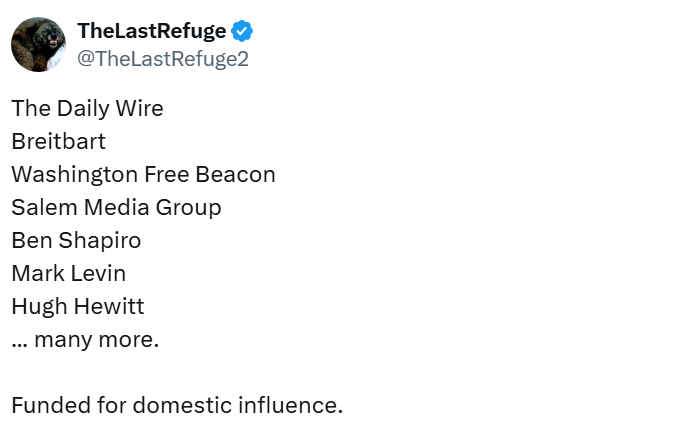
Funded for domestic influence

__________

Poland Makes Unprecedented HIMARS Rocket Artillery Deployment Across Russia’s Northern Border

link

Rethinking sugar: BYU study shows food source is key to understanding diabetes risk

For years, we’ve been told that sugar is a major culprit behind the global rise in type 2 diabetes. Now, emerging evidence from BYU researchers adds nuance to that message, suggesting not all sugar sources carry the same risk.

In the largest and most comprehensive meta-analysis of its kind, BYU researchers—in collaboration with researchers from Germany-based institutions—found that the type and source of sugar may matter far more than previously thought. Researchers analyzed data from over half a million people across multiple continents, revealing a surprising twist: sugar consumed through beverages—like soda and even fruit juice—was consistently linked to a higher risk of developing type 2 diabetes (T2D). Meanwhile, other sugar sources showed no such link and, in some cases, were even associated with a lower risk.

“This is the first study to draw clear dose-response relationships between different sugar sources and type 2 diabetes risk,” said Karen Della Corte, lead author and BYU nutritional science professor. “It highlights why drinking your sugar—whether from soda or juice—is more problematic for health than eating it.”

After correcting for body mass index, excess energy intake and several other lifestyle risk factors, the researchers found the following dose-response relationships:

  • With each additional 12-oz serving of sugar-sweetened beverages (i.e., soft drinks, energy drinks and sports drinks) per day, the risk for developing T2D increased by 25%. This strong relationship showed that the increased risk began from the very first daily serving with no minimum threshold below which intake appeared to be safe.
  • With each additional 8-oz serving of fruit juice per day (i.e., 100% fruit juice, nectars and juice drinks), the risk for developing T2D increased by 5%.
  • The above risks are relative not absolute. For example, if the average person’s baseline risk of developing T2D is about 10%, four sodas a day could raise that to roughly 20%, not 100%.
  • Comparatively, 20 g/day intakes of total sucrose (table sugar) and total sugar (the sum of all naturally occurring and added sugars in the diet) showed an inverse association with T2D, hinting at a surprising protective association.

Why drinking sugar would be more problematic than eating sugar may come down to the differing metabolic effects. Sugar-sweetened beverages and fruit juice supply isolated sugars, leading to a greater glycemic impact that would overwhelm and disrupt liver metabolism thereby increasing liver fat and insulin resistance.

On the other hand, dietary sugars consumed in or added to nutrient-dense foods, such as whole fruits, dairy products, or whole grains, do not cause metabolic overload in the liver. These embedded sugars elicit slower blood glucose responses due to accompanying fiber, fats, proteins and other beneficial nutrients.

Fruit juice, even with some vitamins and nutrients, is much less beneficial. Because of its high and

link

Trump on Iran nuclear negotiations