


Medical Journal DISAPPEARS New Study Tying Covid Vaxx To Deaths — with Dr Peter McCullough
Col. Doug Macgregor: the truth behind building Ukraine combat power & IDF’s prospects in Gaza
I think Macgregor consistently misses the point that Ukraine has been deliberately destroyed—denuded of population through flight and death and of military men through death. This has to have been part of the plan, the other part being proxy war against Russia. It also looks like, if possible, the neocon NATO people in control want to expand the Ukraine War to include Poland and the Baltics and possibly all of Europe. The goal is world domination and everything has to be seen in that light, including Gaza which is being denuded of its population in a manner not so different from Ukraine. Neither Ukraine nor Gaza are ends in themselves. They are steps along the way to achieving world domination. The neocons main rivals are Russia and China. ABN
General analyses of signaling systems illuminate fundamentals of psychology
Individual psychology is a locus or node within a larger social system.
More precisely, individual psychologies are particular signaling systems within larger social signaling systems.
It is valuable to see this because general analyses of signaling systems—even those having nothing to do with human psychology—can shed light on human signaling systems, including both individual psychology and many aspects of sociology.
When human psychology is viewed as a signaling system, we can readily see that narcissism is bound to occur because narcissism is fundamentally a simplistic signal system. (See Narcissism redefined (yet again) for more.)
When human sociology is viewed as a signaling system, we can similarly see that parasitism is bound to occur because the exploitation of one system by another is a fairly simple matter. (See Social parasitism in ants and humans for more.)
In like manner, we can see that social hierarchies importantly have evolved because they are simple and decently efficient signal (communication) systems.
We can also see why hierarchical system often are overthrown and why they often do not arise in systems where they are not needed. For example, no hierarchy is needed for a language system once the basics have been established. A parasitic or authoritarian group might impose a hierarchy on a language system, but that’s a different animal.
When individual psychology is viewed as a signaling system, we can see that a great deal of what we consider “disordered” or “ill” within that system is fundamentally a problem of the signal system itself and not the “personality” we have mistakenly abstracted out of that system.
Indeed, most of what we think of as personality is nothing more than an individual signal system attempting to conform to its understanding of the larger social system within which it exists. When science is applied to “personality” erroneously conceived, we arrive at the many psychometric tautologies on personality traits we now have. Psychometrics have limited value for describing societies, but are frequently misleading, even damaging, when applied to individuals. In this, they resemble BMI data which originally was used as a marker for the health of whole populations, not individuals, and which can be misleading when applied to individuals.
When we view individuals as signaling systems rather than personalities, we can immediately see that these systems can and should be optimized for better communication. Indeed, this is the real job of psychology—optimizing individual signaling systems. Not just treating “personality” disorders.
Mike Benz: The West’s Burgeoning Censorship Industry and the Government Funds Pouring In–From DHS to DARPA to National Science Foundation
Infectious Disease Society of America awards Peter Hotez the Anthony Fauci Courage in Leadership Award
Mortality rises just after onset of covid vax rollout
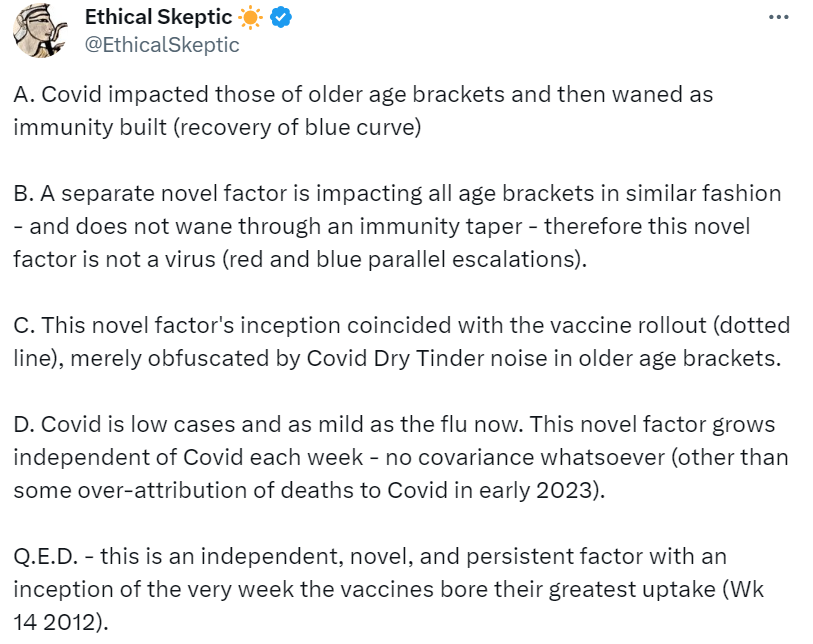

click image for larger

Forget Fall Cleanup! Autumn Gardening Tips to Help Pollinators
COME AUTUMN, as temperatures drop and summer flowers fade, gardeners in most parts of the country turn their attention to the annual chore known as “fall cleanup” then assume they’re done until the following spring. But for gardeners who care about wildlife, autumn is an ideal time for tasks that have an impact year-round. “Just because the seasons are changing, don’t think there are no opportunities to help wildlife,” says National Wildlife Federation Naturalist David Mizejewski. “That’s especially true if you’re trying to support birds, butterflies, bees and other pollinators.” Here’s what he and other experts suggest.
Leave the leaves. In many places, raking and bagging fallen leaves is expected—and may even be required by cities and homeowners associations. But the need to dispose of leaves is “one of the biggest false assumptions about fall cleanup,” says Mizejewski, “and it’s a bad idea if you want to help wildlife survive winter, see butterflies in spring or have your vegetables pollinated in summer.” Leaf litter on a garden bed creates habitat for wildlife, from small mammals and reptiles and amphibians to overwintering bees and moth and butterfly larvae. If you have too many leaves, rake to the corners of your property or use as mulch. Sending leaves to a landfill is the worst option, robbing your soil of natural fertilizer and contributing to greenhouse gas emissions.
Nurture fall-blooming native plants. Because many plants stop flowering by late summer, maintaining those that bloom into or through fall is critical for pollinators, including migrating monarch butterflies and native bees. In social species such as bumble bees and many sweat bees, “only mated queens live through winter, so they need forage to put on fat during late summer and early fall,” says James Cane, a biologist and head of the nonprofit WildBeecology. He recommends goldenrods, asters, sunflowers and, in much of the West, rabbitbrush.
Small, simple tasks to make life better for all sentient beings. ABN
Psychophysics gains a new law of sensory perception that also sheds light on subjective perception
First we have to understand Weber’s Law:
Weber’s law, also called Weber-Fechner law, historically important psychological law quantifying the perception of change in a given stimulus. The law states that the change in a stimulus that will be just noticeable is a constant ratio of the original stimulus. It has been shown not to hold for extremes of stimulation. (Weber’s Law)
Hang in with this, it’s interesting.
About 200 years ago, the German physician Ernst Heinrich Weber made a seemingly innocuous observation which led to the birth of the discipline of Psychophysics – the science relating physical stimuli in the world and the sensations they evoke in the mind of a subject. Weber asked subjects to say which of two slightly different weights was heavier. From these experiments , he discovered that the probability that a subject will make the right choice only depends on the ratio between the weights.
For instance, if a subject is correct 75% of the time when comparing a weight of 1 Kg and a weight of 1.1 Kg, then she will also be correct 75% of the time when comparing two weights of 2 and 2.2 Kg – or, in general, any pair of weights where one is 10% heavier than the other. This simple but precise rule opened the door to the quantification of behavior in terms of mathematical ‘laws’. (NEUROSCIENTISTS MAKE MAJOR BREAKTHROUGH IN 200-YEAR-OLD PUZZLE)
What’s new today is Time–Intensity Equivalence in Discrimination (TIED):
We investigated Weber’s law by training rats to discriminate the relative intensity of sounds at the two ears at various absolute levels. These experiments revealed the existence of a psychophysical regularity, which we term time–intensity equivalence in discrimination (TIED), describing how reaction times change as a function of absolute level. (The mechanistic foundation of Weber’s law)
Simply stated TIED says that the intensity of the stimulus determines the time it takes to “just notice” a change in it and that that scales linearaly as intensity changes up or down. For example, changes in louder sounds are noticed quicker than proportionally equal changes in quieter sounds and this can be scaled mathematically.
TIED is a new theory and needs more research, but whether it works out perfectly or not, I think it shows something very important about our individual and shared subjective perceptions of words, gestures, meanings, intentions, implications, and so on including all semiotics.
At present, we do not have machines that can measure our subjective perceptions, but we can surely feel them. And with training, we can also decently calibrate them.
Most of us can already vaguely talk about our subjective perceptions of each other, but few of us know how to do that with the precision of Weber’s Law or TIED. This is because we are all unique and we all react uniquely to each other. On top of that, few are able to employ language efficiently enough to capture significant detail when describing subjective responses or impressions.
FIML provides a very useful method for isolating and calibrating individual, idiosyncratic subjective perceptions.
Consistent, repeated use of FIML gradually recalibrates and reorganizes the entire psychologies of both partners.
FIML has virtually no content.. FIML is a method, and as such it allows partners to gradually identify, isolate, measure, and reorganize their entire body of psychological data, however they construe it.
TEXAS SEIZES CARTEL ISLAND IN THE RIO GRANDE IN RISKY FIRST-OF-A-KIND OPERATION
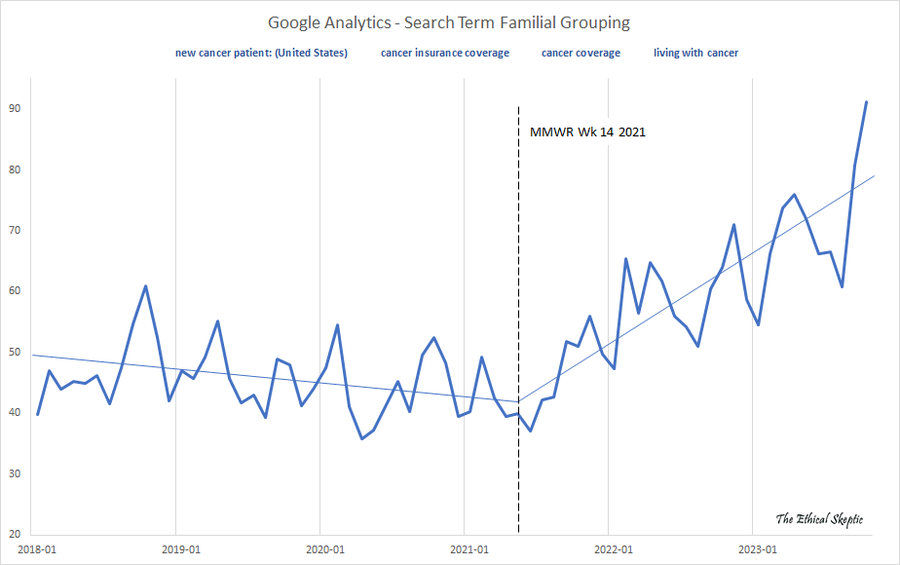
Glaringly obvious signal of vax harm ignored by mainstream mind-control

click image for larger
 American Buddhist Net