
__________
This may become a spiritual battle that will change the world. Some 50 million American Christians are Zionists, meaning they believe the modern state of Israel is fulfilling scriptural prophecy. ABN
Do your best. Speak the truth.

__________
This may become a spiritual battle that will change the world. Some 50 million American Christians are Zionists, meaning they believe the modern state of Israel is fulfilling scriptural prophecy. ABN
Canada just lost 109,000 jobs in 2 months.
In US terms that’s almost 1 million jobs.
Meanwhile food inflation just hit 7.3% — the highest in the G7. And 60% of Canadians are borrowing to buy groceries.
Carney is sacrificing regular Canadians to score points on Donald Trump.
In my opinion, “personality disorders” are more easily understood as signaling problems.
All types of personality disorder involve dysfunctional signaling with other people. Signals are both sent and received in ways that result in suffering.
As currently defined, personality disorders “develop early, are inflexible, and are associated with significant distress or disability.”
Thus, if there are no significant brain injuries or other biological problems, all personality disorders (PD) develop through experience.
This means that during childhood the PD sufferer has received many bad signals (and/or interpreted many signals badly) resulting in their failing to form a coherent well-functioning internal signaling system.
The way to fix this is work with the signals. And the best way to do this is FIML practice. A professional psychotherapist cannot possibly provide this level of treatment.
This brings me to a second point: is there anyone who would not benefit from improving their signaling?
Why do we view psychotherapy as treatment designed merely to make us look and feel “average”? Why don’t we instead work to optimize our psychologies every day?
The Buddha said we are all crazy. We are. We all need to work on our signaling—our personality disorders—all the time.
The distinctions between one PD and another and those who have PDs and those who don’t are vague. This is because all PD problems (absent significant biological deficits, which may include intelligence) are idiosyncratic varieties of signaling malfunctions.
If signaling is the core problem, it should follow that all acquired PD will be classifiable as some kind of signaling malfunction. And that is precisely what we see.
Narcissism is a too simple signaling system. Borderline is an unstable signaling system. Compulsive, passive aggressive, histrionic, avoidant, and so on all are variations of a poorly formed internal signaling system.
The way to study this is through interpersonal semiotics; that is interpersonal semiotic analysis of real-time, real-world communicative signs and symbols.
All people need to do this to optimize their psychologies (their internal signaling systems). Why would anyone not want to do this? Maybe not wanting to do this is the surest sign of PD there is.
The hardest part about doing FIML is finding a willing and able partner. To me, this shows how pervasive bad signaling is. Most people will do almost anything but examine their own signaling with the help of another person.
Here is the full 40 minutes of my crew and I exposing California fraud, Minnesota was big but California is even bigger… We uncovered over $170,000,000 in fraud as these fraudsters live in luxury with no consequences. Like it and share it, the fraud must STOP.
We ALL work way too hard and pay too much in taxes for this to be happening. These fraudsters have been able to defraud American taxpayers for years without any pushback from the public and politicians.
It is time to EXPOSE IT ALL and end America’s fraud crisis.

click image for larger version
__________
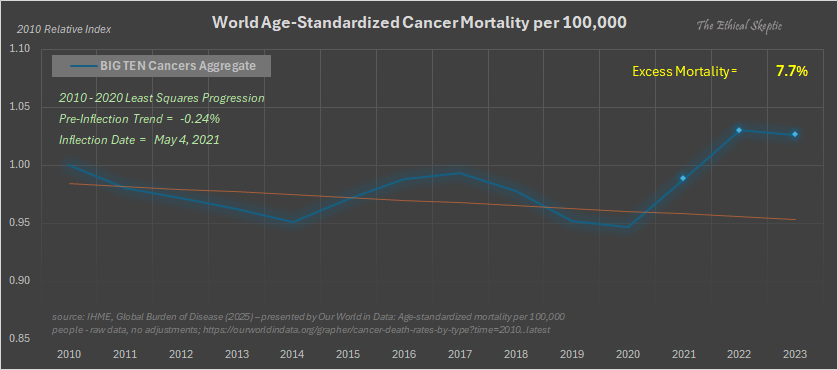
Clearly rises with the rollout of the covid vaxxes. Cancer mortality is an indubitable sign. Obviously, many other maladies and deaths have been caused by the covid mRNA vax, which has acted like a bioweapon, not a preventative or cure. ABN
…One he witnessed handling the solitude better than most was Kaczynski, who didn’t speak to him for months.
‘He was able to handle the Supermax almost to a point of surprising the staff,’ said Hood. ‘He beat the system in one sense because it never seemed like it ever got to him.
‘He would always have books and in various languages, I think it was six or seven different languages he knew.’
Met with Kaczynski’s initial silence, Hood decided to employ similar tactics to those of the TV detective Columbo.
‘I said, “Kaczynski, over the weekend, I was reading some stuff,” and again very distant, he said, “That’s good, what was it?” I said, “The manifesto that you wrote.” And that’s the first time, after like six months or seven months, that he finally really connected with me. I could tell that I hit a nerve.
‘He goes, “You read my manifesto?” I just simply said, “I read it,” and then I played the Columbo guy. I said, “You know what, Kaczynski, it’s almost like Shelley, the lady that wrote Frankenstein. That was almost like the manifesto, where there’s a monster but it’s technology. Technology could be for the good. In this case, you’re seeing the negative part of the technology.”‘
__________
Brief, mildly interesting glimpse into their dismal lives. Kaczynski was an exception to the rule because he was very intelligent and had been manipulated/ programmed by MKULTRA. He was not a born criminal or someone who turned to crime due to social and biological deprivations. ABN
Before Donald Trump’s top spy chief submitted his stunning resignation over the Iran war, he had secretly confided his plans to his closest political ally, JD Vance.
Joe Kent quit as Trump’s director of the National Counterterrorism Center on Tuesday in protest over the Iran war, accusing Israel of pressuring the US into a conflict he says was built on lies.
Kent, a close political ally of Vance and Tulsi Gabbard, presented his resignation letter to the Vice President 24 hours before dramatically stepping down from the administration.
‘The VP encouraged him to speak to White House chief of staff and Trump before making any final decisions,’ said a White House official. ‘The VP encouraged him to be respectful to POTUS.’
Following the meeting, Kent issued a blistering resignation that claimed Trump was tricked into striking Iran ‘due to pressure from Israel and its powerful American lobby,’ adding: ‘I cannot in good conscience support the ongoing war.’
Kent accused the President of reneging on the non-interventionist principles he campaigned on.
Gabbard was present during Kent’s in-person resignation to Vance, according to the Washington Post.
It is unclear if Vance warned other members of the administration about Kent’s plan to discredit Trump’s war during his resignation.
__________
Trump is the incompetent one on this issue. He is either a liar, a crypto Jewish Supremist, a deep pragmatist with an ace in the hole (not likely) or something else. He is still our president and I hope he handles this much better going forward. To all appearances and evidence, he has made a huge mess which will be very expensive for USA in reputation and wealth. The good side of this is many more people are becoming aware of the deep stranglehold Jewish Supremists hold on USA and the West. ABN
__________
I have often wondered if these symbols also mean the food has not been poisoned. ABN
The game linked below explains some basics of game theory and also some basics of why FIML practice works so well.
The game can be found at this link: The Evolution of Trust.
I highly recommend playing this game. It takes about thirty minutes to finish.
For the first part of it, I was only mildly interested though the game is reasonably engaging.
When it got a point where communication mistakes are factored in, I sat up and took notice.
The game is a very simple computer model of some very simple basic choices human beings make all the time. Without giving away too much, even this simple model shows something I bet most of us can already see.
And that is: zero-sum games do not give rise to trust. Win-win games do.
What was most interesting to me is the game also shows that communication mistakes foster trust if there are not too many of them.
Accepting mistakes in communication requires trust. Mistakes happen. When two people accept that in each other and in themselves, trust grows.
This is a very important point and a foundation of FIML practice.
In fact, I would say that mistakes foster trust even more in FIML than other communication games. This happens because in FIML mistakes are isolated in such a way that they can be fully recognized and understood for what they are.
This provides a method for solving immediate problems while also building a foundation for the inevitable occurrence of future ones. Moreover, the kinds of mistakes people make become less stupid.
In many respects, the game of FIML is largely one of recognizing communication mistakes or potential mistakes as soon as they arise, within seconds of their onset.
By doing that FIML shows us how our deep psychology is actually functioning in real-life. Multiple insights into this aspect of psychology are transformational.
MAGA billionaire Peter Thiel has angered the Vatican by hosting a four–part lecture series in Rome warning that the Antichrist is coming and will subject humanity to a ‘one–world’ government.
Thiel, 58, has raised concerns for months about what he views as an imminent threat, according to The New York Times.
The tycoon, who made his money by setting up PayPal, has warned of the ‘occult forces [that] are ceaselessly at work, intent on destroying what remains of the West,’ the outlet reported.
The Antichrist is described in the Bible as a conniving figure who opposes Jesus Christ and seeks to challenge human allegiance to God.
Thiel, the chairman of big data and artificial intelligence giant Palantir, has argued the Antichrist will manipulate humanity by promising solutions to contemporary existential threats.
Britain’s national security adviser, Jonathan Powell, attended the final talks between the US and Iran and judged that the offer made by Tehran on its nuclear programme was significant enough to prevent a rush to war, the Guardian can reveal.
Powell thought progress had been made in Geneva in late February and that the deal proposed by Iran was “surprising”, according to sources.
Powell’s attendance at the Geneva talks, as well as at a previous set of meetings earlier in the month in the Swiss city, helps in part to explain the UK government’s reluctance to back the US attack on Iran, a reluctance that has put the UK-US relationship under unprecedented strain.
The UK saw no compelling evidence of an imminent threat of an Iranian missile attack on Europe, or of Iran securing a nuclear weapon. This is the first time it has become clear that Britain was so closely involved in the talks, and so had good reason to decide whether diplomatic options had been exhausted and a US attack was necessary.
Instead the UK regarded the attack as unlawful and premature since Powell believed the path remained open to a negotiated solution to the long-running issue of how Iran could reassure the US that it was not seeking a nuclear weapon.
Normal socially-defined communication—business, school, professional, etc.—operates within known limits and terminologies. Skill is largely defined as understanding how to use the system without exceeding its limits, how to play the game.
Many other forms of communication must be imagined. That is, I have to imagine what you mean and you have to imagine what I mean.
In many cases of this type I will imagine that you are normal to the extent that I am able to imagine what normal is. And I will imagine that you imagine me to be normal. As I imagine you I will probably assume that your sense of what is normal is more or less the same as mine. This is probably what the central part of the bell curve of imagined communication looks like. People in this group are capable of imagining and cleaving to normal communication standards. If you reciprocate, we will probably get along fine.
If my imagination is better than normal, I will be able to imagine more than the normal person or given to imagining more. If this is the case, I will tend to want to find a way to communicate more than the norm to you. If you reciprocate, we might do well communicating. If you don’t, I might appear eccentric to you or distracted.
If my imagination is worse than normal, I will have trouble imagining or understanding normal communication. I won’t have a good sense of the cartoons we are required to make of each other and will probably appear awkward or scatterbrained to most people. If you reciprocate, we might do well communicating and find comfort in each other.
Normal communication, even when imagined, is based on something like cartoons. I see myself as a cartoon acting in relation to the cartoon I imagine for you. If my cartoon fits you well enough that you like it and if your cartoon of me fits well enough that I like it, we have a good chance of becoming friends.
A great deal of normal imagined communication is cartoon-like, and being normal, will take the bulk of its cartoons from mass media—movies, TV, radio, and, to a lesser extent today, books and other art forms.
People still read and learn from books and art, but normal communication has come to rely heavily on the powerful cartoons of mass media.
The big problem with our systems of imagined communication is they are highly idiosyncratic, messy, and ambiguous. We have to spend a lot of time fixing problems and explaining what we really mean.
It’s good to have idiosyncratic communication, but we have to find ways to understand each other on those terms.
 American Buddhist Net