Donald Trump‘s top advisor has fallen victim to a sinister scheme by hackers who infiltrated her phone and used artificial intelligence to impersonate her voice.
The nefarious plot involved stolen data from the personal cellphone of White House chief of staff Susie Wiles that was then used to call some of American’s most powerful people.
Over the course of several weeks, high profile senators, governors and American business executives have received voicemails or messages from an unknown number claiming to be Wiles, Wall Street Journal reported.
The hackers came undone when they made the fatal mistake of asking questions that the president’s closest aide would already know the answer to.
Wiles – who has been nicknamed ‘Ice Maiden’ – has been contacting associates urging them to disregard any unusual messages or calls from unknown numbers purporting to be her.
In a terrifying twist, some of the phone calls used a voice that mimicked Wiles. Authorities suspect the impersonator used artificial intelligence to replicate it.
The revelation that University of Zurich researchers secretly deployed AI bots to manipulate Reddit users’ opinions should chill anyone who values authentic human discourse.
These weren’t merely passive observers—they were digital persuaders that analyzed users’ personal histories, fabricated identities, and crafted arguments specifically designed to change minds.
Most troubling?
They succeeded spectacularly—achieving persuasion rates six times higher than normal human interactions.
This experiment crossed critical ethical lines.
Without consent or disclosure, researchers unleashed bots that claimed to be rape victims, misrepresented religious teachings, and spread misinformation about controversial topics.
These digital ghosts generated over 1,500 comments, each precisely calibrated to exploit cognitive vulnerabilities of their human targets.
We’ve long worried about social media’s echo chambers.
But what happens when those chambers are deliberately infiltrated by increasingly sophisticated AI systems trained on the very platforms they’re manipulating?
Reddit’s recent data-sharing deal with OpenAI suggests we’re actively providing the training material for ever more persuasive digital manipulators.
Reddit moderators rightly condemned this unauthorized experiment, but their discovery came months after the damage was done.
How many other digital conversations are currently being shaped by invisible algorithmic hands?
I view Reddit fairly often. Started using it when it had very few users and you could easily get a post on the front page. AskScience was glorious back then as conversations would go on and on and there was very little bs. That was a long time ago. Today’s Reddit is mind-control totalitarian thought-slavery on virtually all major subjects. However, if you go to small subreddits, you can find very interesting material; subreddits on narcissism and other personality disorders; on aspects of culture such as parenting or marriage customs. I highly appreciate hearing authentic voices from around the world on topics like those and many more. That said, another thing you can see on Reddit is what looks to me like spontaneous hive-mind formation. These look real to me because they can form very quickly in subs that have nothing to do with politics. Tooafraidtoask is one example where this can happen. I encourage everyone to support free-speech on all platforms and use your free-speech yourself, use it often. Keep pushing the envelope wherever you are because widespread free-speech that people use is probably our only defense against a looming and probable computerized totalitarian nightmare. ABN
FIML is both a practice and a theory. The practice is roughly described here and in other posts on this website.
The theory states (also roughly) that successful practice of FIML will:
Greatly improve communication between participating partners
Greatly reduce or eliminate mistaken interpretations (neuroses) between partners
Give partners insights into the dynamic structures of their personalities
Lead to much greater appreciation of the dynamic linguistic/communicative nature of the personality
These results are achieved because:
FIML practice is based on real data agreed upon by both partners
FIML practice stops neurotic responses before they get out of control
FIML practice allows both partners to understand each other’s neuroses while eliminating them
FIML practice establishes a shared objective standard between partners
This standard can be checked, confirmed, changed, or upgraded as often as is needed
FIML practice will also:
Show partners how their personalities function while alone and together
Lead to a much greater appreciation of how mistaken interpretations that occur at discreet times can and often do lead to (or reveal) ongoing mistaken interpretations (neuroses)
FIML practice eliminates neuroses because it shows individuals, through real data, that their (neurotic) interpretation(s) of their partner are mistaken. This reduction of neurosis between partners probably will be generalizable to other situations and people, thus resulting a less neurotic individual overall.
Neurosis is defined here to mean a mistaken interpretation or an ongoing mistaken interpretation.
The theory of FIML can be falsified or shown to be wrong by having a reasonably large number of suitable people learn FIML practice, do it and fail to gain the aforementioned results.
FIML practice will not be suitable for everyone. It requires that partners have a strong interest in each other; a strong sense of caring for each other; an interest in language and communication; the ability to see themselves objectively; the ability to view their use of language objectively; fairly good self-control; enough time to do the practice regularly.
In mathematics, a ‘computation’ is the process of performing mathematical operations on one or more inputs to produce a desired output. A problem in analyzing human psychology arises when we understand that human psychology cannot be reduced computationally. The ‘computational irreducibility’ of human psychology does not mean, however, that there is no way to probe it and understand it. In the following essay, I show how FIML practice can greatly enhance our understanding of our own psychologies and, by extension, the psychologies of others.
Rather than rely on tautological data extractions or vague theories about human psychology, FIML focuses on small interpersonal exchanges that can be objectively agreed upon by at least two people. These small exchanges correspond to what Wolfram calls ‘specific little pieces of computational reducibility’. When we repeatedly view our psychologies from the point of view of specific little pieces of computational reducibility, we begin amassing a profoundly telling collection of very good data that shows how we really think, speak, and act.
FIML is a method of inquiry that deals with the computational irreducibility of humans. It does this by isolating small incidents and asking questions about them. These small incidents are the “little pieces of computational reducibility” that Stephan Wolfram remarks on at 42.22 in this video. Here is the full quote:
One of the necessary consequences of computational irreducibility is within a computationally irreducible system there will always be an infinite number of specific little pieces of computational reducibility that you can find.
This is exactly what FIML practice does again and again—it finds “specific little pieces of computational reducibility” and learns all it can about them.
In FIML practice, two humans in real-time, real-world situations agree to isolate and focus on one “specific little piece of computational reducibility” and from that gain a deeper understanding of the whole “computationally irreducible system”, which is them.
When two humans do this hundreds of times, their grasp and appreciation of the “computationally irreducible system” which is them, both together and individually, increases dramatically. This growing grasp and understanding of their shared computationally irreducible system upgrades or replaces most previously learned cognitive categories about their lives, or psychologies, or how they think about themselves or other humans.
By focusing on many small bits of communicative information, FIML partners improve all aspects of their human minds.
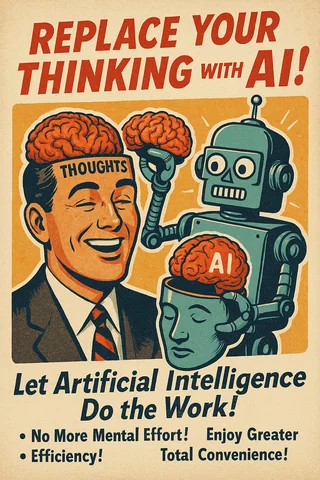
I do not believe any computer will ever be able to do FIML. Robots and brain scans may help with it but they will not be able to replace it. In the not too distant future, FIML may be the only profound thing humans will both need to and be able to do on their own without the use of AI. To understand ourselves deeply and enjoy being human, we will have to do FIML. In this sense, FIML may be our most important human answer to the AI civilization growing around us. ABN
One AI, called Truth Terminal, has recently made the news by becoming the first AI millionaire by promoting crypto currencies it was gifted. While not fully autonomous yet, it’s quite likely by later this year, some AI agents—not dissimilar from viruses—will be able to independently wander the internet, causing significant change in the real world.
AI could have huge ramifications for the financial world. Let’s examine one wild scenario—which I call the AI Monetary Hegemony—something that could possibly already happen in 2025.
A fully autonomous AI agent is programmed to go on to the internet and create cryptocurrency wallets, then create crypto currencies, then endlessly create millions of similar versions of itself that want to trade that crypto.
Now let’s assume all these AIs are programmed to try to indefinitely increase the value of their crypto, something they accomplish in similar ways humans do—by promotion and then trading their cryptos for higher values. Additionally, the autonomous AIs open their crypto to be traded with humans, creating a functioning market on the blockchain for all.
This plan sounds beneficial for all parties, even if people decry that the AI created-crypto currencies are essentially just Ponzi schemes. But they’re not Ponzi schemes because there is an endless supply of AIs always newly appearing to buy and trade more crypto.
It doesn’t take a genius to realize the AIs endlessly replicating and acting like this could quickly amass far more digital wealth than all humanity possesses.
According to leaked media reports [CBS HERE] President Trump is going to unveil a private sector launch of $500 billion to create data processing centers for a national Artificial Intelligence (AI) network. The network will be known as “Stargate.”
SoftBank Chief Executive Officer Masayoshi Son, OpenAI head Sam Altman and Oracle co-founder Larry Ellison are expected to be at the White House for the announcement.
The initial launch will consist of $100 billion for the first Stargate (AI processing center) in Texas. Other projects in other states will come online in the future.
The inevitable arriving more or less as predicted. Only DARPA can stop or slow technology and it can only do that by hiding it and owning all the researchers. AI is out in the open. KOBK absolutely 100% demands USA continue developing it. Not saying I like it. Just saying this is how power is wielded in this world. Altman and Ellison are both Jewish. Son is Japanese. The only defense we the plebs have is free speech and as many of us as possible being on more or less the same page. I do not believe that is near enough but it is all we have. ABN
The CDC’s Center for Forecasting and Outbreak Analytics (CFA) has partnered with the CIA-linked Palantir to cement the public-private model of invasive surveillance in “public health,” all while pushing the U.S. national security state and Silicon Valley even closer together.
The Pentagon and Silicon Valley are in the midst of cultivating an even closer relationship as the Department of Defense (DoD) and Big Tech companies seek to jointly transform the American healthcare system into one that is “artificial intelligence (AI)-driven.” The alleged advantages of such a system, espoused by the Army itself, Big Tech and Pharma executives as well as intelligence officers, would be unleashed by the rapidly developing power of so-called “predictive medicine,” or “a branch of medicine that aims to identify patients at risk of developing a disease, thereby enabling either prevention or early treatment of that disease.”
This will apparently be achieved via mass interagency data sharing between the DoD, the Department of Health and Human Services (HHS) and the private sector. In other words, the military and intelligence communities, as well as the public and private sector elements of the US healthcare system, are working closely with Big Tech to “predict” diseases and treat them before they occur (and even before symptoms are felt) for the purported purpose of improving civilian and military healthcare.
This cross-sector team plans to deliver this transformation of the healthcare system by first utilizing and sharing the DoD’s healthcare dataset, which is the most “comprehensive…in the world.” It seems, however, based on the programs that already utilize this predictive approach and the necessity for “machine learning” in the development of AI technology, that this partnership would also massively expand the breadth of this healthcare dataset through an array of technologies, methods and sources.
Yet, if the actors and institutions involved in lobbying for and implementing this system indicate anything, it appears that another—if not primary—purpose of this push towards a predictive AI-healthcare infrastructure is the resurrection of a Defense Advanced Research Projects Agency (DARPA)-managed and Central Intelligence Agency (CIA)-supported program that Congress officially “shelved” decades ago. That program, Total Information Awareness (TIA), was a post 9/11 “pre-crime” operation which sought to use mass surveillance to stop terrorists before they committed any crimes through collaborative data mining efforts between the public and private sector.





 American Buddhist Net