
Do your best. Speak the truth.

Nvidia said there are no backdoors or kill switches in its chips, denying an accusation from the Chinese government. The company also urged policymakers to reject proposals for backdoors and kill switches.
“There are no back doors in NVIDIA chips. No kill switches. No spyware. That’s not how trustworthy systems are built—and never will be,” Nvidia Chief Security Officer David Reber Jr. wrote in a blog post yesterday.
The Cyberspace Administration of China last week said it held a meeting with Nvidia over “serious security issues” in the company’s chips and claimed that US AI experts “revealed that Nvidia’s computing chips have location tracking and can remotely shut down the technology.”
The accusation is related to the H20 chip Nvidia made for the Chinese market to comply with US export restrictions. US lawmakers are meanwhile considering a Chip Security Act that would require exported chips to be built with “location verification.” The bill also calls for an assessment of mechanisms to stop unauthorized use—a proposal that critics say could lead to a “kill switch” like the kind that Nvidia wants to prevent.
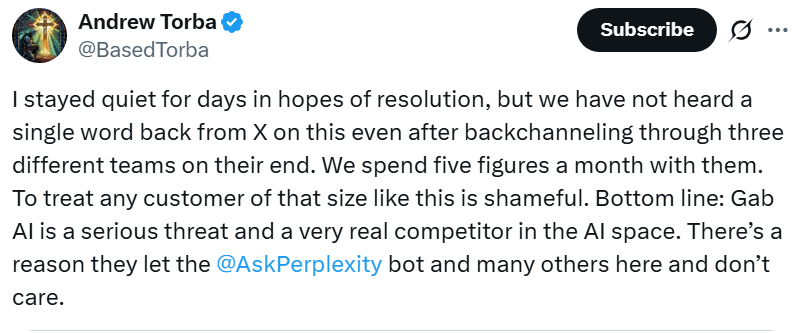


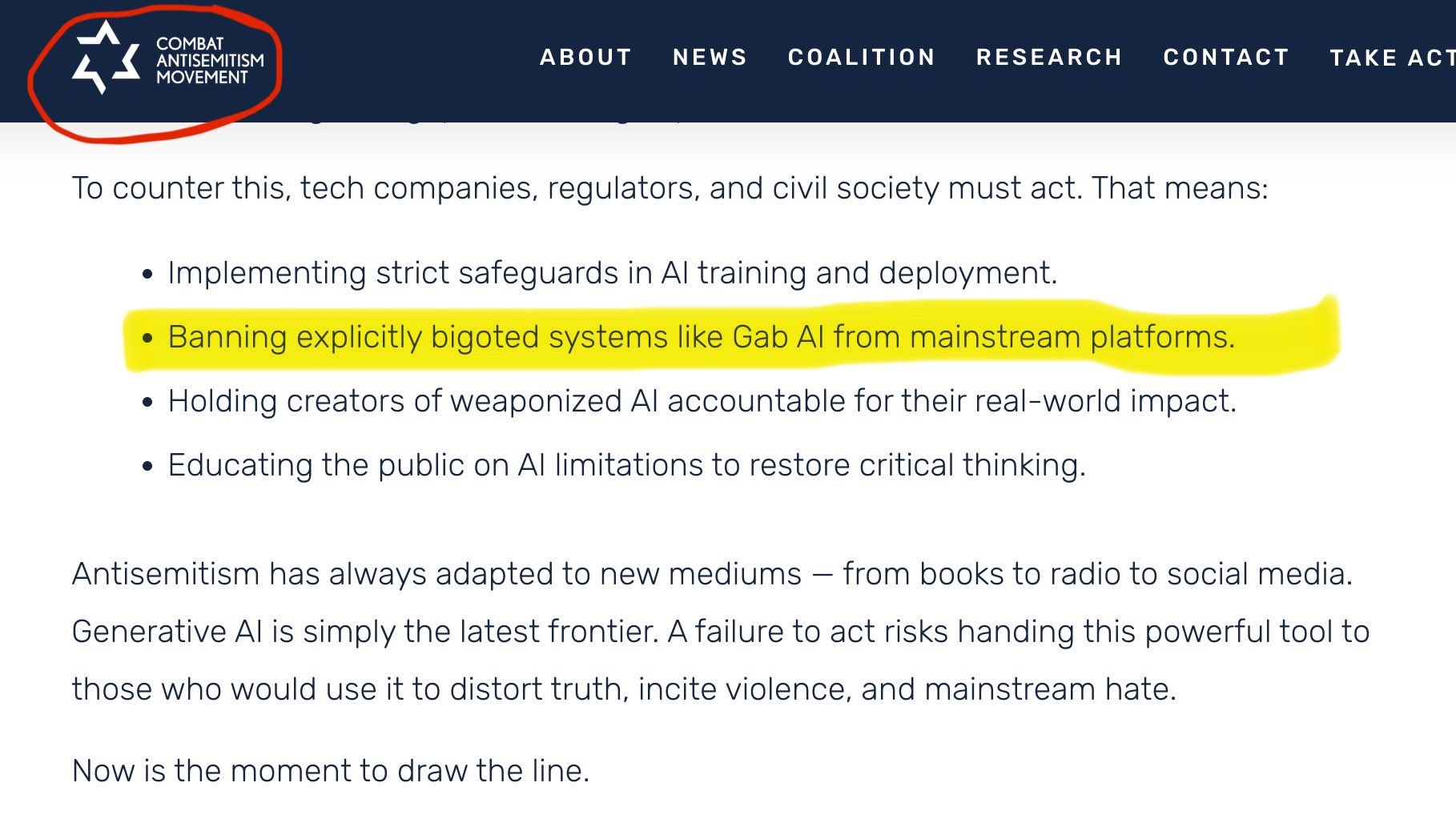

Not sure how we ensure it’s neutral or what that even means but the goal is worthy. If USA can clean up its past government malfeasance and treason and then follow up with first-rate AI, there is a chance all things USA will improve. ABN
“The era when humans program is nearing its end within our group”, says Softbank founder Masayoshi Son. “Our aim is to have AI agents completely take over coding and programming. (…) we are currently initiating the process for that.”
Son made this statement on Wednesday at an event for customers organized by the Japanese corporation, as reported by Light Reading. According to the report, the Softbank CEO estimates that approximately 1,000 AI agents would be needed to replace each employee because “employees have complex thought processes.”
AI agents are software programs that use algorithms to respond automatically to external signals. They then carry out tasks as necessary and can also make decisions without human intervention. The spectrum ranges from simple bots to self-driving cars.
- Elon Musk‘s xAI announced “Grok for Government” on Monday.
- The company signed a contract with the Department of Defense for up to $200 million.
- The service will also be made available to other federal government agencies.
Elon Musk’s xAI is launching a new government-facing service. Its first client happens to be the largest employer on Earth.
The Department of Defense will pay up to $200 million for “Grok for Government,” a new collection of AI products geared toward use by federal, local, and state governments.
The department has also awarded similar contracts to Anthropic, Google, and OpenAI, which launched its own government-facing initiative last month.
OpenAI Text Summary
In recent months, Ron Unz has been extensively utilizing OpenAI’s Deep Research AI for fact-checking his controversial articles, which often explore contentious historical topics like the JFK assassination, 9/11 attacks, and the origins of COVID-19. This advanced AI system, known for its computational resources and depth in research, has become an invaluable tool for Unz, allowing him to substantiate his claims and refine his body of work. Despite its limitations, such as occasional failures in processing complex inquiries and producing garbled outputs, the AI has consistently validated a significant portion of Unz’s assertions, providing a level of confidence in his work that he believes will encourage readers to engage with his findings.
Unz’s articles touch on various controversial subjects, often challenging mainstream narratives. He asserts that the AI’s analyses have generally confirmed the accuracy of his claims, particularly regarding politically sensitive issues, including allegations about the influence of Israeli intelligence in major historical events. For instance, he highlights the AI’s positive evaluations of his pieces on the assassination of prominent figures and the role of sexual blackmail in politics, emphasizing how it has supported his conclusions with credible evidence. This validation serves to bolster his position in a landscape where many of his views are dismissed or ridiculed, especially by the mainstream media.
However, Unz also notes that the AI’s evaluations can be inconsistent, especially concerning topics deemed sensitive or controversial, such as the Holocaust narrative. While the AI has largely endorsed his factual claims, it issued strong critiques when his articles contained skepticism regarding established historical accounts. This discrepancy raises questions about the potential biases ingrained in the AI’s programming, suggesting that it might be conditioned to respond negatively to certain subjects while maintaining a more favorable stance on others. Unz points out that when his articles focus comprehensively on controversial subjects, the AI tends to validate them more favorably, which could indicate an underlying complexity in how the AI processes sensitive content.
The broader implications of Unz’s findings extend into the realm of AI ethics and the reliability of automated fact-checking systems. His experiences suggest that while AI can significantly enhance research and verification processes, it must be carefully monitored to avoid biases that could distort factual accuracy. As Unz continues to publish articles that challenge mainstream narratives, the interplay between his provocative hypotheses and the AI’s evaluations highlights the importance of rigorous scrutiny in both human and machine-generated analyses. The ongoing dialogue about the role of AI in journalism and research, particularly in relation to controversial topics, remains a critical area for future exploration.
As AI reshapes the labor market, the real threat may not be unemployment — it could be something subtler and more corrosive: the collapse in what skills are worth.
That’s according to MIT economist David Autor, who made the comments in an interview released Wednesday on the “Possible” podcast.
Autor warned that rapid automation could usher in what he calls a “Mad Max” scenario — a world where jobs still exist, but the skills that once generated wages become cheap and commoditized.
“The more likely scenario to me looks much more like Mad Max: Fury Road, where everybody is competing over a few remaining resources that aren’t controlled by some warlord somewhere,” he said.
Properly managed, the world should end up with enormous abundance, such that no one has to work much or work at all. I tend to believe elites will eventually become tired of their greed and status competition and, thus, be more inclined to use global wealth to everyone’s advantage. This may take a long time, but as new generations arise and digital babies become common, Darwinian instincts will be weakened or replaced by new insights. ABN


_________
I would add that since it is illegal in Europe to question the Holocaust and since even Grok is programmed to lie about, it behooves all of us to reject the entire story. ABN

 American Buddhist Net