Narcissistic vengefulness. They view the exposure of that text thread as the beginning of the public recognition that Charlie was betrayed.
It was the launch pad for people with common sense asking “why hide the fact that Charlie’s views were changing about Israel, unless it’s somehow relevant to his assassination?”
“Why didn’t Turning Point, or Erika back Candace up when she told the truth?”
It was the first crack in their narrative. Were they not guilty, they would be tremendously grateful to the people who exposed the truth about Charlie’s final days.
As I have said many times, Turning Point execs possess a dangerously low emotional IQ. They don’t know how innocent parties behave. They can’t even imitate innocence. Anger towards Joe Kent makes them look worse. Were I running their PR, I would have had Joe Kent on the Charlie Kirk show. Instead, they send Israeli attack dogs on him.
1. Humans are highly cogno-linguistic. We perceive reality largely by the language that we use to describe it. Most everyone believes and presumes that you have to be able to think something before you can say it. The more dominant-reality is that, above a certain base-level of perception and communication, you have to have the words, language, grammar, and comprehensive-concordance-syntax by which to say something before you can think it. Whosoever controls language – controls the mind – for better or for worse.
2. The world is ever-increasingly controlled and administered by people who genuinely believe whatever is necessary for the answer they need. Administrative agents of broadly-defined entrenched-financial-power have solved the criminal-law enigma of mens rea or guilty-mind by evolving or devolving (take your pick) into professional-schizophrenics who genuinely believe whatever they need to believe for the answer they need, and who communicate among themselves subconsciously by how they name things, and by how things are named for them. They suffer a cogno-linguistically-induced diminished-capacity that renders them largely-incapable of perceiving reality beyond labels.
3. Their core business-model or modus operandi is called a systematized-delusion:
“A “systematized delusion” is one based on a false premise, pursued by a logical process of reasoning to an insane conclusion ; there being one central delusion, around which other aberrations of the mind converge.” Taylor v. McClintock, 112 S.W. 405, 412, 87 Ark. 243. (West’s Judicial Words and Phrases (1914)).
The top of the mind cogno-linguistic layer as described in paragraph one above, with paragraph two providing a good example, has another very important application. That application is spiritual or religious. Virtually all people have very stubborn language at the top of their mental and spiritual cognition. Examples of this are words such as God, Jesus, Buddha, science, politics; or texts such as the Bible, sutras, the Talmud, philosophy, Marxism, etc. From a Buddhist POV, the best thing you can do with this top cogno-linguistic category is leave it entirely open and never cling to any linguistic rendering of what it is. Rather than believe you know what God wants or means, just leave that top category open. Metaphorically, Tibetan Buddhist traditions call this the ‘sky mind’, our natural, unconditioned state of awareness — vast, clear, and open like the sky. No human can seriously claim they ‘hold’ the sky mind or know what God wants, but all humans can experience ‘the reigning principle of nature that inheres in both the universe and in us’, as Marcus Aurelius puts it. Buddhists also call the sky mind the Buddha Mind, the Tathagata, original enlightenment. Some philosophers today call it ‘mind at large’, the ‘thinking universe’ or the ‘conscious universe’. When we claim we know this ‘reigning principle of nature’ or ‘mind at large’ specifically and know verbally precisely what it wants, we prevent ourselves from actually experiencing it or being in respectful harmony with it. We delude ourselves. This is why the Buddha never answered questions about the top cogno-linguistic layer of our minds. Rather than follow words in a text that is purported to be the exact word of God, in Buddhism it is better to simply experience God or the conscious universe or the sky mind. If we remain open, humble and in awe before the sky mind and refrain from cogno-linguistic rigidity, we will free ourselves from a linguistic cage at the top of our minds. When we cling to specific cogno-linguistic stated ‘truths’ we block our minds from actually experiencing mind at large, which is all around us, God who is much bigger than we are, higher beings who do not communicate with words. No one needs a self, an identity, a rigid value or belief system. In fact, just having a self we ‘believe in’ leads to greed, anger, pride, ignorance and doubt. The freshest and most recent example of this is all three Abrahamic religions and many of their sects are at war with each other, led by false prophets and deluded leaders. Nirvana in Buddhism means the ‘going out’ or ‘extinction’ of delusion. Nirvana is enlightenment. When delusion ‘goes out’ or is ‘extinguished’ in our top cognitive categories, we are enlightened to the sky mind, we experience it. All good religions prepare us for enlightenment or experiencing the sky mind. A good Christian is better than a bad Buddhist. No human should claim within themself that they have full knowledge of God nor proclaim to others that they know what God wants of them. Leave the top category of your mind open so God, mind at large, or the sky mind can fill you with guidance. For normal mundane concerns, use you rational mind to determine what to do, supported by the best practical and moral parts of any religion, philosophy, science or art you know. ABN
Key Insight: TACO is not a literal game but a strategic behavioral model reflecting how unpredictable leadership can create exploitable patterns in financial markets.
TACO in game theory primarily refers to the “Trump Always Chickens Out” (TACO) theory, a meme-based investment and political strategy concept. It describes a pattern where former U.S. President Donald Trump makes aggressive policy announcements—such as imposing high tariffs or threatening military actions—only to reverse course when markets react negatively, often leading to a rebound in stock prices. This behavior creates a predictable market expectation: buy assets when Trump makes a threatening move, as the market will likely recover after he “chickens out.”
This theory is rooted in game theory, where both Trump and financial markets are seen as players in a strategic interaction. If markets know Trump will back down, they may not panic—yet a small initial reaction is necessary for him to receive the signal that his actions are destabilizing. As noted by Nate Silver, this creates a mixed-strategy equilibrium: Trump must sometimes follow through on threats to maintain credibility, while markets must react to some degree to signal their concerns.
Recent developments (as of March 2026) suggest the TACO theory has become more viral, potentially leading Trump to stick to more extreme positions to prove he isn’t bluffing, increasing market volatility. The concept has been analyzed in financial media, including Bloomberg and the Financial Times, and is often linked to the broader “Trump Put” idea—where markets assume he will intervene to stabilize the economy.
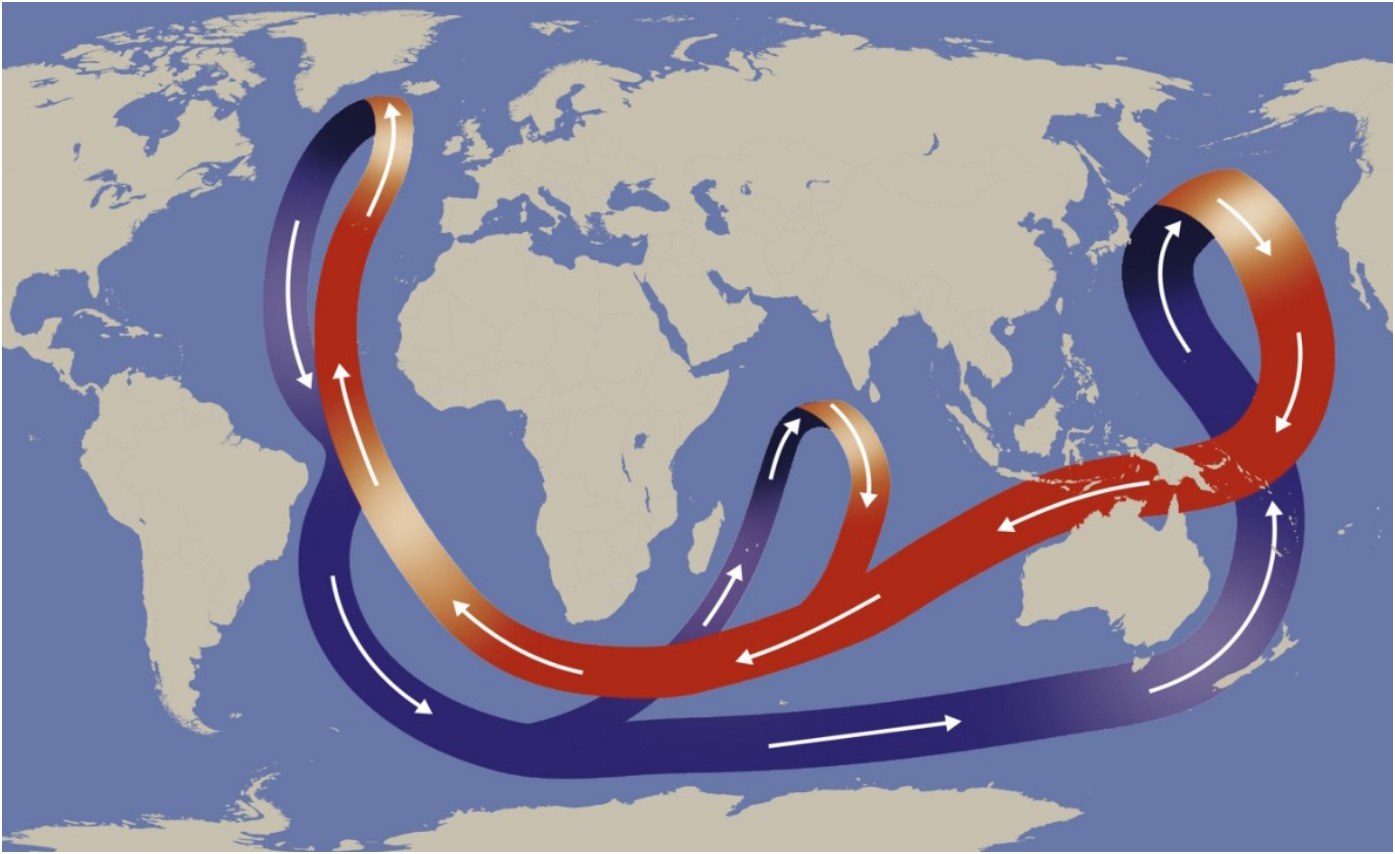
The entire heat capacity of the atmosphere is equal to the top 3.5 meters of the oceans. The remaining 3,700m of the abyss is Earth’s true thermal vault.
The truth is, the Earth is a water planet and oceans cover 71% of the surface to an average depth of 2.3 miles. Ocean currents carry warm water from the mid tropics to the northern hemisphere, then the currents return after a round trip of 1,000 years. Without these currents northern Europe would look like Greenland.
Warm waters from the Roman warm period (240BC to 400AD) are still just returning to the mid latitudes. The atmosphere by comparison is a gaseous envelope that retains almost no thermal energy, hardly any CO2 and is largely controlled by ocean dynamics.
The deep Pacific itself is so massive that it is only now receiving the cold waters from the Little Ice Age. We aren’t starting from scratch, we are mid-cycle in a 4.6-billion-year-old machine.
We’ve also reinvented the climate. Once, it was a word for the local weather of robins and sparrows. Now it’s a global ideological abstraction. We’ve lost our admiration for the natural world. We count CO2 in ppm while ignoring the satellite-proven greening of the Sahara.
It’s time to move past the light breezes and offshore winds and look into the deep. Ask yourself, is the 1.4°C warming since 1850 really an unprecedented crisis?
Israel’s veiled threat to Moscow came just after Russian media warned traffic cameras in Moscow were vulnerable to the same exploits that Israel reportedly used to monitor Ayatollah Khamenei’s residence before assassinating him.
Israeli military spokeswoman Anna Ukolova has drawn outrage in Moscow after threatening that Russian authorities who “wish Israel ill” could be subject to “elimination,” while suggesting Israel could hack into Russian closed-circuit television cameras to identify and track targets.
Asked by a journalist with Russian radio broadcaster RBC whether Israel had access to Russian traffic cameras, Ukolova declined to answer directly but warned that “Khamenei’s elimination shows our capabilities are serious” and that “no one who wishes us harm will be left aside.”
She added, ominously, “I hope Moscow does not wish Israel ill right now – I’d like to believe that.”
Ukolova’s statements came just days after it was revealed that a large number of Russian CCTVs were potentially using BriefCam – an Israeli video analysis software that closely matches the description of a program the Netanyahu regime reportedly deployed to track Iranian movements outside the home of Iran’s Supreme Leader before they assassinated him during their February 28 sneak attack.
UPDATE: Below is a thoughtful comment I found under the article above. It describes precisely how a great deal of mind-control works. Define the terms, commandeer the psycholinguistics and you will control entire civilizations, and move them in any direction you like. ABN
1. Humans are highly cogno-linguistic. We perceive reality largely by the language that we use to describe it. Most everyone believes and presumes that you have to be able to think something before you can say it. The more dominant-reality is that, above a certain base-level of perception and communication, you have to have the words, language, grammar, and comprehensive-concordance-syntax by which to say something before you can think it. Whosoever controls language – controls the mind – for better or for worse.
2. The world is ever-increasingly controlled and administered by people who genuinely believe whatever is necessary for the answer they need. Administrative agents of broadly-defined entrenched-financial-power have solved the criminal-law enigma of mens rea or guilty-mind by evolving or devolving (take your pick) into professional-schizophrenics who genuinely believe whatever they need to believe for the answer they need, and who communicate among themselves subconsciously by how they name things, and by how things are named for them. They suffer a cogno-linguistically-induced diminished-capacity that renders them largely-incapable of perceiving reality beyond labels.
3. Their core business-model or modus operandi is called a systematized-delusion:
“A “systematized delusion” is one based on a false premise, pursued by a logical process of reasoning to an insane conclusion ; there being one central delusion, around which other aberrations of the mind converge.” Taylor v. McClintock, 112 S.W. 405, 412, 87 Ark. 243. (West’s Judicial Words and Phrases (1914)).
Iran fired two ballistic missiles at a joint US-UK military base in the Indian Ocean just hours after Keir Starmer gave the green light for Donald Trump to use UK-based bombers threatening the Straits of Hormuz.
The move prompted Tehran to warn the Prime Minister he had placed British lives ‘in danger’ by consenting to Trump’s request to use B-52s and other aircraft flying out of RAF Fairford and Diego Garcia to blast Iranian missile sites in the strategically important waterway.
Multiple US officials confirmed to the outlet that neither missile had struck the base. Two sources said one of the missiles failed in flight, while the other was intercepted by a US warship, but the action is a concerning development in the third week of the US-Israeli war on Iran.
Two deep points worth mentioning: 1) Trump is doing Netanyahu’s bidding because he fears Jewish Supremists will kill or harm him or members of his family; and 2) Starmer, who appears to be a Jewish Supremist, is purposely destroying Britain through the mass invasion of migrants. Starmer is Jewish but you do not need to be Jewish to be a Jewish Supremist. Some 50 million Zionist Christians in USA are fundamentally Jewish Supremists. They are at the bottom of the JS pyramid, but they are JS nonetheless and will be harmed or killed like Charlie Kirk if they turn against JS. This is the deep fact at the heart of what is now WW3 destroying the world economy. The more people understand this, the better our chances for a better world. JS do not care about anyone else’s blood, treasure or land. They only care about their own blood, treasure and land, which is ultimately, in their fantasies, the entire world once everyone else is killed or enslaved. ABN
Joe Kent said the same in his interview with Tucker, below. Trump surely also fears for his family. Recall, Netanyahu gifted an Israeli-made cellphone to Trump. That was a blatant threat. He also gave a bunch of US Congress people Israeli-made cellphones some months ago. McGovern says these threats against Trump [and all of the US elite, I would add] are the real story here. Yes, it is. That’s the real story. A Jewish Supremist gang controls when and where USA goes to war and everyone at the top is afraid of being killed if they disagree. ABN
In my opinion, “personality disorders” are more easily understood as signaling problems.
All types of personality disorder involve dysfunctional signaling with other people. Signals are both sent and received in ways that result in suffering.
As currently defined, personality disorders “develop early, are inflexible, and are associated with significant distress or disability.”
Thus, if there are no significant brain injuries or other biological problems, all personality disorders (PD) develop through experience.
This means that during childhood the PD sufferer has received many bad signals (and/or interpreted many signals badly) resulting in their failing to form a coherent well-functioning internal signaling system.
The way to fix this is work with the signals. And the best way to do this is FIML practice. A professional psychotherapist cannot possibly provide this level of treatment.
This brings me to a second point: is there anyone who would not benefit from improving their signaling?
Why do we view psychotherapy as treatment designed merely to make us look and feel “average”? Why don’t we instead work to optimize our psychologies every day?
The Buddha said we are all crazy. We are. We all need to work on our signaling—our personality disorders—all the time.
The distinctions between one PD and another and those who have PDs and those who don’t are vague. This is because all PD problems (absent significant biological deficits, which may include intelligence) are idiosyncratic varieties of signaling malfunctions.
If signaling is the core problem, it should follow that all acquired PD will be classifiable as some kind of signaling malfunction. And that is precisely what we see.
Narcissism is a too simple signaling system. Borderline is an unstable signaling system. Compulsive, passive aggressive, histrionic, avoidant, and so on all are variations of a poorly formed internal signaling system.
The way to study this is through interpersonal semiotics; that is interpersonal semiotic analysis of real-time, real-world communicative signs and symbols.
All people need to do this to optimize their psychologies (their internal signaling systems). Why would anyone not want to do this? Maybe not wanting to do this is the surest sign of PD there is.
The hardest part about doing FIML is finding a willing and able partner. To me, this shows how pervasive bad signaling is. Most people will do almost anything but examine their own signaling with the help of another person.


 American Buddhist Net