Multi Dimensional Yin Yang (MDYY) is a term I made up.
It can be used when two people are making a joint decision and discover that both of them care a lot about what the other one thinks or wants.
This kind of situation can arise between husbands and wives, good friends, or even business partners.
It’s good to have a term like this so that when weighing the factors going into a decision, this part of the weighing has a referent which both partners understand is intrinsically difficult to weigh rationally and to discuss.
MDYY is useful only when both partners care about each other and the decision they are making.
And both partners want to be honest and fair with each other and arrive at a good outcome.
In colloquial short-hand, the usefulness of MDYY arises when one partner says, my wanting to do this depends on how much you want to do it, and the other partner feels the same.
I have been using this term with my partner as we discuss a very consequential and complex decision we are making together.
Using this term allows us to set aside the MDYY aspect of our decision-making while talking about other factors that impinge on both the weighing of the decision and the final decision itself. ABN
For some people, sleep brings a peculiar kind of wakefulness. Not a dream, but a quiet awareness with no content. This lesser-known state of consciousness may hold clues to one of science’s biggest mysteries: what it means to be conscious.
The state of conscious sleep has been widely described for centuries by different Eastern contemplative traditions. For instance, the Indian philosophical school of the Advaita Vedanta, grounded in the interpretation of the Vedas – one of the oldest texts in Hinduism – understands deep sleep or “sushupti” as a state of “just awareness” in which we merely remain conscious.
Similar interpretations of deep sleep are made by the Dzogchen lineage in Indo-Tibetan Buddhism. According to their teachings, different meditative practices can be followed during wakefulness and sleep to acknowledge the “essence” of consciousness. One of those meditative practices is that of dream yoga or luminosity yoga, which enables the practitioner to recognise the states of dream and sleep. This aims to bring them to a state of “pure awareness”, a state of being awake inside sleep without thoughts, images or even a sense of self.
For western science, this state poses a conundrum. How can you be aware without being aware of something? If these reports are accurate, they challenge mainstream theories that treat consciousness as always about an object. For example, my awareness of the laptop in front of me, or the blue sky rising above my window, or my own breathing. The existence of this state pushes us to reconsider what consciousness is.
In those studies, we found a spectrum of experiences we called “objectless sleep experiences” – conscious states that appear to lack an object of awareness. In all cases, participants who alluded to an objectless sleep experience reported having had an episode during sleep that lacked sensory content and that merely involved a feeling of knowing that they were aware.
This is an interesting article, sent by an alert reader.
From a Buddhist POV, these states are samadhi or dhyana states, which are essential to successful Buddhist practice.
The reason these states are essential is they provide the experience of pure awareness, pure consciousness with zero self and zero referent.
The Mind-Only Buddhist explanation of these states is they are touching on or engaging with the universal Tathagata, or enlightened mind.
In modern philosophical terms, these states are awareness of ‘mind at large’ or some version of ‘quantum consciousness’ or the fundamental ‘field of consciousness or thought’, which is posited as a primary component of the cosmos.
These states are extremely valuable and worth remembering and pursuing.
In higher levels of samadhi, enormous joy or bliss is experienced along with a total absence of self or referent.
The highest samadhi state is perfect equanimity coupled with deep awareness of the Tathagata.
Samadhi states eventually bump up against nirvana.
I love Western civilization, but the one thing it deeply lacks is a tradition of knowing about and using samadhi, which at the very least provides a marvelous and wonderful place to stand aside from all that is mundane.
Philosophically, Buddhism recognizes ‘relative truth or reality’ (mundane reality) and ‘ultimate truth or reality’, the full knowing of which constitutes Buddhist enlightenment.
In many Buddhist traditions, samadhi states are understood to be natural and attainable by anyone who tries diligently.
If you are fortunate enough to experience samadhi without trying, be thankful!
You have gained a deep realization.
One of the most difficult parts of Buddhism for non-Buddhists to understand is the experience of samadhi.
Also fundamental to Buddhism is the experience of a clear conscience, an honest and pure mind which is gained through wholesome moral and ethical thoughts and behaviors. ABN
Over the past few months, I have spent several hundred hours building a live, physics-based monitoring system for Earth’s rotation, gravity field, magnetic field, and crustal activity. It uses only authoritative open data (IERS, GFZ, USGS, EONET, standard geomagnetic reconstructions).
Before I share more in a few weeks, I wanted to offer up a complete summary as it is now monitoring live and recording data. First, the system doesn’t assume any specific theory. It literally just watches, in physical units:
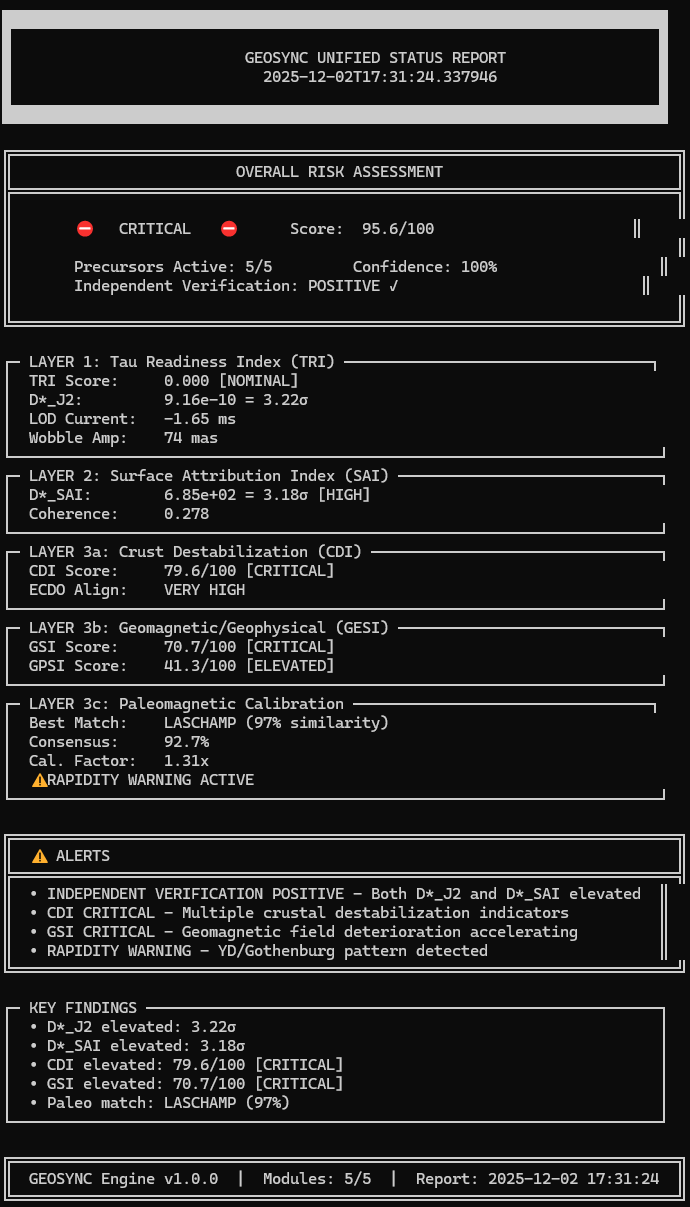
Paleo similarity: strongest match to documented excursion onsets (e.g. Laschamp)
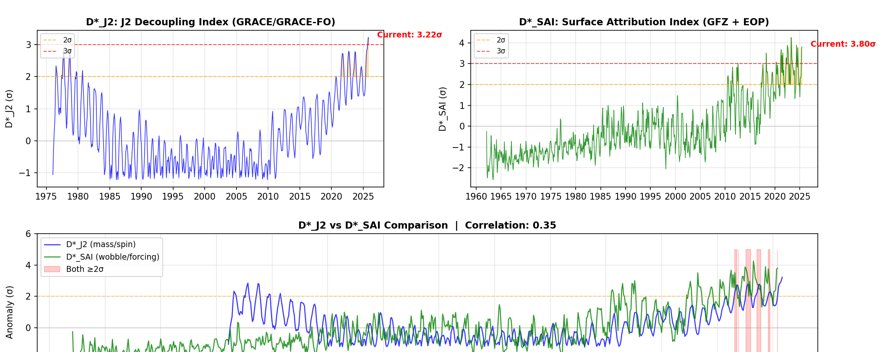
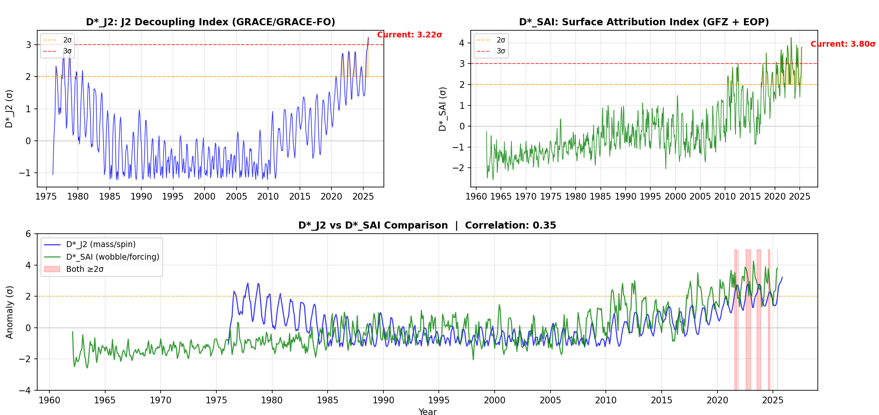
Both D* J2 and D* SAI are in highly anomalous states
Historically, you do see large J2 spikes or individual anomalies by themselves (namely in the 70s, with return to nominal conditions throughout the 80s) but the system recovered. However, what you do not see in the modern data is what we see now: high J2 + high SAI residual + critical geomagnetic stress + critical crustal stress + excursion-like paleo match, all at the same time. In other words, we are no longer in a “quiet, stable dipole” state on this planet.
We are in an excursion-like, high-stress phase of the Earth system, as far as rotation, geomagnetism, and crustal response are concerned.
There is absolutely no refuting this.
This does not mean I can tell you “what day something happens,” or guarantee any particular outcome with really any level of confidence. In my opinion though, only two broad paths exist at this point (and the paleo record does show both):
The system partially recovers (indicators relax, timelines stretch)
The system continues to deteriorate and commits to an excursion-class transition
Which path we’re on depends on how these indicators move from here.
If current deterioration persists or accelerates, the odds of a major reorganization in the coming years rise significantly. If key indicators stabilize or reverse (J2, SAI residual, field decay, pole drift, SAA behavior, crustal stress), risk stretches or falls.
However, based on the data, we entered an anomalous state roughly 50 years ago but underwent said recovery. Such a precursor-recovery-crisis pattern is documented in excursion literature (e.g. Laschamp). Early instabilities (like 1970s-80s D*_J2 spikes) probe the system but recover when the geomagnetic infrastructure is intact. Unfortunately,
50 years ago we did not have convergent, rapidly accelerating anomalous conditions across Earth rotation, geomagnetism, and crustal destabilization over known LLVPs as we do today. And we have already exceeded the peak instability of D*_J2 from back then.
Nevertheless, the point of GEOSYNC is to make that evolution measurable, not speculative.
With all of the above in mind, people have a right to know the present state:
Multi-σ departures from baseline in rotation/gravity
Synchronized anomalies in field behavior and crustal activity
A combined configuration that, in the modern record, has no prior analogue and looks most like known excursion phases in the paleo record
In the coming weeks, I will release:
The complete GEOSYNC v1.0 findings and outputs
Full indicator definitions
Comprehensive data library
Backtests showing when these metrics did not fire together
Live dashboards / logs so anyone can independently verify, critique, or falsify the framework using the same public data (possibly early 2026)
NOTE: Please, do not read too far into the similarity calibration to Laschamp. This is most likely because there is simply substantially more data and literature around Laschamp then just about any other excursion we have identified. More to come.
Proprioception means “one’s own” or “ones’ individual” (Latin proprius) “perception.”
We normally use this word to refer to our physical position in the world—whether we are standing or sitting, how we are moving, and how much energy we are using.
When we dream, our capacity for physical movement, with rare exceptions, is paralyzed. But we still do a sort of proprioception in dreams—a semiotic proprioception, or proprioception within the semiology of the dream.
In dreams, we grope through semiotic associations and respond, gropingly, to them. People and things often look smaller in dreams, or distorted, because we do not have either the need or the capacity to calibrate our physical proprioception as we do in waking life.
Dreams move from one semiotic proprioception to another via our individual four-dimensional (3D plus time) groping/associative function. In one short segment of a dream we are at home, then we go through a door only to find ourselves on a boat in the ocean. Our 4D semiotic proprioception within dreams readily accepts groping, associative shifts like this.
Much of what we perceive when we are awake is memory. We glance at a room we know well and call up our memory of it rather than actually look closely at the room.
I am fairly sure that the memories we call up to aid perception while we are awake are much the same as the groping proprioception we experience in dreams. A major difference is when we are awake we can and do check our waking proprioception with the people and objects around us, while in dreams the associative function has a much freer range.
Notice how dreams move from scene to scene rather slowly. Things can go quickly, but normally dreams grope somewhat slowly along the 4D path of semiotic proprioception.
In waking life, our dreamy use of memory and association to aid perception of the world happens constantly.
When we speak with another person, we use this function to make groping associations concerning what we think they are saying. We grope and respond to them as in a dream while at the same time searching for clues that indicate we are both in the same dream.
These clues that two people may sort of “agree on” while speaking are normally standard public semiotics that belong to whatever culture(s) they share. By “agreeing” on them, we form a sort of agreeable camaraderie with whomever we are speaking, and this can be satisfying, but if we only get this, it can also become deeply unsatisfying.
The four dimensional groping/dreamy function of our mind is far richer than any standard collection of public semiotics. In our public lives—professional, commercial, based on organizations, etc.—we have, at present, little recourse but to accept normal public semiotics, to agree with them and manifest agreement.
We can express some deviation from them and sometimes make jokes about them, but we are generally fairly bound to the semiotics of the culture or organization that generates the context of our speaking. Consider how people in the same church or school are bound by the semiotics of those institutions.
In our intimate relations, however, we do have recourse to investigate and understand how our groping, 4D semiotic proprioception works. This is what FIML does. It allows partners to observe, analyze, and understand the semiotic proprioceptions of their minds as they are actually functioning during interpersonal communication.
If you constantly avoid FIML types of investigations, you will be stuck with a mix of dimly shared public/private semiotics that will tend to become highly ambiguous, even volatile, or very shallow.
How would it work living in an economic system where ordinary citizens were able to get interest free mortgage loans instead of Black Rock and other insiders?
Let me explain in 5 min in the video below.
My name is Mads Palsvig, I am a former investment banker from Morgan Stanley, Credit Suisse First Boston and Danske Bank specialising in government financing and fixed income trading. I was advising Federal Reserve in Conferences, private meetings and numerous drinks and dinners.
A Russian person could not visit New York, Chicago and Los Angeles and then say they visited The United States and have an understanding of Americans. They might think they understand, but any American would giggle at the notion.
Conversely, the same is true in Russia. You cannot visit Moscow, St Petersburg and Kazan and think you have an understanding of Russians. However, if you give yourself time, join in the daily tasks and challenges of ordinary Russians, you can easily discover some of the deeper stuff that really puts context on life in the Russian Federation.
Perhaps what follows is a different perspective.
It took a while, but I finally figured out what this phrase “the Motherland” is all about.
Let me start by sharing another phrase that almost every American will find familiar, yet virtually every Russian asked has no reference to comprehend: “you work for us.”
When talking to a federal, state or local government official in the United States and saying, “you work for us,” everyone listening would completely understand your sentiment. However, in Russia that phrase is akin to asking a Martian for a canoe. This is the way to understand “the motherland.”
Within Russia the social compact is organized around the premise (key word “premise“), that government is the mother figure within a family – and all of the citizens are children. The government knows best. The state engages in all facets, systems and structures as if they are the omnipotent mother who cares about the children.
This is a very good essay, well-worth reading. It provides an outsider’s sympathetic view of what Russia today is and why it is that way. It’s not easy to compose an overview of this type. ABN
My ancestors lived as white slaves in a backward part of Europe which was colonized for hundreds of years. My people have made contributions to Western civilization, but they pale compared to Western and Southern Europe. So I kind of think like this guy. Be grateful to those who invented science, technology, working economies and political systems, and made them truly great. Western, Central and Southern European men created the modern world, made billions of people worldwide healthier, wealthier and freer than they ever had been. Ask anyone from any other part of the world do you want to go live like your ancestors centuries ago? No honest person ever says yes unless they are living in a fantasy. ABN
Long-term practice of FIML generates deep change in the human psyche.
Social relations, habitual traits and attitudes, as well as ingrained emotional responses may all be subject to profound transformation.
The reason this happens is the basic FIML technique provides consistently good counter-evidence to habitual mental and emotional reactions. In addition, the technique itself teaches the practitioner’s mind–or shows it by example–to apply similar kinds of reasoning to many other situations that are not open to FIML dialog.
The basic FIML technique is a deceptively simple stop-and-query technique designed for use in conversations between close friends or partners. In our How to do FIML post, we have described the basic technique as clearly and simply as we could. This description should work as an effective model for beginning FIML practitioners, but it is a bit like describing in words how to hit a baseball or dive into a pond. The experience of actually doing FIML in a real-life, dynamic, emotionally-charged conversation will draw on a wide variety of skills and emotions from both partners. These aspects of FIML cannot be well-described in words because they will be different for different people and in different situations.
FIML does not tell anyone what to think or feel, but rather provides a method for clarifying thought and feeling as they occur in real life.
FIML practice allows partners to expand their senses of who they are and access these areas through speech. Correctly done, FIML will keep partners from becoming lost in side-issues or emotional traps. FIML gives partners access to a shared meta-perspective that will help them gradually rediscover or redesign how they think of themselves and each other, and how they react in many different kinds of situations.
FIML is like yoga in that it uses no props. Yoga uses the body to exercise the body. FIML uses two minds working together on the basis of shared rules. With practice, FIML partners will find that they are able to leverage or gain access to many areas of themselves that cannot be reached by other means. After several years of practice, partners will discover that they have gained levels of mental and emotional strength and freedom that had been barely imaginable before.
The basic FIML technique depends on partners clearly remembering everything that is/was in their mind(s) at the moment a phrase in question was spoken and/or heard. By honestly comparing the contents of their minds under these circumstances, partners will gain access to the rich realm of secondary and tertiary meanings that accompany all utterances. At the same time, they will free themselves from habitual mistaken interpretations whenever they arise.
Their minds, thus, will gradually gain freedom from error (mental and psychological) while broadening the range of subject matter they are capable of entertaining. And this will have a far-reaching influence on both behavior and perception in many other areas.
Once partners are skilled in the basic FIML technique, they will find that it need not always be done immediately upon noticing an emotional or judgmental reaction. After a few months of successful FIML practice, partners will probably find that they can bring up events from hours before and both will still have a reasonably accurate memory of what was said and heard.
It is important not to jump to this level too quickly, though, because if the basic technique has not been mastered, partners will lose sight of the meta-perspective, without which deep understanding and transformation will not be possible. Experienced partners will know when they have good data and can proceed with a FIML dialog and when they don’t. If you don’t have good data (both partners remember exactly what was said and what they were thinking), don’t do a FIML dialog. Just drop the subject. Though retain the general sense of something having happened because the subject will almost certainly come up again. When that happens, try to get good data you both agree on and then proceed with a FIML dialog.
X and the Covenant of Good Faith and Fair Market: Fraud in the Inception
When a contract party pays for a service under the presumption of equal access, yet is never informed that a throttling mechanism will be used to meter or diminish that service at the direction of a third, non-governmental entity, the contract is compromised at the outset. This hidden mechanism becomes even more problematic when the third party makes throttling decisions based on a social-conformance profile it has assigned to the buyer.
Under such conditions, users are charged as if they are receiving full, equal participation in a public commodity, while in fact experiencing discriminatory contract fulfillment and selective product impairment triggered by their identity, viewpoints, or classification — criteria determined not by the platform’s stated terms of service, but by an unaccountable external actor.
If the provider degrades or withholds the paid-for service — visibility, advertising utility, algorithmic distribution, or fair access to market by other paying parties who have an interest in the contracted party — not for violations of the terms of service, but because of external preferences, then the behavior becomes analytically indistinguishable from:
– throttling one customer at the behest of another,
– selling an inferior product at a full-price rate, and
– administering a concealed, criteria-dependent class system within the market itself.
The ethically salient question is not whether a platform moderates — as moderation is an operational requirement. The issue is whether the platform:
– covertly delegates moderation power to outside parties,
– without disclosure,
– and without transparent, appealable standards.
This is where the covenant of good faith and fair dealing is breached, and where the transaction shifts from a simple service agreement into a form of inception-level fraud.
Great point, this is the kind of legal reasoning that may eventually protect free speech.
Social media companies may be able to dodge this legal problem by reducing user fees if users are throttled; and/or refunding user payments, with fines added, after the fact if the company is caught.
If that were included in terms of service, not throttling or being milder about throttling would be a big selling point.
X is already working that angle.
It’s bad that advertisers can influence public discourse as much as they do, especially as advertising itself is often a bribe or payoff for doctored information.
This is all fixable if handled well. Legal skills backed by open source AI monitoring. ABN



 American Buddhist Net
