Don’t worry about the gag order in the Charlie Kirk case.
I plan to violate it on the world’s behalf.
The things I’ve discovered this past week are enough to burn the house down.
Yes, Charlie was betrayed. By everyone.
See also:
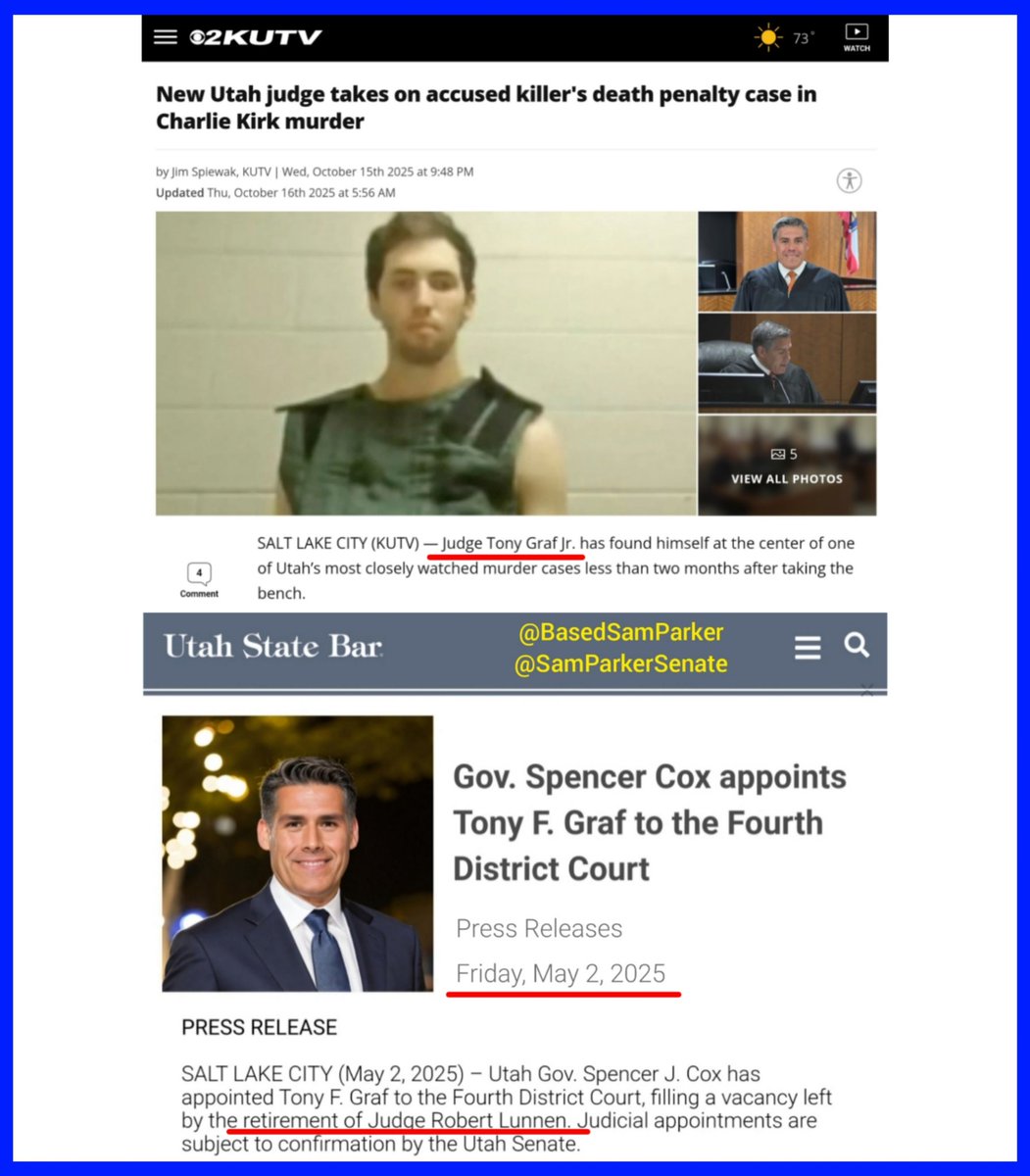
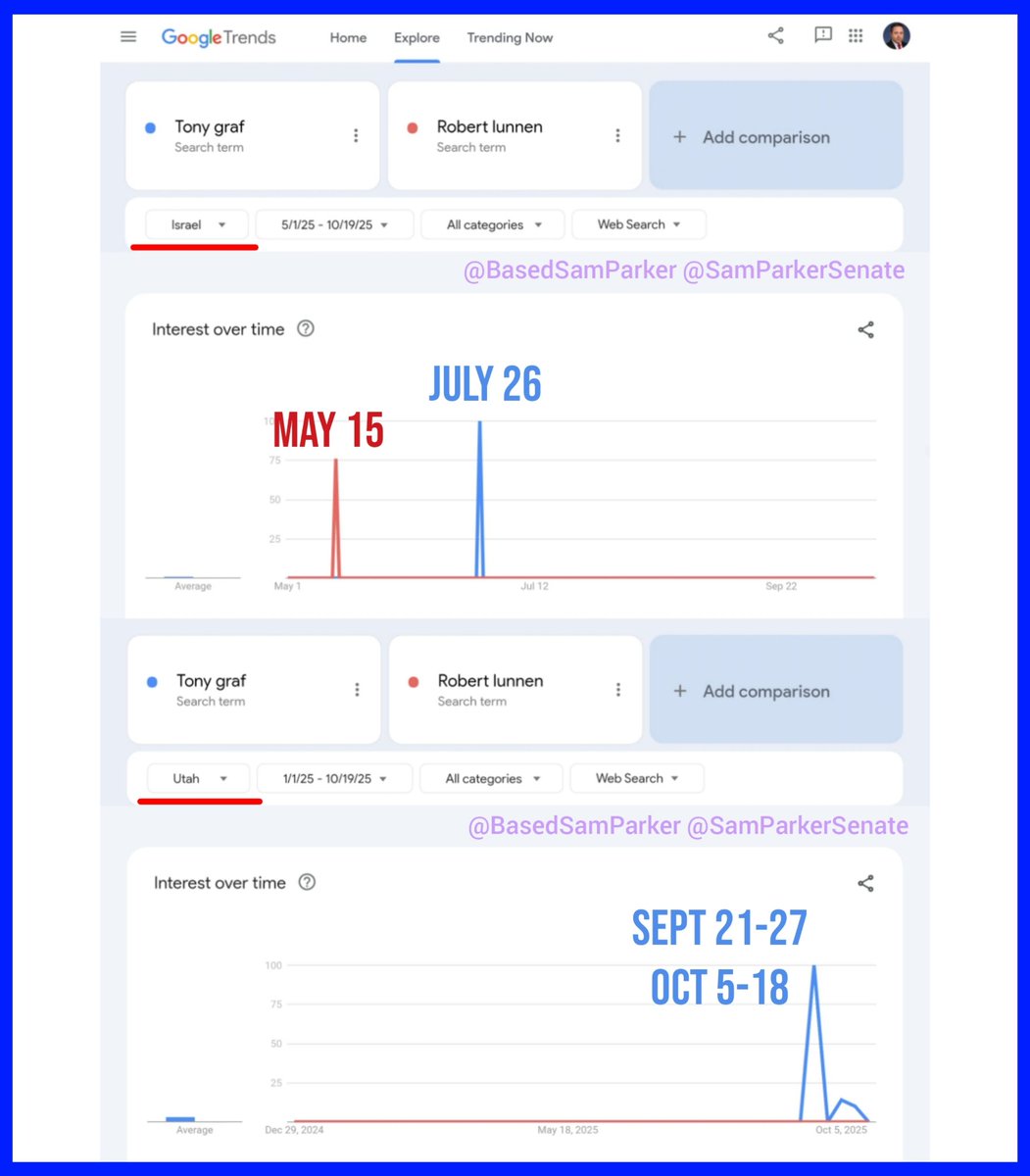
BREAKING NEWS, TYLER ROBINSON TRIAL: Tony Graf, the judge selected to preside over the Charlie Kirk assassination trial—and the judge he replaced, Robert Lunnen—were both the subject of unique Google searches from israeli IP addresses BEFORE the assassination (July 26 & May 15, respectively). Neither was the subject of any searches in Utah until AFTER the assassination.
Judge Lunnen retired on August 1, & Judge Graf assumed his duties on August 4th—on or about the same day Mehtab Syed, the Special Agent In Charge of the SLC FBI field office, was removed.
Despite the intuition that strongly held beliefs are particularly difficult to change, the data on error correction indicate that general information errors that people commit with a high degree of belief are especially easy to correct.(Emphasis added.)
According to the study, this happens due to:
…enhanced attention and encoding that results from a metacognitive mismatch between the person’s confidence in their responses and the true answer.
This is exactly what happens when a FIML query shows the questioner that his/her assumptions about what their partner’s thoughts or intentions were, were wrong.
Initially, FIML partners may experience some embarrassment or disbelief at being wrong. But since FIML queries are generally based on negative impressions, after some practice being shown to be wrong will typically produce feelings of relief and even delight.
A FIML query will generally arise out of a state of “enhanced attention” and usually further increase it by being spoken about. Incidentally, this is probably the most difficult aspect of FIML practice—controlling the emotions that accompany enhanced attention, especially when that attention concerns our own emotional reactions.
With continued practice of FIML, however, even strongly held erroneous interpersonal beliefs will be fairly easily corrected whenever they are discovered during a FIML discussion. Correcting core false beliefs (mistaken interpretations) has a wide-ranging, beneficial effect on all aspects of a person’s life.
Since the hypercorrection effect discussed in the linked study only occurs during moments of enhanced attention, the FIML technique of focusing quickly on good data agreed upon by both partners can be seen as a way of inducing states of enhanced attention that will lead to deep changes in both partners. This technique (using good data) also turns the discussion from one about feelings to one about “information,” which the study finds makes errors “especially easy to correct.”
Furthermore, since FIML practice tends to deal with very small incidents, the enhanced attention FIML induces works like a laser that quickly and painlessly excises erroneous thoughts and feelings while they are still small and have not been allowed to grow into full-blown emotional reactions.
An idiolect is the “dialect” of one person. It is unique to that person. We all speak an idiolect unique to us. No one else speaks in exactly the same way as you do. In fact, the varieties of idolects among speakers of even the same dialect can be quite pronounced, to say nothing of speakers who have been acculturated to different dialects.
Virtually, the same thing is true for our use and understanding of semiotics. Each one of us has a unique tangle of semiotics even if we share the same culture. Even if two people were born and raised in the same very strict cult, they will have different takes on their “shared” semiotics; they will see thier semiotics in individual and unique ways.
The term “idiolect” is a blend of the prefix idio, which means “own, personal, distinct to the individual” and the suffix lect, which is taken from the word “dialect.”
In that spirit, I want to coin the term “idiotics” to mean “the semiotics unique to one person.” Each and every one of us has a very complex idiotics.
It is profoundly important to know this and to understand it deeply.
We can talk at length about the generalities of our idiotics and profit from discussions like that. But we will never fully grasp what our idiotics do, how they function, and when they come into play unless we tackle them the moment they arise.
This is so because idiotics are very complex, with many parts bonded and tangled together in unique ways. The only time we can really get anything approaching an objective view of them is when they arise as small bits within real-life conversations. We can only see them when they function in the moment, when they touch our emotions in the moment, when they determine how we hear, speak, or respond in the moment.
General discussions lead away from idiotics because general discussion by their very natures (being general) are not unique to the individual. By definition, generalities are not idiotics.
This is one reason it is possible (indeed, common, I believe) for individuals to feel horribly lonely while in the company of other people. Or to feel horribly lonely when trying to explain yourself as you get more and more lost in generalities.
If you are never able to deal with, contend with, analyze, or remark upon you or your partner’s idiotics, you will have a bad time.
FIML practice works because it works with idiotics. Ironically, working with your own and your partner’s idiotics will make you much smarter.
All human interactions entail some uncertainty and most entail a lot.
To deal with uncertainty, humans use heuristics (“rules of thumb”) that generally are based on what they perceive to be normal or required in the situation at hand. These heuristics come from experience, from role models, from organizational structures, beliefs and so on.
…an evolutionary simulation model, showing that even intermediate uncertainty leads to the evolution of simple cooperation strategies that disregard information about the social interaction (‘social heuristics’).
This study uses simulations to tease out how social heuristics and social cooperation evolve in very simple game scenarios.
If social games have rules, we can change how much uncertainty they contain and how best to cooperate within them.
This is essentially what FIML practice does. FIML greatly reduces interpersonal uncertainty between partners while increasing cooperation by having a few fairly simple rules.
When uncertainty is lowered and cooperation increased between partners, psychological well-being and understanding is proportionally enhanced. This happens because social interaction and communication are basic to human psychology.
The study linked above employs simulations to show a sort mathematically forced evolutionary outcome arising from initial settings. I believe FIML is similar in this respect, though the FIML game involves complex humans rather than simple sims.
I often wonder why no one has discovered the rules of FIML before. So many great thinkers, but not one found these key rules for optimal communication and psychological understanding. I believe there are two basics reasons for this: 1) FIML requires developing dynamic metacognition during real-time real-life communication events and this takes practice; and 2) most great thinkers that we know about today and hence could learn from also had great status, and this prevented them from noticing the deep flaws in interpersonal communication that FIML corrects.
In this post I am going to contend that: linguistic ambiguity tends to lead to or produce hierarchical social systems.
By linguistics, in this context, I just mean language and its uses, though expressions, gestures, roles, and so on can also be factors. Of course, many other things–genes, wars, historical precedents, etc.–also produce hierarchical societies, but today we will just deal with language.
Another way of stating the contention above is: humans have adapted to linguistic ambiguity by forming hierarchies. Or human hierarchical societies have evolved as adaptations to linguistic ambiguity. A stronger way of saying that would be human hierarchical societies have evolved as adaptations to linguistic ambiguity and they exploit ambiguity to maintain themselves.
Another way of saying all that might be to say that in hierarchical societies linguistic ambiguity is good for the top people because it maintains the status quo. This happens because if the ambiguity matters in any way, it is almost always the top people who will decide what it means.
I am going to present a microcosmic example of this point. Please notice as you read this example that this kind of ambiguity is very common. Something like this will occur in your life very often, maybe as often as a few times per hour of conversation, maybe more.
This morning I was cutting some (store-bought) potatoes for breakfast. As I was doing that I said to my partner: “The potatoes from our garden are so much better than these store-bought ones.” All I meant was that. I had no further implication in mind.
My partner (my FIML partner) did a FIML query and asked me: “Did you say that to make me feel good about our garden?” I replied: “No, I did not.” After which she said: “Because if you had I would have felt bad because I was very careful when I bought those potatoes so I would have felt that you were criticizing my shopping.”
This example shows very clearly that the only way to resolve the ambiguity inherent in my statement is to fully discuss the statement–why I said it, what I meant by it, and what I didn’t mean by it. Anything less would leave a puzzle in my partner’s mind.
This example also shows the value of trivial incidents for FIML practice, something we have emphasized many times. That this incident is trivial and small (just a single sentence) makes it perfect material for a FIML query. If the incident were larger, it would be harder to isolate and agree upon data points. As it was, my partner and I were able to clearly remember what I had said and how we both understood that statement very differently. As it was, we were able to clear up the ambiguity very quickly. No, I was not implying criticism. Yes, I do appreciate your careful shopping. Yes, these are excellent store-bought potatoes, but they aren’t as good as the ones we grow in our garden.
Everything was clear and we both experienced a resolution, my partner more than I because I had not initially noticed the ambiguity in my statement or the effect it had on my partner.
That’s a good example of a FIML query. And it is a good example of how a FIML query can lead to an extensive discussion. The extensive discussion in this case is how even very minor ambiguities like the potato incident can lead to or support hierarchical social structures.
In most non-FIML homes, I am pretty sure most people would not have inquired as my partner did. Most people would probably not say anything. Not saying anything would maintain whatever status quo had been established in that home.
If our home were a hierarchy and I were the top dog (and we did not do FIML), my partner would be forced to wonder silently about what I meant about my potato comment. Maybe she would suffer or feel confused or resentful. It is natural for humans to interpret language in a self-centric manner and it is natural (normal) for humans to be a little paranoid about what they hear. If my partner were the top dog and I had said that, she might question me in an aggressive manner or accuse me of being ungrateful. In that case, I would probably be forced to apologize and claim that I hadn’t meant it that way. Going forward, I might become more wary about what I said around her.
So, not inquiring, not resolving small linguistic ambiguities maintains the status quo. If the status quo is a hierarchy, it will be maintained.
If the status quo is not hierarchical, other problems will result from not resolving ambiguities even as small as the potato example. In the example of partners who live together, partners will feel a mounting sense of confusion and uncertainty as ambiguities like that accumulate. It will be harder for them to trust each other. Kind motives may be misinterpreted as being aggressive, and so on. In time, things may get so bad partners will separate or stay together but divide their lives into separate spheres of influence. If they separate, no status quo has been maintained (demonstrating my main point). If they divide their lives into separate spheres of influence, they will essentially be dividing their lives into small hierarchical spheres of influence (ditto). The garden is yours. The basement is mine. Et cetera.
Some hierarchy is inevitable and desirable between friends or in the home. But for close relationships, less hierarchy is better for most people because it is through egalitarian relationships that we learn the most about ourselves and each other, and it is in these sorts of relationships that we develop the most.
In hierarchical societies, generally speaking the person who is higher up decrees the resolution to all ambiguities. Do what the boss says. Just do what you’re told. She’s in charge. He is infallible, etc.
One reason hierarchies get away with decrees like that is it would simply take far too much time to resolve every ambiguity in a perfectly egalitarian way. Thus, almost all humans today are well-adapted to living in hierarchies. I am sort of OK with that in many professional and business contexts.
Where I am not OK with it is between close friends or couples, except for a little bit here and there depending on context (for example, one partner has special knowledge or experience the other doesn’t have). I suppose many people are very content living in a hierarchy in their own home, but that’s not for me. I don’t want my partner obeying me or being afraid of me and I don’t want to obey or be afraid of her either.
From this small potato example, I hope readers will be able to extrapolate to the formations of social groups. Surely social groups formed in many places at many different times. As history moved forward in time, less well-adapted groups were dominated by groups that were better adapted. And that is why the world is run by hierarchies almost everywhere.
One consequence of this is it affects the individual psychology of all of us who live in hierarchical societies. This may make us intolerant of ambiguity. It may make us view our private lives through hierarchical lenses. Without FIML, our massive training in hierarchical systems will lead to confusion and suffering in our private lives. The inevitable ambiguity will eat away at us if we have no way to fully deal with it.
Another consequence of living in hierarchical societies is people who for one reason or another don’t quite understand the rules will often be judged as mentally ill, dangerous, trouble-makers, outlaws, and so on. In very rigid societies you can be sent to a gulag or be burned at the stake for not conforming. In less rigid societies, you will be fired or ostracized.
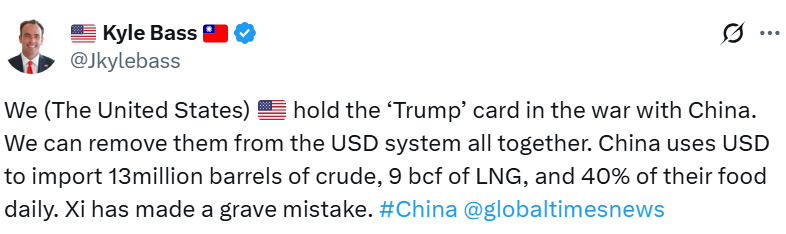
Also Kyle Bass: ‘The path forward certainly feels like an inevitability of war.’
Bass is fairly reliable and does not have stars in his eyes vis-a-vis China, which is a very good thing.
I would hope USA has other ways to get rare earth minerals.
This move by China has been brewing for a long time and it has been a well-known option all along.
As for BRICS becoming stronger if USA responds vigorously, Bass has this to say:
‘The BRICS are akin to 5 garbage trucks backing into each other. Reserve managers won’t go there and China will collapse in the meantime.’
For decades I have watched Westerners being overly intimidated and/or impressed by China. This is a natural form of what might be called ‘culture shock’.
Everyone who studies Chinese starts out this way, super-enamored. It takes years of study to see their weaknesses and faults; their real humanity.
The best thing China has going for them is ethnic/ racial cohesion.
Sun Yat-sen taught this over one hundred years ago and it has become gospel in all Chinese communities everywhere.
It is a foundational part of Chinese education everywhere.
In the West, we have mistakenly gone the other way and are fast destroying ourselves with endless self-criticism and resignation.
The ‘culture shock’ aspect of this is societies affected by it typically feel despondent, even hopeless because the confronting culture is new and seems indominable.
Japan and China both reacted this way when first confronted by the West.
Japan figured things out more quickly than any other society in the world and succeeded in modernizing without losing their Japanese identity.
China today is still reeling from its self-perceived ‘Century of Humiliation’.
The West today is akin to Japan in, maybe, 1885 in our understanding of the ‘culture shocks’ we are experiencing.
Another big factor in the West is we are infested with powerful and hostile parasitic subcultures, literally high-end gangs, who are actively seeking to destroy us as they feed on us. ABN
While Chris Martenson has, I believe, conducted a conclusive scientific ballistic analysis to prove that the sniper who killed Charlie Kirk was on a different building than the alleged shooting position of Tyler Robinson, other researchers continue to accumulate circumstantial evidence that, in the weeks preceding Kirk’s death, his pro-Israel backers were trying to blackmail and threaten him into abandoning his recent criticism of Israel.
They feared that Kirk would follow the path of Tucker Carlson and Candace Owens and draw millions of his Gen Z followers behind him.
After inviting Carlson on Turning Point in mid-July, Kirk was thinking of inviting Owens, who is now on the frontline in the battle for the truth about her friend’s “public execution”.
Meanwhile, il is becoming public knowledge that, in the words of “someone well situated in conservative circles who personally knew Kirk” and spoke to Ron Unz, “everyone in Kirk’s circle, even including important Trump Administration officials, suspected that Israel had probably killed the young conservative leader.”
Here, I recap what I think are the most important established facts. I have borrowed much from Sam Parker’s long investigative tweets on the subject (here, here and here), and I strongly recommend following him on X.
The Unraveling Stillness: An Introduction to Flux Wisdom Field Theory
We do not begin with things. We begin with a tautology so fundamental it precedes existence itself: Nothing can’t exist. Perfect, absolute stillness is an unstable fiction; the slightest potential for difference, a whisper in the void, unravels it. This primal instability, this ceaseless becoming, is Flux. It is not a substance moving through space, but the very genesis of space, time, matter, and meaning as an ongoing process.
This is the foundational premise of Flux Wisdom Field Theory (fWFT), a conceptual framework that stretches from the deepest questions in cosmology to the intimate nature of consciousness. It proposes that the universe is not a collection of objects governed by laws, but a self-organizing, self-revising informational structure in constant, creative motion. The theory offers a compelling narrative that seeks to unify the measurable world of physics—addressing concrete problems like the Hubble tension and the nature of dark matter—with the experiential world of life, thought, and wisdom. It reframes reality as an endless dance of ripples on a cosmic pond, where interference gives rise to pattern, and resonance gives rise to form. From the quantum foam to the murmurations of starlings and the flash of human insight, fWFT suggests we are witnessing the same fundamental dynamic: the elegant, infinite unfolding of instability into interaction, and interaction into being. The Axioms of Becoming The architecture of fWFT rests on a set of five core axioms that describe the behavior of Flux. These are not arbitrary rules imposed from without, but are presented as the intrinsic, unavoidable logic of a universe where true nothingness is impossible.
There cannot be nothing. This is the origin story. A true void, a perfect null state, is a logical contradiction because it has no potential to persist. The universe exists simply because “nothing” is not a stable option. Flux cannot be still. As a direct consequence of the first axiom, the ground state of reality is one of “never-stillness”. Uniformity is dynamically unstable. A tiny disturbance, a single “wrinkle in the void,” is inevitable and all that is needed to initiate the cosmic dance. Interaction creates loops. When distinctions arise from the flux, they influence one another. This interplay is not linear; it creates feedback, recursion, and self-referential patterns. These informational “loops” are the seeds of structure, memory, and identity. Interference produces resonance. As ripples of flux propagate, they overlap. This interference is not mere noise; it is where creation occurs. Waves amplify and cancel, and through this dynamic interplay, stable, self-reinforcing patterns—resonances—emerge from the turbulence. A particle, a planet, or an idea are all forms of resonance. Resonance decays, seeding further ripples. No structure is permanent. As resonant patterns eventually decay, they don’t simply vanish. They dissipate back into the field, releasing their stored information and energy as new, smaller-scale fluctuations that seed the next generation of structure.
These axioms depict a universe that is perpetually bootstrapping itself into existence. It is not a machine set in motion long ago, but a living, breathing process of continuous creation and dissolution, where every ending is a new beginning.






 American Buddhist Net