In my opinion, “personality disorders” are more easily understood as signaling problems.
All types of personality disorder involve dysfunctional signaling with other people. Signals are both sent and received in ways that result in suffering.
As currently defined, personality disorders “develop early, are inflexible, and are associated with significant distress or disability.”
Thus, if there are no significant brain injuries or other biological problems, all personality disorders (PD) develop through experience.
This means that during childhood the PD sufferer has received many bad signals (and/or interpreted many signals badly) resulting in their failing to form a coherent well-functioning internal signaling system.
The way to fix this is work with the signals. And the best way to do this is FIML practice. A professional psychotherapist cannot possibly provide this level of treatment.
This brings me to a second point: is there anyone who would not benefit from improving their signaling?
Why do we view psychotherapy as treatment designed merely to make us look and feel “average”? Why don’t we instead work to optimize our psychologies every day?
The Buddha said we are all crazy. We are. We all need to work on our signaling—our personality disorders—all the time.
The distinctions between one PD and another and those who have PDs and those who don’t are vague. This is because all PD problems (absent significant biological deficits, which may include intelligence) are idiosyncratic varieties of signaling malfunctions.
If signaling is the core problem, it should follow that all acquired PD will be classifiable as some kind of signaling malfunction. And that is precisely what we see.
Narcissism is a too simple signaling system. Borderline is an unstable signaling system. Compulsive, passive aggressive, histrionic, avoidant, and so on all are variations of a poorly formed internal signaling system.
The way to study this is through interpersonal semiotics; that is interpersonal semiotic analysis of real-time, real-world communicative signs and symbols.
All people need to do this to optimize their psychologies (their internal signaling systems). Why would anyone not want to do this? Maybe not wanting to do this is the surest sign of PD there is.
The hardest part about doing FIML is finding a willing and able partner. To me, this shows how pervasive bad signaling is. Most people will do almost anything but examine their own signaling with the help of another person.
This is an excellent overview of the Iran War by a well-recognized expert on Iran. Napolitano is a skilled interviewer who has the good sense to keep his videos short and to the point. For this one, I wish he had gone on longer. Parsi lays out background and ancillary information very well, and has a clear take on Israel’s underhanded role in talking Trump into this catastrophe. ABN
Well-worth viewing. Shows Trump has a plan and it looks good. I would add that Israel’s constant disruptions of the Middle East may also be coming to an end, and may also be part of Trump’s plan. He gave Bibi what Bibi wanted, or thought he wanted, but the result appears to be a degradation of Israel’s status and possibly the end of their Greater Israel fantasies. ABN
President Trump’s latest two messages via Truth Social present an interesting geopolitical approach with multiple enmeshed aspects.
First, some background context is needed. Treasury Secretary Scott Bessent and USTR Jamieson Greer are in Paris to meet with Chinese government officials ahead of a scheduled meeting between Chairman Xi Jinping and President Trump.
The main objective of the pre-summit assembly before President Trump goes to Beijing, is to hammer out the actionable agreement details that can be signed off by Xi and Trump. Bessent and Greer are looking to put a deal together with their Chinese counterparts so that Trump and Xi can announce mutually beneficial outcomes during their summit.
Second, President Trump has already indicated the March 31/April 1 meeting with Xi will be all business. The traditional pomp and splendor will not be present, and Trump will only be visiting Beijing – no sidelines.
Third, Secretary Rubio will be accompanying Trump on this trip to Beijing, which might seem ordinary were it not for the fact that in 2020 China sanctioned and banned Rubio from entering China for criticizing Xinjiang and Hong Kong.
Fourth, there are rumors that President Trump is going to announce a significant weapons deal with Taiwan at some point immediately following the trip. If those rumors are true, it would be a top priority for the Chinese advance team in Paris to stop that from happening.
Regardless of what happens in the next few weeks, President Trump will be meeting with Chairman Xi with full Eagle eye confrontation toward the returning dragon stare. There will be no panda mask on this trip whatsoever; this face to face is an apex predator showdown, while the world watches intently.Everything President Trump does between now and his arrival in Beijing, should be contemplated through this adversarial position. With strong moves in Venezuela and Iran President Trump has already pulled Chairman Xi into the jianshu1circle, showing the soul of his blade.
FIML is both a practice and a theory. The practice is roughly described here and in other posts on this website.
The theory states (also roughly) that successful practice of FIML will:
Greatly improve communication between participating partners
Greatly reduce or eliminate mistaken interpretations (neuroses) between partners
Give partners insights into the dynamic structures of their personalities
Lead to much greater appreciation of the dynamic linguistic/communicative nature of the personality
These results are achieved because:
FIML practice is based on real data agreed upon by both partners
FIML practice stops neurotic responses before they get out of control
FIML practice allows both partners to understand each other’s neuroses while eliminating them
FIML practice establishes a shared objective standard between partners
This standard can be checked, confirmed, changed, or upgraded as often as is needed
FIML practice will also:
Show partners how their personalities function while alone and together
Lead to a much greater appreciation of how mistaken interpretations that occur at discreet times can and often do lead to (or reveal) ongoing mistaken interpretations (neuroses)
FIML practice eliminates neuroses because it shows individuals, through real data, that their (neurotic) interpretation(s) of their partner are mistaken. This reduction of neurosis between partners probably will be generalizable to other situations and people, thus resulting a less neurotic individual overall.
Neurosis is defined here to mean a mistaken interpretation or an ongoing mistaken interpretation.
The theory of FIML can be falsified or shown to be wrong by having a reasonably large number of suitable people learn FIML practice, do it and fail to gain the aforementioned results.
FIML practice will not be suitable for everyone. It requires that partners have a strong interest in each other; a strong sense of caring for each other; an interest in language and communication; the ability to see themselves objectively; the ability to view their use of language objectively; fairly good self-control; enough time to do the practice regularly.
[In mathematics, a ‘computation’ is the process of performing mathematical operations on one or more inputs to produce a desired output. A problem in analyzing human psychology arises when we understand that human psychology cannot be reduced computationally. The ‘computational irreducibility’ of human psychology does not mean, however, that there is no way to probe it and understand it. In the following essay, I show how FIML practice can greatly enhance our understanding of our own psychologies and, by extension, the psychologies of others.
Rather than rely on tautological data extractions or vague theories about human psychology, FIML focuses on small interpersonal exchanges that can be objectively agreed upon by at least two people. These small exchanges correspond to what Wolfram calls ‘specific little pieces of computational reducibility’. When we repeatedly view our psychologies from the point of view of specific little pieces of computational reducibility, we begin amassing a profoundly telling collection of very good data that shows how we really think, speak, and act.]
FIML is a method of inquiry that deals with the computational irreducibility of humans. It does this by isolating small incidents and asking questions about them. These small incidents are the “little pieces of computational reducibility” that Stephan Wolfram remarks on at 42:22 in this video. Here is the full quote:
One of the necessary consequences of computational irreducibility is within a computationally irreducible system there will always be an infinite number of specific little pieces of computational reducibility that you can find.
This is exactly what FIML practice does again and again—it finds “specific little pieces of computational reducibility” and learns all it can about them.
In FIML practice, two humans in real-time, real-world situations agree to isolate and focus on one “specific little piece of computational reducibility” and from that gain a deeper understanding of the whole “computationally irreducible system”, which is them.
When two humans do this hundreds of times, their grasp and appreciation of the “computationally irreducible system” which is them, both together and individually, increases dramatically. This growing grasp and understanding of their shared computationally irreducible system upgrades or replaces most previously learned cognitive categories about their lives, or psychologies, or how they think about themselves or other humans.
By focusing on many small bits of communicative information, FIML partners improve all aspects of their human minds.
I do not believe any computer will ever be able to do FIML. Robots and brain scans may help with it but they will not be able to replace it. In the not too distant future, FIML may be the only profound thing humans will both need to and be able to do on their own without the use of AI. To understand ourselves deeply and enjoy being human, we will have to do FIML. In this sense, FIML may be our most important human answer to the AI civilization growing around us. ABN
There’s a lot of talk about the Marines taking Kharg Island.
But the truth is the USS Tripoli, an America-class amphibious assault ship that carries the embarked 31st MEU, can’t get anywhere near the island—the Strait of Hormuz is closed.
To even try and enter the Persian Gulf is the kind of suicidal venture former Marine Commandant, General David Berger, warned about in his 2019 Commandants Planning Guidance, where he noted that “our Nation’s ability to project power and influence beyond its shores is increasingly challenged by long-range precision fires; expanding air, surface, and sub-surface threats; and the continued degradation of our amphibious and auxiliary ship readiness. The ability to project and maneuver from strategic distances will likely be detected and contested from the point of embarkation during a major contingency…it would be illogical to continue to concentrate our forces on a few large ships. The adversary will quickly recognize that striking while concentrated (aboard ship) is the preferred option.”
And yet here we are, seven years later, a prisoner of legacy doctrine and systems.
If Marines are to attempt to take Kharg Island, it will have to be an assault launched from ashore, not from the sea. Marines and their Osprey tilt-rotor aircraft will need to deploy to Kuwait or Bahrain, both of which are currently under attack from Iranian missiles and drones, and from their attempt an air assault.
If this sounds familiar, it’s because in May 1975, US Marines carried out a similar vertical envelopment on Koh Tang island in the Gulf of Thailand. Conceived as a rescue mission to free US merchant marine sailors taken prisoner by the Khmer Rouge, the Marines instead found no prisoners, but lots of dug in Khmer Rouge fighters who ended up shooting down three of the eleven helicopters used in the initial landing, and heavily damaging five others. In the end, 38 Marines and US Air Force personnel were killed, and another 50 killed before the Marines had to be extracted under heavy fire. In the confusion of the final evacuation, three Marines were left on the island, and were subsequently captured and executed by the Khmer Rouge.
Any attempt to land Marines on Kharg Island will end in a disaster that would make Koh Tang island look like child’s play.
General David Berger knew this.
I wonder what the current Commandant, General Eric Smith, has to say about this? Back in 1990 the Marine Corps Commandant, General Al Gray, formed an ad hoc planning cell to challenge the plans being put together by General Norman Schwarzkopf to liberate Kuwait.
Does General Smith (@CMC_MarineCorps) possess the kind of intelligence and courage that General Gray had in standing up to bad ideas, or will he stand by silently as history repeats itself in the Persian Gulf, where the 31st MEU may find itself in a repeat of the Koh Tang debacle so Donald Trump can falsely declare victory over Iran.
[i] Here, the monk, detached from sense-desires, detached from unwholesome states, enters and remains in the first jhana (level of concentration, Sanskrit: dhyāna), in which there is applied and sustained thinking, together with joy and pleasure born of detachment; [ii] And through the subsiding of applied and sustained thinking, with the gaining of inner stillness and oneness of mind, he enters and remains in the second jhana, which is without applied and sustained thinking, and in which there are joy and pleasure born of concentration; [iii] And through the fading of joy, he remains equanimous, mindful and aware, and he experiences in his body the pleasure of which the Noble Ones say: “equanimous, mindful and dwelling in pleasure”, and thus he enters and remains in the third jhana; [iv] And through the giving up of pleasure and pain, and through the previous disappearance of happiness and sadness, he enters and remains in the fourth jhana, which is without pleasure and pain, and in which there is pure equanimity and mindfulness.
This is a description of the first four states of Buddhist meditation or ‘concentration’, as it is sometimes translated. This is the eighth element of the Noble Eightfold Path. What is meant in this description is very clear. It is pure religious practice, the essence of prayer and contemplation. It is that which leads to the ‘presence of God’ in Christian mysticism. It is communion with the Divine, the experience of transcendent Cosmic Consciousness that underlies and oversees our small consciousnesses. The Buddha taught a path of ethical purity, diligent mindfulness and non-attachment to anything that detracts from a clear mind, an unencumbered mind. In this sense, Buddhism is a pristine spiritual elixir with no added vocabularies, stories, beliefs or ornamentation. The ‘going out’ or ‘cessation’ of all hindrances to achieving jhana and samadhi states is nirvana. In this sense, Buddhism is a universal religion that focuses directly on the goal of all ethical religious practice—direct knowledge and communion with ______; use your own word(s) for that. ABN
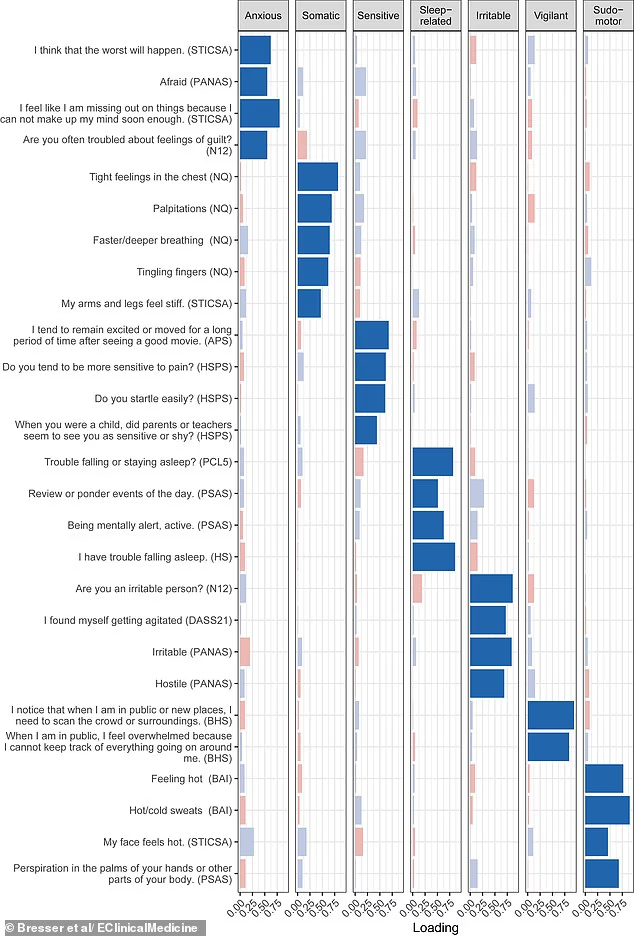
Most of us go through periods of stress in our everyday lives – but there are actually seven types of ‘hyperarousal’, according to a new study.
Researchers say the feeling of tension can be teased out into distinct subgroups.
This includes anxious, somatic, sensitive, sleep–related, irritable, vigilant and sudomotor – and each are characterised slightly differently.
Perhaps the most well–known, the ‘anxious’ feeling of tension, is defined by being worried or concerned about something bad happening in the future. It can also indicate feelings of guilt or fears about missing out on things.
Feeling ‘sensitive hyperarousal’ indicates emotional vulnerability and being easily startled, the scientists explained.
Another common source of tension is ‘sleep–related’ – defined by trouble falling or staying asleep and leading to trouble being mentally alert.
‘No previous study has addressed the unresolved question of whether hyperarousal may be one common…construct or rather has multiple dimensions,’ the team, from the Netherlands Institute for Neuroscience, wrote in the journal EClinicalMedicine.
‘This study discovered seven different dimensions of hyperarousal and provides a concise instrument to assess them.’
Psychology gets lots of stuff wrong, but generally does a good job with descriptive overviews like this. This study is based on a questionnaire of 467 adults, all of whom had some sort of psychiatric diagnosis. Seems worth thinking about. Anything well described constitutes or can lead to useful explanations, which may yield methods of control or intervention. ABN
Motorcyclists face the highest risk of fatal crashes in Florida, Texas, and Colorado, respectively.
Motorcycle fatalities are up 11% in the last 3 years.
In 2022, there were 6,219 motorcycle fatalities in the U.S. due to crashes.
Texas had the highest average annual motorcycle fatality rate at 13.69 deaths per 10,000 registered motorcycles. This is followed by Arkansas (12.79) and Missouri (11.51).
South Dakota experienced a 45% reduction in motorcycle crash fatalities between 2020-2022, the largest decrease of all U.S. states.
Harley-Davidson riders were the least likely to wear a helmet across different motorcycle makes, with 48% of those in fatal crashes not wearing one. But, their drivers were least likely to be speeding or racing, with only 9% doing so.
Reasonable and informative overview, unfortunately lacking per capita breakdown. Harley riders are least likely to wear a helmet due to the dumbass culture surrounding Harley. They are also the least likely to die while speeding or racing, due to the slowness of the bikes. I actually own a Harley Pan America (which is not slow) and enjoy it very much. Motorcycles in general define a subculture, and within that subculture there are many sub-subcultures. The Harley subculture is an example of how intransigent cultures can be. It has remained largely the same for many decades. The weird part of that is the Harley brand is the hardass maverick rider who does his own thing, while in reality it’s nothing more than a highly conformist style, which includes not wearing helmets. Still, I like Harley guys and all motorcycles. Besides helmets, very good body armor and airbag vests are available for all riders. ABN


 American Buddhist Net